
Translated material
"Prigozhin's Gambit"
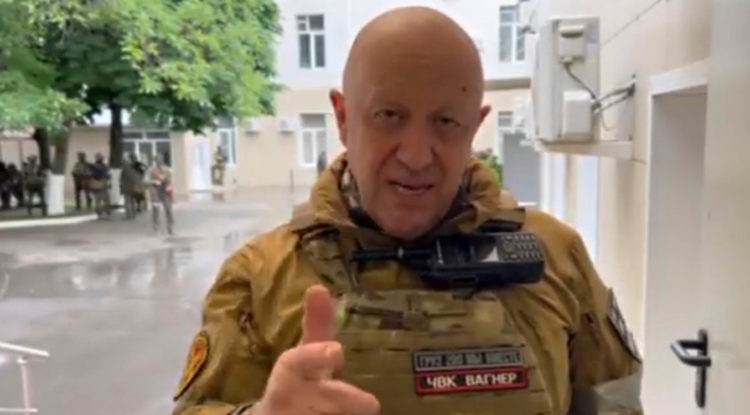
What the Western media wrote about the uprising of mercenaries PMC "Wagner"
The head of the Wagner PMC, Yevgeny Prigozhin, accused the Ministry of Defense of rocket attacks on mercenary camps in the rear and, in fact, announced the start of an armed rebellion against the leadership of the Russian army. The Wagnerites took control of Rostov-on-Don and tried to move towards Moscow through the Lipetsk region. President of Belarus Alexander Lukashenko managed to stop Prigozhin - by the evening of June 24, Prigozhin announced that he was turning the column around. Kholod studied materials from American and European publications and tells how the West reacted to what was happening in Russia.
In order not to miss the main materials of "Cold", subscribe to our instagram and telegram .
The Wall Street Journal, США
The main article on the website of the American edition of The Wall Street Journal came out with the headline: “Putin ordered the military to suppress the Wagner rebellion, calling it high treason.” Prigozhin's uprising is "the most serious challenge to Putin's 23-year rule" and "a direct consequence of the war he unleashed against Ukraine." A senior intelligence official from an Eastern European country told the publication: "The longer this goes on, the harder it will be for him [Putin] to regain control."
Prigozhin used the war in Ukraine to become one of the most powerful and popular personalities in Russia, gaining wide audiences with his virulent populist rhetoric against Russian elites.
Financial Times, UK
“Putin promises to crush the impending uprising of Prigozhin in Moscow,” is the headline of the main article on the website of the British edition of the Financial Times. The FT calls Prigozhin's rebellion "the first coup attempt in Russia in three decades." The uprising is a serious threat to Putin's twenty-year rule in Russia, a country mobilized to invade Ukraine that has jeopardized the economy, claimed tens of thousands of lives, and created a dangerous web of competing paramilitary and security forces.
“Prigozhin’s gambit appears to have marked the collapse of a hybrid system in which competing security forces fought alongside Russia in Ukraine, often autonomously. Chaos follows months of public squabbling between the Wagner PMC and the military as Russia's full-scale invasion of Ukraine continues to stall.
France
The left-liberal French daily newspaper Le Monde placed among the main publications on the site materials about Prigozhin's rebellion. The Moscow correspondent of the publication Benoit Vitkin writes that in Russia there is a camp of "loyalists" and "rebels" (probably anti-war citizens), and now another one has been added to them - a camp of "rebels" led by Yevgeny Prigozhin, which plunges Russia "into a huge black hole."
The material, signed "from the editor", says that the 16-month war has led to deadly competition between groups. “Whatever the epilogue, this power grab has the effect of a litmus test that reflects the state of what we are more than ever hesitant to call the institutions of Russia. The contrast is striking with the national unity during the trials that we see every day in Ukraine,” the newspaper writes. Prigozhin's words strike the French as startling because they challenge the narrative that Putin has been constructing all along. Prigozhin's rebellion is really aimed at the "master of the Kremlin", says Le Monde. The publication writes that countries bordering Russia should use their influence to end the war as soon as possible. These countries have nothing to gain from the fact that Russia is increasingly immersed in uncertainty, the editors believe.
El País, Spain
A leading Spanish newspaper published an article about the identity of Yevgeny Prigozhin, with the headline "From St. Petersburg hot dog sales to anti-Putin uprising", describing the transformation of a "Petersburg petty criminal" into a "weapons baron".
News of the insurrection in Russia is a welcome occasion for Ukraine, which "celebrates the chaos in Russia and interprets it as nothing more than a sign of Putin's weakness," writes El País. One column says that however disastrous Prigozhin's attempt to stage a coup in Russia was, it marked the end of the Putin regime and the war in Ukraine.
The Atlantic, USA
The material about the "military coup" in Russia is posted on the main page of the website of the American edition of The Atlantic. “There is a civil war in Russia. Is Putin now in the same position as Tsar Nicholas II?” - such a question is asked by the columnist of the magazine Ann Applebaum.
The day before Prigozhin's rebellion, an article was published in the publication under the heading "There is a Crisis in Russia" . In it, author Tom Nichols suggested that readers perceive what is happening in Russia as "a war of mafia clans or a couple of gangsters." Nichols wrote that while the internal conflict in Russia does not have a direct impact on the Americans, but it will allow Ukraine to “breathe”.
The Guardian, UK
“Wagner PMC soldiers are on their way to Moscow while everyone is arguing where Putin is”, “Even if the Wagner uprising fails, Putin has never looked so weak”, “Rostov-on-Don. Why exactly this city became the target of Wagner PMC fighters?”, “Prigozhin and Wagner cannot compete with Putin, but they proved that his grip is weakening” – materials with such headlines appeared on the main page of the website of the British left-liberal newspaper The Guardian.
“The enmity between Prigozhin and Shoigu never seemed like a joke. But in Putin's opaque system, more like a Turkish sultan's court than a Western-style government, it was hard to gauge the scale of the conflict. For more than two decades, Putin has played the role of supreme arbiter, pitting one Kremlin tower against another. It was the old 'divide and conquer' tactic," Luke Harding, a foreign correspondent for the newspaper, writes in his column.
He is confident that whatever the outcome of the rebellion, its consequences will be a source of political instability in Russia for a long time to come. “In Shakespeare’s corpse-strewn play about the long presidency of a Macbeth-like Putin, we are in the fifth act,” writes Harding. He believes that the events in Russia are playing into the hands of Ukraine, whose troops, according to his information, have already recaptured several streets in Bakhmut from the Russian army. It will be very difficult for the Russian armed forces to resist the Ukrainian counteroffensive without the fighters of the Wagner PMC, who, despite their criminal past, have established themselves as the most disciplined and effective unit of the Russian army, the journalist writes.
France
The main page of the site of the oldest French daily newspaper, which reflects the views of the moderate right parties, is also devoted to the rebellion of Yevgeny Prigozhin. The publication writes that due to the uprising of PMCs, the Ukrainian counteroffensive will advance. In another material, Prigozhin's rebellion is called "insane".
A survey of expert opinions on Russia says that Prigozhin is one of the Kremlin's mistakes. Doctor of Historical Sciences, a specialist in the Russian army, Dmitry Minik, ironically says that the Wagner PMC was conceived to undermine foreign states, and as a result arranges a coup in Russia.
Researcher Anna Colin Lebedev believes that Prigozhin's cavalcade is a sign of the weakening of the monopoly on violence in Russia. “The monopoly of legitimate violence is the ability of the state to convince that it regulates the rules, uses force and punishes with force. The actions of Wagner PMC, an irregular unit of the army, were a force at the front, but a clear vulnerability of the state,” she comments.
The founder of the American analytical center Silverado Policy Accelerator, Dmitry Alperovich, suggests that the Russian authorities will come to an agreement with Prigozhin, as it once was with the Kadyrov family, who were on the other side of the barricades during the Chechen war. Another expert, Sergei Radchenko, says there has not been such a threat in Russia since 1991.
"A Night of Long Knives for Wagner?" asks one of the experts, the head of the Franco-Russian analytical center "Observo" Arnaud Dubien, referring readers to the massacre of Adolf Hitler with disloyal SA stormtroopers on June 30, 1934.
El Mundo, Spain
The popular Spanish newspaper El Mundo also published materials about the rebellion on the main page of the site. In the article under the heading “Russia is on the verge of civil war: the Wagnerites are advancing towards Moscow, and Putin is fleeing the Kremlin,” it is said that it is very important for Prigozhin to enlist the support of the military dissatisfied with his superiors in the coming hours, which will be decisive for him. The author of the text believes that no matter how soon the suppression of the rebellion was, he had already done irreparable damage to Putin, who "never went to sleep, being in such a distress as last night [June 23]."
The New York Times, USA
The American edition of The New York Times published an op-ed by the head of the Moscow bureau of the newspaper, Anton Troyanovsky, with the headline: "Putin condoned chaos, but now it shakes his power."
Over the past months, as Yevgeny Prigozhin has been increasingly at odds with Russia's military leadership, Vladimir Putin has not publicly reacted to this, writes the NYT. Silence contributed to the kind of political ambiguity that has long been a hallmark of Putin's rule, but this approach has now backfired: when Prigozhin seized military installations in Rostov-on-Don, Putin's regime faced its most dramatic challenge since December 1999, when he was appointed acting president of Russia.
It is likely that Putin hesitated whether to support Prigozhin, writes the NYT. In May, he congratulated the Wagner PMC on the capture of the Ukrainian Bakhmut, but a few weeks later he supported the Defense Ministry’s demand that all volunteer formations sign a contract with the military department — a demand that angered Prigozhin. Now that Putin is trying to quell a rebellion that could lead to "anarchy and fratricide," Prigozhin looks like the creation of the Russian president himself, the column says.
As political scientist Mark Galeotti told the NYT, Prigozhin "had no real independent power, other than the benevolence of the president." “Be that as it may, this undermines the credibility of Putin and his legitimacy,” he said.
La Stampa, Italy
The editors of Italy's largest daily newspaper published online with the headline: "This is a 'civil war'. "Wagner" enters Rostov and is located 500 kilometers from Moscow, skirmish: "We will not surrender." Putin: "Put a knife in the back, we will eliminate the traitors." Kyiv: "For Russia, this is just the beginning." Europe's fears. The newspaper calls Prigozhin's rebellion "a great march of mercenaries who rebelled against the tsar."
Analysts at La Stampa write that "the former tsar's chef has 24 hours to take the country under control" and that Prigozhin said what many in Moscow thought but did not dare to say - that the invasion of Ukraine on February 24, 2022 was a mistake. In an interview on the main page of the site, Andrea Margeletti, President of the CeSI Center for International Studies, Advisor to the Minister of Defense of Italy, calls Prigozhin Putin's Frankenstein and recalls that Prigozhin is not a "man in velvet gloves", but the head of the Wagner PMC, who reproached Putin precisely for weakness and if he wins, he could get control of Russia's nuclear arsenal.
La Repubblica, Italy
Compared to La Stampa, another popular Italian newspaper, La Repubblica, reacted to what is happening in Russia more restrained: it calls Putin not a tsar, but a Russian leader, and Prigozhin is not called “Putin’s cook” or a rebel, but writes about him as a protagonist of the conflict.
One of the materials is called “The Rubicon of the Mercenary Divides the Military: Should I Be With Him [Prigozhin] or with Putin?”. Another says that the Italian government has been warned about "chaos" in Russia, but there is no reason for the evacuation of Italians (there are 5,600 Italian citizens in Russia). Italian Prime Minister and leader of the Brothers of Italy conservative party, George Meloni, calls Prigozhin's rebellion "a mirror of the chaos of Russia's domestic politics."