
Translated material
"Putin was not anywhere else"
"Medusa" found out how the Kremlin tried to agree with Prigozhin during the rebellion - and why did Lukashenko need this for this
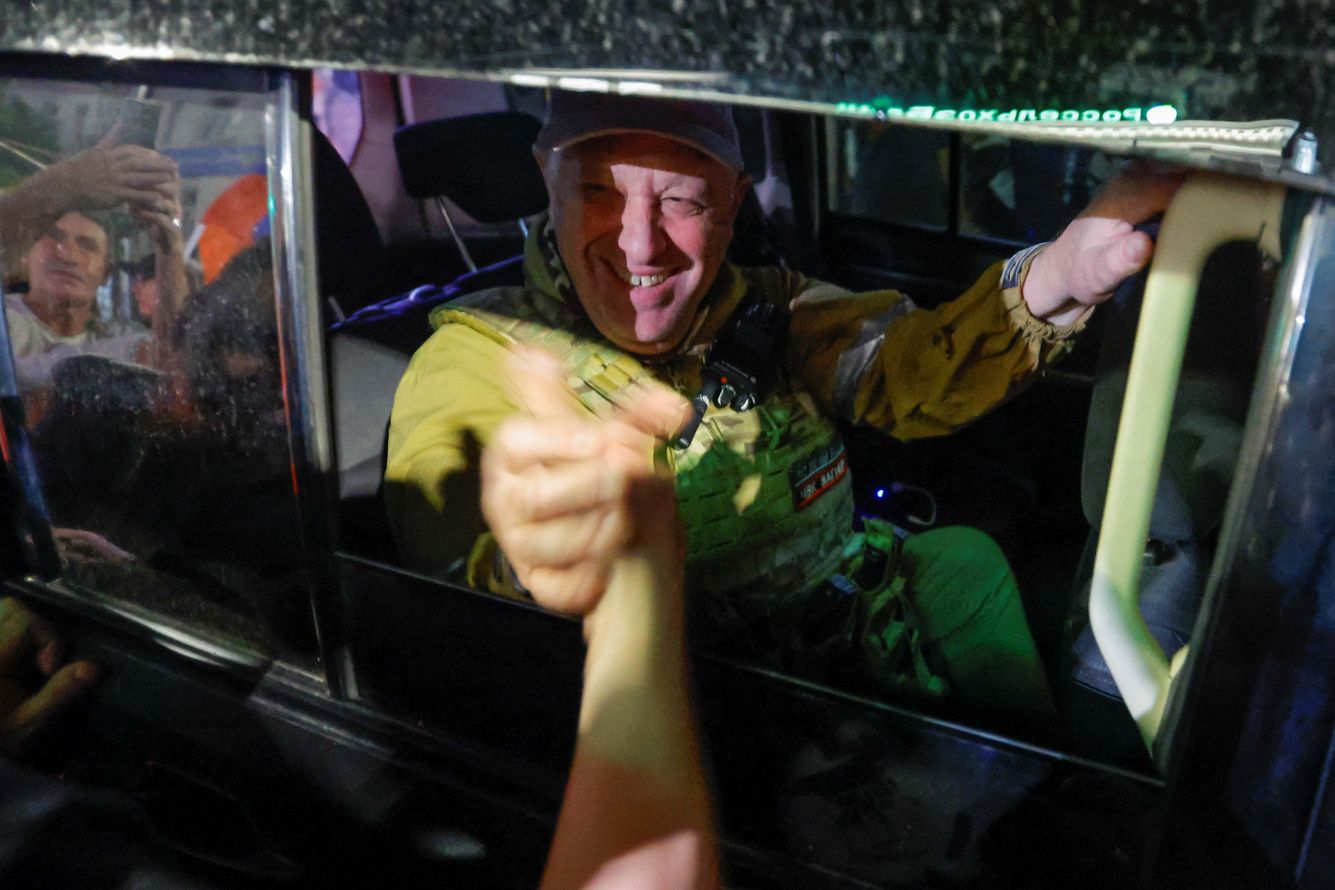
On the evening of June 24, Evgeny Prigozhin said that his mercenaries, who had stopped a couple of hundred kilometers from Moscow, "unfold their columns and go back to the field camps according to the plan." The creator of the PMC Wagner explained the reason for his decision: "Now the moment has come when the blood can spill." It was not only vague, but also lying wording: 13 Russian pilots died per day of the rebellion.
In addition, on the eve of Prigozhin, he accused the leadership of the Ministry of Defense of the Russian Federation of shelling the mercenaries (without presenting any convincing evidence) and said that PMC would deal with the “scum” who “destroy Russian soldiers”. First of all, with the Minister of Defense Sergey Shoigu, whom Prigozhin called “Baba” and “Creature”.
Right before Prigozhin turned his uprising, it suddenly became clear that Alexander Lukashenko led negotiations with him - and supposedly Prigozhin accepted the proposal to stop the columns of the mercenaries; This was reported by representatives of the official Minsk. The founder of the PMC himself did not say anything about this (although during his rebellion he was extremely talkative). But soon the version of Minsk was confirmed by the press secretary of the Russian president Dmitry Peskov. Moreover, according to Peskov, Prigozhin will “go to Belarus” - and the criminal case of the rebellion, excited against him, will be terminated. What exactly will Prigozhin do in Belarus is unknown.
According to the interlocutor of Medusa, close to the Kremlin, in one form or another, the authorities were negotiating with Prigozhin since the evening of June 23, when he announced the beginning of his “march of justice”:
The military leadership, employees of the presidential administration, the leadership of the Russian Guard and officials close to him tried to communicate with him. But his actions themselves were such that it is not very clear what to talk about at all.
The requirements were also foggy and strange: to remove Shoigu, not to go into the affairs of Wagner, to finance more. But after such actions in the system [Prigozhin] there was no place. In any case, he [would have lost something], even if he received guarantees of life and preservation of business in some form. He did not want to lose.
As Medusa wrote earlier, at first the Kremlin hoped to resolve the situation “more or less peacefully”, but it was not possible to agree with the leader of the mercenaries. After that, the Kremlin ordered that Russian governors and politicians publicly condemn Prigozhin’s actions and declare him a “traitor”. At about 10 in the morning in Moscow, Putin himself made a television thing in which he accused Prigozhin, without calling his surname, of “treason” and “hit in the back” , so it seems to completely exclude the possibility of a peaceful resolution of the situation.
Prigozhin replied that "the president was deeply mistaken": "No one is going to the president, the FSB or someone else to come with a confession." By this time, the Wagnerians had already controlled Rostov-on-Don; Over the next hours, they advanced completely unhindered to Moscow.
At the same time, according to the sources of Medusa, close to the Presidential Administration of the Russian Federation, around the middle of the day on June 24, Prigozhin began to try to contact the Kremlin himself - and supposedly even "tried to get through to Putin, but the president did not want to talk with him."
According to the interlocutors of the Medusa, close to the Kremlin and the government of the Russian Federation, Prigogin realized that he "exceeded the measure", and "the prospects for the movement of his columns are vague." By that time, the mercenaries were no longer so far from the Oka River - it was there that the Russian army and the Russian Guard decided to build the first line of defense from the Wagnerians. At the same time, despite Prigozhin’s statements that “half-Armia” is ready to go with him (and despite the fact that in the regions he did not receive any rebuff from the security forces), the PMC did not have additional support for the first hours of the UCC.
Seeing the change of Prigogine, the Kremlin allegedly decided not to go to the “bloody clash”, the interlocutors of Medusa say. According to them, the final negotiations were engaged in a large group of officials, which among others included the head of the presidential administration Anton Vaino, Secretary of the Security Council of the Russian Federation Nikolai Patrushev and the Russian Ambassador to Belarus Boris Gryzlov.
The frontman of this group was Alexander Lukashenko. According to a source close to the Kremlin, Prigozhin insisted that “first persons” participate in the negotiations; Given the reluctance of Putin to contact the founder of PMCs, the negotiators did not have many options.
“Prigogine needed a worthy confident to leave the game [retaining the face]. Such was Lukashenko. He loves PR and understands the benefit - that's why he agreed, ”says the interlocutor of Medusa. In his opinion, the “benefit” for Lukashenko is obvious: it was he who became publicly a man who “saved Russia as a maximum from the civil war, but at least from the big blood.”
Sources of Medusa, close to the Kremlin and the Government of the Russian Federation, agree that according to the results of his radical performance, Prigozhin lost: “He is supplanted from Russia. The president does not forgive this. ” According to them, the parties will still “discuss” the details of the agreement regarding the new position of Prigozhin, but he will not have the previous influence and resources. ”
At the same time, the interlocutor close to the Kremlin did not exclude that according to the results of the rebellion there may be personnel changes in the leadership of the Ministry of Defense: “But not at the request of Prigozhin, but because of the self-removal of the Ministry of Defense.”
At the very beginning of the rebellion, General Sergei Surovikin (commanded the grouping of Russian troops in Ukraine from the beginning of October 2022 to the beginning of January 2023) made a video message in which he urged Vagnerians to stop and “resolve issues peacefully”. Exactly the same video was recorded in the same place by Lieutenant General Vladimir Alekseev: he called Prigozhin’s actions “a blow to the back of the president” and “attempt by the coup.”
A few hours later, Prigozhin at the headquarters of the Southern Military District in Rostov-on-Don met with Alekseev and Deputy Defense Minister Yunus-Buck Evkurov. The businessman told them that he was going to go to Moscow and wants to “receive the head of the General Staff [Valeria Gerasimov] and [the Minister of Defense of Sergey] Shoigu” (to which Alekseev answered with a smile: “Take it”). Prigozhin also informed the army negotiators that they were "elderly clowns."
At the same time, neither Sergey Shoigu nor Valery Gerasimov still said a word about Prigozhin's uprising. It is also not known where they were all this time.
The source of Medusa, close to the government, nevertheless doubts that personnel decisions regarding the Ministry of Defense of the Russian Federation can be made in the near future: "Putin almost never goes on the circumstances and does not bend under pressure."
The interlocutors close to the Kremlin at the same time admit that the rebellion weakened Putin’s position: “He could not descend to Prigozhin, but yesterday [after television,] was not anywhere. He is the “king”, “first”, but a badge-mukha, when necessary-interfere, and do not force yourself to shine with the facade of Lukashenko and talk to the security forces. ” On the day when Prigozhin moved his army to Moscow, Putin worked with documents in the Kremlin, as his spokesman Peskov claims. At the same time, Putin’s aircraft equipped with army management equipment, on June 24, flew out of Moscow and disappeared from the radar in the Tver region, “important stories”reported with reference to the Flightradar service data.
According to one of the sources of Medusa, close to the presidential administration, it will now be more difficult for Putin to “collect the vertical of power” - and there will only be more attempts to “reinstall the system” by the “Russian elites”.
How did the Russian security forces showed themselves during the rebellion of Prigogine? And is a new military coup against Putin possible?
The podokast “Medusa” “What happened” with journalists, authors of articles and books about Russian special services Irina Borogan and Andrei Soldatov - about the actions of the Russian security forces and whether they themselves are capable of rebellion or coupling.
 |
Andrey Pertsev