
Translated material
Wagner? "Cache" from here
The dollar of 100, a shortage of air tickets and cash - the economy of several Russian regions shocked events on June 23–24
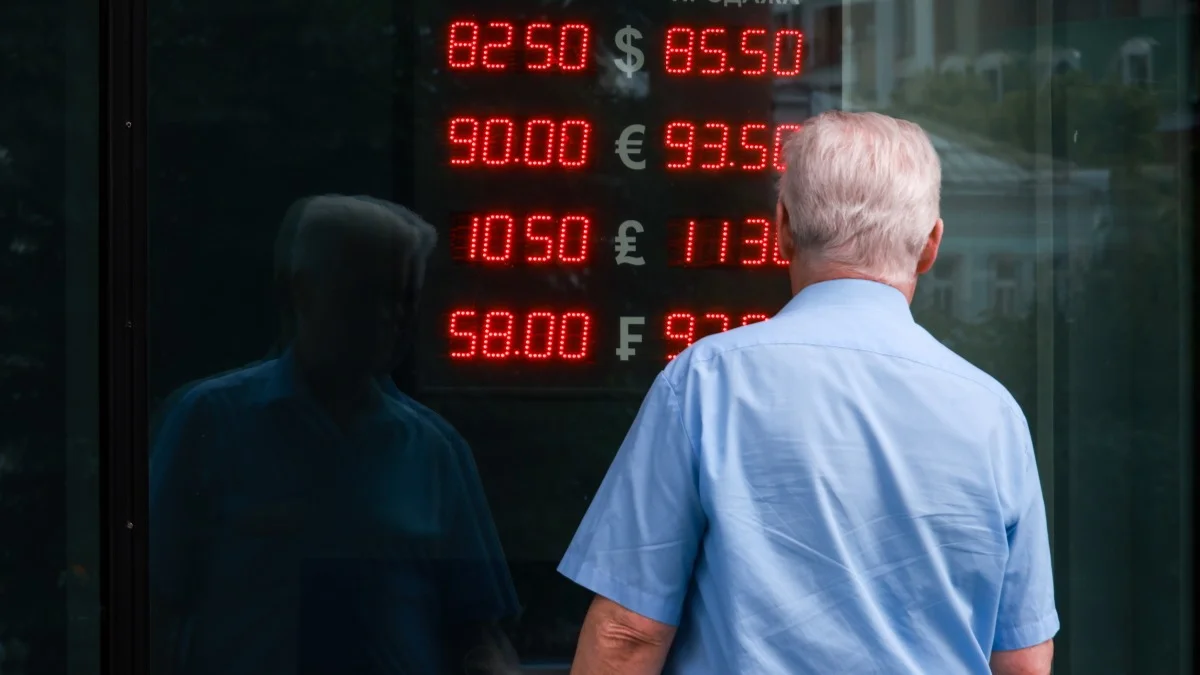
Photo: Vladimir Gerdo / TASS
The reaction of the Russian markets to events on June 23–24, related to the march of Prigozhin and the Wagner PMC for Moscow, was sharp, albeit short -term. It is known about the shortage of air tickets with exciting demand for them, we saw a jump in the dollar in exchangers up to 100 rubles, Russians, especially the southern regions, stood in line for cash. Today, part of these “shocks” has already gone, but calm should not deceive anyone - the main consequences are still ahead, the editor of the economy department believes.
Currency fluctuations
The events that unfolded last Saturday, June 23, reflected primarily in the foreign exchange market.
At first, banks sharply increased the exchange rate of currency (without increasing the purchase rate). So, on Saturday, in Moscow exchangers, a cash dollar sold 100 rubles and higher, and then during Sunday reduced it: the more optimistic the rhetoric of the authorities became, the cheaper the dollar was sold. True, on Monday morning, the exchange said its word - in the first minutes of the trading, the ruble exchange rate decreased to the minimums of spring 2022, but by the middle of the day he “fought off”.
The dollar from 84.7 rubles went up to 87.23 rubles, after which he began to cheaper and at 11.20 Moscow time cost 84.9 rubles. The euro flew up to 95.28 rubles, adding almost 3 rubles compared to Friday's values, but four hours after the start of the bidding dropped to 92.42. The Russian stock market opened a day with a fall of 2% on the Mosbirzhi index, but played almost half of the collapse and after an hour and a half of the main session loses only 1.15%.
The situation came back to the norm in exchange points where the exchange rate of the American currency returned to 88–90 rubles.
Everything is fine? Not really.
Swans arrival
The theory says: economic agents (and these are not only banks and brokers, but also ordinary people), faced with a “black swan”, perform actions that have both short -term and long -term consequences.
For example, when in exchangers they raise the price of the sale of the dollar, and then they lower it back, someone buys a “dollar one hundred”, although he could tolerate and buy it 90 each.
Another short-term consequence is a sharp increase in demand for cash in 15 regions and large cities of the Russian Federation, which was noted at a government meeting on Monday, June 26, the first deputy prime minister Andrei Belousov.
“The most active growth in cash demand was noted in the southern regions - in the Voronezh, Rostov, Lipetsk regions ( coincides with the Prigozhin and Wagnerians route. - Ed. ), As well as in large cities. There, demand has grown by about 70–80%, ”said Belousov. And he added: now "the situation is completely stabilized."
But long -term consequences will be different.
Providing banks
Everyone who thought about buying a currency received confirmation that in every incomprehensible situation, banks will try to sell currency more expensive. What is the conclusion? So, you need to stock up on currency constantly, without listening to any demagogy about deadllarization. Accordingly, the long -term demand for the dollar will grow.
In addition, people will probably think about increasing the share of savings in cash. Yes, in one case everything turned out well - but also because on the weekend, not everyone watched the news, and no one can say that if the inhabitants of the main agglomeration together went to ATMs.
According to the Central Bank of the Russian Federation , only
On Friday, June 23, the amount of cash in circulation (outside the Central Bank) grew by 105.3 billion rubles. To understand the scale, this is a record amount from the last week of September 2022.
True - and this is important - the indicator indicated by the Central Bank does not mean the pure demand of citizens for cash, namely, "reinforcement of the cash desks and ATMs of banks in order to ensure potential increased demand." That is - both the banks and the financial regulator itself immediately realized that they would have to wait for “increased demand” (at the time of writing the article, the Central Bank of the Russian Federation has not yet published data for the weekend on June 24–25), and were conceived by bills.
Unpredictable outcome
If the consequences of a major economic crisis are analyzed, then the consequences of a sudden conflict, similar to the one that we observed these days, is much more difficult to analyze. There are many scenarios, plus the consequences of each of them can vary significantly - for example, no one can really say what specific measures are hiding behind the discussions about the “mobilization economy” or “restoring order”:
Mass removal of savings?
Credit amnesty?
Cash reform?
Emergency tax on the rich?
Mandatory labor service for the poor?
And most importantly - what will happen to the property?
There are no scenarios for the development of the situation-there is no way to successfully insure yourself from a negative outcome. Therefore, people conclude that “anything” can happen, and this situation will also be resolved “as you like”.
What conclusion in such a situation will a person who thought to “invest money” draw? Most likely, it will wait. And someone will decide to get the money out of the case, go to the “cache” and keep savings in this form.
We will not be able to see the long -term consequences of such short -term shock immediately, and these consequences can take the most unexpected form.