
Translated material
The pawns do not go back
What is wrong with the termination of the criminal case of rebellion against the Wagner PMC
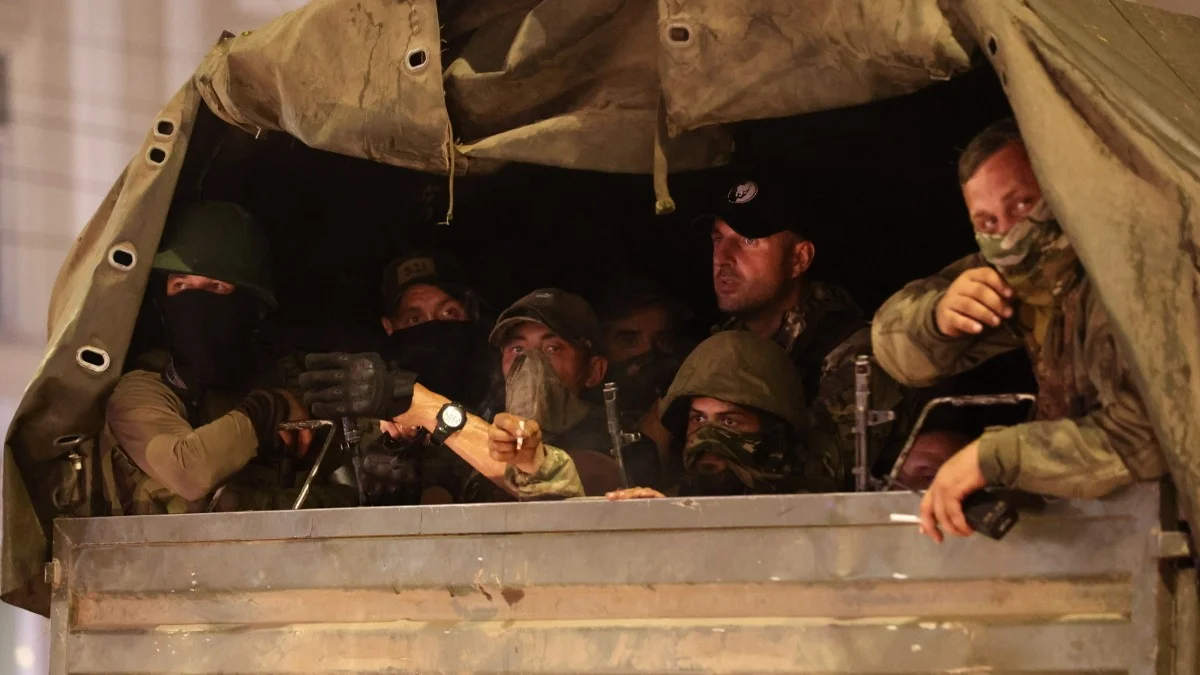
Fighters of ChVA "Wagner" in a car on Rostov-on-Don Street. Photo: Eric Romanenko / TASS
On June 27, two messages appeared on the TASS feed almost simultaneously - let's compare them:
1
“In Nalchik, according to the FSB press service,“ the unlawful activity of a Russian citizen, suspected of preparing for a treason in the form of a transition to the enemy’s side, has been suppressed ... “Many thanks to our special services for saving my life (without letting me go to fight) so that I returned to my native alive and healthy,” the detainee said. ”
- The FSB COO reports: “During the investigation of the criminal case initiated by the Investigative Department of the FSB of the Russian Federation on June 23 under Article 279 of the Criminal Code of the Russian Federation on the fact of an armed rebellion, it was established that its participants stopped on June 24 directly aimed at committing a crime. With this in mind ... a decision was issued to terminate the criminal case. ”
The last “fact of an armed rebellion” in Russia took place almost 30 years ago (October 1993), and under Article 275 of the Criminal Code (state treason) in the form of “preparation for the enemy side”, the regional department of the FSB after the start of the start of the start of their packs. The far from a complete sample of such cases that are always classified was recently published by the Russian BBC service. For “preparation for entry into the Armed Forces of Ukraine“ in the Lefortovo pre -trial detention center ”are now:
Geodesist Valery Kachkin from Birobidzhan,
student Gleb Verdiyan from Astrakhan,
Muscovite Saveliy Frolov
And, probably, many more.
These three at first subjected to administrative arrest allegedly for obscene abuse, and then, without letting go of special receivers, presented to each article 275 of the Criminal Code.
Frolov, detained on the Georgian border, received by a court decision in Vladikavkaz 15 days in a row, three days in a row. This may indicate that the accusations are held on confession.
In general, we do not know about evidence and in the near future we will not find out due to the regime of secrecy.
The case of Prigozhinsky rebellion is not only, of course, classified, but already in some secret way is discontinued. But we know about the evidence of a whole bunch of crimes that form the general concept of “rebellion” from the video and audio messages Evgeny Prigozhin himself, from an objective, recorded photo and video filming of the movement of his columns, from the testimony of many hundreds of eyewitnesses.
These evidence relate to:
organizations of mass riots (Article 212 of the Criminal Code, a complete corpus delicti);
public calls for extremist activity (Article 280 of the Criminal Code, completed composition)
Organization of the armed rebellion (Article 279 of the Criminal Code).
Before (quoted according to TASS) “to stop actions directly aimed at committing a crime”, the participants in “monstration” (let's call it conditionally, since there will be no sentences) have managed to do a lot of things that also forms individual compositions of other crimes:
intentional killings of Russian troops,
destruction of property for fabulous amount
etc., etc.
For many years, the judicial investigative bodies of the Russian Federation have been engaged in the stretching of the articles of the special part of the Criminal Code on those actions that do not contain signs of public danger (like throwing a paper glass in a riot police in special protection) and for this reason should not be considered crimes. Now they have the exact opposite task,
And all these years they did not look at the common part of the Criminal Code at all and forgot how to use it.
Recall that Articles 30 and 31 of the Criminal Code distinguish between the following stages of crime:
Preparation for a crime: the execution, production or adaptation of funds or tools of committing a crime, an appropriation of accomplices of a crime, a conspiracy to commit a crime ... If at the same time the crime was not completed due to circumstances beyond their control;
Assembly for a crime: intentional actions directly aimed at committing a crime, if the crime was not brought to the end due to circumstances independent on behalf;
A voluntary rejection of a crime: a person with a person’s termination for a crime or termination of actions directly aimed at committing a crime, if a person realized the possibility of bringing a crime to the end;
In some cases, the completed crime is exempted from liability, as provided, for example, in a special note to Article 290 of the Criminal Code: “The person who has given a bribe is exempted from criminal liability if it actively contributed to the disclosure and (or) investigation of the crime ... either after committing the crime, they voluntarily informed the criminal case, about the giving a bribe,”
The last option for the circumstances of the armed rebellion is not suitable, and about a voluntary refusal as the basis for the termination of the criminal case, one can speak only in the case, "if the person was aware of the possibility of bringing the crime to the end."
That is, terminating the case against Prigozhin and Co., the FSB sign that the rebels could, if they wanted to, bring to the end the plan: to capture the Kremlin, to hand over the king-gun in scrap metal ... or what is there? - This is also by law to find out before terminating the investigation.
If, in fact, Prigozhin and KO could not achieve their strategic goals that have not yet been clarified, then in their actions there are signs of at least preparation for a crime. Or an attempt with unusual means. With the examples of the “transition to the side of the enemy,” we know how successfully the FSB copes with proving “preparations”, even when things are apparently not very good with objective evidence. In the case of Prigozhin and to evidence above the roof, there is even a conversation in a special projectant with a plastic bag on the head with anyone.
Feelled inexorably.
But the task is not trivial: do not find the composition of the crime where it is not, and not find where it is obvious. Ferz commanded to cut the back, and the pawns were not taught to walk back. "And the king is naked."