
Translated material
How a summer resident with a bucket skewed the axis of the earth

Scientists have found a way to calculate the direct effect of a person on the rise of the ocean. We explain how it works
Summer - and therefore, millions of people around the world begin to carry water from the wells to water the beds, and millions of pumps pump water into the fields and irrigation systems. All this water eventually enters the world ocean. But to what extent does this affect its level? Who is more dangerous: summer residents with buckets or melting glaciers? Scientists have found a way to answer these questions: they measured how the movement of the axis of the rotation of the Earth is changing under the influence of the gradual devastation of the underground storage facilities of the water. "Cold" explains how it works.
In order not to miss the main materials of the "cold", subscribe to our Instagram and telegram .
You need to start with physics: the axis around which any object rotates - for example, a top - seeks to maintain its position in space, obeying the law of preserving the moment of the impulse - you probably felt it when you tried to move closer to the center of the rotating carousel and it immediately began to spin faster. On this principle, all navigation gyroscopic devices are based, Planet Earth is also subordinate to this law. Its axis is always oriented along one line, which passes through the point next to the polar star on one side and through the constellation of the Southern Cross - on the other.
More precisely, it would be so if our planet were perfect - a homogeneous continuous ball without oceans and atmosphere. Fortunately, the earth is far from this ideal, streams of magma move in its bowels, rivers flow on its surface and glaciers melt, atmospheric fronts and tropical cyclones move higher; Finally, someone transports things to another apartment or rolls the piano from the room to the room. In the language of physics, all this is the movement of the mass, and any such movement changes the properties of our gyroscope, which means that it can cause an axis displacement.
Scientists have long noticed the displacements of the earth's axis; The most noticeable part of them is associated with the influence of the gravity of the sun and moon. But there are very small fluctuations associated with the movement of the axis of rotation not relative to the heavenly sphere, but relative to the surface of the Earth - with an amplitude of only a dozen meters. They were discovered and measured in the second half of the 19th century, the American astronomer Seth Chandler. These fluctuations had a seasonal frequency, apparently related to processes in the atmosphere and hydrosphere, but there were also numerous other fluctuations, with periods, for example, in tens of years, the reason for which is not quite clear so far.
With high accuracy to predict how exactly the position of the axis of our planet will change, scientists still do not know how, therefore, the international service of the Earth’s rotation of the Earth is monitoring all these parameters, and the world time and the network of spatial coordinates are consistent with its dimensions, the accuracy of which in turn depends on all navigation systems.
For an employee of the Seoul National University of Ki-Von, the field of scientific interests was not the movement of land poles. He and his colleagues studied as melting glaciers, polar hats and other factors affect the rise in the level of the oceans. In recent decades, many exact methods have appeared to measure these factors and the global average ocean . For example, satellite altimetry (measuring the ocean level using satellites) showed that for the period from 2005 to 2015 the ocean level at a speed of 3.5 millimeters per year, while data from the floating hikes of the International Oceanological Project Argo showed that 1.3 millimeters per year should be attributed to the thermal expansion: the average temperature of the ocean grew, and therefore the water volume. The remaining 2.2 millimeters per year should be attributed to the account of additional water that got into the ocean-this was confirmed using gravimetric Grace satellites, which measure the gravity at each point of the Earth with high accuracy and can, for example, “see” the Greenland glacier gradually becomes easier and how, on the contrary, the mass of water in the ocean grows.
The Ki-Von group was able, according to Grace, to calculate the full “budget” of the level of the ocean level: how much should be attributed to Greenland, how much-at the expense of Antarctica, how many-at the expense of melting mountain glaciers, and how much-at the expense of the tributary from land. However, ambiguity remained with the last component. At first, due to errors in the calculations, his contribution to the rise of the ocean was considered negative: it was believed that in total water on land could linger and return to the ocean not so quickly. Therefore, the sea level due to this grew not as fast as it could. However, adjusted measurements gave a positive contribution - about 0.3 millimeters per year, but the details had to be dealt with, because they also hid a person’s direct influence.
Scientists divided the water of land into three components: an influx from surface waters, from underground water and the contribution of artificial reservoirs created by man. Since the construction of dams and reservoirs, on the contrary, slowed down the growth of the ocean level, artificially delaying water on the continents, the contribution of land was supposed to consist of water, which was extracted from natural underground tanks.
But how much water from there got into the ocean and how did it raise its level? Scientists could not look far enough into the past, since they had Argo Bui only in 2005.
And here the displacement of the poles came to the rescue: scientists realized that the dynamics of the movement of the axis of the Earth’s rotation can help distinguish between effects - since, for example, thermal expansion does not change the mass of water.
Ki-Won CO and his colleagues analyzed all the components of the fluctuations in the earth's axis, compared them with well-known acting factors-the contribution of the melting of glaciers and polar hats. But in the end, they got a noticeable inexplicable rest; Even the accounting of the parameters of the reservoirs did not help. “I scratched my head and said: perhaps this is the effect of groundwater,” the Nature website quotes the scientist quoted .
All over the world, underground water is intensively consumed in irrigation systems. Part of it, of course, returns back to natural underground tanks, but part evaporates, and part enters the rivers and promotes the growth of the ocean level - and an additional deviation of the axis of the Earth’s rotation.
According to scientists, in the period from 1993 to 2010, underground water became less than 2.2 trillion tons, which corresponds to the rise of the ocean level by 6.24 millimeters. Most of the losses fall on India and the western part of North America. In the United States, the speed of underground water, according to official figures, is about 25 million tons per year.
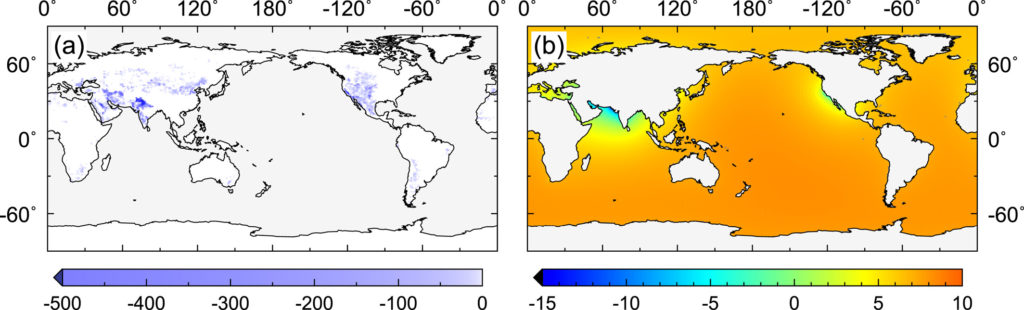
Scientists built the models of pole movement from 1993 to 2010, taking into account the contribution of all factors (melting glaciers, the construction of reservoirs and depletion of groundwater), and then compared with observations. It turned out that if you do not take into account the contribution of underground water, then the earth's axis would deviate much west than in reality. If you add to the model the factor of reducing underground water reserves, then the scale of the displacement and its direction practically coincide with the actually observed.
Thus, it turned out that from 1993 to 2010, the devastation of underground water tanks forced the Pole of the Earth’s rotation to shift 4.36 centimeters per year in the direction of 64.16 degrees of eastern longitude (the longitude of the new land archipelago).
People are responsible for a significant part of this devastation. According to scientists, underground water closes 42% of the water necessary for irrigation, 36% used in households, and 27% in production. Moreover, about 40% of world food production accounts for irrigated lands. The rapid growth of underground water for irrigation can mean a quick exhaustion of this type of sources (and in many regions there is no other water), a lack of food and water.
A passing increase in the speed of sea level and displacement of the earth's poles do not carry a serious threat to us, but once again show that a person has become really geological strength and, perhaps, should once again comprehend how this geological force acts for the benefit of the planet.