
Translated material
Deadly drops
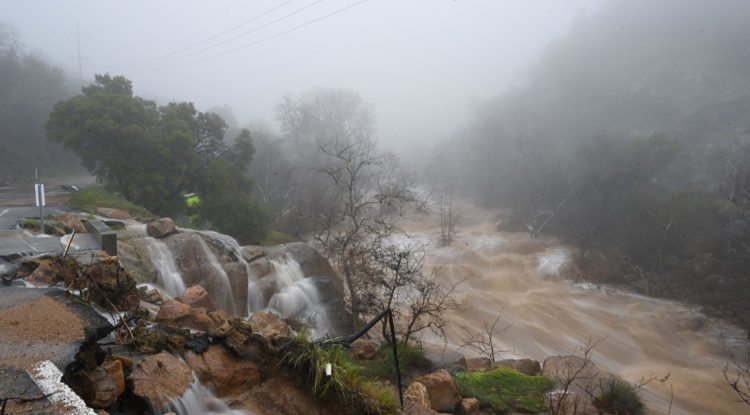
Billions of people are under a new threat due to global warming. It's all about the rain
As a rule, scientists attribute the risks of climate change to rising global temperatures, rising sea levels and melting glaciers. However, more than two billion people who live in mountainous regions will be at particular risk due to global warming. According to a new study, warming in the area will lead to a reduction in snow cover and a sharp increase in rainfall, causing serious soil erosion that will result in deadly landslides and floods. "Cold" tells the main story of the new study.
In order not to miss the main materials of "Cold", subscribe to our instagram and telegram .
American scientists Mohammed Ombadi, Mark Risser, Alan Rhodes and Charuleka Varadharajan in a new study on the consequences of global warming come to the conclusion that rising global temperatures will have an extremely devastating effect on the mountainous terrain of the planet. Details of the study are provided by The New York Times. In their work, climatologists analyzed the mountainous regions of the Northern Hemisphere (they considered data on the tropics of the Southern Hemisphere irrelevant) and came to the conclusion that all mountainous regions at an altitude of 2000 meters above sea level are at risk. Such regions turned out to be the most sensitive to even minor changes in temperature.
Scientists analyzed climate data from 1950 to 2019, simulated different scenarios of global warming and concluded that a one degree Celsius increase in temperature increases the likelihood of extreme rainfall in mountainous regions by 15%. Initially, scientists believed that at some stage this dependence would reach the limit - that is, the dependence of the amount of extreme precipitation on temperature rise would come to naught, but this did not happen, which became the main discovery of the study.
“We concluded that every degree matters,” concluded Mohammed Ombadi, lead author of the study, Ph.D. uncertain.
Dr. Ombadi says he and his colleagues are the first to quantify the change in extreme precipitation as a result of warming. Frances Davenport, professor of civil and environmental engineering at Colorado State University, who was not involved in the study, confirms its unprecedentedness. Many researchers have previously studied how extreme precipitation increases and how snow turns to rain due to climate change, but no one has previously studied the two topics in a comprehensive manner, she said.
More fatal crashes
The new study raises big concerns among scientists. According to Dr. Ombadi, about a quarter of the world's population (more than 2 billion people) lives in mountainous regions and directly below them - in the lowlands of mountain rivers. All are at risk of landslides and floods, which scientists estimate will become more frequent due to extreme rainfall. Such precipitation destroys established natural ecosystems and damages agriculture. All these problems are superimposed on the already existing threats associated with the melting of glaciers in the same mountain ranges.
According to study a 2019 , the number of deadly landslides has increased significantly in recent decades, with most of them caused by rain. The study's lead author, epidemiologist Abidul Haq, an expert on the impact of spatial factors on human health, says that the areas of highest risk in his study are the same as those noted by his colleagues. He also called the approach of colleagues innovative, and the studied list of data - extensive. He hopes that the study will help humanity reduce the effects of climate change.
So does Dr. Ombadi, who has worked in the construction of civilian facilities in the past. He hopes the study will renovate and build buildings and infrastructure that are resilient to potential climate risks, and his team's findings will update existing landslide and flood risk assessment models.
Climate change is a natural process that can be caused by changing weather conditions, changes in temperature, solar activity, or eruptions of particularly large volcanoes. Since the 1800s, however, human activity has been the main catalyst for climate change that scientists no longer consider natural. The industrial revolution, increased use of fossil fuels, urban growth and deforestation have led to an increase in the average temperature on the planet by 1.2 degrees Celsius since the end of the 19th century.
An increase in average temperatures unprecedented in human history is causing severe droughts, devastating wildfires and deadly heatwaves. Moreover, agriculture is suffering and entire ecosystems are being destroyed. At the moment, humanity is trying to stop this process and limit the growth of the average global temperature to 1.5 degrees by 2050. To do this, according to the UN and the IMF, by 2050, humanity must switch to a carbon-neutral economy.