
Translated material
The ruble did not drop the rebellion, it is itself
What happens to the Russian currency course
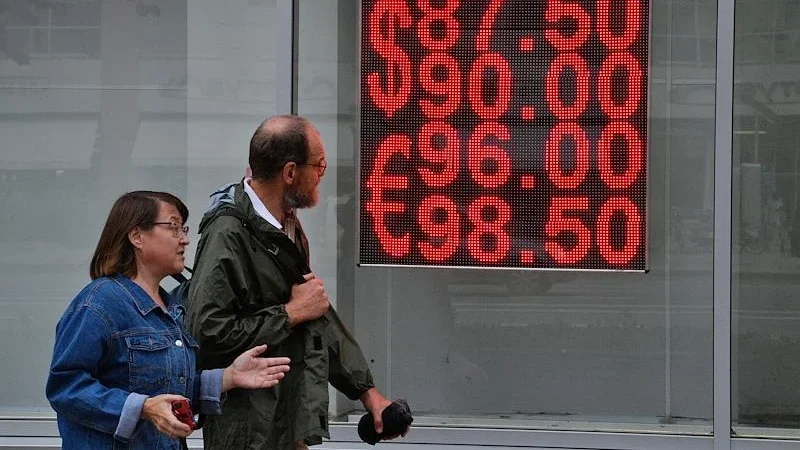
Photo: Anton Novoderezhkin / Kommersant
To close the auction on June 30, 2023, the dollar on the Moscow Exchange cost 89.55 rubles. He went up by two rubles per session and almost five rubles per week.
By the end of the session, the euro traded at the level of 97.8 rubles, adding 2.7 rubles per day in the price. Before closing the auction, Yuan gave 12.35 rubles. In general, in a month, the ruble exchange rate in relation to the dollar decreased by nearly by 10% - from the level of 80.06 rubles./$ 1 (CEC of the Central Bank of the Russian Federation by May 30) to 87.03 rubles/$ 1 (Course of the Central Bank of the Russian Federation as of July 1). What's happening?
External circumstances
The best explanation of what is happening in the foreign exchange market was given by the Deputy Chairman of the Central Bank of the Russian Federation Alexei Zabotkin :
QUOTE
“Our course is floating. The dynamics of the course is determined by the flows of the payment balance. First of all, what is happening on the side of export and on the side of imports. We pay attention that in recent months the prices of the main goods of Russian exports go down, and world prices, without even looking back at the discounts that are applied to world prices for Russian export goods. And the course reflects this deterioration in external conditions ”( quote for Interfax ).
Indeed, you can’t argue.
You can follow how “external conditions” worsen, you can literally online - at this link - on a graph illustrating the dynamics of Urals oil prices. If a year ago, more than 93 dollars were given for the Urals barrel, now less than 56.
You can’t deceive the economy:
The ruble course in relation to world currencies is a derivative of the volume of foreign exchange earnings of exporters, and this revenue is a derivative of hydrocarbons and export volumes, to whom you will not sell oil and do not nominate for the prices - even in yuan, even in rupees.
“Oil Data” by the Russian government is classified, but the situation with the export of hydrocarbons can be indirectly judged by oil and gas revenues of the budget. In May, the budget of the Russian Federation received 570.7 billion rubles of oil and gas revenues. This is almost 12% less than in April (647.5 billion), and 36% less than in May 2022, when oil and gas revenues amounted to 886 billion.
Yes, and the demand for the currency has grown: some withdraw their savings from the Russian Federation, others do not make foreign exchange earnings here.
"Friends" for the ruble is no better than "enemies"
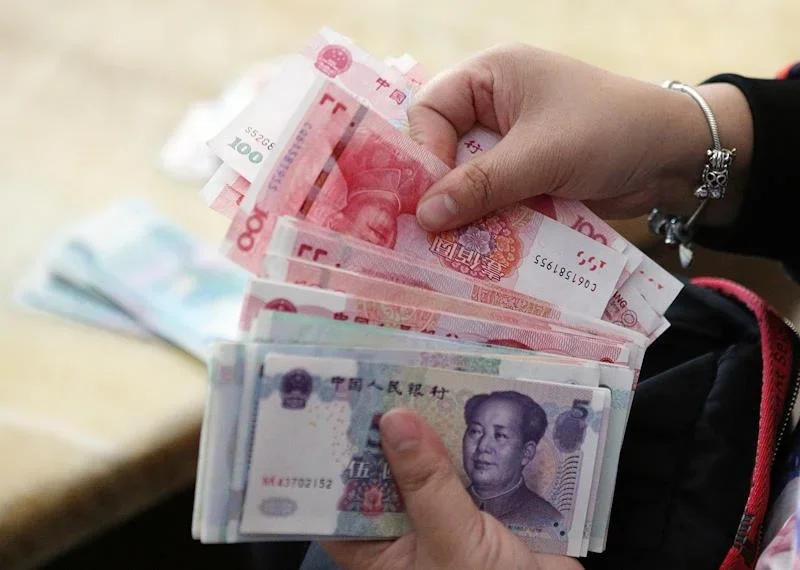
Funny (actually not), but the active and joyful “deadllarization” also plays against the ruble. In May, the share of the yuan in the foreign exchange market increased from 36.1% to 39.2%, and the share of “toxic” currencies decreased from 62.3% to 59.4%. But if, it was a matter, Russia sold more to China than I bought in China, now it is not so - a negative trade balance with China is a negative, the economy lacks “friendly yuan”.
According to the Central Bank of the Russian Federation, for April -May, monthly exports in the yuan grew from $ 6.9 to $ 7.2 billion, and imports from $ 7.7 to $ 7.9 billion.
The share of the Chinese currency in imports grows faster than in export, the higher it is, the more influence Yuan has a ruble/dollar through cross-waistons on the course.
The situation with Indian trade is even more interesting - India is now a leading buyer of Russian oil, only calculations for this oil are in rupees. There is no exact data on the scale of Russia accumulated by Russia, the approximate amount is within $ 10-15 billion. But the rupee is a partially convertible currency with restrictions on the influx and outflow of capital. That is, to export and import rupees is expensive and difficult.
To reduce the number of accumulated rupees, theoretically can increase imports. One problem: India has nothing to buy.
In the 2022–23 financial year, Russia's deliveries to India amounted to about $ 42 billion, while deliveries from India to Russia did not reach even $ 3 billion (that is, export exceeded the import by almost 13 times).
Budgets and people
It is generally accepted that the weakening of the course per 1 ruble per dollar additionally brings about 150 billion rubles to the budget. We can say that the weakening of the course for 25 rubles, which we observed over the past seven months will bring an additional budget up to 3.8 trillion rubles. If the rate decreases to 100 rubles per dollar, this will give an additional 2 trillion rubles to 3.8 trillion.
The only question is how such a decrease will affect citizens.
A cheap ruble is a plus for the budget, but minus for the economy: a possible panic in the foreign exchange market and a sharp increase in the cost of imports - which will worsen the investment capabilities of enterprises, cause an increase in inflation and reducing real incomes of people.
At a rate of 60 rubles per dollar, a salary of 60 thousand rubles is a thousand dollars (and the corresponding level of demand for consumer imports). At a rate of 90 rubles per dollar - a salary of 70 thousand rubles - this is eight hundred dollars (and, accordingly, the level of demand for consumer imports is 20% lower).
Just in case: ten years ago - in 2013 - the average salary in the Russian Federation, expressed in dollars, reached $ 940. Only, after all, the dollar has since become different - according to the United States Statistics Bureau, the purchasing power of $ 1,000 in May 2023 is equal to the purchasing power of $ 766 in May 2013.
So the Russian salary in 2013 ($ 940) today would be equivalent to about $ 1,200. And she, as we recall, is 400 dollars less.
But to what extent did the events last week affect the ruble? They influenced, but weaker than it might seem. The dependence here is rather the opposite: the reduction of the resource cake will provoke the growth of conflicts within Russian elites. And the capabilities of the authorities to distribute these resources with a minimum of conflicts, as before, are reduced.