
Translated material
Inevitability
In France, the gendarme received a lifelong genocide in Rwanda
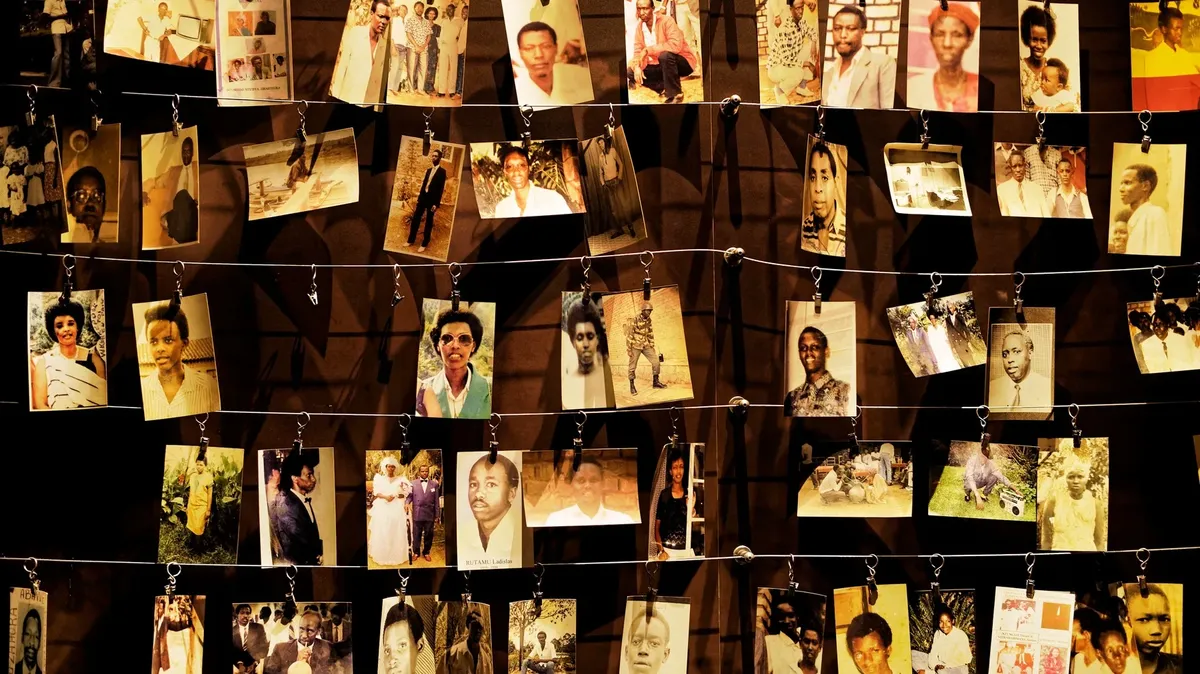
Photos of the victims in the memorial center of the genocide in Kigali, Rwanda. Photo: AP / TASS
The jury in Paris sentenced the 66-year-old Philip Khathehehekiman, the former Rwanda gendarme, who has been living in France and received a passport under a new name-Philippe Mania, to a life imprisonment. The court found Mr. Mannya guilty of genocide and crimes against humanity. Almost 30 years have passed since the commission of crimes.
The process on this former senior warrant officer of the Rwandian gendarmerie took place on the basis of “universal jurisdiction”, which French justice could be carried out to consider the most serious crimes committed outside France.
The verdict of Mr. Mania was passed late on the evening of June 28.
He was found guilty of participating in the massacres and incitement to murders in the Prefecture Butar (South Rwanda), including the murder of a local mayor named NGYASO, who tried to stop the genocide in his commune.
According to AFP, the ex-jandarm was found guilty, including in the participation of three massacres-he gave orders and killed himself:
This is a massacre on the hill of Nyabubar, where 300 people were killed on April 23, 1994,
The massacre four days later on the hill of Nyamura, where thousands of people died,
And the massacre at the Institute of Agricultural Sciences Rwanda with tens of thousands of victims.
In relation to the last crime, the court found only the complicity of Mania, but not his guilt as an executor of murders.
The ex-jandarm himself did not plead guilty and kept silence during and after the sentence.
During the hearings that lasted a month and a half, he only agreed that the “Tutsi genocide is a reality”, and stated that he “sincerely sympathizes” with the victims, the “witness” of which he was the murder. “But I have nothing to blame myself for,” the accused said.
His lawyers, who now have ten days to appeal, called a mane of “scapegoat” in the “political game” between the authorities of France and Rwanda.
In this regard, it should be noted that in French territory, according to the media, at least about a hundred people continue to live, whom representatives of the associations of victims of the genocide are called the culprits of the 1994 mass killings.
It is known that many of them, including the propagandists of the notorious “free radio and television of thousands of hills” (RTLM), the French military helped to leave Rwanda.
Among them is Agatha Khabiariman, the wife of President Rwanda Juvenal Khabiarimans, whose murder on April 6, 1994 was used by representatives of people from the people of the Khutu people as a “signal” to begin the massive extermination of people from the Tutsi nationality.
The ex-jandarm of Hategekiman, according to RFI radio, arrived in France
In 1999, where, under a fictional name, he received refugee status. He lived in the area of the city of Renn, worked as a guard at a local university and in 2005 received French citizenship. At the end of 2017, he left for Cameroon, where in March 2018 he was arrested and an extradited to France a year later.
Manye-Hategekiman became only the fifth accused (at the same time two were justified), who had introduced before the French court for crimes committed during the Genocide in Rwanda from April to July 1994.
As a result of the genocide, according to various estimates, from 800 thousand to 1 million people died.
In early June 2023, the international residual mechanism for criminal tribunals in the Hague made a decree that Felicien Kabuga, an ex-president and one of the creators of RTLM, responsible for calls to the genocide, is in the “state of vascular dementia”, which means that he cannot be sentenced to legal sentence. Although the trial (in which Kabuga can take part according to his desire) will continue, and the accused will not be released, remaining in the premises of the UN prison in The Hague.
In November-December 2023, in Paris, another, sixth trial, the French trial over the accused of genocide and crimes against humanity in Rwanda should take place. The Rwandian gynecologist will judge Muneman, who has been living in France since September 1994. Muneman was denied the provision of French shelters because of complaints put forward against him about participating in the genocide, but in the early 2000s, according to Le Figaro , he received an ambulance at the hospital in Vilnev-Sur, in the southwest of France.
Despite the fact that the first complaint against him was put forward in 1995, the case was finally sent to the court only in 2022.