
Translated material
The "young" are the cities
Street riots do not stop in France after the murder of a teenager in the nanter
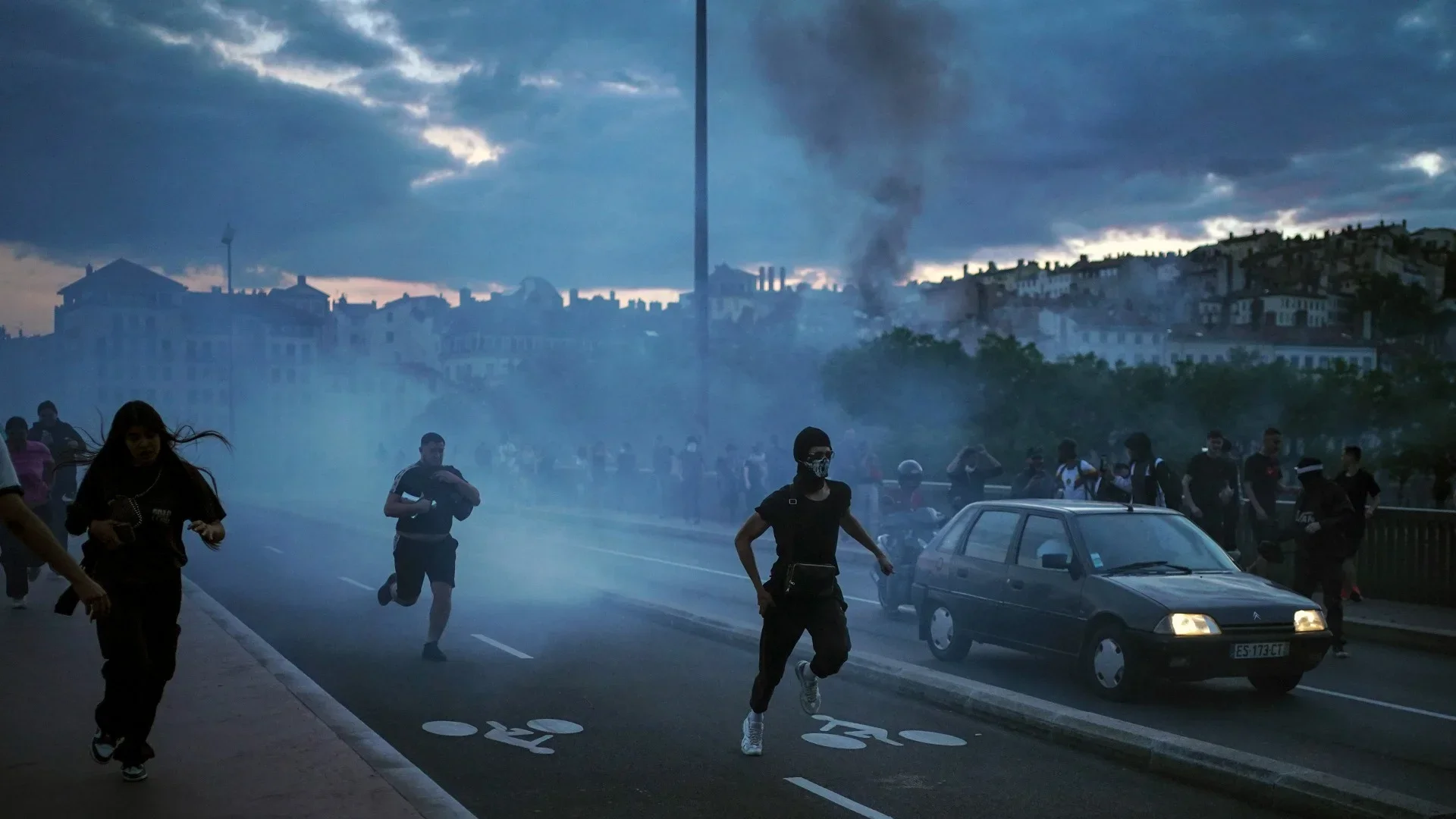
In France, riots continue after the murder of a 17-year-old teenager by police officers. Photo: AP / TASS
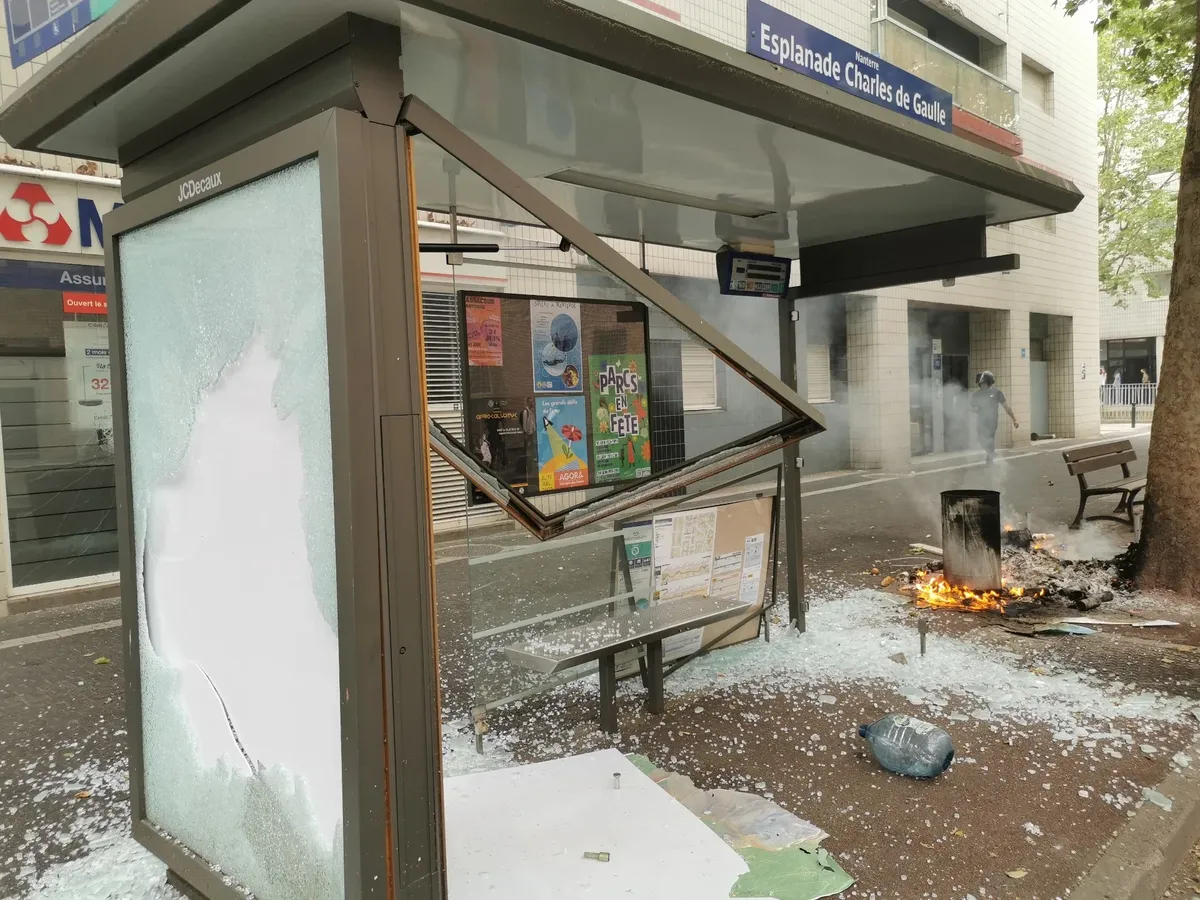
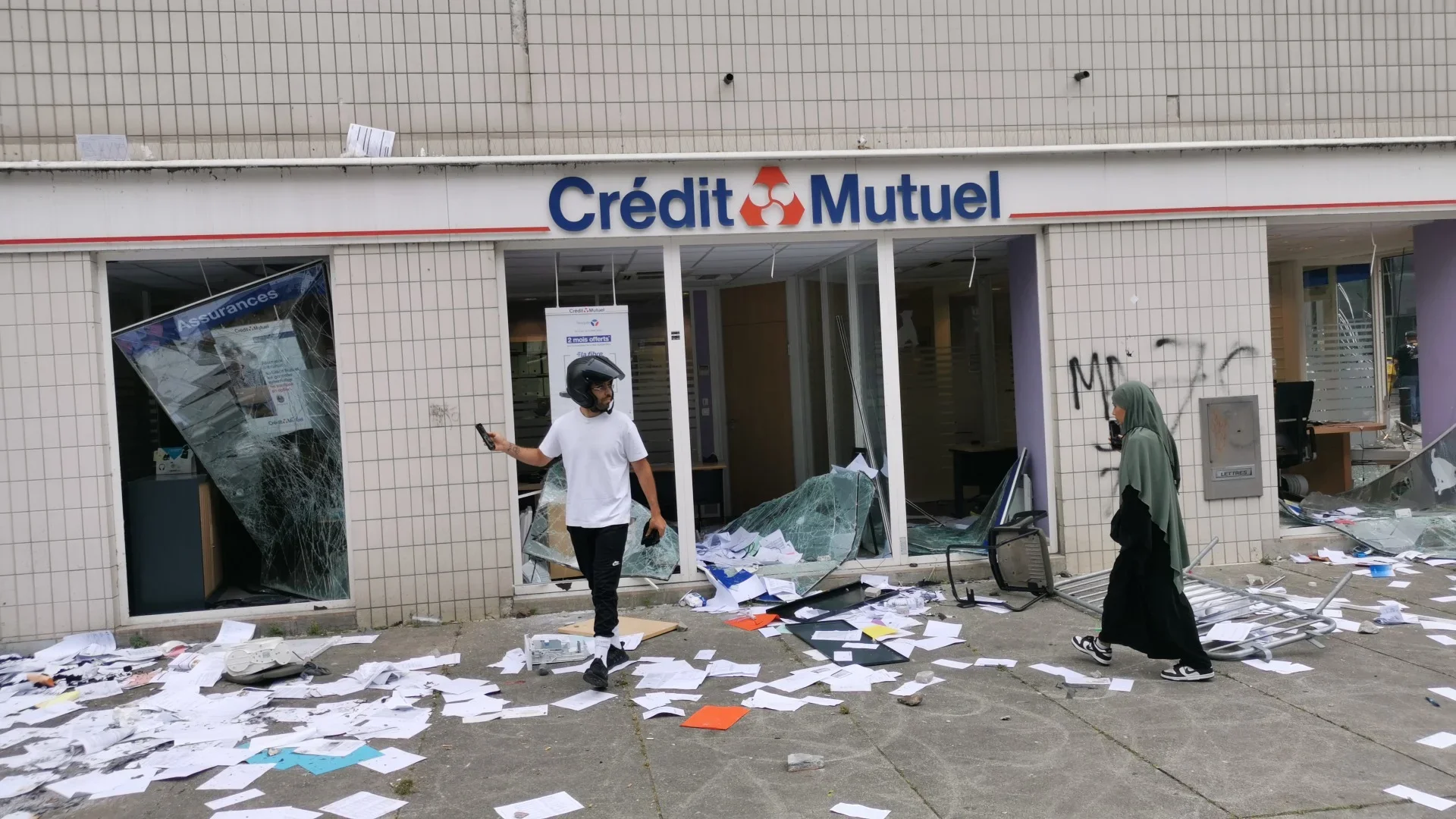
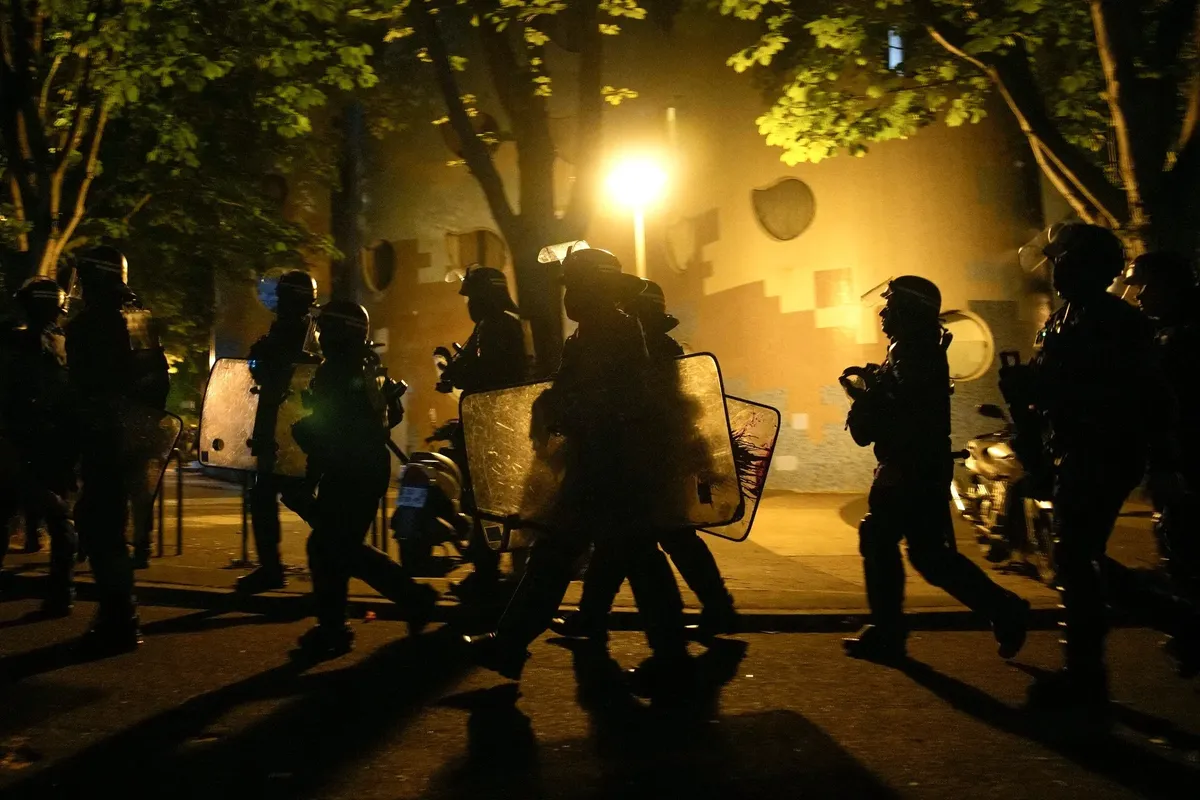
On Sunday night, many cities of France expected the fifth of the riots night - when “wild hordes” (as police unions call them), the city halls, police officers and barracks of gendarmerie, media texts, beat windows and banks, throw law enforcement officers with stones and bottles, and shelling from the tools for launching for launching Salutov ... security officials use light -school grenades, tear gas; They use helicopters and armored vehicles - to overcome the skeletons of burning machines ...
Last night, the Minister of Internal Affairs Darmanen brought 45 thousand police and gendarmes to the streets (including BRI, RAID and GIGN and Republican Guard special forces) - five thousand more than the day before. The authorities of several more cities introduced a commandant hour. The right and ultra-right opposition demanded a state of introduction from President Macron, but so far it is holding, and the pogroms, and what has led to them-the murder of a 38-year-old police officer of 17-year-old Nael M. in the Parisian suburb of Nanner. As a result, the “complex of measures” led to the fact that the fifth night was more calm than the four previous ones,-the head of the Ministry of Internal Affairs was happy early in the morning: only more than 700 people were detained, almost half as much as the day before.
There are few truly serious incidents by the French standards-for example, in the Paris suburb of L'Ay-le-Roz into the mayor’s house, Vincent Zhanbrun (the right-hand Party of the Republicans), sent a Taran car and set fire to the building where his wife and two young children were sleeping. “Trying to defend myself and escape from the attackers, my wife and one of my children were injured,” the mayor said.
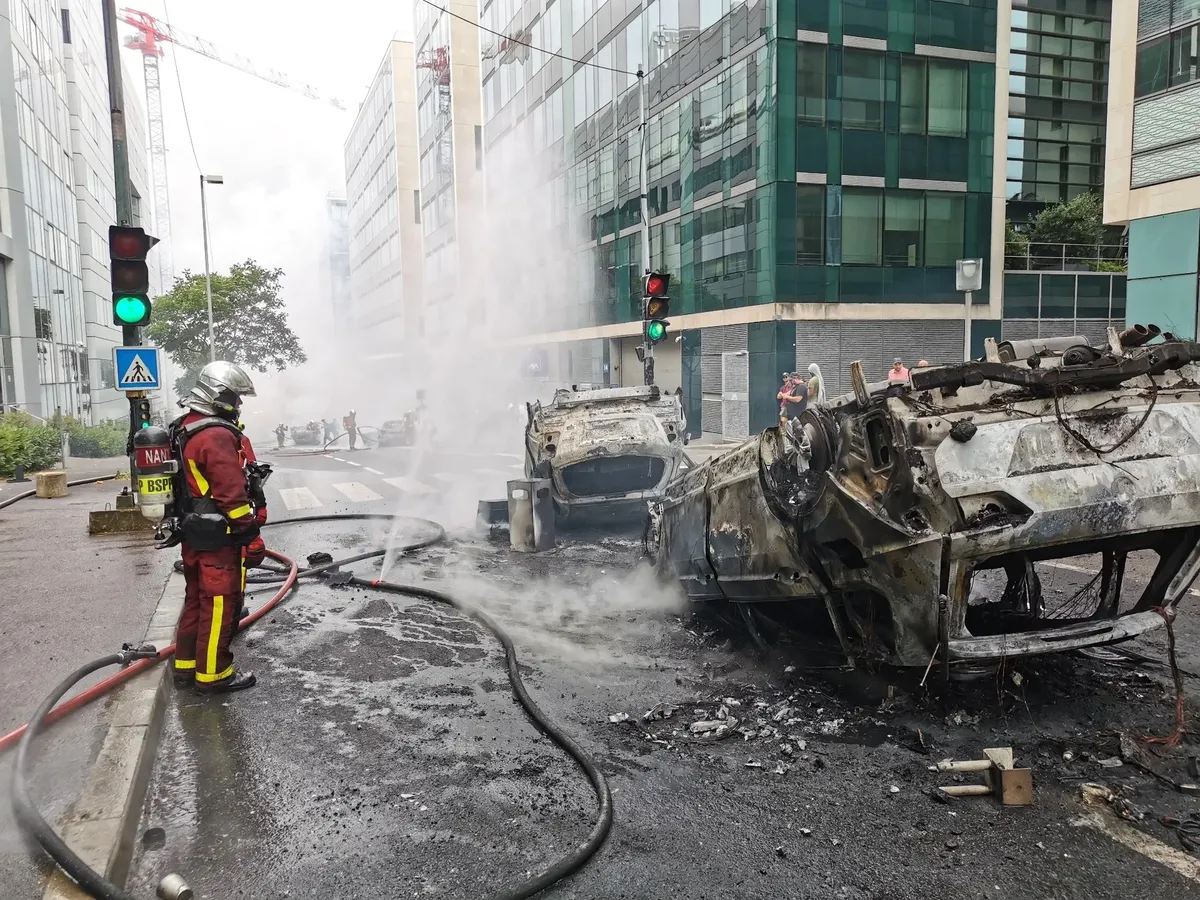
By eight Ministry of Internal Affairs, it announced that 45 police and gendarmes were injured throughout the country, 577 cars and 74 buildings were set on fire, 871 fire "was registered on public roads."
Shots with which it all started
On June 27, in the Nanter, the yellow car of Nael M. (with whom there were two friends) were stopped by the police on motorcycles. More precisely, the car pursued by the police stopped in traffic. One of the “hurrying” policemen sent a pistol at Nael’s temple, threatening to shoot, the second policeman said: “He shot him.” When Nael decided to leave the police again and pressed the gas, two shots were sounded. An hour later, with a little, the teenager died of injuries. A shooting policeman was immediately taken into custody. That evening, in Nanter and several more cities, including large Lyon and Marseille, clashes of the “young” and the police began.
President Macron immediately condemned the police officer’s actions, calling them “inexplicable” and “unforgivable”, for which he received a portion of criticism from the right and ultra -right, as well as from police trade unions.
The riots continued the next evening.
At 8 a.m. on June 29, an urgently, before a planned trip to the EU summit , the president held a meeting of the Crisis Staff in the building of the Ministry of Internal Affairs.
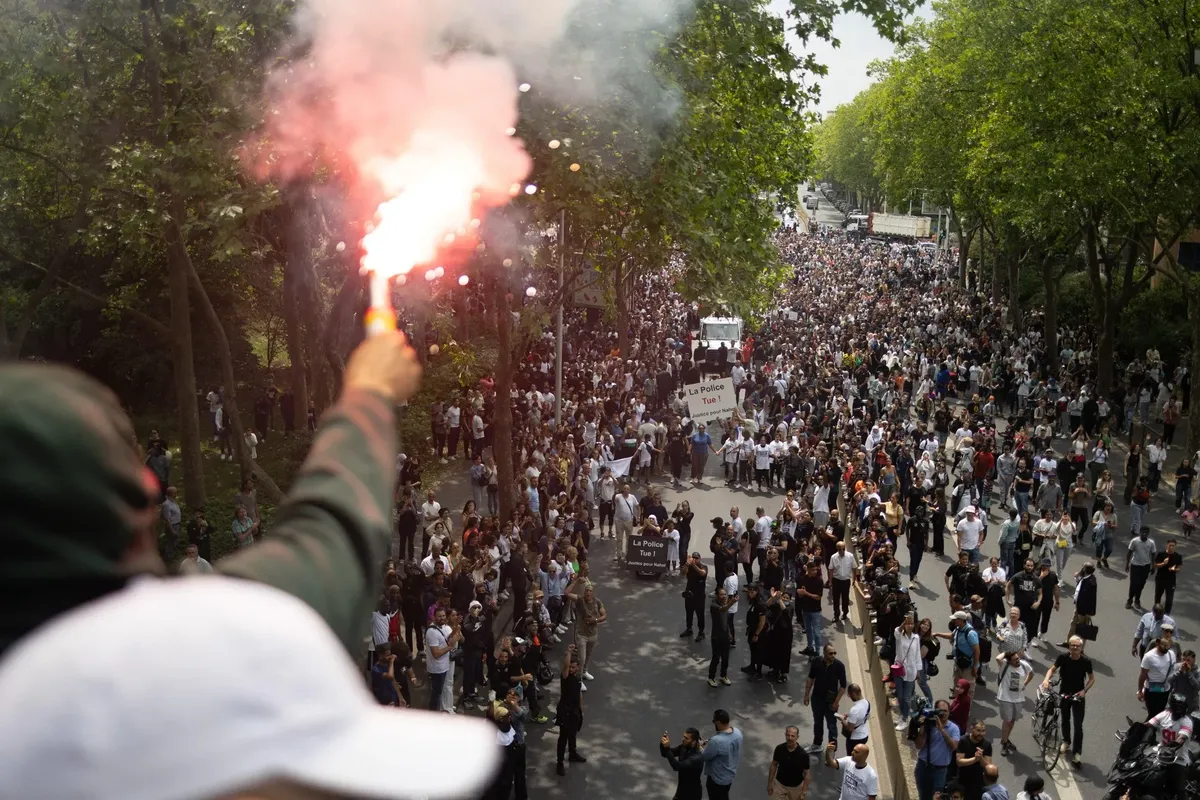
At the same time, in the Nanter “White Marsh” (march “Memory and Anger”) ended with mass pogroms - which was preceded by “traditional” cries “Everyone hate the police”, “Police - killer!” For most large French manifestations. (With the same inscriptions, as well as traditional calls for the “revolution” and violence in relation to the police and government representatives every evening, the protesters “decorate” the walls and windows of buildings along the route.) In addition,
Protesters - among whom there were many women in Muslim scarves ( the ancestors of the deceased guy - natives of Algeria, his mother called on the march ) - demanded "justice for Nael!"
On the same day, the court, at the request of the prosecutor's office, which stated that the situation in no way forced the use of weapons, brought the police an accusation of a deliberate murder.
But even on the third night, on the streets of French cities and towns, it thundered and burned. The Ministry of Internal Affairs, the next morning, again reported about hundreds of detained pogroms (on Thursday and Friday it was more than 1300) and more than a hundred wounded police officers. In the city of Vosan-Veren, the satellite of Lyon, the police on Friday fired from long-barrel weapons, four were injured .
On the morning of June 30, Macron, without waiting for the end of the EU summit, returned from Brussels to Paris. Again he held a meeting of the “Crisis Staff” (the next day it was still under the chairmanship of the head of the prime minister’s office).
On Saturday afternoon, July 1, the Champs Elysees announced the abolition of the Macron three-day visit to Germany: “The president of the French Republic and the Federal President of Germany, Frank-Walter Steinmeier, negotiated ... Given the internal situation, the president of the republic said that I would like to be able to stay in France over the next few days ...” the presidential press service said.
Indeed, in France and the next night, "there was something to see."
Then the Macron administration reported that the head of state made a “number of telephone calls to the mayors of cities”, concerned about the level of violence in the country.
What do the authorities do
Prime Minister Elizabeth Bourne indicated on Friday that the crisis headquarters is now “constantly” to observe the situation and “make the necessary decisions”. Madame Bourne herself on Saturday night visited the national police command post in the building of the Ministry of Internal Affairs, and then in the Paris Prefecture.
In Paris, by the way, last night through the social networks of the pogroms were called to the Champs Elysees, but the authorities, who sent 400 employees there and completely blocked them by one in the morning, managed to avoid riots.
Macron, as with the suppression of other mass violent shares (and there have already been a lot of them to its presidential share in the last five years: “yellow vests”, then protests against the law of labor - protests against the new police law - protests against pension reform ...), tries, as far as necessary, and to respond to the “aspirations of the people”, and show him the irreplaceable face of state power (in a police helmet and armor). The authorities, which is tough - but also in moderation, so as not to enjoy the hot “young” - suppresses the riots. And he tries that the arrested pogroms, as soon as possible, presented as soon as possible to the judges and be punished.
Already on Saturday it was announced that the first participants in the robberies of defeated stores received their sentences in Paris and the capital's suburb of Bobinia - from 100 hours of public work and a two -month ban on entering the capital up to six months of real imprisonment.
Which, however, cannot be called punishments that can dissuade all hot teenagers from the suburbs from the “chance” to take out computers from a broken bank in the nanter or, at the worst, several pair of sneakers of a “cult” brand from a company store in the center of Paris.
In addition to the “tough response of justice” and sending the maximum possible number of police officers to the evening streets (which are still not enough, given the number of “young” opposing them), the authorities are introducing restrictive measures.
In the cities in the north of the country and in some Parisian suburbs they introduced a commandant hour for minors-somewhere from 21.00, somewhere from 22.00, separate city halls-as, for example, in the city of Colomb, bordering Nanter-established a commandant hour for everyone;
Buses and trams in the Paris region stop traffic at 9 pm,
In Marseille, all the transport stops at six (this, so that, God forbid, the transport does not set fire to the passengers, because the buses were already burning these days) ...
Many mass events were canceled, including shows of the Parisian Fashion Week and long-expected (she himself and her faithful veterans fans) concerts are eternally young Milen Farmer at Stade de France ...
Representatives of the tourism industry have already expressed concern to the authorities with "degradation of the image of France." As if they had not seen such uprisings before. On Saturday, the Minister of Economics urged banks “show more understanding”, and insurers to reduce franchises and quickly pay compensation to business representatives suffering from riots. However, the banks themselves are the first victims of the pogroms.
"To blame" social networks? Will everything calm down soon?
And all these troubles fell on the president who called on the country to “100 days of calm and concentrated work” after the end of mass protests against pension reform. 100 days were supposed to end approximately by the day of the capture of the Bastille.
Now you don’t know if the current fire will have time to go out until July 14.
Although personally, I would put on the fact that they will subside by the national day of the riots: not so much because of the invincible desire of the inhabitants of France to celebrate, not only because the vast majority of residents of even the most “hot” suburbs do not like this mess, but also because the current outbreak of anger due to police violence is far from the first. In 2005, when the Parisian suburbs were dusted-in response to the death of two teenagers who died during the pursuit of police-it all ended in three weeks. And this is despite the fact that the head of the Ministry of Internal Affairs of Nicolas Sarkozy, unlike President Macron, now, publicly, harshly and definitely, stood on the police side. However, almost twenty years have passed since then and it cannot be said that the next generation of the “young” has become less hot and more thoughtful. In addition, social networks were added, which, according to Macron, make their negative contribution to inciting riots.
June 30
The President called on the main platforms of social networks to show the "spirit of responsibility." Snapchat and Tiktok mentioned, through which cruel gatherings are “organized”. According to Macron, these networks "also give rise to the form of imitation of violence, which forces the youngest members of society to move away from reality."
“Sometimes there is a feeling that some of them live in video games that intoxicated them,” the head of state added. Since the beginning of the current “uprising”, thousands of videos and photographs of riots have been circulating on social networks. In addition, a video recording of a policeman’s shooting at a teenager is massively distributed on the platforms, calling for the streets.
On the same day, the Minister of Justice, Eric Dupon-Mretti, also indicated that he asked prosecutors to issue court requests to provide social network users data by operators: “I want all these young people to know that their IP addresses and, of course, their personality can be established.”
In addition, representatives of Snapchat, Tiktok, Meta* and Twitter were invited to the Ministry of Internal Affairs of France on June 30 to meet with the head of the Ministry of Internal Affairs Darmanen and the Minister of Digital Transition and Telecommunications, Jean-Nole Barro. The purpose of the meeting is to “warn” representatives of social networks about “their responsibility” for violence in French cities.
"Fear" before the police and police threats
However, there are separate experts claiming that the case is hardly in social networks: in France the streets are more or less on a regularly burning since 1979, and now “speed is changing, not the nature of the phenomenon,” Ervan Ruti, author of the book “History of French suburbs” said in an interview with Le Monde . In his opinion, “shooting at a young man is perceived as the top of injustice, she arouses memories of institutional oppression and fear of the police, which is perceived as repressive, and not protective, despite the fact that more and more police officers are immigrants from these quarters.”
However,
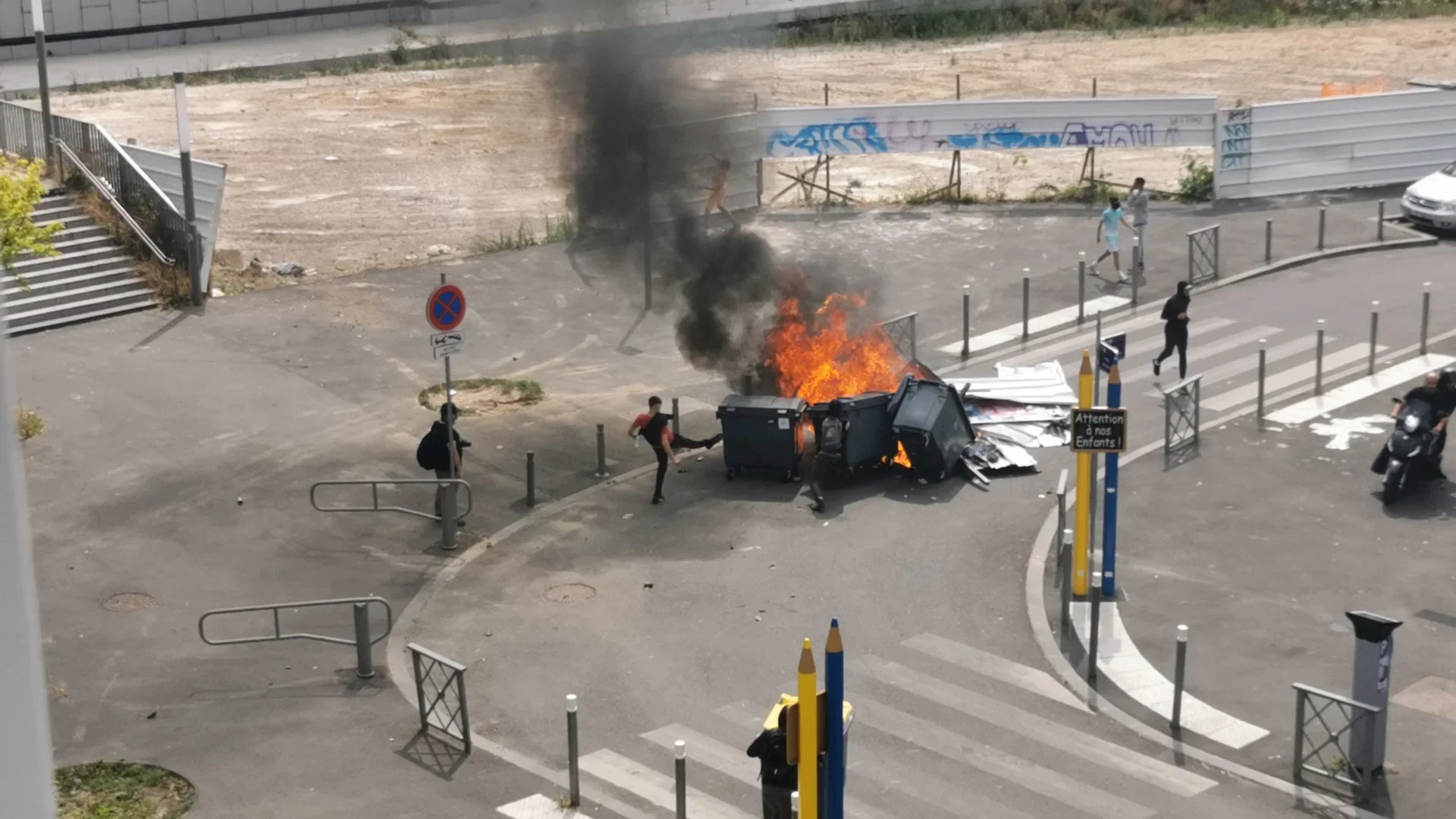
It is difficult to argue about the “fear of the police” when you see how French “clear” guys attack her armored ranks with all the means available to them and with the Olympic tranquility pull the eyes of garbage tanks and tires in the eyes of the “employees” into the already glowing fire.
Moreover, this time in the pogroms, according to the same Le Monde, activists of the radical environmental environmental movement Les Soulèvements de la Terre (“Land uprisings”) also participate in June.
In addition to the actions of left -wing radical activists, the authorities may have to track another “source of violence”: according to the newspaper, central territorial intelligence also notes that “extreme right -wing persons and groups are formed in order, on the contrary, to begin the fight against local youth, starting with this weekend.” As evidence of this desire for fascist activists, to fight the “clear” young people and extremely left -handed activists of the media leads to the video distributed in social networks. On it is an attack on the demonstrators on June 30 in Anzher from the side of a dozen militants formally dissolved by the authorities of the extreme right group L'Alvarium, armed with baseball bats and batons. There have not yet been reported on serious wounds after the meeting. And messages about the preparation of serious resistance from the ultra-right so far look, rather, as the “scarecases” of the authorities, who are also trying in this way to “warn” at least a number of activists from exits to protests.
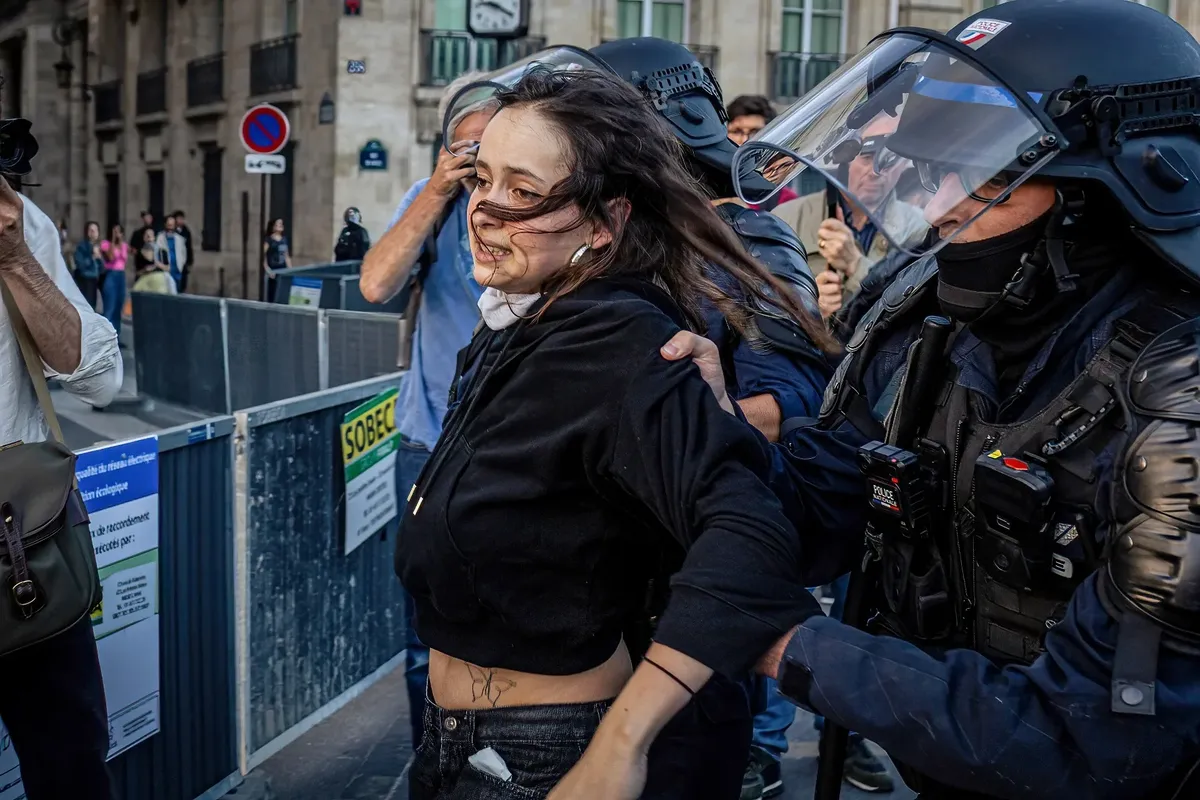
Threats sound from the police professional universities. On Friday, Aliance and Unsa-Police trade unions made an unusually furious statement directed against “these wild hordes”. “The police are in battle”, “We are at war” against “these pests”, “Tomorrow we will resist, and the government must realize this,” the statement resembles the vocabulary of ultra -right radicals.
The head of the Ministry of Internal Affairs on Saturday evening said: "The next person who touches a policeman or gendarme should know that they will find him."
As for the “radicals” in politics, almost all of them - both the head of the Republican Right Party Eric Sotti, and the extreme right -wing presidential candidate Eric Semmur - are calling for the immediate introduction of a state of emergency in the country (as during the 2005 uprisings). And the extreme right Marine Le Pen - first to the “sectoral” commandant’s hour, and soon, if the situation does not improve, to an emergency. The head of the main opposition parliamentary power of NUPES, the ultra -lane melanshon (unlike the allied socialists) refuses to condemn violence from the pogrom.
The president habitually accuses the opposition of “unacceptable instrumentalization” of the tragedy, the opposition accuses him of “inability to restore order”. Classic.
On the role of parents and K. Mbappe
But Macron and his government, according to several sources, are categorically against the introduction of a state of emergency, believing that resorting to such a strict degree is to demonstrate a major failure in building a dialogue with society.
“If there is no emergency, this does not mean that there are no exceptional resources and measures,” said the head of the Ministry of Internal Affairs of Darman on the air of the first national television channel TF1 on June 30.
In addition to a “tough police response”, the authorities are trying to act with persuasion. They seek help "to parents." “Not the state is raising children,” the Minister of Justice Duppo-Marty wisely remarked, adding for fidelity: “Parents who are not interested in their children and leave them to wander at night <...> are subject to punishment in the form of two years in prison and a fine of 30,000 euros.” “I am appealing to just by mothers and fathers,” said Macron, calling for “hold [children] at home.”
Traditional methods of agitation are also used - through the “leaders of public opinion”: then the imam of the mosque near Lyon will call for calm, then the association of fans - in another flaming village of Marseille, then a whole country of France in football, led by Mbappe and Desham.
“First of all, our thoughts are addressed to him ( the deceased guy. - Yu. S. ) and his family, to whom we express our sincere condolences,” the team participants said, explaining that they could not “remain indifferent” and “to the circumstances in which this unacceptable death occurred.”
And they added: “After this tragic event, we witnessed the expression of popular anger, the essence of which we understand, but the form of which we cannot approve. Many of us left the working quarters, and we also share this feeling of pain and sadness. But the suffering of helpless witnesses of a real process of self -destruction is added to this suffering. Violence does not solve anything, especially when it inevitably and constantly turns against those who express it, their families, relatives and neighbors. You destroy your property, your quarters, your cities ... "
«Свой общественный транспорт, в который вы привыкли входить, не заплатив, свои прекрасные современные медиатеки, которые вы обходите стороной», — добавил бы я от себя, если бы такие речи не вносили еще больший раскол в общество, да еще в ситуации конфликта, который необходимо поскорее погасить. Да и кто меня услышал бы, иностранца.
Зато Управление Верховного комиссара ООН по правам человека в самый подходящий момент, на фоне горящих городов, решило покритиковать Францию за «глубоко укоренившиеся проблемы расизма и расовой дискриминации среди сотрудников правоохранительных органов»".
«Обвинения [в убийстве] предъявлены не национальной полиции, а одному полицейскому», — ответил министр Дарманен.
К тому же еще никто не доказал, что убийство было совершено «на расовой почве». Точно так же, как никто не доказал — в отличие от отдельных политических деятелей (включая многих европейских правых), что погромы сейчас устраивают «мигранты». Если, конечно, не считать мигрантами людей, чья семья живет во Франции во втором-третьем-четвертом поколении…
Что касается расизма в полицейской среде, то не секрет, что во многих странах в силовые органы часто идут люди с определенным уровнем развития, не позволяющим им перешагнуть через дикие стереотипы и «дотянуться» до самых простых гуманистических ценностей человечества.
И да, расизм во французской полиции (и в армии) распространен сильнее, чем «в среднем по больнице» — об этом не раз писали СМИ и говорили социологи.
Прощание с единственным сыном
Погибший Наэль М. родился, вырос, погиб и был похоронен в субботу, 1 июля, в Нантере — рабочем и университетском пригороде Парижа.
С которого, к слову, начался знаменитый май 1968-го — в немалой степени «вдохновленный» тем, что студенты местных факультетов «любовались» здесь самими крупными в парижском регионе трущобами на 10 тысяч человек, где жили алжирские рабочие. Сегодня большинство их потомков живет здесь же — только в удобных, современных «социальных» домах.
Наэль — единственный сын у своей матери . Она растила его без мужа. У Наэля были «приводы в полицию» за мелкие правонарушения, но он начал «программу интеграции» с ассоциацией Ovale Citoyen, которая поддерживает молодых людей через спорт, и установил «партнерские отношения» с регбийным клубом Нантера.
«Для меня Наэль был типичным примером соседского ребенка, который бросил школу, иногда нарушал правила, но не был разбойником. И у него была воля к выходу», — сказал Джефф Пюк, глава Ovale Citoyen, в интервью газете Sud-Ouest. «Он собирался построить новое будущее», — говорится в сообщении ассоциации в соцсетях.
Месяц назад Наэль исполнил мечту многих его товарищей: снялся в Нантере в качестве статиста в клипе французской рэп-звезды по прозвищу Jul. Как и многие другие спортсмены и рэперы, Jul поделился в социальных сетях призывом помочь семье Наэля финансово в память о его «младшем брате». Одновременно есть «энтузиасты», собирающие деньги в помощь семье арестованного полицейского.
Мама Наэля, Муния М., сказала в интервью каналу France 5, что винит «человека, который лишил жизни моего сына», но «не полицию» в целом. Добавила: «У меня есть друзья-полицейские, и их сердца сочувствуют мне <…>. Они не согласны с тем, что он сделал».
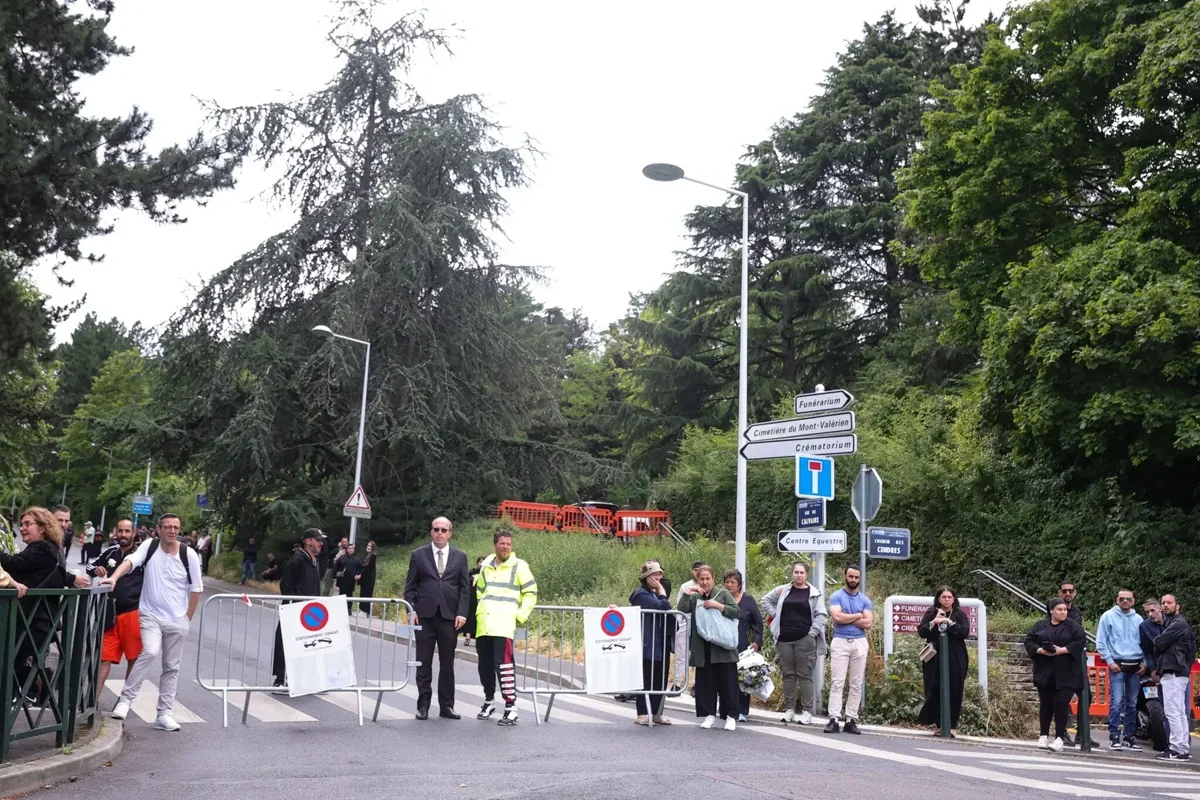
Наэль был похоронен поздно вечером в субботу на мусульманской части кладбища Мон-Валериан в Нантере в присутствии матери, бабушки и еще нескольких сотен человек. Агентство France-Presse сообщило, что церемония была очень спокойной.
Адвокат полицейского заявил в четверг, что его подопечный «опустошен», был «шокирован, когда ему показали видеозапись» убийства, и «не хотел убивать» («целился в ногу»). А еще — «просит прощения» у семьи Наэля.
При этом полицейский уверен, что его «используют» в назидание, чтобы «успокоить бунтовщиков», — добавил адвокат.
Paris