
Translated material
"You are against my dead"
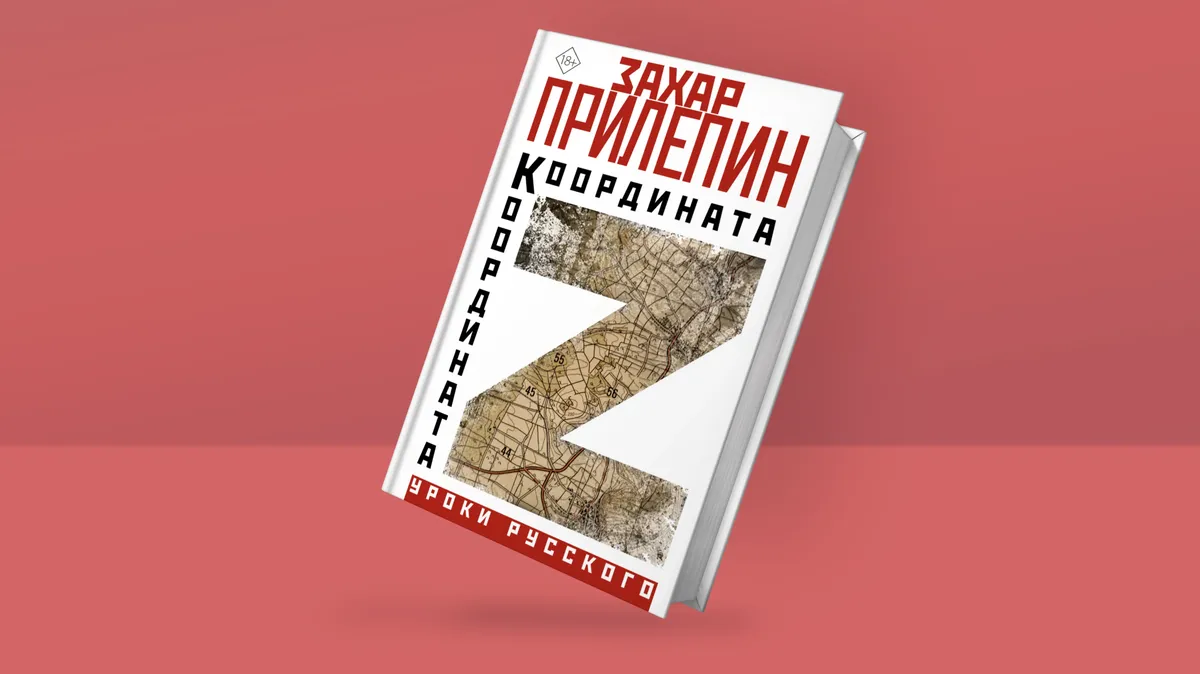
Necrophilia Zakhara Prilepin: we analyze his new book "Coordinate Z"
Mettle: Vectonauta, Freepik
One of the main cultural frontmen of the war - the writer Zakhar Prilepin - has released a collection of journalism “Coordinate Z”. In it, Prilepin is lamented about the dominance of the liberal fifth column, imagines the world as chaos, and also uses an appeal to the dead Red Army as a political argument justifying the invasion of Ukraine. How tasks are in Russia, and why there is almost no war in the collection about the war as such,-especially for the “Novaya newspaper Europe”, the historian, a researcher of the TG-Venko phenomenon Konstantin Pakalyuk sorted out.
You will be surprised: Prilepin has practically no Donbass theme.
But there is much more. For example, the most gall hatred of the “liberal cultural elites”, which every now and then “canceled” his work, prevented the printing and did not give bonuses. The fact that the novel "The Abode" was caressed by someone - silence. The status of the most cited writer of Russia, state units and a political career - all this, apparently, also cannot replenish a deep resentment on those whose recognition Zakhar was so unsuccessfully looking for.
Even this book was an impressive with a circulation for Non-Fiction-12 thousand copies, and a team from the editorial office of Elena Shubina worked on it. One of the most, if not the most prestigious edition of Russian prose in the country - she published the literary work of Prilepin for a long time. However, now there is no label of the famous edition on the cover. Such shyness explains the content.
The croaking front of the war, albeit criminal, can be found here with difficulty. “Coordinate Z” is located in two too “elevated” planes - geopolitics and history.
This is not original: demagogy on these topics has become the basis for the last year to justify the attack on Ukraine.
It is logical: history - it is no longer there, and geopolitics is a few. The layman remains to breathe, recognize the “complexity of this world”, accept the inevitable, and if the agenda comes, go to the front. Prilepin intentionally tries to give this a certain gloss: "You are dying for a reason."
Fascist roots
The book consists of 50 essays written at different times and not always interconnected. However, a certain ideological system is still visible behind this cacophony. True, cleansed of high rhetoric and truisms, it appears to be something simple, like a sledgehammer of the Wagnerians. It is symbolic that the book flew to me in the same package with Hitler's Mine Campf (the latter is a tribute to my professional interests as a Holocaust historian).
The classic of historical sociology, Michael Mann, wrote that fascism is "an attempt to create a transcendental national state with the help of paramilitarism by conducting the people through purges." In the text of Prilepin, we will find a lot in common with this: both the belief in the transforming “ideal” state, and the support on paramilitarian groups, and the willingness to clean the disagreements.
The ideas of Prilepin differ from the mentioned definition of fascism only in terms of organic nationalism. Roughly speaking, the “classic fascists” believe in the nation as in the principle of “blood and soil”. Prilepin is much more accurate here - he tries to combine three elements: Russianness (in the spirit of the ancient "nationality"), the state (political form) and the empire (external space of power).
On the one hand, he, trying to imagine the meaning of the war, states that there is a struggle between the “fake” and “original”, “over -frozen, linden quasi -Ukrainians, non -Russian Russians are opposed to us”. But on the other hand, Prilepin writes above: “They are enemies of the Ukrainian, Little Russian, Russian people and the Cossack family, and we are this people, this kind” (P. 49).
Ukrainians are seen as Little Russians who have the right to their difference, but only as part of the Russian people: any cultural difference is possible-you only need to submit to the government-state.
The main thing for Prilepin is ethics. The state appears as something unifying, organizing and functioning well only if it acts tough. Prilepin's reasoning about the Great Patriotic War, namely about the enthusiasm of cultural figures, which is not observed today, is indicative. The answer is the difference in the state: “This happened because the state worked stubbornly and consistently, building a year after year a personnel pyramid on the principles of total devotion to the Fatherland. Not a regime (although he, too) - but primarily the Fatherland ”(p. 195).
This thesis, of course, does not withstand criticism, since Prilepin completely incorrectly describes how the ideas of “Soviet patriotism” began to form on the eve of World War II. The main advantage of Alexei Surkov and Konstantin Simonov as cultural figures is the fact that “they traveled and sang all military conflicts where their homeland sent” (p. 283). Even somehow a shame for a writer who assigns such a role.
The state of Prilepin, which entered the struggle “For the Russian World” against the “entire Western world”, looks quite “tolerant”: Imperials, monarchists, White Guards, neopaganisms, and Stalinists - all of ours. Just support the struggle for the Donbass. Almost any political positions, except for the liberal, are acceptable, since “over eight years I have never met [in the Donbass] not a single liberal who came to help the Russian world defend his legal rights” (p. 62).
Sometimes a rhetoric of Prilepin can acquire an anti -eelitarian and even anti -capitalist character. Prilepin criticizes how “Svo” failed from the very beginning, defends Lenin in front of Putin and repeatedly convicts the Russian authorities in softness. But all this is a “vaccination”, which is necessary only so that he, the writer, is not immediately convicted of Lisobate before the authorities.
So, in the essay “Fattening of the graves” he represents the history of modern Russia as a conspiracy between the “liberal political elite” - on the one hand, and “bourgeois” and “creative class” - on the other. The latter were supposedly the main beneficiaries of the system, while manipulating the "ordinary people." However, the war changed a lot: the people allegedly remained faithful to the country, and the creative class and the bourgeoisie betrayed it. The Prilepin completes the “horror story”: the younger generation enters the arena, which is also against the war, which means that the bourgeoisie and the creative class will be able to break the pact with the authorities: “And they will devour power. The only problem is in one thing: it will devour it with the country ”(p. 91).
On the day of mobilization, Putin made a choice in the direction of his people (p. 171). And therefore, the war appears to be something purifying: “Through the war, Russia retains itself ... getting rid of not only the heresy of Ukrainians, but also from false democracy, quasiliberalism, gender innovations, Russophobia and other persistent infection” (p. 296). Absolute cosplay of militarists of the First World War.
But here are the idea of the statement of the “transcendental state”, and cleansing from otherness - two key features of fascism according to M. Mann.
However, Prilepin is far from celebrating the final victory. It may, outside, and it seems that Russia is a country of victorious fascism, but the ideologist himself does not think so. This book, sent to print on March 17, 2023, ends with hints that a significant part of the westernized elites remained in place, and also calls for mass mobilization. His ideal, outlined on the last pages, is a mobilization society, ready for everything, where in the center “Warrior, Worker, Man of Science, Priest, Poet”, the main values are courage, insolence and justice (p. 347).
This idea goes in unison with the rhetoric of the vast majority of the “military commissar” (that is, those who are personally in the war zone) and the Wagner group. Well, at least to the failure of the “march of justice” to Moscow.
Geopolitical imagination
Although Prilepin uses many geopolitical arguments, it is difficult to conceptualize his idea of the outside world. The outside world appears as a certain chaos where, perhaps, certain trends are observed (for example, “In the 21st century, the Reasonable World will simultaneously be left (in the economy) and right (in ideology)” (p. 237)), but in general it remains a purely negative space where there are many enemies (primarily the West and the USA). The attitude of Russia to him is ambivalent: it is fenced off at the same time (after all, “Switch” is an action on “its land”), and acts as a light of the anti -colonial struggle and an example for other peoples.
If the appeal to the “Donbass context” allows Prilepin to affirm the “Russian irrient”, then the international context introduces already opposite imperial ideas. So, referring to one conflict in the post -Soviet space and silent others, Prilepin claims that “the civil struggle of a number of oppressed peoples for independence did not stop in the territory of the former USSR, in fact, over the years never. And the fact that all independence in one way or another had the capital in Moscow - for Moscow all these 33 years were not a holiday, but a cross. But we had no choice before - and will not continue. Someone must look behind space ”(p. 200). "The burden of the white man", nothing new.
Historical imagination
Over the past ten years, history has become the main quasi -national language of the Russian authorities, and naturally, Prilepin cannot help but speak on it.
But the current moment is experienced not just as a “accomplishment of history”. No, the line breaks between the present and the past, and the fallen ancestors become forced power. At the very beginning, Prilepin speaks of 417,323 dead Soviet soldiers in the battle for the Dnieper in 1943, and then asks: “Why did you get that your voice weighs more than this immense cemetery? You decided this only because you are alive? .. Does death reset our voices? .. Ukraine should be freed not only in the name of the living. It should be freed for the glory of all the fallen ”(p. 16).
Despite the abundance of historical references and reasoning in the “Z coordinate”, throughout the story, Prilepin proposed only one “forgotten” hero of the past, who was now in demand, namely General Grigory Rosen, who not only participated in the Napoleonic wars, but also suppressed the Polish uprising in 1830, and then fought in the Caucasus (p. 298–301).
We draw attention to the fact that the imperial principle here at Prilepin turned out to be higher than the ethnus Russian.
"Their"
All this political imagination would be uninteresting and rather boring, if not for the main thing. The armed struggle for Russia and the “Russian world” is the main tool that allows you to separate “its own” and “strangers”. “Own” for Prilepin is a fundamental category. The correctness of “his” is obvious to him, and the fact that it is washed with blood is once again protecting it from criticism: “For me, who buried the most important friends in the Donbass, the best people in my life, there is nothing above this right” (p. 30). Residents of Ukraine will be included in this space of “their own”, but then, after the victory. “Own” are determined by the space of the general struggle and, above all, the battle fraternity. Russians and Chechens, yes, fought in the past, but now, during the new war, they are their own for each other. By the way, a fairly common analogy among the military commissars - they loved to tell the residents of the defeated Mariupol: they say, it’s okay, we also destroyed the formidable.
The death of “its own” is a moral claim to another, primarily Liberal, opposing the war. Prilepin directly says: “You are against my dead. Why should I sit with you at the same table? They answer me: he has a different opinion. What other “other opinion”? Are you out of your mind? I had a brother - they killed my brother! .. I don’t want to be killed, this person with another opinion. I just want him to shut up - at the funeral, where we escort the comrades ”(S. 93–94).
Behind the category of “your” one can easily guess the cult of power, asserting its right of the eternal army, for which the process is more important than the result.
War for the sake of war
The book has so much about history and geopolitics, and so little - about the essence of the current conflict. We need to try to find at least something justifying this war on 340 pages of the text.
In principle, it is possible to find the motives of soil and culture for nationalism, the rights of the “people of Donbass” live “on their land” (as if two million people did not leave these territories in 2014–2021 and cannot consider this land to be their own). “Yes, because of the language you need to fight if it is taken away. Language is the conscience and memory of the people ”(p. 106).
But the search for specific reasons for the war does not really care about Prilepin. Criticizing the song of Yevtushenko’s poems “whether the Russian wars want,” Prilepin says: “The Russians are fighting because they want. They were hesitated - so they are fighting, and not howl ”(p. 205). In one of the following essays, he even more clearly formulates:
“Therefore, we are now and forever respond to those who say:“ ... we did not ask us to free us, ”no one frees anyone. Russia has its own tasks. Russia has its own land. She solves her problems on her land ”(p. 216).
And this is honest.
But the question arises: why else 340 pages, if the main idea is expressed in several sentences? It is amazing how much the voice of Prilepin is secondary.
No wonder the category of “their” is blurry from Prilepin. Is all the people with whom he wants to be “his own” will want to see “his own” in him? The converting echoes of Z-Poesias force to doubt it. And I'm not talking about the half-stewed Igor Karaulov or Anna Dolgarev. I'm talking about the real, crooking front-line poetry of those who are only because of the machine gun. However, maybe Prilepin “veteranka” will not be torn. It is easy for him to demonstrate injuries from a failed attempt.