
Translated material
The dollar reached already 93 rubles, the euro - up to 102. Why does the fall of the Russian currency stop?

The Russian currency at the auction on July 6 updated the next annual minimum: the dollar on the Moscow Exchange reached 93 rubles (so much the American currency was not worth it from March 28, 2022), and the euro broke off a mark of 100 rubles and even reached the level of 102 rubles (this, in turn, is a maximum of March 29, 2022). By the end of the day, courses decreased from peak values, but still grew up to the previous session: the dollar sank closer to 92 rubles, the euro - exactly 100. From the beginning of the year, the ruble has lost about 30% with respect to the American and European currencies - this is the worst result among the currencies of developing countries. Medusa studied why the collapse turned out to be as strong as the riot of Evgeny Prigozhin influenced the ruble and what experts say about the future of the Russian currency.
Why does the ruble fall so quickly?
The ruble exchange rate is continuously falling for more than a month - from May 26. And the main reason for this, expertscall problems with the trade balance .
Russia is a country-exporter. Therefore, the more rubles she receives from one dollar of goods sold (primarily oil and gas), the more money in the budget. But this year, with export, there are just big problems-in particular, due to Europe's refusal from Russian hydrocarbons. The Chairman of the Central Bank (Central Bank) Elvira Nabiullina said that exports from January to May fell by 40%, while imports grew by 15%. This means that the currencies come to the country less, and the demand for it is growing, as the “parallel imports” of Western goods have been established.
In 2022, everything was exactly the opposite. Then, after the start of a full -scale war in Ukraine and the introduction of Western sanctions, imports to Russia were sharply reduced, and Europe continued to buy oil and gas at abnormally high prices. As a result, there was a lot of currency in the country, but it was poorly in demand: because of the destroyed logistics chains and the economy that had not yet been tuned to the new realities of the economy had nothing to buy. Because of this, exactly a year ago, the dollar at some point went for a mark below 55 rubles.
Why doesn’t oil affect the ruble now? Its price does not fall
The price of oil, indeed, is already half a year as it costs almost in place (with the exception of a jump in April). For the standard variety of the North Sea Brent gives $ 75 per barrel, as in December 2022.
But the world economy is not in the best form - there are fears that the need for oil will be reduced, and at the same time prices will go down. Therefore, the OPEC and OPEC+ alliances countries have already decided to extend the reduction in production in August. Among them are the largest manufacturers - Saudi Arabia and Russia. Reducing the proposal, exporting countries whose budgets depend on raw materials, do not allow the price to fall.
But for Russia, the situation is especially complicated. Her oil, due to sanctions, went into the “gray” zone, and the Urals variety is sold with a noticeable discount. Now the “discount” to Brent is about 35%. Oil and gas revenues of the budget of the Russian Federation in the first half of 2023 almost doubled in relation to the same period of 2022-up to 3.38 trillion rubles. This is largely due to the high base of last year, when, following the invasion of Ukraine, energy prices rose sharply, and the Western countries, before the embargo, increased deliveries from the Russian Federation.
It is the low price of Brent that first of all affects the approval of the Accounts Chamber, to the fall of oil and gas revenues of the budget. His deficiency is now the main headache of the Ministry of Finance. And this is another reason why the ruble falls.
And how exactly does the budget deficit affect the course?
The budget deficit in Russia is the largest in its entire latest history. In five months of this year, he reached 3.4 trillion rubles. Although according to the plan, 2.9 trillion rubles are expected according to the results of only 2023.
There are several options for reducing the deficit. You can increase income by increasing taxes or increasing exports. And it is possible - with the help of devaluation, that is, a decrease in the course of the national currency. The Ministry of Finance laid the cost of Urals $ 70 for 2023, the dollar rate was 68 rubles, and oil production at 10 million barrels per day.
But Urals really costs 52 dollars, and Russia pledged to reduce production as part of the OPEC+contract. Calculations show that oil and gas revenues according to the results of the first half of 2023 will be less planned for 500 billion rubles. At the goal of the Ministry of Finance, to collect nine trillion rubles per year due to the sale of hydrocarbons should be at least 96 rubles per dollar. But even such a bar does not guarantee the authorities to achieve the target indicator - the “guilty” in this is the deadllarization of the trade relations of the Russian Federation with large partners, explained by the chief economist of Raiffeisenbank Stanislav Murashov:
Now most of the volatility , it seems to us, proceeds from the fact that a significant part of export foreign exchange earnings comes to us in rubles. About 40% of exports we get in rubles. Accordingly, we cannot sell it and cause the effect of strengthening the ruble for obvious reasons. It remains to hope for the remaining part, which we receive directly in the currency.
Cutting expenses is another way to reduce the deficit. The Ministry of Finance, according to the newspaper Vedomosti, discusses the program “Frontal cost reduction” in 2024 by 10%. However, this is not yet a project - it is far from a fact that the war implemented in the context of warfare.
Moreover, if the costs are not reduced, but income is not increased, then the currency of any country is doomed to fall. A striking example of this is the Argentine peso, which fell to the dollar for a year more than double (in Argentina is the same serious problem with the trade balance: the budget export cannot help - in the country a long drill, so grain, meat and wine producers and pay few taxes).
And there is any other reasons for the collapse of the ruble?
Yes, you can distinguish several more factors pressing on the Russian currency:
The Ministry of Finance will sell less currency in July
The ruble course also affected the decision of the Ministry of Finance to reduce currency sales in July as part of the so -called budget rule . According to the Ministry of Finance, in July half the funds will be aimed for the sale of currency than in the previous month. So, from July 7 to August 4, the ministry will sell Yuan from the National Welfare Fund for 34.9 billion rubles, or 1.7 billion per day. Whereas in June these indicators amounted to 74.6 and 3.6 billion rubles, respectively.
According to Alexei Antonov from the Alor Broker company, a decrease in foreign exchange interventions suggests that the financial department is waiting for an increase in oil and gas revenues, which may be favorable for the Russian currency.
At the same time, as the analysts of Raiffeisenbank say , "conducting foreign exchange interventions does not have a significant point effect on the ruble, but reduces dependence on the conjuncture of energy goods (in any case, this is its goal)."
Currency demand growth
Among other factors, experts identify increased demand for foreign currency from large importers.
This is how the main analyst of Promsvyazbank Yegor Zhilnikov describes the influence of this demand:
The market remains in the market for foreign currency by large players, which is indirectly confirmed by an increase in the average transaction in the market. We associate [this] that the effect is partially caused by sustainable demand from importers in the Russian Federation, partly - overcoming important resistance levels in the region of 90 rubles per dollar under the conditions of preserved geopolitical fears.
We also still admit that one-time factors can contribute to the weakening of the ruble as the implementation of large transactions. So, for example, yesterday the Federation Council approved the admission of non-resident banks, which also rather acts as a factor in foreign currency support.
Did Evgeny Prigozhin riot for the ruble also influenced?
One of the factors of devaluation is the outflow of capital. When stability and business in the country is comfortable, he wants to invest: build enterprises, buy promotions and earn. Now many are afraid of social shocks, so they withdraw money from the country.
According to Bloomberg , from the beginning of 2022 to May 2023, the volume of Russians deposits abroad increased more than doubled, by $ 43.5 billion.
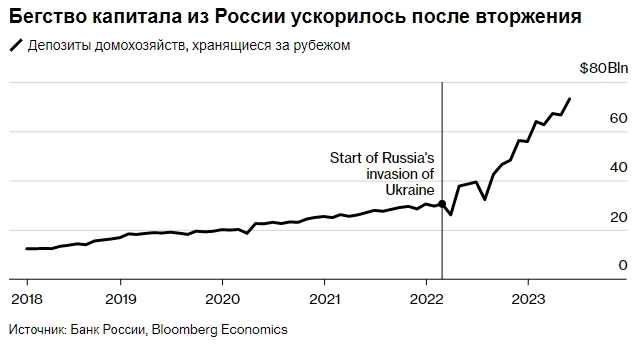
“If earlier the size of foreign direct investment in Russia was $ 25 billion a year, portfolio investments - $ 18 billion in 2019, now this value is negative. Thus, non-residents will not be able to stop the weakening of the national currency, ” said economist Rodion Latypov, author of the Telegram channel“ Solid numbers ”.
Wagner's military's military rebellion could accelerate the process of currency outflow. The risk of a coup d'etat naturally forces the population to look for more reliable assets for savings - and move to dollars and euros in the old fashioned way. “The fears associated with the political situation can increase the demand of the Russian population for foreign currency, and this will exert speculative pressure on the ruble,” said Natalya Milchakova, leading analyst Freedom Finance Global.
The dominant factor of pressure on the ruble of private capital is considered by the chief economist in Russia and the CIS of the IR Renaissance Capital, Sofya Donets.
By the way, the collapse of the ruble already has consequences in the form of rising prices for a number of goods
Manufacturers of household appliances and electronics begin to increase prices against the background of devaluation for the second time from the beginning of this year, Kommersant reports . Prices are rising because most of the supply of equipment to Russia is still paid in foreign currency.
According to the newspaper, the procurement cost of products increased by 10-15%, including the brands Beko, Tefal, Lex and others. Some equipment suppliers confirmed the newspaper price increase.
As the commercial director of the distributor of household appliances Holodilnik.ru Alexei Sogudalov noted, the most of all prices will affect products that are not made in the Russian Federation: smartphones, laptops and tablets. “New price tags for these devices can be expected next week, approximately the cost will rise by 10-15%,” the manager said. He expects rising prices for household appliances by mid -August, since retailers still have enough goods in warehouses.
The example of household appliances was followed by alcohol importers, Kommersant writes , citing sources in the market. According to the newspaper, the cost of drinks can increase within 10% this month.
What do the Russian authorities say about the collapse of the ruble?
The financial authorities are not going to intervene in the pricing of the ruble, despite an alarming dynamics. About currency interventions of speech, it is also not yet. “We do not target the ruble exchange rate, for us any course is acceptable. We take it into account with monetary policy. The Central Bank is ready and can intervene with interventions only when it sees risks for financiality. Now there are no such risks, ” said the Chairman of the Central Bank Elvira Nabiullina during a speech at the financial congress in St. Petersburg on July 6.
One of the consequences of the course of the course may be an earlier increase in the Central Bank. “Given the strong fall of the ruble, it can be expected that the Bank of Russia will not wait on July 21, when it is planned to make a decision at a key rate, and will increase it earlier. Moreover, the case will not be limited to 0.5 percentage points, we do not exclude that the regulator will send a bet to a double -digit area, ” said Alexey Antonov from Alor Broker.
Nabiullina herself carefully commented on such forecasts: “Of course, we allow the possibility of increasing the bet, but it will be disposable, whether there will be a whole cycle - everything will depend on the development of the situation that we will analyze.”
Sberbank President German Gref agreed with Nabiullina in assessing the situation as not causing risks for the stability of the financial system. He did not rule out that in the future the ruble can even strengthen a little:
The course is a float. Thank God that this float exists: we see what a problem with the economy in countries where they try to interfere in pricing. This float has now jumped up, adjusting to the new realities of all sectors of the economy, and some new stabilization will come. I’m not sure that the course is now at the optimal level, I think that it should be strengthened, but of course, it will not go to extremely low levels that were last year. Nothing unusual happens.
The population and press secretary of Vladimir Putin Dmitry Peskov reassured. According to him, the volatility of the ruble should not be perceived as a threat of economic stability in the country:
We really see what fluctuations, indeed the currency course is growing, the ruble is falling. But let's remember, we saw this several times and earlier - and there were rebounds back. And we know perfectly well that, as a rule, in such increases there is always a significant share of speculative games that we cannot exclude now.
At the same time, the First Deputy Prime Minister of the Russian Federation Andrei Belousov in May said that the best for the country's economy and budget can be considered a rate of 80–90 rubles per dollar.
So what to expect from the ruble further? And is it worth buying or selling currency?
Any actions on the wave of panic are usually the most disadvantageous. If you want to exchange currency, economists recommend doing this in parts - then there is less likely to be mistaken.
As for the forecasts, most experts indicate the upcoming rollback of the ruble to more fundamental, that is, more “fair” values.
- Sberbank has not yet reviewed his forecast at the end of 2023 - 75–78 rubles per dollar.
- The Finam analyst Andrei Maslov expects the ruble by the end of the year will bargain in the range of 80–87 per dollar and 88–95 per euro.
- Rosbank expects 87 rubles to the end of the third quarter.
But all this is provided that the financial system is stabilized and the lack of political upheavals.
“We believe that the ruble is now traded weaker than its fundamentally justified level and subsidence to the current levels above 90 rubles per dollar should not be sustainable (support for oil and gas revenues of the budget, should be restored the price components of oil exports),” concludes Raiffeisenbank analysts.
Alexander Molchan