
Translated material
Where the waters of Siberian rivers disappear
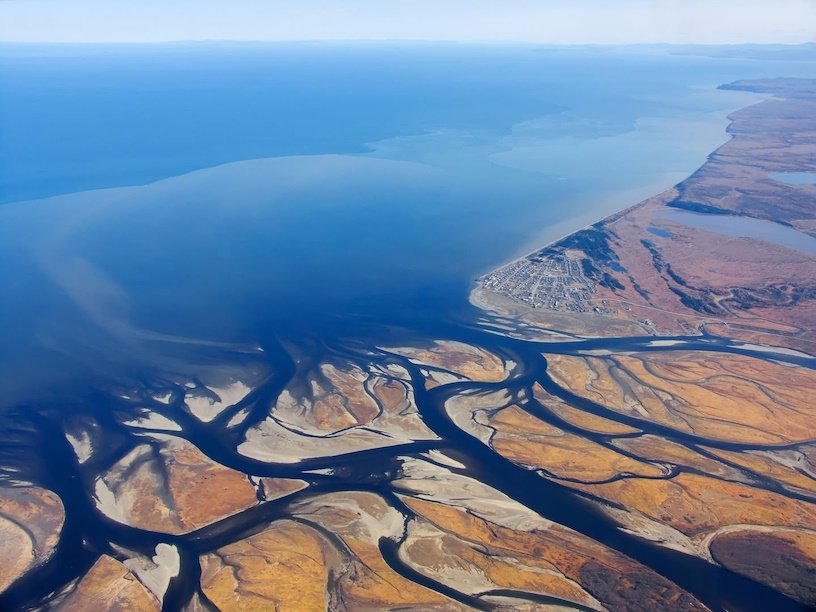
Based on the data collected by scientists and students of the “Floating University”, the disappearance of the fresh runoff of Ob and the Yenisei in the Arctic in the winter is explained, the IGFT press service reports. It turned out that the two largest rivers of Russia after getting into the ocean “dissolve” in the waters of the Kara Sea and the distant sea of the Laptevs.
A large amount of fresh water from the largest Siberian rivers of Ob and Yenisei enters the Kara Sea. These two rivers account for a quarter of a common river flow into the northern Arctic Ocean. These waters form the so -called river plum.
“The plum is a desalinated water mass formed in the sea as a result of mixing river runoff and salted sea waters. When the river flows into the sea, light river waters spread on the surface of the sea with a thin layer. Large rivers of the Ob and Yenisei bring a significant amount of fresh water to the Arctic: the thickness of the formed plum reaches 10-15 meters, and the area - 200–250 thousand square kilometers. This is one of the largest river plums in the oceans, ”explains Alexander Osadchiev, the main author of the study, the leading researcher at the Institute of Oceanology named after P.P. Shirshova RAS and the supervisor of the expedition "Floating University IO RAS - MIPT".
The formation and distribution of this plum in the northern Arctic Ocean affects many processes, including ice formation and ice water, on biological productivity, and the spread of pollution. Therefore, it is important for researchers to understand what is happening with a plum: how it is mixed with sea water, at what speed and where it moves.
Over the past two decades, many oceanographic surveys have been carried out in the warm and free period of the year in the Kara Sea, which ensured a general understanding of the structure and dynamics of the pluma of Obienisai from July to October. However, data collected in the cold period from November to June, when the sea is covered with ice, is extremely few due to severe weather and ice conditions. At the same time, those few works that were carried out say the absence of a plum in the Kara Sea this season, that is, within a few months after the formation of the ice, all this huge pluma disappears somewhere.
“We suggested that the pluma’s waters can either mix with the underlying waters (that is, go“ down ”), or move under the ice with the entire layer of the Kara Sea to some other place (that is, go“ to the side ”). But then the question arises: why in the summer nothing like this happens with this plum? Numerous previous observations showed that in the warm season, the plum of Obi-Senisei from year to year is in about the same water area. Neither such active mixing, nor intensive advection of the whole plum in summer and autumn, ”said the project manager Roman Sedakov, senior researcher at the Institute of Oceanology named after P.P. Shirshov RAS.
In this study, the team analyzed the measurements taken in the Kara Sea at the end of October in 2020, 2021 and 2022. Measurements were carried out at the very end of the empty season. In all cases, the ice was formed less than a week after the end of the measurements, and in one of the expeditions - the day after the end of work. This allowed the first time to study the structure of the pluma of Obienisius shortly before the formation of ice.
“The expeditions, whose data we analyzed in this work, was carried out on various research courts:“ Academician Mstislav Keldysh ”,“ Professor Logachev ”,“ Alexei Maryshev ”. For measurements in sea water, we used a hydrological probe. This device is displayed on the cable overboard, descends into the water and measures the temperature and salinity of water with a frequency of up to 20 times per second. Diping the device from the surface of the sea to the bottom, we fix in detail the vertical structure of the sea with high accuracy, ”says Dmitry Frey, a key participant in the Arctic expeditions, the leading researcher at the Oceanology Institute named after P.P. Shirshov RAS.
The map of the research area in the Kara Sea and the location of hydrographic stations in 2020–2022. The stroke black line shows the position of the border of the pluma of the Obienisa during periods of expeditionary research. Source: Frontiers in Marine Science
An analysis of the data obtained showed that in the pluma of Obi-ONISEI, before the start of ice formation, an intense loss of heat with a surface layer of sea occurs, which is cooled by frosty air from the land. The continent at this point has already cooled a lot, snow lies on Yamal and Taimyr, and the air from the continent begins to sharply cool the relatively warm water in the central part of the Kara Sea. This process leads to the formation of vertical convection and the formation of an extremely sharp leap of salinity between the plum of Obienisa and underwear sea water. Thus, the interaction of the sea with the atmosphere quickly and significantly changes the vertical structure of the pluma of the Obienisius immediately before the start of ice formation, which affects its further spread under the sea ice in the winter season.
“The main achievement of our work is that we have established a mechanism, because of which so quickly (in just a few weeks) the vertical structure of the pluma is completely rebuilt. This process was originally recorded by direct measurements, after which we created a numerical model that confirmed our hypothesis and allowed us to understand what was happening in more detail. Due to the formation of a sharp jump in salinity between the plum and the sea, friction between these layers is significantly reduced. After that, the pluma actually does not hold anything on the spot and goes into “free swimming”, leaves the Kara Sea, ”explains Zinaid Zabudkin, a student of the MIPT, a key participant in the study that formed her graduation work in the magistracy.
The scientific group was also able to establish the direction of departure of the pluma of Obienisai. As it turned out, this huge volume of fresh water for 2-3 months moves under the ice by more than 1000 km to the east, to the next sea of Laptev. Such a quick and distant movement of the river plum should greatly affect the seas ecosystem: many living organisms live mainly in the upper layer of the sea, and for their life, the stability of the salinity of the environment is fundamentally important. Another article of the authors' team is devoted to this process that continues this study and is currently undergoing review in one of the leading scientific journals.
Data for the work was collected during a series of research expeditions in the Kara Sea, organized in 2020–2022 by the Institute of Oceanology named after P.P. Shirshov RAS, Pacific Oceanographic Institute. V.I. Ilyichev FAR RAS, Center for Marine Studies of Moscow State University. MV Lomonosov, as well as the Moscow Physics and Technical Institute as part of the program “Floating University”.
The results of the study are published in the journal Frontiers in Marine Science.