
Translated material
Family altar with Sicily
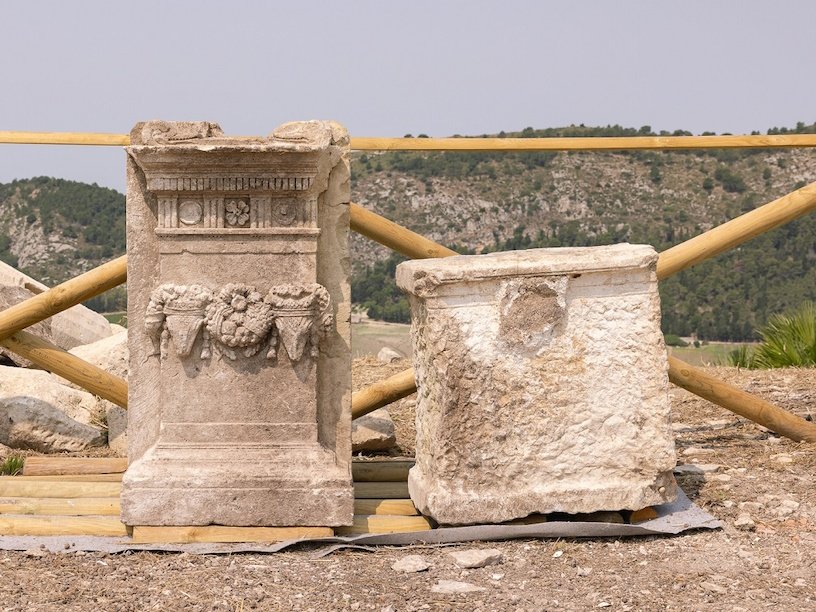
The altar of the late -Hellenistic era (around the 1st century BC) was discovered in the archaeological park of Segest in Sicily. It was just a few centimeters under the surface during the clearing of the Earth in the area of South Acropolis.
The altar has the shape of a truncated pyramid, decorated with carved stucco molding and reliefs. In the center is a high relief crowned with baskets with flowers and fruits. Probably, the altar was intended for storing relics and images of family heroes or ancestors. He has a niche behind where it would be possible to attach a metal hook to fix the altar on a masonry.
The second item found nearby was either a smaller altar, or, possibly, a support for a cult statue. It has a rough surface, which contributes to the adhesion of gypsum. At least three sides were originally covered with plaster and probably painted. Today, only one small fragment of gypsum has been preserved. The top has a stucco cornice and a horizontal surface, like a large altar. Both altars were intended for family worship, and not for public rites.
Segest was founded by Elima, one of the three groups of the indigenous inhabitants of Sicily. Ancient sources record that Segesta competed with Selinunt back in 580 BC. e. It was this long -standing conflict that led the city to the Union with Greek states and colonies. Segesta collaborated with Athens in the 5th century BC. e., but the union could not prevent the destruction of the city in 307 BC. e. Tyran Agafokla from Syracuse. The inhabitants of the segesta were killed or sold into slavery, and the city did not completely recover. Segesta supported Carthage in the early years of the 4th century BC. e., but during the First Punic War (264 BC) turned to Rome for marine and military help. It remained an important port city until the II century AD, but after that ancient sources cease to mention segest. Finally, the city was abandoned during the Arab conquest of Sicily around 900 AD.