
Translated material
What is Z-poetry made of?
Writer Yevgeny Babushkin analyzed the latest heritage of pro-war writers. Now you can't really read them.
Perhaps the main literary phenomenon of wartime is Z-poems. Never before in the recent history of Russia has the state supported poets so much. The Ministry of Defense arranges competitions with cash prizes for them, Channel One launched the show Svoi on Saturday prime time (however, it closed it down quite quickly: according to rumors, due to low ratings), Gosuslugi obsessively distributes the Poetry of the Russian Summer collection (the the paper edition of 2,000 copies published by RT in October 2022 is still not sold out). Z-poetry seems to be everywhere, but, judging by the reader's response, its main connoisseurs are the Z-poets themselves. Kholod asked the writer Yevgeny Babushkin to analyze what modern ultrapatriotic poems are like.
In order not to miss the main materials of "Cold", subscribe to our instagram and telegram .
Finally lucky with the leader
Let's decide where the enemy is and who to hate.
Alexander Sigida hates pacifists:
I hate the idea of pacifism
In politics, mass media and creativity.
Dmitry Moldavsky hates bohemia:
I'm not creative at all
and not even a latent pederast.
Sergei Panferov hates America:
ISIS was given a break
And blacks do not scold whites.
Now for every burp
"Putin's Russia" is blamed.
Maria Vatutina hates Europe but loves Putin:
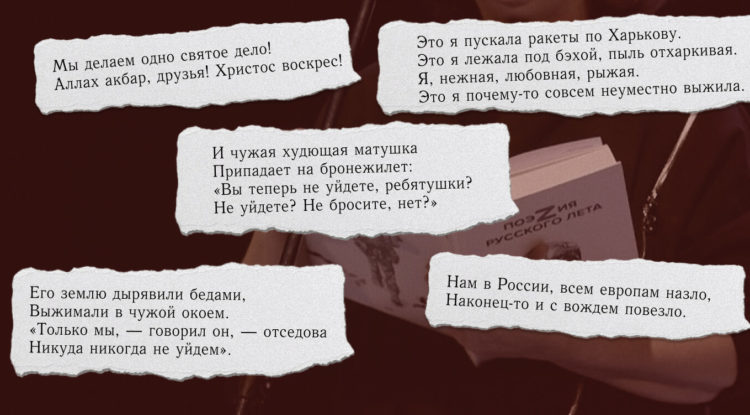
To us in Russia, to spite all Europeans,
Finally, and with the leader was lucky.
These are the Z-poets in the first approximation. If you are already sick, close the text: there will be more hate.
But I taught people to write books before the war. Therefore, even to such verses I want to approach as a writer.
I will try not to mock, not to give a moral assessment of the Z-poets and not to trace their path from depression to denunciation.
Let's take a closer look at the form. What techniques do Z-poets use? What picture of the world do they create? What are the underlying symptoms?
Neither Blok nor God
Any flaw in the rhythmic pattern, any hole in the worldview Z-poets plug God.
Maria Vatutina is sure that "God is never Timoshka - he understands a little about the rules of war."
Vlad Malenko claims that "God with nails in his hands is the first enemy for the West." And he adds that "in Munich there is no smell of Russia and there is no God."
Ivan Kupreyanov offers to "pray to the Russian Gods of War."
Anna Revyakina prays rather to the forces of nature: "God is with us, the sun is with us, and the rain is with us, loading a sniper rifle."
Konstantin Frolov doesn't care:
We are doing one holy thing!
Allah Akbar, friends! Christ is risen!
More often, a Christian God fights on their side, sometimes a pagan one. Martial Orthodoxy smoothly turns into the cult of the classics - the post-Soviet variation of the cult of ancestors.
It's not about God, of course. It's about the boundless love of authority. Who is the boss is right. And whoever died is the biggest boss in literature.
Igor Karaulov worries that “our “War and Peace” was cursed in Konotop.”
Olga Starushko summons Soviet poets to the draft board: "Simonov and Selvinsky stand embracing, looking at the snow and at the tank track."
Aleksey Shmelev is looking for deviationists in the 19th century: “Tolstoy and Pushkin are at war - the capital is empty.”
Elena Zaslavskaya pretends to be a sniper and crosses God with the school curriculum:
Neither Blok nor God
no point, no point!
And I'm left
last cartridge
and a rifle.
I love my homeland
Literature often plays with the canon. A modernist poet writes an anecdote about Pushkin or throws him off the ship of modernity. The modern poet is already making fun of modernism. Z-poet works with the canon differently.
Just read aloud Boris Bergin (2019) and Pavel Kogan (1940).
Boris Bergin:
If I were younger , I would call you Juliet
I would be a Spaniard - exactly then Dulcinea,
and here we have such a hellish summer,
and the cornflowers turn deathly blue.
Pavel Kogan:
My generation is clench your teeth and work
My generation is take a bullet and collapse.
If there is not enough salt , wet the bread later,
If gauze is not enough - wrap a rotten footcloth.
One of these poets died in battle, defending the country from the Nazis. The other borrows rhythm, meter and time signature from the first.
Is this plagiarism? No, it's cosplay. Focusing only on the external, Z-poets transform into Soviet classics. Judge for yourself:
I love my homeland selflessly,
like a full breasted commissar.
Or:
I was defined by Engels - Marx
like a hegemon. Stalin gave the order
I became a poet, and a farmer, and a warrior.
Dmitry Artis saw the commissar's full breasts only in the movies. Dmitry Moldavsky hardly ever read even a line of Marx. But the wartime poets expressed themselves in this way - which means they are supposed to. Cosplayers take tradition very seriously.
Are you leaving now, guys?
Guys! When was the last time you pitched a cigarette while admiring a dawn? Well, get out of here, you bastard!
I have collected in two lines all the favorite words of the poetess Marina Vatutina. No, this is not a joke: this is how the truth is taught at the Literary Institute.
His land was riddled with troubles,
Squeezed out in someone else's window.
“Only we, ” he said, “ from
We will never go anywhere."
All Z-poets abuse archaic vocabulary, but Vatutin also uses military jargon: “ribbon” (border), “drying” (airplane), “cargo 200” (corpse). She cries, lisps and threatens at the same time.
And someone else's skinny mother
Applies to body armor:
"Aren't you leaving now, guys?
Won't you leave? Don't quit, no?"
You will not find such a dump of body armor and cigarettes among the classics, but there is one suitable contemporary - the producer and patroness of Z-poets Margarita Simonyan. It was she who arranged the publication of the collection "Poetry of the Russian Summer". She also likes to express herself in military style and ” with amazing tenacity uses the word “ nedykomka .
Loving dead bosses is good, but a living boss with money is better.
Children bury a cat
One day the poet feels: it didn't work! God is silent, Pushkin is dead, the missiles have been shot down, funding has run out. He is standing in a tunic made in China, disguised as a Soviet military commissar, and the audience is sitting on their phones.
So, it's time to put on all the most beautiful at once. Collect all the special effects in one short text to definitely tickle the reader's nerves:
- kill someone
- to make someone defenseless suffer;
- sprinkle diminutive suffixes on top.
To get through to the reader, Alexei Shmelev kills a soldier:
And the soldier killed near Donetsk
Handed to the apostle in a handful
Children's drawing in blood and sweat
And I heard a voice: "Skip."
Dmitry Artis - cat:
The sun gets dark when
in the most beautiful funnel
children bury a cat
bow pulled on a cardboard.
Maria Vatutina - children. More specifically, children
Invisible in the scope of the gun
Her pigtails and palms,
Her funny freckles
Her swollen lips.
To put pressure on pity is the reception of those who most of all want attention in life. Completely novice authors - or experienced manipulators. Or Z-poets.
So that children in schools read Dolgareva and Karaulov
An important theme is not their poems, but their telegram channels - that they were not invited somewhere, they were not published somewhere, and somehow they were not taken into account in the most terrible way.
Their resentment is familiar and understandable: poetry in Russia is a niche phenomenon, just yesterday they performed for four regular readers of the city library.
But this insult successfully coincided with the state resentment. After all, they didn’t let the whole country go somewhere, they were deprived of something and generally planned to destroy it, and how glorious that we attacked first.
Special thanks to the former ultranationalist and current Z-poet Alexander Pelevin for his honesty:
And my ideas are simple: to name streets after Limonov,
So that children in schools read Dolgareva and Karaulov,
Well, and also me, sorry, I'm such an important chicken,
It’s better to read a sad one than to put on a gloomy one.
Reading poetry, even bad ones, is really better than injecting yourself with heroin (“putting a gloomy”).
It was I who launched rockets in Kharkov
But every poet-cosplayer understands that in a military era, real glory can only be in combat.
Really fought, it seems, only Dmitry Artis. The rest of the Z-poets soul at the front, and the body in the rear.
Elena Zaslavskaya imagines herself on a beautiful battlefield:
This night is endless.
Between fire and lead
I'm like a Russian spy
I go to the end.
Igor Karaulov sings the power of words and missiles:
Our truth glows in flight
friendly rocket family.
Our truth is thrashing furiously
along the concrete burrows of the banderya.
Anna Dolgareva mentally joins the bombing:
It was I who fired rockets at Kharkov.
It was me lying under the beha, coughing up dust.
I, tender, loving, redhead.
For some reason, I survived completely inappropriately.
These lyrics are henna-colored and full of slyness. Of course, Karaulov and Dolgareva are not bloodthirsty by nature and do not plan to kill anyone personally. They just want to lean against something big and strong. Participate in something important and meaningful.
At once - on command - stand up, and by lot - lie down separately
for the king, for friends, for native speech.
So it is called in beautiful poetic language.
In ugly everyday language, this is called "sharing responsibility for war crimes."
The opinion of the author may not coincide with the opinion of the editors.