
Translated material
“So as not to get scolded”
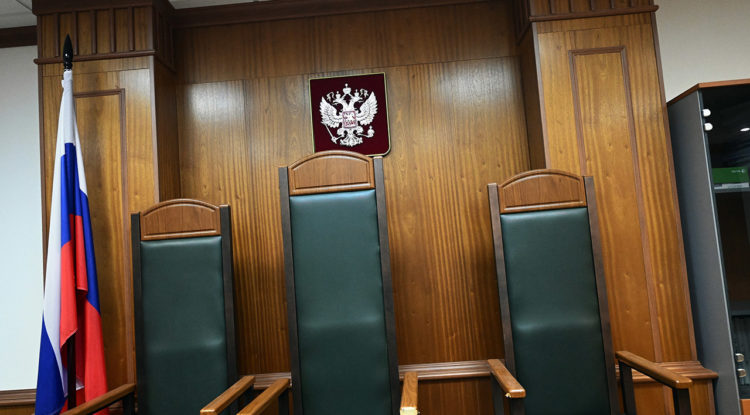
In Russia, acquittals in courts have become even less common. This is because the judges really don’t want to admit the mistakes of the security forces
Russian courts had almost never given acquittals before, and after the start of the war, only two thousand people were found innocent (out of 614 thousand cases!). If a criminal case was opened against you and it went to court, then you should expect an acquittal in only one case out of 676, according to statistics from the Russian judicial system. Why does this happen and is there any point in turning to lawyers for help in this case? Let's figure it out together with researchers of the Russian judicial system Elena Yurishina and Kirill Titaev.
In order not to miss the main materials of “Cold”, subscribe to our Instagram and telegram .
According to experts, judicial statistics in Russia are considered one of the most open and transparent in the world, despite the repressive nature of the judicial system. Since 2007, data on criminal cases has been displayed on a special website of the Judicial Department : there you can find information on the number of cases filed from year to year, the distribution of punishments for various criminal articles, information about defendants and much more.
Using these raw numbers, independent analysts can draw conclusions about trends in the Russian justice sector. One of these conclusions is disappointing: the percentage of acquittals is decreasing from year to year, and in 2022 it was a critical 0.15%. This is a negligible figure: only one out of 676 defendants received an acquittal. Since the statistics began to be published in 2007, this figure has never risen above 1%.
Why is the system so “cruel”?
A visiting scholar at Cornell University Law School, Kirill Titaev, tells Kholod that a Russian judge, on average, does not issue a single acquittal during his career.
“If a judge retires with two acquittals in his career, then he can be considered very “liberal,” says Titaev. According to him, the Russian judicial system is not ashamed of such figures.
“This is not something that they are trying to hide; on the contrary, they consider these numbers an achievement,” explains Titaev. “Every acquittal for the system is a person who was “unfairly” tortured in court [therefore there should be as few acquittals as possible].”
In a city with a population of about 50 thousand people, an acquittal is rendered on average once every three years. “This means that investigators who bring 500–600 criminal cases to court during their careers “do not make mistakes” even once,” explains Titaev. “That is, an indictment against a defendant whose guilt has been “poorly” proven” will simply not be submitted to the court.”
In a normal situation this should not be the case. The court must also consider cases in which the investigator is not 100% sure of the guilty verdict. “Imagine that you have a very cunning killer who got rid of evidence,” explains Titaev. — As an investigator, you can take a risk and go to court, despite weak evidence: with some degree of probability, the killer may receive punishment if the judge or jury considers your evidence significant. But Russian investigators often choose another option: play it safe.”
If the defendant is acquitted, then for the investigator this will mean that he made a mistake and may be left without an annual bonus, which is usually about half of his salary. Why take the risk when you can simply not send a case to court that you are not sure about? From the point of view of the law enforcement system in Russia, for an investigator, an unsolved case is just a line in the report, and an acquitted person is a mistake.
At the same time, the employees of the law enforcement system themselves are confident that they work quite honestly, says Titaev: “[The prosecution] has a very popular phrase: “Three lawyers looked at the case” - the investigator, his boss and the prosecutor. This is enough justification for them to believe that they are working as they should.”
It turns out that if the case goes to court, then only wait for a guilty verdict?
Not really. Although acquittals are made in only 0.15% of cases out of 100, this does not mean that more than 99% of those involved in criminal cases are found guilty. “Only” about 80% of the defendants. The remaining cases are terminated either on non-rehabilitating grounds (about 20%), or compulsory medical measures were applied to the defendants (1%), or cases are terminated on rehabilitating grounds: for example, due to the lack of corpus delicti (0.13%).
“Cases can be terminated upon reconciliation of the parties, after the expiration of the statute of limitations, or due to the death of the defendant. Such outcomes do not imply punishment, but they nevertheless imply the recognition of a person as guilty, explains Titaev. “This means that the person still faces serious legal consequences.” For example, if he wants to get a criminal record certificate, it will be noted there that he was prosecuted under such and such an article.” In this case, the security forces are not mistaken.
“Less than a third of all defendants in Russia are sentenced to actual imprisonment, as is approximately the case throughout the world,” adds Kirill Titaev. “The system is brutal, but only at the level of lack of justification, and not at the level of the size of the punishments.”
Should there be a high percentage of acquittals in the “beautiful Russia of the future”?
Probably not. Team Against Torture analyst Elena Yurishina believes that a high percentage of acquittals could also become a problem. “From the point of view of spending budget resources, we are interested in the courts working on those cases that have real grounds and are well-developed in terms of the evidence collected, and the innocence of people is established at the investigation stage. Otherwise, the work of investigators, prosecutors, and operational officers will be considered meaningless,” explains Yurishina.
She also points out that in some developed countries the acquittal rate is also not very high. For example, in 2020, 4.9% of those involved in criminal cases were found innocent in France, and 3.9% in Germany.
However, there are nuances here. Kirill Titaev explained to Kholod that, despite the seemingly small difference in the numbers, in fact the differences are very significant. “Approximately 10% of defendants do not admit their guilt - this figure is approximately the same for both Russia and other countries. So, in Russia, out of those who do not admit guilt, every hundredth person is acquitted in court. And, for example, in Germany, approximately every fourth. This is 25 times more often than in Russia,” says Titaev.
Arnold Khachaturov, head of the To Be Precise project, which analyzes social problems in Russia, explained to Kholod that the acquittal rate itself is not the main indicator of the fairness of the judicial system. “The most important thing is the motivation that law enforcement agencies rely on. Cases with the highest probability of a verdict are obviously brought to court: this happens in all countries. But there is a significant difference in goal setting,” says Khachaturov. — In a “fair” system, the goal of the work of all law enforcement officers is to punish the guilty. And in Russia, the goal is to get a “stick,” that is, a statistical unit, in the general report on work, to fulfill the set indicators.”
Elena Yurishina agrees with this assessment: “The logic of the judicial system in Russia is not tied to the goal of punishing the guilty and restoring justice, it is rather bureaucratic. In order not to receive a scolding for poor quality work, the system cannot allow an acquittal. If a “doubtful” case has reached the stage of trial, the judge always has a chance to avoid an acquittal: he can “wind up” the case under Article 237 (return of the criminal case to the prosecutor. - Note “Kholod”) of the Code of Criminal Procedure or make a decision to dismiss the case, if there is a reason for it. Because if the judge acquits the defendant, it will be considered a verdict on the entire system: they say, somehow you did a bad job.”
At the same time, the absolute numbers of criminal cases initiated and convicted are steadily decreasing from year to year. Thus, in 2007, more than 930 thousand people were convicted, and in 2022 - three times less, about 615 thousand people.
Reducing crime is a global trend, says Kirill Titaev, and Russia is no exception. According to him, researchers do not yet have a consensus on what is causing this decline. Most likely, there are several reasons.
The average criminal [in any country] is a young man. As hypotheses that influence the reduction in crime, the general increased standard of living in general, computer games (where people vent aggression), and the demographic decrease in the number of men in the world are discussed. “But this is not due to the fact that the courts have become more merciful,” says Titaev.
If the courts give almost no acquittals, why spend money on a lawyer?
The short answer is to get a lighter sentence or have the case fall apart altogether. As Elena Yurishina says, the main work of defense lawyers, based on her experience, falls on the investigation stage, which occurs before the start of the trial. “If there is a chance to prove other versions of what happened, to ruin the prosecution’s version, then this can be done precisely at the investigation stage,” she explains.
Kirill Titaev notes that based on the results of a study of 10 thousand verdicts, he and his colleagues found that a lawyer can have a significant influence directly during the trial. The study shows that those materials that the lawyer usually brings - “positive characteristics” and the like are statistically associated with the amount of punishment.
“A lawyer can influence the choice and amount of punishment if we are not talking about custom [political or economic] cases,” says Titaev. “For example, a businessman who broke someone’s jaw during a fight in a restaurant, and a man from a poor family in a small town who knocked out a drinking buddy’s jaw while drinking in the kitchen are being tried for the same crime. Thanks to a good lawyer, it is possible to ensure that a businessman is given a fine instead of a suspended sentence, and a person from a small town, for whom a fine would be an unbearable burden, is, on the contrary, given a suspended sentence that will not affect his life.”
The defense can also influence the size of the punishment: if the lawyer collects positive characteristics and selects witnesses who will give important testimony, then the verdict may not be acquittal, but the fine or prison term may be less.