
Translated material
Zuckerberg fights with a mask for you
Threads - Twitter killer, text Instagram, or another parody of decentralization?

Photo: EPA-EFE/Etienne Laurent
IMPORTANT
We remind you that the “new newspaper Europe” is recognized as undesirable. Do not refer to us in social networks if you are in Russia.
The owner of the META Corporation Mark Zuckerberg launched a social network for short messages called Threads, and in five days it has already registered 100 million users.
Journalists of the mainstream spoke about the “Twitter killer”, and Twitter himself did not subtly hint at a possible court lawsuit. In Threads, they say, they lured the army of well -set former Twitter employees, who had access to the most secret secrets of the code. Here, as everyone understands, a stone's throw to Copyright Infringement, copyright violations - the most serious crime in Western civilization.
Partially, the voltage managed to pay off the IT -docks, which rightly indicated the based on the basis of Threads, the ActivityPub protocol, which is open and decentralized . But, as often happens in life, it went out in one place - it drew in another. The court lawsuit faded into the background, but cards were confused by the fighters for the bright Libertarian future of mankind.
The fact is that on the same ActivityPub protocol long before Threads there was a sea of poured social networks claiming the status of completely independent and decentralized : this is Mastodon (an exchange of short messages, the faulty failed Twitter and NextCloud (storage of files), and Peertube, and Peertube (Video Story), and Pixelfed (photo exchange), and many more different open software engines and finished solutions. And now, Threads, a product of one of the most odious corporate stranglers of freedom - Monster Meta (aka Facebook, aka Instagram) joined the ranks of ideologically verified and morally clean decentralized projects. How do you order to understand such an infiltrate?
Before we try to give an answer to the question in the headline of the replica, I propose to briefly compare the functionality of Threads with the reference Twitter. Then we will be able to associate what we saw with logic, which, with a high degree of probability, was guided by Mark Zuckerberg when he rushed the wolf of the corporate web2 into the sheep of the decentralized Web3.
If you forget about the “correct” protocol Activitypub, the technical functionals of Threads and Twitter coincide to indecent.
Both networks limit the number of printed marks (500 in Threads, 280 on Twitter, but the limit increases in the paid version of Twitter Blue). Both allow you to integrate external links and photos in messages. In both you can delete messages and you can not edit them post -facts.

However, we should go beyond the scope of purely technical restrictions and compare the functionality of Threads with Twitter in terms of information flexibility and - most importantly! - Correspondence to the Spirit Web3, as it turns out that the product of Mark Zuckerberg is catastrophically inferior to Twitter in all respects.
So, on Twitter you can send direct messages to other users (Direct Messaging), but in Threads you can’t. On Twitter, you can track popular topics (Trending Stories), but in Threads you can’t. On Twitter, you can work with hashtags (in fact, this is a key tool for exquisitive work and analysis!), And in Threads you can’t.
The last and the most monstrous:
Twitter allows you to work inclusive, that is, it does not require any user verification, and Threads does not allow,
Because registration in the new Tsuckerberg network is performed only through the user account on Instagram.
If the listed by someone is not enough, I propose to familiarize yourself with the list of information access that the Threads and Google PlayStore requests: the user will not be able to work with the application if he does not allow the company Zuckerberg to access the photo and video camera, all contacts and all the alternative accounts of the user himself (!), The location, microphone, microphone, microphone, microphone The file system (this is the ability to scan, read, modify and delete (!) The contents of your smartphone), place personified advertising marks (Advertizing ID), and read the geolocation data of all photographs and multimediaFails . And so on and the like. There is not even half of the list of permits. And all this totalitarian-corporate-ORULLOV HAPPINESS is served under the sauce of the most advanced, coolest, most decentralized, Web3-P2P-federal protocol.
I believe that the “feature” mentioned is enough to again establish itself in the axiom about the Chumazo and piano : there are no miracles, and the giant of corporate totalitarianism is physiologically unable to overcome its genetic nature, no matter what kind of web3-shkests he was as a result.
However, I will try to give my conclusions a more universal justification in order to avoid accusations of a biased attitude (and it is, which is already lurking) and, most importantly, provide the reader with pragmatic recommendations of what to do with the new Tsukerberg Miracle Yuda.
The answer to the question in the headline of the replica, IMHO, depends exclusively on the place that the reader occupies in the trench. Those in whom the light of sympathies continues to warm up to ethics (in the broad sense of the term - faith in the need and usefulness of the state as a social institution) will inevitably come to the conclusion that the emergence of Threads in the market is a positive news, since it affirms the key value of all poems - consumerism.

Happy consumerism as the highest value of life, for which we give ourselves to the power of the state and exchange freedom for comfort, is possible only in conditions of maximum diversity and diversification of consumer objects. If goods or services are not with excess, then it is not possible to build voluntary ethics, and the state is forced to slide down to the vulgarity of ideological (spiritual, ideological, religious) blackmail (all this nonsense about “scrapers”, “systemic values”, “patriotism”, etc.).
Accordingly, in the framework of the ideology of Threads, this is another alternative to Twitter, Mastodon, Bluesky (the product of the former host of Twitter Jack Dorsy), which increases competition in the market, gives additional choice options and so on - with all the bonuses of happy consumerism.
If the reader belongs to an IT -linked party and experiences happiness in life from one touch to the high ideals of technological progress (the author understands this audience well and in many ways shares its illusions!), Then Threads is no less benefit for him than for ethangers. The Threads engine is clearly more advanced than the closed proprietary code of Twitter, and taking into account the corporate power and the amount of META money, the evolution of the product promises to be rainbow and enchanting.
Finally, the last, numerous group of those who read my replica now are adherents of libertarianism and cyberanarchy. For them, the Threads rating is no less single than for the two previous audiences.
Threads is an absolute evil, since it allows a centralized business to parasitize on Web3 technologies (activitypub) to achieve its unchanged old goals:
Dirty capitalist operation of the most valuable product of the 21st century - private data of the user.
The apology of this last interpretation of Threads seems to me the easiest task, since the tendency of “frustration” (that is, changing the capitalist wolf in sheep skins of advanced technologies) is today mass and universal. I will name only two expressive and vivid examples from a person close to me professionally cryptoeconomics.
Today in the USA, in the midst of the next round of the struggle of the establishment of the democratic party with the threat of the monopoly of the dollar as a world reserve currency. Within the framework of this turn, the tireless Gary Gensler (the Chairman of the SEC, the Securities and Exchange Commission) switched from the oppression of the “digital assets”, which are accused of the seventh year (taking into account the proximity to the hystabishman) of similarity to “unregistered securities”, to the flushing of the so -called Dao, defentralized autonomous autonomous autonomous organizations that are the most popular forms (itself) by financial protocol management in Defi.
The chip, however, is that the “Tao” “Tao” who has already received the agenda in fact, are not such. All of them, without exception, are the same “wolves in sheep’s skin” as Threads: Cryptofed, Ooki, Sushi, Barnbridge - corporate shifts, whose founders tried and try to get away from responsibility for their actions, fictively covering up the format of allegedly Tao. In reality, absolute control in these Tao belongs to the founders themselves, or residual assets are transferred to Tao after the lion's share of the value was pumped out (in favor of the founders).
The second example with the same item, only in profile. Just the other day (July 5), Mathieu Michel, Belgian Secretary of State on Digitalization, announced the creation of Europeum-a pan-European blockchain-infrastructure that replicates the famous Ethereum cryptoste. Six countries have already signed under the initiative (Belgium, Slovenia, Portugal, Croatia, Italy and Poland), but it is expected that the whole magnificent 27 is also expected in the near future.
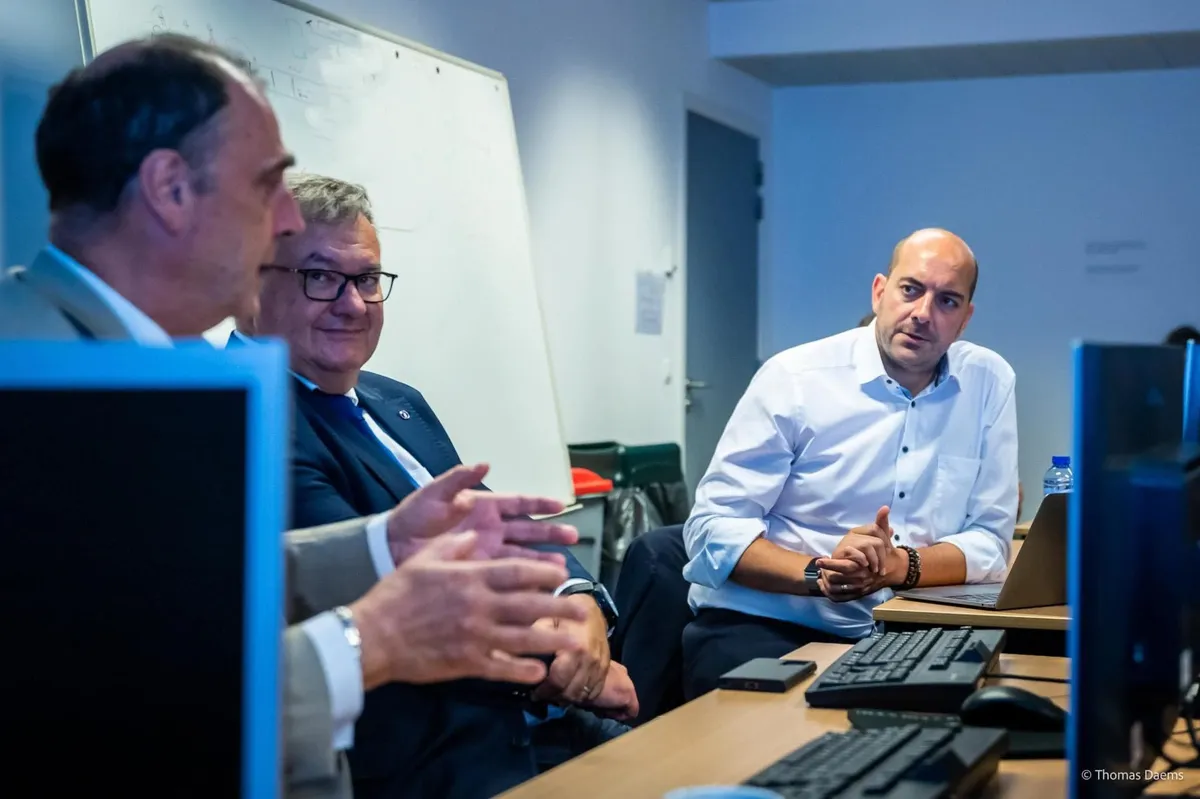
Europeum's goal is to create a new revolutionary environment for interaction between enterprises and consumers in order to increase the competitiveness of the European economic space in the world. One bad thing: the new pan -European Europeum has nothing to do with a real full blockchain. From Ethereum they borrowed only the “letter” (computer code), and the “spirit” was strangled in the root. Suffice it to say that network nodes (network servers) in Europeum are not launched voluntarily (the key condition of any full blockchain!), But exclusively - by the permission of government officials and departments.
As you can see, Mark Tsuckerberg, using a decentralized open protocol of Activitypub in his Threads, acts quite as part of fashionable corporate-cleaning trends. Of course, borrowing the “letter” and emasculating the “spirit” of the full -fledged ideas of Web3 and decentralization, Threads does not bring this decentralization closer, but only increases the efficiency of operation, because under the cover of “correct” technologies, the measure of user trust increases , which means that the personal data of users will turn out with increased backwards to advertising agencies.
Nevertheless, my own conclusions about the place that Threads can and should take in our life, I will build on a completely different foundation - the foundation of pragmatism. My vision of the situation is closer to the position of ethics:
The more options, the better. The more Facebooks, telegrams and twitter, the better for the consumer. The only thing that is required of the consumer is an understanding of the essence of what is happening.
Threads is not a certificate of the unexpected insight of Zuckerberg, but only a new and more advanced machine to monetize private data of users.
If you have a clear understanding of why new social networks are created by people like a mask, Zuckerberg, Dorsi and Durov, and at the same time you do not experience discomfort from the feeling that the farther, the more exquisitely you will be exploited, then the Threads network (or Bluesky) should not cause you. Because in technical terms, working with these products should give more pleasure than work only with Twitter.
If an increase in the degree of operation causes you a disgust, and by nature you are religious (that is, the principles and ideals for you are more important than practical benefits), it is more reasonable, of course, to abandon all three networks - as an option, in favor of Mastodon (the only ideologically sustained in the spirit of Web3 of a social network for short messages).
Finally, if you are so cynical and not religious that you put your own creative or analytical performance above principles and ideals (like your humble servant), then you will use the network that increases the efficiency of your work as much as possible.
Today, the most pragmatic network is Twitter, so as I used this service every day in my work to search for data and plots, I will continue to use it. For the same reason, I never had an Instagram account. Not because I do not accept everything that Zuckerberg creates, but only because I do not need this network in work.