
Translated material
Completely secret and extremely harmful
About the book of Mark Harrison, not yet translated "Secret Leviathan"
All countries to one degree or another use the regime of secrecy to hide important secrets from prying eyes. However, the USSR was clearly a champion in this discipline - to great damage to the quality of its government. This conclusion was reached by British researcher Mark Harrison, the author of the book “Secret Leviathan” not yet translated into Russian. Read about her in the material of Vladimir Gelman.Starting from February 24, 2022, we were all in the face of the advancing barbarism, violence and lies. In this situation, it is extremely important to preserve at least the remnants of culture and support the values of humanism - including for the sake of the future of Russia. Therefore, the editorial office of Gorky will continue to talk about books, reminding our readers that the world remains in the world and fiction.
Mark Harrison. Secret Leviathan: Secrecy and State Capacy Under Soviet Communism. Stanford: Stanford University Press, 2023. Contents
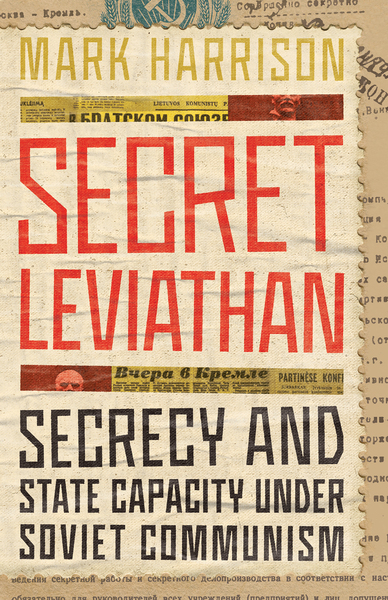 Mark Harrison -one of the most authoritative British specialists in economic history-has repeatedly turned in his studies to non-standard scientific topics, such as the study of postscribes in the Soviet economy or economic analysis of the role of suicide bombers. His new book “Secret Leviathan. The secrecy and quality of public administration under Soviet communism is devoted to the analysis of the “Secret Regime” in the Soviet Union and its influence on the Soviet economy and politics. Based on archival materials (including the archives of the KGB of the Lithuanian SSR) and other historical sources, Harrison tries to evaluate this influence from the point of view of its short -term and long -term effects, based on quantitative and qualitative evidence.
Harrison believes that the most important characteristic of Soviet public administration was its exceptional fixation on secrecy issues that distinguished the USSR from a number of other states, including authoritarian ones. Following the typology of state administration models proposed by Daron Asemoglu and James Robinson in the recent book “narrow corridor” , Harrison calls this mechanism “Secret Leviathan”. It was based on the “regime of secrecy”, that is, the totality of the rules established by the authorities and management, which limited the access of persons to secret documents, fixed the procedure for their use and distribution, and regulated the behavior of all persons related to state secrets. This “regime of secrecy” in the Soviet Union was based on the institutional conditions that the country's leadership created and supported. These included: (1) state monopoly on almost everything, including the production and distribution of information; (2) almost widespread preventive censorship; (3) the conspiratorial principles of the activities of the Communist Party since its creation; And finally, (4) the influence of special services and secret departments at all levels of state management. Although these principles were transformed over time (especially after the death of Stalin), their essence remained almost unchanged since the formation of Soviet power for many decades. Only during the period of perestroika did their revision, coincided with the collapse of the Soviet system.
Of course, secrecy in one way or another is inherent in any states. However, when its scale exceeds the optimal level, further tightening of the “secrecy regime” leads to a decrease in the quality of the state. The Soviet leadership was so feared that the loss of control over the production and dissemination of information would undermine the political system, which increased the costs associated with ensuring the “Secret Regime”: starting with the Glavlite apparatus, which totaled in the 1960s, according to Harrison, more than 70 thousand employees, and ending with the network of “first departments” in almost every organization. Indeed, information of different levels of secrecy infrequently became accessible to Soviet citizens, and its leaks abroad were sporadic. But the flip side of ensuring the “secrecy regime” in the Soviet Union was the high costs of maintaining it: an expensive and inflated apparatus of control over information was used by the state to the detriment of solving other problems. Using data on Lithuania, Harrison shows that the costs of ensuring the “secrecy regime” in the post -Stalin USSR (he calls them “secrecy tax”) amounted to at least a third of all those costs that the Soviet intelligence agencies in the period 1954-1982. For comparison, similar costs carried by the London police in the mid-2000s were approximately 5% of all its costs, and in the British press this level of expenses was then criticized as an unacceptably high.
Speaking on the merits of the matter, then the excessive secrecy of the Soviet state also did not justify itself at all. Harrison very convincingly shows that, in particular, the widely branched network of secret informants of special services for the most part did not bring any significant information to the Soviet leadership (at least in Lithuania), helped a little in the fight against real and/or potential seditum and only increased the costs of monitoring the Soviet state over citizens. Moreover, the “regime of secrecy” supported a deeply rooted department in the Soviet state apparatus. Being multiplied by a low level of trust against the background of a high level of repression, it sharply reduced the quality of management and stimulated the leadership to value the loyalty of officials higher than their effectiveness, and the officials themselves - to minimize their risks and to the literally followed official instructions to the detriment of the results of their own work. Moreover, the rigidity of the “secrecy regime” contributed to the fact that various measures to tighten it (for example, decisions adopted by Stalin soon after the Second World War in connection with the “Klyuev -Roskin case ”) led only to failures in the Soviet state machine, but did not stimulate improving the quality of its work. Harrison illustrates these aspects, quoting the correspondence of officials on issues related to the official name of the camps in the Gulag system - how exactly they should have been indicated in the official official correspondence in order not to accidentally violate the “regime of secrecy” (discussions on this issue lasted about four years, almost until Stalin’s death). However, at the same time, attempts to mitigate the “secrecy regime” were accompanied by considerable problems. Harrison talks in detail about how the highest Soviet bureaucracy reacted to Gorbachev’s demands on disclosing the full expenses of the Soviet military budget in 1987-1989. The attempts to delay in every possible way delay the legend of the publicity of this information came a partial and incomplete disclosure of information by officials. In other words, the “regime of secrecy” in the Soviet Union was called upon at any cost to maintain political status quo, while the country's leadership deliberately sacrificed the quality of the state.
The mitigation of the “secrecy regime”, according to Harrison, became possible not only thanks to the decline and subsequent collapse of the Soviet political system, but also thanks to the development of modern information technologies, which put barriers to the state monopoly on information and widespread preliminary censorship in the Soviet Union and not only. The Secret Leviathan lost in the struggle not only with perestroika and publicity, but also with the Internet, mobile communications and social networks. Nevertheless, from the beginning of the 2000s, the author notes in Russia attempts to partially return the previous “regime of secrecy”, which sometimes entail even more pernicious consequences compared to the Soviet period. According to Harrison, at the beginning of the 21st century, the “Secret Leviathan” was transformed into “Leviathan of thousands of types of lies”, when the state, being unable to completely prevent information leaks, tries to drown reliable information in the sea of disinformation, which is carried out and spread under its auspices and/or with its consent. In this regard, he relies on the concept of the “dictatorship of deception”, which was developed by Sergey Guriev and Daniel Traisman. However, the consequences of this approach become extremely detrimental, especially when it comes to external shocks like the recent pandemia of the Covid-19, to which the Russian state reacted extremely inefficiently , trying to hide the scale of incidence and excessive mortality. And judging by what is happening in Russia, especially in the past year and a half, maintaining the regime of perfect secrecy at any cost is still the priority of the Russian state, which is clearly oriented in this area (as well as in many others) to samples of the Soviet past, despite all their detriment for our country and its citizens.