
Translated material
Plastic world or nuclear war?
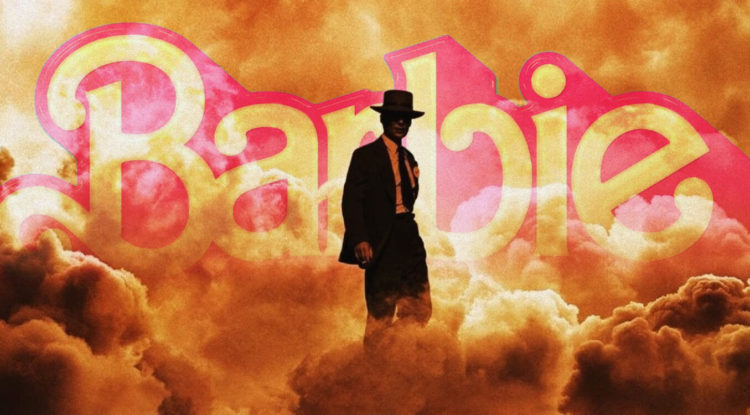
The whole world is watching Barbie and Oppenheimer in a row. Film expert Andrey Kartashov - about the phenomenon of "Barbenheimer"
The brightest event of this year in Hollywood cinema is Barbenheimer, the simultaneous release of Greta Gerwig's Barbie with Margot Robbie and Ryan Gosling and Christopher Nolan's Oppenheimer with Cillian Murphy on July 21 in the American and world (but not Russian) rentals. The first film is a pink puppet fantasy, the second is a serious biographical drama about the creator of the atomic bomb. The comical contrast between the two radically different pictures has sparked a wave of jokes and memes. Many chose to go to both movies in a row (including Quentin Tarantino and Tom Cruise, whose Mission: Impossible came out two weeks earlier); some enterprising people have started producing Barbenheimer T-shirts, and the phenomenon already has its own Wikipedia page in 16 languages. Film critic Andrey Kartashov also watched both films in a row and, at the request of Kholod, tells if there is any sense in this.
In order not to miss the main materials of "Cold", subscribe to our instagram and telegram .
In the jargon of film distributors, this technique is called counter-programming: the date of the premiere is set taking into account another film that comes out on the same days, but is designed for a fundamentally different target audience. It's a common strategy in Hollywood, and it's not new to Oppenheimer director Christopher Nolan either. Back in 2008, Universal released the musical Mamma Mia! day to day with The Dark Knight, the dark superhero blockbuster from Nolan and Warner Bros. The Dark Knight grossed over a billion dollars worldwide and effectively ushered in an era of comic book dominance in Hollywood; the cheerful comedy with Meryl Streep, Pierce Brosnan and ABBA songs did not open any eras, but collected 600 million. Thus, no one left offended.
No one seems to have lost at Barbenheimer either, but the current situation is more acute. After years of working with Warner Bros. Nolan fell out with the company over its digital release policy and filmed Oppenheimer at Universal. Although there is no direct confirmation of this, according to rumors , the former producers of the British decided to take revenge on him, specifically scheduling the release of one of this summer's obvious pop hits at the same time as his new film.
When asked about this in an interview, Nolan reacted nervously, albeit in correct terms. In the competition of two blockbusters on the basis of the first weekend of rental, Barbie wins with a crushing score: more than $ 300 million worldwide (the best start of this year!) Against Oppenheimer's 165 million - which, however, is also a good result.
The fact that the confrontation turned into a meme increased attention to both premieres and ultimately benefited both Barbie and Oppenheimer. And Hollywood in general: thanks to the hype around films in North America, this past weekend was the most profitable for film distributors in the last four years, that is, since pre-Covid times.
The case of The Dark Knight and Mamma Mia! in 2008 did not provoke anything like the current hype, although the comparison of those two films also looks pretty funny. Why is it now that intrigues between competing studios have turned, unexpectedly for the participants themselves, into a global pop-cultural phenomenon?
On the one hand, "Barbie" and "Oppenheimer" are not just dissimilar films: they represent diametrically opposite approaches to the great American cinema, and each of them can be called a benchmark in its own way. Nolan's picture is old-fashioned Hollywood: a three-hour author's statement about real historical events, a standalone film not connected to franchises of any kind. Now there are few such films: they are too risky for studios.
Barbie, in turn, is an addition to the line of dolls that Mattel has been developing for many decades. The corporation itself, in fact, produced the film Gerwig. Franchises and adaptations of anything up to emoji are the main trend of modern Hollywood. But while feature-length films about popular children's toys are no longer an event in themselves - Mattel was inspired by the success of the Transformers and Lego movie franchises - Barbie is even more like a long commercial. The film contains whole excursions into the history of the brand and a description of its most famous puppet models.
The obvious contrast between the films is gender: daughters-mothers for girls, war games for boys, so in theory, the audience of Oppenheimer and Barbie should not overlap much. However, as Stephanie Zakarek writes in Time magazine, one of the reasons for the Barbenheimer hype was the mass migration of adult viewers and films about adult issues to streaming platforms. Because of this, the simultaneous release of two films of this caliber, interesting for adult audiences, already becomes an exceptional event in itself. In this case, as it turned out, the boundaries between "male" and "female" topics may turn out to be secondary.
A large part of Barbie is devoted to criticism of corporate capitalism and consumer society, which is unlikely to be called a purely female agenda: this was strongly emphasized by the film's trailers, where it was reported that the movie was also suitable for "those who hate" the doll itself. As for Oppenheimer, even without a trailer, it is clear why its topic concerns everyone now. Made before the Russian invasion of Ukraine and the transformation of the nuclear threat from an unlikely horror story into a topical issue, Nolan's film looks different now than it would have if it had come out three years ago. (As with Wes Anderson's Asteroid City, also released in 2023, this hit in the nerve of time can be considered a coincidence, or it can be an ominous prescience, depending on the attitude towards both authors.)
In this sense, the two premieres are not a film about physicists and a film about a toy, but statements about two of the worst inventions of the twentieth century, inherited by our time - the atomic bomb and consumerism. The girlish pink country of Barbieland and the gloomy masculine world of American politics in the 1940s border on each other and complement each other: the Barbie doll and nuclear weapons are two symbols of the same era, which is sometimes called the "era of plastic" and sometimes - "atomic". Mattel was founded in 1945, six months before the first nuclear tests shown in Oppenheimer and the bombing of Hiroshima and Nagasaki. Ecologist Tyler Austin Harper, in a column for The Washington Post, wittily combines Gerwig and Nolan's films with the theme of human impact on the environment, comparing graphs of the presence of radioactive isotopes in the atmosphere and plastic pollution on the planet (a hundred Barbies are sold every minute in the world, and sooner or later they all turn out to be in a landfill, the author recalls). While the politicians and the military were in an arms race in the middle of the 20th century, the rest enjoyed a consumer boom - and both became a threat to the world.
So the key difference between the films is not in their themes, or that one is made by a woman and the other by a man. It is in relation to this difficult past, and here the result of the comparison is unexpected. Christopher Nolan, an organically conservative director (see The Dark Knight and Dunkirk), this time exposes the sins of history, referring to the moment when humanity, in the person of its protagonist, opened Pandora's atomic box. At the same time, the director does not cease to be a conservative. This manifests itself at the level of form: Nolan, as you know, shoots on film and prefers not to use computer graphics, his stylistic decisions are quite traditional. In addition, the director, in whose filmography there is not a single interesting female character, only talks about men here. But it is in the case of Oppenheimer, Nolan's second historical film after Dunkirk, that his insight into the male world reveals the toxic nature of patriarchy (much like Scorsese does).
At the same time, for mainstream progressive icon Greta Gerwig (see “Lady Bird”), the past is primarily a nostalgic object, and the injustices and mistakes it has generated can be corrected. Her critique of patriarchal capitalism comes directly from within the capitalist system (the Warner Bros., Discovery conglomerate and Mattel, Inc.). Jokes about male businessmen who trade in the idea of female emancipation cannot help but sound hypocritical in a film that, whatever one may say, helps male businessmen trade in the idea of female emancipation. Gerwig's film is witty about the inner workings of his world, but when the characters start talking about feminism, their speeches sound like empty declarations - no matter how true and important thoughts they utter. Barbie tries to please everyone like a gold coin, and her sunny optimism seems to suggest that patriarchal and unjust capitalism can be remade into unpatriarchal and just.
Not surprisingly, the main question in Barbenheimer discussions is which movie to watch first in a double screening? Perhaps it is a matter of political views and a penchant for utopian or dystopian views. Depending on this choice, Barbenheimer's day could have two endings: Nolan wins an atomic war, Gerwig wins a plastic world.
The opinion of the author may not coincide with the opinion of the editors.