
Translated material
We ourselves will manage. There is no more private property in Russia
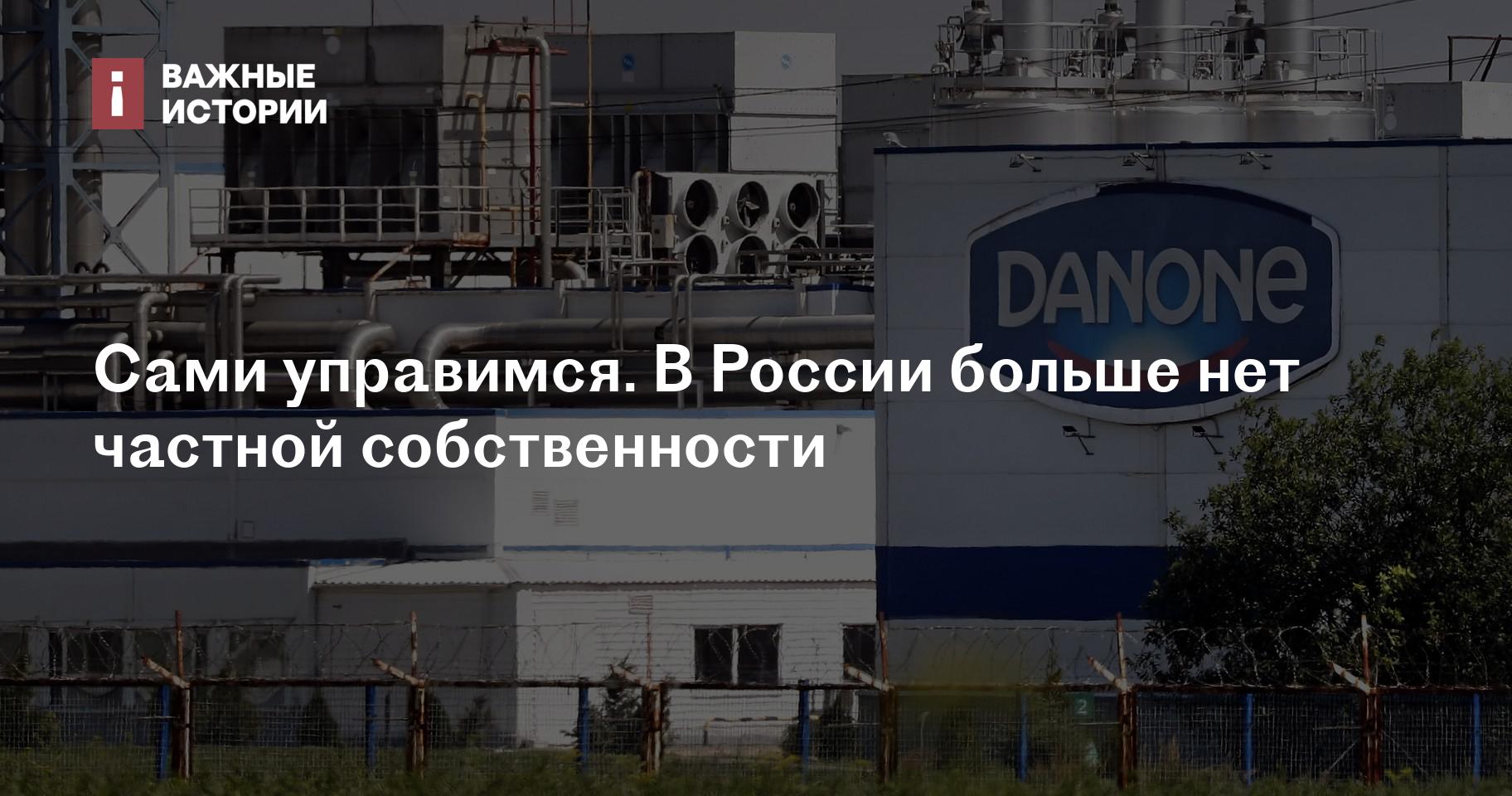
Formally, what happened with the Baltic and the assets of Danone (Danon Russia) is not nationalization, but the introduction of temporary management. Vladimir Putin created this opportunity at the end of April with his decree . Then the Federal Property Management Agency was transferred to the Unipr and Fortum energy companies, the daughters of the German Uniper and the Finnish Fortum. The list could be replenished that the president made a new decree on Sunday, July 16.
In principle, this is normal practice. It is used, for example, when the company falls into a difficult position or for some other reasons can stop working, but it is important and does not want to allow this. Last year, Germany introduced external management in Gazprom and Rosneft's subsidiaries (the authorities noticed an attempt to change the owner of Gazprom Germania, which for owners of critical infrastructure - and the company also owned underground gas storage facilities - must be coordinated). It is difficult to call this an anti-Russian measure: a few months later, Germany nationalized the German Uniper, which suffered billionths due to gas jump prices.
In Russian conditions, external management is actually nationalization. The owner does not change, but nothing can do with his property.
❌ Manage. According to the April Decree, the manager has the right to replace the leadership (which in all cases was immediately done).
❌ receive income. Owners from the "unfriendly" countries (and a decree issued about them) cannot receive dividends or interest on loans - they are credited to special accounts of the type "C", from where they cannot be taken away.
❌ Sell. For this, the permission of the authorities is necessary.
The decree explicitly says: the Federal Property Management Agency exercises the powers of the property owner, which is managed, with the exception of the disposal. And the expenses of temporary management are taken from the income that the selected property brings.
So the owners can only observe how Russia controls their assets, and hope that one day it will stop. In the decree, by the way, it is written when exactly: when Putin decides (temporary management stops by decision of the president).
This is not an answer
And what, in fact, happened? You might think that in Russia they have never taken anything. Nevertheless, the story with the Baltic and Danone is fundamentally different from what happened earlier.
Until now, Russia has justified all its actions by the fact that it did the same with it. The fact that sanctions and freezing of assets became a reaction to an unleashed war, of course, falls: you hit - we answered. You froze our reserves, and we are your investments. “Important stories” talked about how Russia robs foreigners (the authorities like to tell how the harmful West robs Russia), but all measures are fed into this approach.
It is often formal. As the gas war showed last summer, Germany was not in vain worried about the stability of supplies to the Gazprom daughter (and Gazprom Germania, among other things, owned underground gas storages). The threat of energy security by Fortum and Juniper was completely unobvious. At least before the transmission of the Federal Property Management Agency, they stably gave energy to all consumers.
We can approve the sale, we can not, but we can introduce external management. There are no formal criteria - the ideal situation for redistribution
Nevertheless, their nationalization could be issued for a response measure. You can blame Russia that both companies were headed by people of influential Igor Sechin - there are almost no other personnel left. In the energy sector, there will be either the man Sechin, or Alexei Miller (Gazprom), or Nikolai Tokarev (Transneft) or one of Putin's friends. Finally, both Uniper and Fortum are state -owned companies.
Private Baltic with Danone cannot be summed up under a response measure. If they took which bank, as the VTB President Andrei Kostin offers (““ Banks were taken from us, and they need to take the banks, “reset” the topic ”), it would be possible to understand. The decree explicitly says: assets can be transferred to the management if the property of Russia, its companies or citizens (or even such a threat) or a threat of defense or national, economic, energy or any other security can be removed. What threatened the large (second largest), but still one of many, the brewing company, which the Danish Carlsberg has almost sold (it remained to receive the approval of the government commission)? Or Danone, the largest milk processor. The company stopped investment, but regularly produced yogurts and other cottage cheese. She announced that she would transfer the business (to whom it was not disclosed) and leave the Russian market (and he was the fourth largest for the United States, native France and China - 6% of global sales). Infoline CEO Ivan Fedyakov called her decision by impact on retailers (with the departure of promoted brands, they will earn less), but good for consumers. Somehow not very scary.
This is a hand who needs a hand
But sometimes I want to take a good asset to my hands. Or give him in good hands. Whose ones, one can judge by the person who is appointed as the leader-so businessmen controlled the state-owned companies in the “dashing 90s” (the most striking example is Boris Berezovsky).
The director of the Baltic was appointed Taimuraz Bolloev, who led the company for many years, who worked in it back in Soviet times. He led the Baltic to success in the 90s and well acquainted with Putin: he oversaw the privatization of the Baltic. In 2009–2011, Bolloev led the Olympstroy State Corporation, which built facilities for the Sochi Olympics. He has a joint business with Yuri Kovalchuk, together with Putin and Arkady Rotenberg Bolloev enters the leadership of the Javara-Neva sports club. In general, your person.
Until now, Russia has justified all its actions by the fact that it did the same with it: you hit - we answered
The head of Danone was also a bright character-32-year-old Ibrahim Skriev, Deputy Prime Minister, Minister of Agriculture of Chechnya, nephew Ramzan Kadyrov. The Financial Times claims that the company could be headed by the man Dmitry Patrushev, the Federal Minister of Agriculture and the son of the Secretary of the Council of People's Commissars, but did not work out.
After Buchi, Kramatorsk, Kakhovka and everything else, Russia does not give a damn about the reputation that they think about it in the West (and it will not offend the Chinese and Indians). But still this is a transition to the next level. It is one thing - not to give investors to withdraw money or to rip it off at the same time like a sticky. And quite another - just select assets and distribute them to the right people.
The redistribution began
But maybe this is just a special case, but we just don’t know what Danone and Carlsberg “guilty”? Everything suggests that this is the beginning of a large redistribution of property. Russia has become "absolutely unsafe" for foreign investors, the EU foreign policy service said .
There are other examples. The Financial Times quotes the story of a person who helped a foreign company sell two plants: enterprises and applications were identical, but one was approved, and the other was not, because Prime Minister Mikhail Mishustin “already had a buyer for the second plant”.
A classic situation of uncertainty has been created. We can approve the sale, we can not, but we can introduce external management. What does it depend on? There are no formal criteria - the ideal situation for redistribution.
After Prigozhinsky rebellion, the purchase of elite loyalty will be more expensive, but where to get funds for this?
The approach of the authorities was explained by the official “Rossiy Gazeta” by the Deputy Prime Minister and the head of the Ministry of Industry and Trade Denis Manturov: there are normal and “unscrupulous companies”. The former said that they were leaving (and they gave them) or continue to work as usual (and they are not touched). And "unscrupulous" stop production or turn investment programs. It seems that this is the main stimulus: in the latter case, the profit is extracted, but the company is declining, which forces new owners to invest their own funds, sets out the RG position of Manturov and gives a quote: “Our economy and our citizens should not suffer from the actions of unscrupulous owners, so in such cases we will actively involve the mechanism of introduction of external management”.
Support for independent journalism your donation will help us and continue to tell the truth - we do not obey censorship to supportMany companies work just like that: they stopped investing in advertising ( there are no foreign companies among the largest advertisers on TV), we canceled investment projects (the already begun can end). For Western companies, this is an acceptable compromise: we continue to work for humanitarian reasons, but investments in the aggressor country were frozen. So there are plenty of excavation candidates.
“There is no system in who receives permission to sell, albeit with a very large discount, and who just loses everything,” gives the opinion of another consultant to withdraw a foreign company from Russia. “The only thing that matters is whether someone close to Putin wants to get an asset.”
If he wants, the asset must be in perfect condition - do not invest his money!
To be continued
Manturov said so. The business understood: the concept has changed. Until now, the Kremlin’s approach has been like that, says FT one of the consultants: they want to leave - let them pay good compensation and leave; Now the approach is different - “Why pay? Let's just take it! "
All logic pushed to this. It has long been clear that the war is for a long time, there is nothing to even dream of lifting sanctions, the economy is ahead of the problem (the restoration phase of development as a whole was completed, and warned the Central Bank on Friday). After Prigozhinsky rebellion, the purchase of elite loyalty will be more expensive, but where to get funds for this? Gosakas, which are used to cutting, will not grow much: the budget is not rubber. Sooner or later, redistribution should begin.
The authorities are no longer counting on anything. And if so, you can drop the masks: there is no property in Russia
The starting redistribution over time will spread to its current participants. When they deal with Western companies (one will give away, others will begin to invest in development, the third will take away assets from the third), and things in the economy will go worse (otherwise there can be no surrounding and lined with sanctions to the country), the question of the source for buying loyalty will arise again. And the appetite of friends and other people important for the system will have to be satisfied.
The end of private property
And a couple more conclusions from this story.
It is almost impossible for foreign companies to leave Russia. There is no road back, who did not have time - he was late. The choice is also difficult: a 50% discount no longer seems to be a big problem, a 10% contribution to the budget (that is, for war) is no longer acceptable for everyone, and now the compromise scheme “work, but we do not invest” is fraught with the fact that the business will simply be taken away. Negotiations on the sale of a business with a gun at the temple is impossible.
Subscribe to our mailing rooms we will send you only important storiesThey will take it away because they can. They will take it away because the owner of the "dishonesty" leads his business. They will take it away because not only does not spit on a reputation, but also the hope of restoring it is lost, attract or at least keep investors, their money, technology and experience. The authorities are no longer counting on anything.
And if so, you can drop the masks: in Russia there is no property. There is such a concept, there is an article in the Constitution, but no property is. Entrepreneurs, even the so -called oligarchs formally - the owners of their business, but in fact - temporary managers. Oleg Deripaska was the first to say this out loud back in 2007. They are “appointed” by the owners, but can be replaced. The price of ownership was explained by the technocracy mayor Sergei Sobyanin after the “ night of the long buckets ” in 2016: “You can’t hide behind the property about property acquired clearly with crazy.” The Russians temporarily manage their property. In January, the speaker of the Duma Vyacheslav Volodin proposed taking the property from the "villains-emigrants." It didn’t happen and is unlikely to happen - but they can!
It was clear for a long time, but now the last line has been taken: foreign investors. Those whom Russia until recently called with all its might. For whom their countries can stand up (now they are all “unfriendly”). Now foreign owners are also not quite owners. And this was the end of the Institute of Private Property in Russia.