
Translated material
"There is nothing left there"
A monument to the Poles - victims of political repression disappeared in the Levashov Memorial cemetery in St. Petersburg in St. Petersburg
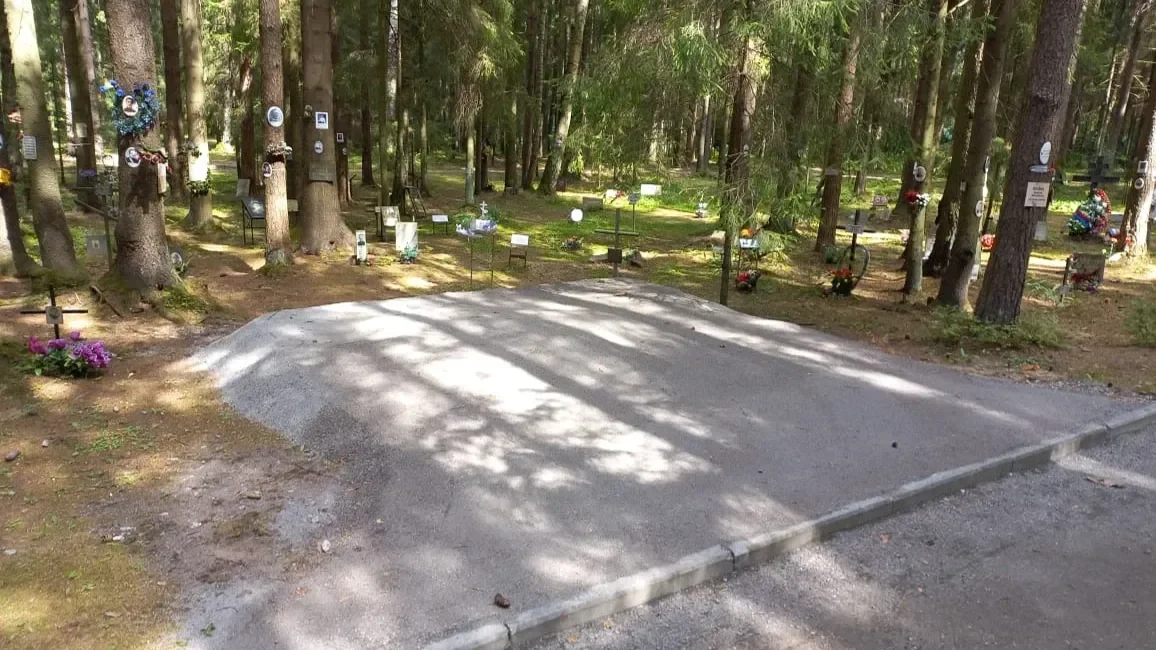
The place where the monument was repressed Poles, July 23, 2023. Photos provided by Anatoly Razumov
The versions of the disappearance put forward by the administration of the cemetery and the government of the city are equally absurd and dubious. However, they still do not coincide. The Polish side does not believe any of the explanations and directed the official note of the Russian Foreign Ministry.
Help "New"
The Levashov wasteland near St. Petersburg was a firing landfill of the NKVD. In total, almost 45 thousand victims of the Stalinist repressions of different nationalities were buried on it. The Levashov memorial cemetery was recognized as such in 1989. In 2015, it acquired the status of an object of cultural heritage of regional significance.
Today it is already impossible to accurately establish when a monument to the repressed Poles disappeared in the Levashov Memorial cemetery. Presumably, this happened a few days ago, but they started talking about this only on July 22.
“Last Saturday at the Levashovsky cemetery, members of the Orthodox Society received guests from Belarus, and I received a photo of an empty place instead of a Polish monument from them,” said Anatoly Razumov, head of the Returned Library (RND), the head of the “returned names” center at the Russian National Library (RND).
The media reported the incident. The news also reached the Polish consulate in St. Petersburg, consular workers immediately left for the scene. But on the weekend, neither the diplomats nor the journalists managed to hear the explanations either from the administration of the cemetery, nor from the Smolny, nor from the St. Petersburg parliament.
By the evening of July 23, members of the human rights Council of St. Petersburg sent an appeal to the governor of the city Alexander Beglov and the chairman of the local legislative assembly Alexander Belsky. This document briefly sets out the history of the monument:
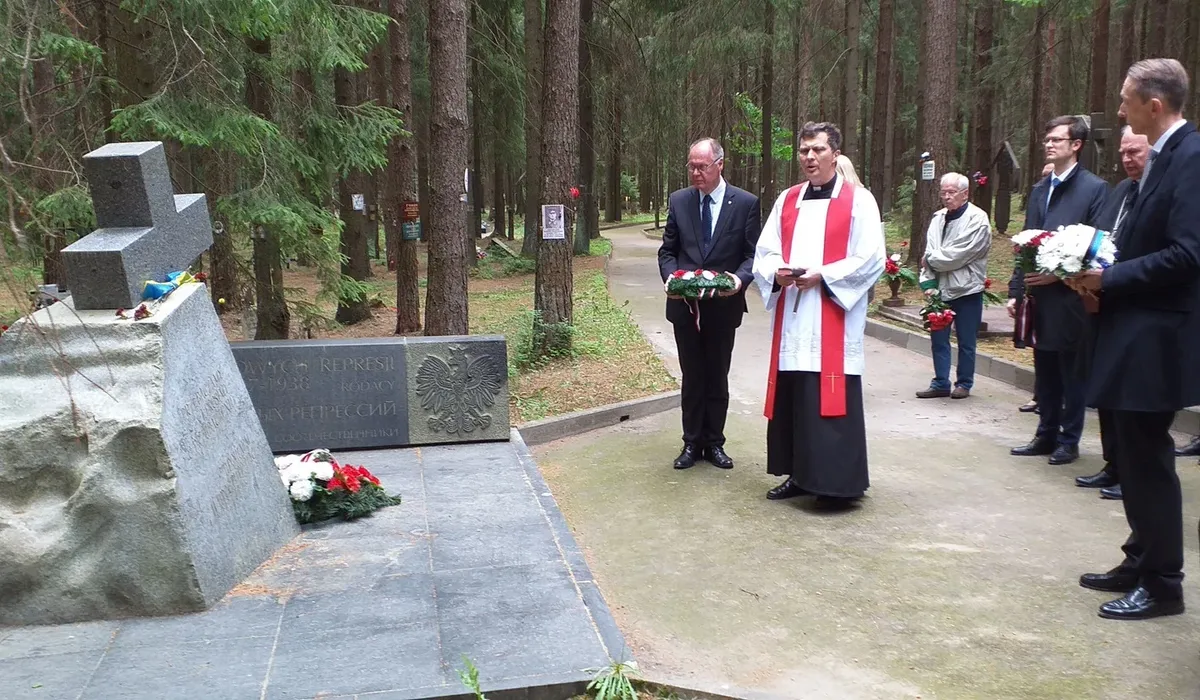
“For a year and a half of the Great Stalinist terror in 1937-1938, several thousand people were shot in Leningrad in Leningrad with the name“ Poles ”. In memory of the dead Poles, a member of the city society "Polonia" Leon Leonovich Piskorsky decided to erect a monument. The Piskorsky was a patriot of our city, helped Daniil Granin and Ales Adamovich collect materials for the "Blockade Book". According to Piskorsky’s plan, the monument should have been erected in the center of the cemetery simultaneously with the Russian Orthodox ... On the day of memory of the victims of political repressions on October 30, 1993, both monuments were opened and consecrated in Orthodox and Catholic rites. Words in Polish are engraved on Polish stone and in Russian "forgive and forgive us."
And now the Russian Orthodox monument remained lonely, Polish is dismantled. As the heads of legislative and executive branch, you are most responsible for what is happening in St. Petersburg, - Remember Rights and Belsky human rights activists. - Please answer the questions: who was given a written or oral order to dismantle the Polish monument in the Levashov Memorial cemetery? Who fulfilled this decision? Where are the parts of the dismantled monument? "
By the evening of July 24, human rights activists received no answers (neither oral nor written).
Meanwhile, around midnight on July 24, Petersburg TASS correspondents with reference to their own sources in Smolny reported that the information published in some media reached Beglov and worried him.
“The governor gave the relevant committees an order to understand ... During the trial, it was established that the memorial sign became the object of the attack of the vandals. After studying the injuries received, it was decided to send him for restoration, ”the agency’s own source in Smolny said.
The “new”, like many other St. Petersburg media, could not receive comments in the city government about the fate of the Polish monument during the day on July 24. And the version of the tricks of vandals initially caused distrust. Firstly, contrary to the usual about the monstrous act of vandalism in the Levashov cemetery, neither law enforcement agencies nor vigilant Petersburgers still reported. Secondly, the very place where the Polish monument was located, neatly cleaned, testified to the planned dismantling rather than about someone's barbaric trick.
“This was not done by vandals,” Anatoly Razumov is sure. - I have a working hypothesis who could do this and how everything happened. But since the hypothesis is undercame, I can’t talk about it. There is nothing new in this incident. In general, it fits into the general picture today, although this is too egregious, too prominent place, too significant a monument. But the story itself is not new and this year is no longer the first.
The disappeared monument to the repressed Poles really continued the series of such incidents in the northwestern region. So, back in January, at the Krasny Bor memorial cemetery in the Prionezhsky district (19 km from Petrozavodsk), members of the Polish delegation led by the Poland ambassador to the Russian Federation Kshishtof Kraevsky discovered a destroyed Catholic cross. The responsibility for the destroyed memory sign was then also assigned to the vandals. In July, a memorial plaque in honor of the Poles - prisoners of the Shlisselburg fortress was removed from the wall of the fortress "Oreshka". The authorities were justified by the fact that the board "needs restoration." In February, the words “eternal memory of Ukrainians who were innocently killed” disappeared into the same Levashovsky cemetery from the monument to the repressed Ukrainians.
“In the case of the Ukrainian monument, they similarly motivated: the monument needs repairs, we will carry it out and return everything to its place,” says Anatoly Razumov. - As a result, the monument to the repressed Ukrainians was covered for repairs, and it is so far. And thank God! Let it stand better, until other times ...
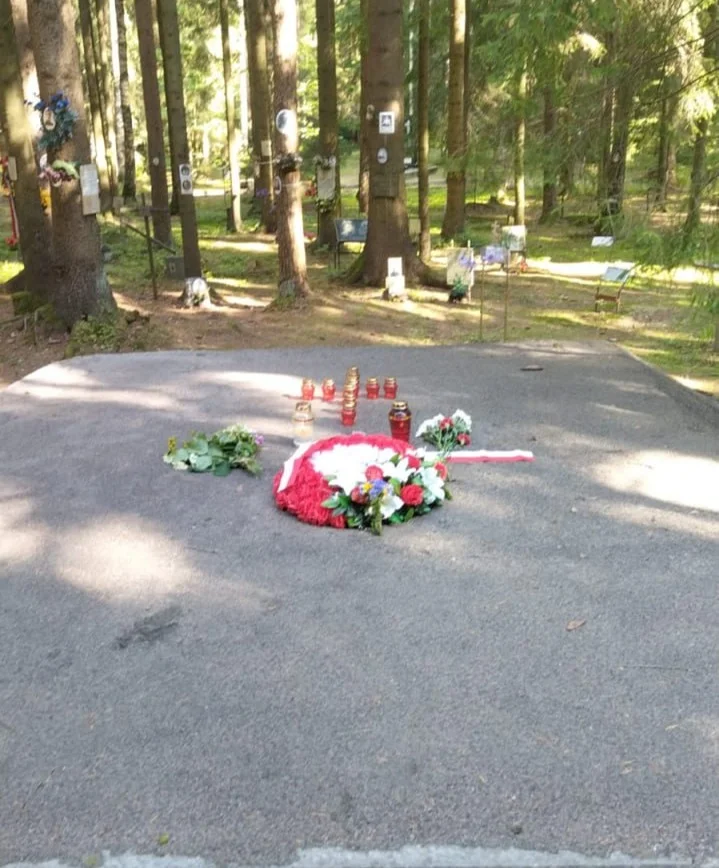
On July 24, the Consul General of Poland in St. Petersburg Grzegozh Slyubovski and his colleagues again arrived at the Levashov Memorial cemetery in order to lay flowers in the place of the disappeared memorial. On Monday, diplomats were able to talk with the administration of the cemetery.
“The leaders explained to me that the monument was taken to restoration, since a tree fell on it,” said the “new” Grzegozh Slyubovski. “But this is very strange.” If even the tree fell on the stove or on the cross and something damaged there, then why did they remove everything? Absolutely everything! After all, there is nothing left there. In addition, there is no picture that some kind of tree or something else damaged a monument.
At the same time, other versions sound. The fact that it was done by some vandals. But I do not believe in all this. I think they just removed the monument - and that’s it. So decided. Who made such a decision, I do not know. Will the monument return and when? I don't know too.
I personally do not believe that the monument is still intact. I think he was destroyed. But let's see ... At the same time, I am pleasantly surprised that in Russia there are so many people who are interested in this situation, they say that this is very bad, we now hear a lot of words of support from different places. This is good, because it is our common story. People who died and lie in the Levashov cemetery are victims of the Stalinist repressions, they are Poles by nationality, but citizens of the Soviet Union. This is our common story. I don’t know why she should be forgotten now?
On July 24, the Consulate General of Poland in St. Petersburg sent an official note to the Russian Foreign Ministry. The terms of its consideration are not established.
On the same day, the deputy of the St. Petersburg Legislative Assembly Boris Vishnevsky sent the appeal to the vice-governor of the city Boris Piotrovsky and the head of the Main Directorate of the Ministry of Internal Affairs in St. Petersburg and the Leningrad region to Roman Plugin. At the head of the regional policeman, the parliamentarian asks where photographs confirming the act of vandalism have been instituted by a criminal case of vandalism? And if not, then the deputy demands to excite, find a monument and return it back.
“What were these damage that did not make it possible to restore the monument on the spot or take the damaged part? - Vishnevsky is interested in Piotrovsky. - They turned out to be so serious that they had to remove the whole monument (multi -ton structure) and at the same time tear the floor tiles, clean everything to a flat site, leaving an empty place? ”
Late in the evening of July 24, Piotrovsky promised Vishnevsky to hurry with an answer. A few minutes later, the vice-governor’s press service extended the official comment of Smolny:
“One of the monuments erected at the Levashov cemetery was poured. Restoration was required. As has already been said, we are not fighting with monuments, but retain them. What, unfortunately, cannot be said about our former brothers in arms ... They are forced to recall that since 1997, about 450 monuments to Soviet soldiers - liberators of Poland have been demolished in 1997 ... Among the most significant losses, the gratitude of the Soviet Army in the Scary Warsaw Park. Of course, in our city, like in Poland, there are scoundrels for whom there is nothing saint. It is important to distinguish an isolated case from a deliberate and purposeful policy to destroy historical truth. ”
Thus, by the end of the day of July 24, the government of St. Petersburg insisted that the vandals with paint were to blame for the dismantling of the monument, and the administration of the cemetery insisted - the fallen tree. As a result, two versions brought to the same director of the Levashovsky memorial cemetery Valery Artemenko, who on the evening of Monday, correspondents of the telegram channel "Rotonda" phoned:
“At first, there was smeared with paint or some other garbage. I don’t know who did this - we, too, cannot run away ten hectares. And then a dry tree fell in us - and directly onto the cross. The dryer fell. We have a forest here. And it turned out such a nonsense, ”Artemenko cut off the conversation, referring to the fact that he was driving and he had no time.
“I think, a few more versions with links to any sources will soon appear,” Anatoly Razumov suggests. - It doesn’t matter what the officials say now. The main thing: by October 30 - to the day of memory of the victims of political repression - the monument should be restored. In addition, on this day it will turn exactly 30 years since the two monuments to the victims of repression - Russian and Polish were erected and consecrated at the Levashov cemetery.