
Translated material
We choose elections. Is it better to vote for fellow countrymen or like-minded people?
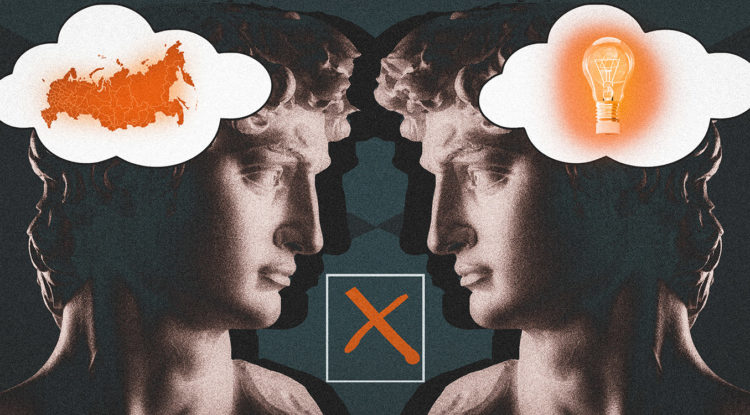
Political scientist Grigory Golosov on how representation works
Leading Russian political scientist Grigory Golosov continues a series of scientific articles in Kholod about what Russia can be like after Putin. In the previous text , he started, and now develops a conversation about elections: what they can be and what they should be. Which system is better: majority or proportional? What is more important: the candidate's belonging to the territory or his ideas? Of course, there are no unequivocal answers to these questions, otherwise everyone would do it exactly as best, but each of the systems has advantages and disadvantages. Golosov writes about them today.
In order not to miss the main materials of "Cold", subscribe to our instagram and telegram .
In a previous article, I wrote that the ability to vote "for specific people" is not a merit of majoritarian rules.
Briefly about what is the majority system
Majoritarian electoral system - a system of elections to state authorities and local governments (parliament, council, and so on), arranged according to the territorial principle, that is, in which candidates who receive the majority of votes in their constituency are considered elected.
The opinion of the author may not coincide with the opinion of the editors.
However, they have their advantages - just like the main alternative - the proportional system. If someone says that one of these two types of electoral rules is fundamentally better than the other, then you should not believe him. They are not better or worse than each other, just different. This is because each of them has its own philosophy of representation.
“Mirror representation”: women represent women, minorities represent minorities
By and large, there are only three philosophies of representation. The first is the so-called mirror representation. It is not taken out as a separate type of electoral systems, since it can be taken into account when designing systems of both main types. This philosophy is that the elected servants of the people should be like the voters in some important way. Clearly, this is not about redheads representing redheads. As important parameters, two are usually considered: gender and nationality (sometimes religious, but in many contexts it coincides with ethnicity).
The principle of "mirror representation" was widely practiced in fictitious non-competitive elections in authoritarian party-type regimes, both communist and some others. There were many women in the Supreme Soviet of the USSR, representatives of nations and nationalities, as well as workers and peasants, sat in large numbers. In liberal democracies, bonuses for workers and peasants are not practiced, but examples with women and nations are quite. Usually "mirror representation" is used when the legislator simply wants to ensure the presence of women or ethnic/racial/religious minorities in parliament. Less often, but there is another motivation: to ensure the "sharing of power" between ethnic groups in accordance with their shares in the country's population. Such a system has long been practiced, for example, in Lebanon, where, however, it led to the most deplorable consequences (in Lebanon, conflicts regularly erupt between right-wing Christian forces, the Shiite movements Amal and Hezbollah and the state army. - Note "Cold ").
Both under majoritarian and proportional rules, “mirror” can be ensured by quotas, that is, by reserving electoral districts or shares in party lists for minorities with guarantees of their replacement in accordance with legally established quotas. The proportional system does this better because it provides more and more varied quota options. There is a scientifically established positive relationship between the level of female representation and the use of a proportional system. With the representation of ethnic groups, the situation is a little more complicated, but even here the proportional system rather wins.
The question of whether women and ethnic and other groups should be given advantages in parliamentary elections, I will not discuss. There is a common-sense logic that women will represent women better, tribesmen better tribesmen, and so on, and this logic can be challenged, but this debate is not worth going into here. I will only note that authoritarian regimes still have a special predilection for "mirror representation", which is considered as a kind of constructive alternative to political representation. in Rwanda for many years For example, one of the highest levels of female representation has been observed .
Territories or ideas?
The principles that underlie the two main varieties of electoral rules, majoritarian and proportional, are, respectively, territorial and ideological representation. That is, if it is quite simple, in the first case, the places are distributed among those who won, in some territories, and in the second - who has more supporters. “Ideological representation” is a term that is not generally accepted and is used in this article for brevity, so as not to repeat the cumbersome phrase “representation in accordance with the distribution of political preferences in society” every time. Since differences in political preferences find their most general expression in disagreements on ideological issues, I find the term "ideological representation" appropriate, if not entirely accurate.
It is obvious that majoritarian systems, which are usually practiced in small constituencies, rather tightly tie each deputy to the territory, that is, the constituency from which he receives his mandate. This is an undeniable advantage, since people do not live in countries in general, but in specific places, and the characteristics of these places largely determine the interests of their inhabitants.
Moreover, these interests can be of a specific nature, assuming, for example, the implementation of infrastructure projects in one's own country, and not in a neighboring district. For deputies who are guided solely by ideological considerations, the places where such projects are implemented are completely irrelevant, but for voters this is by no means an idle issue: jobs and salaries depend on it. There is something in common with "mirror representation", but the difference is that the deputy does not have to be like the majority of the inhabitants of the territory or even settle there. Enough to take care of the interests of its population.
This advantage of majority systems is obvious and, in my opinion, does not need further justification. True, not all systems of this type provide it. There are majoritarian systems used in very large multi-member districts, and the larger the territory of the district and the number of deputies elected in it, the more the territorial principle of representation is blurred.
What is the vulnerability of the majority system?
Sometimes majoritarian elections in multi-member constituencies are quite deliberately used to provide an unreasonable advantage to one or another political force; sometimes - in order to introduce an element of ideological representation into the majority system (but this is achievable only when the voter does not have the opportunity to vote for several candidates at once); however, most often - for a simple technical reason. Namely, it is difficult to use single-mandate constituencies in elections in small municipalities, because the creation of numerous constituencies in such elections is a game that is not worth the candle. There will be more members of election commissions, observers and candidates than voters.
The paradox of electoral systems is that it is impossible to improve them simultaneously on both parameters of representation, territorial and ideological. By providing territorial representation, majoritarian systems can give very serious deviations from the adequate expression of the political preferences of citizens. The main potential source of failure is the peculiarities of the distribution of political preferences of citizens between territories.
Suppose that in a country that uses a plurality system in single-member districts, one of the parties enjoys the support of 30% of the voters in each of the districts, but at the same time in none of them the main opposition party can exceed this figure. Then the leading party will win the elections in all districts and we will have a one-party parliament, which in reality will represent the preferences of less than a third of the population.
Big ones get bigger
As a matter of fact, this mechanism is quite widely used in modern Russian elections, so that the share of United Russia deputies elected in districts systematically exceeds the share of United Russia members elected on party lists. However, it must be emphasized that such a mechanism for distorting citizens' preferences does not in itself depend on the political regime. It is determined by the features of the majority system as such.
This is evidenced by numerous episodes in the history of liberal democracies, when parties lost elections in votes, but won them in seats and, as a result, came to power. There have been several such cases in post-war British history. The US presidential election is a less obvious example, but it must be remembered that the American president is not elected directly, but by an assembly formed according to majoritarian rules, an electoral college. It was these rules that ensured the victory of Donald Trump in the 2016 elections.
However, such profound distortions of the will of the national electorate do not occur often. The main - and much more common - drawback of the majority system is that it provides an unjustified advantage to the leading large parties, which enjoy equal support throughout the country. It suffers the most from large parties, which, even if their average level of support is high, enjoy this support unevenly across districts, and especially the middle-sized parties with even support, for which the majoritarian system can be literally murderous. On the other hand, very small parties successfully survive, enjoying success in one or two districts. These districts are assigned to them almost forever. This is what happens in India.
If there are no features that give rise to the paradoxes described here, then the majority system can do an excellent job of ideological representation. But there is no way to guarantee the absence of such paradoxes through legislation. They arise as a result of changes in the party system, and in a democracy it develops more or less spontaneously. If it exists and functions normally, then the majority system does not give any particular distortions. The problem is that underdeveloped party systems, such as those found in new democracies, never function quite well. It takes time to normalize their effects.
How should it be in Russia?
This directly concerns the prospects for democratization in Russia. It is clear that in the process of change, the current party system will change dramatically. It is possible that nothing will remain of it at all and everything will have to be started anew. With majoritarian rules, party formation itself will be a difficult process, because politicians with significant political resources on the ground will not have much need to shoulder the burden of party obligations and discipline. There is an opinion that I share: if Russia had not introduced an electoral system with a serious proportional element in 1993, then there would not have been any parties in the country, except for the communist one. In Ukraine and some other post-Soviet countries, in fact, this was the case before the introduction of proportional or mixed systems.
Without a functioning party system, the normal operation of democratic institutions is difficult, and if we talk about the parliamentary system (which, as I understand it, enjoys special sympathy for the Russian opposition), it is simply impossible. If we take into account both the paradoxes of representation generated by the majoritarian system and the fact that it does not contribute to the development of the party system, it should be concluded that the option with exclusively majoritarian rules should not be on the agenda when choosing an electoral system for the lower house of parliament. However, it would be appropriate to elect the upper house of parliament, which will replace the current Federation Council, according to majoritarian rules, because the task of this chamber is to ensure territorial representation.