
Translated material
"To protest in Azerbaijan would be suicide"
"To protest in Azerbaijan would be suicide"
Azerbaijani activist and researcher about why there are no anti -war protests in their country, and society supports militarism
On January 25, 2024, Doxa was recognized as an “unwanted organization”.
If you are in Russia or plan to return to it, you can not replace our materials on social networks, refer to them and publish quotes.
Read more about what is possible and impossible, read in the cards .
Azerbaijan has been participating in the Karabakh conflict for more than thirty years. During this time, two bloody wars and countless shootings on the borders took place, and right now people who call themselves “eco-activists” from Azerbaijan are blocking the unrecognized Nagorno-Karabakh Republic. The world community condemns the blockade in the same way as in previous years condemned clashes between the parties. At the same time, in Azerbaijan itself, people opposing escalation are almost inaudible, and there are no anti -war protests at all. DOXA decided to figure out why this is happening, and talked with the researcher and anti -war assets from Azerbaijan about repression, promotion of hatred and attempts to talk about peace.
Editor
Editor
Anton DuanelIllustrator
Illustrator
Alice YastrebovaPublication
April 7, 2023
What is the essence of the conflict in Karabakh?
Nagorno -Karabakh was inhabited mainly by Armenians, but in Soviet times this region was part of the Azerbaijan SSR and had the status of an autonomous region. In the 1980s, the Armenians living in Nagorno-Karabakh accused the Azer SSR government of discrimination on an ethnic basis, as well as collected signatures and arranged rallies for the autonomous region to join the Armenian SSR. This led to an acute conflict between representatives of the two peoples, during which riots, pogroms and mutual expulsion of the population from the republics [Armenian and Azerbaijani] took place.
In 1992, the conflict grew into a bloody war, which was accompanied by mutual ethnic purges and military crimes. The first Karabakh war ended in 1994 by announcing the ceasefire. The Armenian side took control of almost the entire territory of the former Nagorno-Karabakh autonomous region, as well as significant lands around it. The Nagorno-Karabakh Republic was formed on the site of the former autonomous region, and the Azerbaijani population living in the region was forced to flee to Azerbaijan.
The conflict was frozen, but on the contact line regularly, shootings took place, periodically growing into full -fledged fighting, which led to the death of people on both sides.
“I was told that if I am not a supporter of nationalism, then I better leave.” How in Azerbaijan they react to pacifism
At the end of September 2020, Azerbaijan began hostilities in Nagorno -Karabakh, which later became known as the Second Karabakh war. Despite the announcement of partial mobilization and a large number of dead According to various sources, the losses of Azerbaijan for 44 days of the war amounted to from 2908 to 7630 people who died. The support of hostilities in Azerbaijan was incredibly high.
The capture of the Azerbaijani army of each settlement was accompanied by thousands of folk festivities in the yards and on the central streets of cities. People rejoiced at revenge for defeat in the First Karabakh war.
The fighting against the Nagorno-Karabakh Republic exalted all major political figures, even the leaders of the opposition parties, which were previously subjected to repression
Anti -war protests were not carried out, and people who publicly opposed the hostilities were subjected to persecution. Even the most uncompromising opponents of President Ilham Aliyev had to abandon any protest rally.
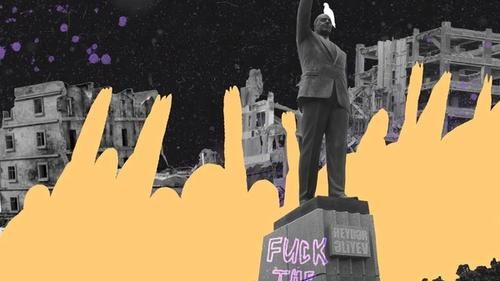
Among these are the anarchist Giya Ibrahimov, who became famous for the fact that in 2016 he painted protest graffiti on the monument to Heydar Aliyev, ex-president of Azerbaijan and the father of the current head of state. For this action, the Giyas served 3 years in prison on false accusations of drug storage, and when he went out, did not stop his protest activities and arranged single pickets against the actions of the authorities. However, against the Second Karabakh war, he did not hold a single street action. According to him, this was simply impossible, since society negatively reacted to any manifestations of pacifism and it would be attacked not even by police, but an ordinary resident.
The gyuas publicly opposed the Second Karabakh war: together with the left activist_ki, he signed a joint anti -war statement and actively spoke out on social networks. For this, he was called to the Prosecutor General for an educational conversation.
“I was told that if I am not a supporter of nationalism, then I better leave, hinting that I, like me, have no place in a society united by the idea of war,” says Giya.
And indeed, soon the Giyas became the object of persecution. On the Internet, he regularly wrote insults in the comments and personal messages. They called the traitor, threatened to kill for the criticism of the war. One of the ardent “patriots” even called Giyas “to disassemble”, and the activist decided to give him his address and see what would happen.
“When he came, it turned out that he himself did not know what he wanted from me, he simply could not choose a word and explain,” recalls Giya.
The activist says that the threats of people on the Internet were empty, but because of the bully, he decided to go outside as little as possible.
In general, during the Second Karabakh war, the rare voices of the opponent of war were drowning in the Revas of the mass patriotic holiday. Because of this, the impression was created that, in addition to a very small group of people, the whole country supported the fighting. However, there were those who simply did not dare to publicly express their anti-war position due to fears of persecution or repression.
Murad (the name changed) was against the war and “almost Nazi propaganda” and did not want to “die for the sake of the golden toilets of the ruling elite,” but he did not even think about protest actions or publications in social networks.
Murad Lezgin. He was sure that, in case of persecution, he would not be remembered by Azerbaijani origin, which means that not only persecution and “conversation” would have awaited him, but also an arrest with torture.
“To protest in Azerbaijan for me would be uniform suicide. In my case, the conversation would immediately go about ethnicity that I do not hide, and then I would be accused of separatism, treason and terrorism. The authorities still continue reprisals against the ethnic activists of the autochthonous peoples of the country, ”says Murad.
He has in mind repressions against the activistic minority of Azerbaijan. For example, the Talysh public figure and historian Fakhaddin Aboszoda, extradited in 2018 from Russia to Azerbaijan and sentenced to 16 years in prison for the Stateizer, died during the Second Karabakh war. The authorities claimed that he committed suicide. Shortly before his death, Abbasov said that the security forces were going to kill him. This is far from the only case. This happened with Lezgi activists .
"Our karabakh, and it is not a pity to die for him." Why are Azerbaijani society and opposition support war
Bakhruz Samedov, master of international relations and a doctoral program of political sciences at Karlov University in Prague, explains that the traditions of anti -war protests did not have in Azerbaijan. And the point is not so much that Azerbaijan is considered an authoritarian country and protest actions in it are harshly dispersed by the police, but in the last decades in Azerbaijani society there have not been a discussion of peaceful settlement.
Even the main opposition parties in Azerbaijan supported and support combat operations. If the authorities were criticized, then only for moderation or for unsuccessful foreign policy decisions. For example, when the war of 2020 was completed by the preservation of a part of the unrecognized Nagorno-Karabakh Republic and the introduction of the Russian peacekeeping contingent into the region, Aliyev was accused of not only not occupying all territories, but also let the Russian army into the country.
“The main part of the opposition in Azerbaijan is represented by people who are called ultra -right in the West. Their rhetoric is almost no different from the authorities, ”explains sociologist Sergei Rumyantsev.
He from Baku, worked for ten years at the Azerbaijani Academy of Sciences, and now lives in Berlin and is engaged in research in the field of peaceful transformation of conflicts in the Caucasus.
Like Bakhruz, Sergey is convinced that a wide anti -war movement in Azerbaijan could not appear, because neither the state nor society created an alternative to military discourse.

We talk about Russia's military invasion of Ukraine, protests and repression. We believe that now, when dozens of media have closed or ceased to cover the war, access to independent information is more important than ever.
In Azerbaijani society, including among the opposition, they saw that peace negotiations did not bring any results through the mediation of the Minsk group, because the representative of Armenia Azerbaijan refused to speak with the representatives of the Nagorno-Karabakh Republic directly so as not to legitimize the power of an unrecognized state. And Azerbaijan did not want to make concessions. At the same time, state propaganda inspired people that only the war could be returned to the lost territories. This was beneficial to the authorities of Azerbaijan, because they could write off all the problems in the country for war and consolidate society. A resident of the country wished a revenge for humiliation of the First Karabakh war.
“The authorities did everything so that the intensity of passions would not decrease, but grew. Ilham Aliyev absolutely openly at the recent Munich conference shared his “secret of success” in the war. Aliyev was not embarrassed, said that it was necessary to educate the younger generation, which will be ready to kill and die for the sake of his historical land. This is exactly what the Azerbaijani authorities did, ”Rumyantsev explains.
The sociologist says that the state machine “The production of conflict” is total and includes the education system: “History textbooks work to inspire children that Azerbaijanis are ancient Armenians, that we have historical rights to these lands.”
In addition, propaganda in education instilled in children hatred of a “historical enemy”. So, Armenians are always negatively mentioned in the Azerbaijani media, and in textbooks they are presented as a people who constantly betrays Azerbaijan_ok.
The author of the history of the history of Azerbaijan, the head of the Department of History of Slavic countries at the Baku State University Tofik Veliev believes that such a negative color creates an “accurate idea of the Armenians”.
Those who do not want to participate in the propaganda of hatred of Armenians, the risk of facing repression . So, the Azerbaijani historian Arif Yunus, who openly opposed propaganda in the education system, was accused with his wife Leila Yunus of espionage in favor of Armenia and got into prison.
Sergei Rumyantsev notes that for decades of active propaganda, they had fruit, and for this reason no one was indignant in losses in 2020. “Citizens and politicians can argue on different topics, but in one they converge:“ Our Karabakh, and it’s not a pity to die for it. ” And it is not a pity to kill people, although they do not say so openly. After all, they are not killed by people, but by enemies. The soldier has been told about the atrocities of the Armenians all his life, and he himself already comes to the conclusion that, for example, you can cut off the old man’s head, because in his eyes this is not an old man, but an Armenian. Not a man, but an enemy. Degumanization is an important component of the conflict, ”the sociologist explains.
" They lied to us too . " How a peacekeeping project destroyed the image of the enemy
The absence of anti -war protests in Azerbaijan does not mean that the outside of the peaceful settlement of the conflict did nothing. Sociologist Sergei Rumyantsev says that in the 1990s there were attempts to rethink the Karabakh problem and investigate it. And already in the 2000th, peacekeeping projects appeared, the purpose of which was to destroy the “image of the enemy” in Azerbaijan, Armenia and Nagorno -Karabakh. Such projects were most often organized by a researcher and independent journalist_ki, and initiatives at foreign funds functioned. Most often these were funds and organizations from the USA, the EU and the UK. Among the largest and most significant are International Alert, Karuna Peacebuilding Center and Crisis Management Initiative. .
Hamida Giyasbeili, Azerbaijani journalist, human rights activist and female activist, has been engaged in such projects for more than ten years.
At first she collaborated with the International Organization of Internets, which shot documentaries about the Karabakh conflict with a focus on human stories in Azerbaijan and Armenia The heroes of the films, as a rule, became refugees, forced to resettle, war veterans and people living in the conditions of the Karabakh conflict. .
“I organized the shows of these films in Azerbaijan,” says Hamida. - The audience met films warm. They finally saw the same people on the screen, and not “sworn enemies”. Documentarys allowed the people who are isolated [from each other] to see how the same people live on the other side of the front. It turned out to create empathy. "
In 2012, Hamida began to cooperate with the Imagine Center for Conflict Transformation project and began to work in Azerbaijan.
The initiative was created in 2008 as a platform on which Armenians and Azerbaijan_ki could frankly talk about the most acute topics, without hiding their feelings from each other.
Hamida helped organize meetings of Armenian and Azerbaijani youth in neutral territory, most often in Georgia.
“The most interesting for me was to conduct dialogs between Armenians and Azerbaijanis. We talked about the history of the conflict, about what events influenced relations of peoples. I saw how people who, in theory, should hate each other, found the strength to say the strength to each other in the face of everything that they feel, what problems of conflict worried them, discussed what could be done about it, ”the activist says.
According to Hamida, these meetings changed people and helped them look at the conflict in a new way. This is confirmed by one of the participants in such meetings named Arpi.
“I remember when we discussed the Sumgaiti pogrom The events of the beginning of the Karabakh conflict. In 1988, in the Azerbaijani city of Sumgait, there were mass riots on ethnic grounds. Azerbaijani pogromers killed ethnic Armenians_ok. According to various sources, from 32 to 90 people died. , one of the Azerbaijani said that the Armenians did all this themselves. I answered her: “What is the logic in this? Are you so subject to propaganda that you have no doubt about this absurdity?” After some time, it was about the Hodzhalinsky massacre Mass murder of Azerbaijan_ok Armenian troops during the assault on the city of Khojaly in 1992, in the midst of the First Karabakh war. According to various sources, from 200 to 613 people died. . I said that in Armenia it is believed that these events were organized by the Azerbaijani themselves. And then I understood the irony of the situation. In Armenia, they also lied about the conflict, ”she says.
According to Hamida, often people after these discussions did not even know how to return to their countries, where enmity reigned in relation to another people, because the image of the enemy was destroyed for them.
Sociologist Sergei Rumyantsev notes that the Imagine Center for Conflict Transformation project turned out to be successful and became a huge step forward in terms of creating a peaceful agenda.
It is not surprising that such projects were faced with great difficulties in Azerbaijan. The fact is that in 2013 the law adopted a law in which foreign donors had to receive accreditation through the Ministry of Justice and register each grant. However, foreign funds and organizations did not do this, and in response the authorities blocked their accounts in the country.
According to Hamida, this greatly influenced the development of peacekeeping projects and many had to close due to lack of funds. Around the same time, a wave of repression covered the country. They persecuted everyone who could prevent Aliyev from consolidating power and mobilize people before the next presidential election.
Hamida herself remained in Azerbaijan until 2020, but during the Second Karabakh war could not withstand the bullying and militarist euphoria and left for Georgia. However, her project lives and she continues to hold meetings of Azerbaijani and Armenian youth in Tbilisi.
"For calls to the world, I spent 29 days in a single cell." How the situation has changed after the Second Karabakh War
Despite the intensifying militaristic propaganda in Azerbaijan and the conflict in Nagorno -Karabakh, there have recently been more people who have been tired of the war.
The researcher of Bakhruz Samedov explains this by the fact that the Revenge in the First Karabakh war did not bring positive changes to the population. On the contrary, Azerbaijan invests huge funds in Karabakh: builds roads and tunnels, repairs some villages and cities. At the same time, the standard of living Azerbaijan_Ok falls. Even according to official figures , products and services prices have increased significantly, and the real picture may be much worse.
“The population cools from the emotions that played during the fighting, and [society] began to reflect that thousands of people were killed, but life did not better. They see that the power has become stronger, and the situation with human rights has worsened, ”says Bahruz.
As an example of the fact that the level of support for militarism has fallen, Bakhruz gives Azerbaijan’s attack in Armenia in September 2022 On September 2, 2022, Azerbaijan accused Armenia of armed provocation and attacked the positions of the Armenian army. Two days later, the battles ended with the occupation of a small part of the border territory of Armenia. According to official figures, 224 military and three civilians died on the Armenian side. Azerbaijan recognized the death of 80 people. . Then some public figures and representatives of the opposition parties who supported the Second Karabakh war expressed an attack on the sovereign territory of Armenia.
During the attack of Azerbaijan on Armenia, the youth movement “Democracy 1918” or “D18” was especially noted The left -centric youth organization, which illuminates social issues and deals with the rights of workers, is solidarized with trade unions and regional peaceful initiatives. The movement also condemned the continued humanitarian blockade of the Nagorno -Karabakh, accusing Ilham Aliyev of trying to tighten the Karabakh conflict. . It condemned the armed escalation, and the chairman of the Ahmed Mamedley movement openly accused Ilham Aliyev of military aggression.
“Someday Ilham Aliyev will definitely be responsible to the international court for crimes committed not only against the Azerbaijani people, but also against the Armenian people. The first task of democratic Azerbaijan will be the punishment of those who sow enmity between the peoples, ”Ahmed wrote in social networks then.
The reaction of the authorities was not long in coming. Ahmed had to fly to another country to study, but was detained in Baku. “In the city center, five police officers in civilian clothes attacked me. They forcibly put me in a civilian car. They wanted me to delete what I wrote on social networks. I refused, ”the politician recalls.
The court sentenced Ahmed to 30 days of arrest under the article on disobedience to the police. The security forces did not notify anyone about this, even Ahmed's lawyer. “In the pre -trial detention center, I was called a“ traitor to the homeland ”. For calls to the world, I spent 29 days in a single chamber. Several times I was refused the right to make a call, ”says the politician.
After Ahmed was released, he found out that the support of their movement had grown. “D18” began to create working groups that cover problems in the regions, as well as work on a peaceful agenda, which they continue to broadcast in social networks, opposing the aggressive policy of the authorities.
The movement even created a political school in which lectures and discussions on such topics as a peaceful settlement in Nagorno -Karabakh, women rights, LGBTKIA rights, feminism and green economy.
Ahmed Mamedley looks quite optimistic at the future of the anti -war agenda and peaceful initiatives in Azerbaijan, but notes that society is not yet ready for mass protests. “We need to wait for the peak of discontent of people,” he explains.
Other materials
"As if in prison, you were closed from the outside world"
Monologues of a resident of the Nagorno -Karabakh about blockade, war and independence
"We went to the border with Russia, dragged huge bags with tangerines on themselves"
How Abkhazia lives-"invisible country"

"The sound of a falling bomb is terrible - probably the end of the world sounds like that"
Interview with M., Transdevushka from Libya


Save the state, not people
Nord-Ost, Beslan: the logic and victims of imperialism in "counter-terrorism operations"


"Putin must answer for his crimes not only in Ukraine, but also in Armenia"
What is based on Russian-Armenian military cooperation and why Yerevan_ki protested against membership in the CSTO
