
Translated material
Why do you need a dream? And how much do you need to sleep to get enough sleep?

We answer the main questions about what the third of our life is spent on
“A sleeping person is not suitable for anything, he is no better than the dead,” Plato wrote . The inventor Thomas Edison compared the dream with a drug, which dumms and takes too much time. Indeed, people on average spend eight hours in a dream. But what this time takes, it is difficult for scientists to say. "Cold" says that science is known about sleep and why it is so difficult to study.
In order not to miss the main materials of the "cold", subscribe to our Instagram and telegram .
A man spends a third of his life on sleep. Why?
This is the most difficult question in the study of sleep - and scientists still do not know the answer to it. However, there are still a number of assumptions.
News, conversations with loved ones, working tasks, films and series - every day a person lets a lot of information through himself. The brain takes time to process this stream and determine what is important and what is not. The moment ideal for this is when a person is sleeping. At least, scientists from the University of Wisconsin .
In 2003, researchers Julio Tononi and Kyara Chirelli published an article that immediately caused a discussion in the scientific community. Tononi and Chirelli suggested that during sleep, when the new information does not receive, neurons have the opportunity to redistribute the load of synapses - small channels that connect the neurons with each other. Those that are used little are torn. Researchers called this process synaptic homeostasis - a kind of natural selection of neural ties. True, his mechanism has so far been not yet studied.
A number of scientists believe that a dream is needed for the body to gain strength. So, during sleep, the rate of metabolism and body temperature decreases - this can help restore energy loss during wakefulness.
And a dream helps the brain get rid of garbage-it was discovered by American scientists in the 2010s. The fact is that as a result of the work of neurons, “waste”, or metabolites are formed: beta amyloids, alpha-synucleins and tau-beam. When there are too many metabolites, they stick together and prevent the cells from cope with their duties. Because of this, the risk of developing neurodegenerative diseases increases. Alfa-synucleines are responsible for Parkinson's disease , but beta amyloids-for Alzheimer's disease .
In experiments on mice, the researchers found that during sleep glial cells - they participate in the metabolic processes of neurons and the transmission of impulses - are compressed. As a result, the space between neurons increases by 60%, and then the brain is easier to clean from metabolites-beta amyloids. This is engaged in a glymphatic system, and the principle of its operation is similar to the sewer. When the space between the neurons increases, it literally pumps fluid into the brain - and the “waste” accumulated over the period of wakefulness is washed out.
In 2019, a group of scientists led by neurobiologist Laura Lewis found a similar mechanism in people.
This list of hypotheses about the meaning of sleep is not exhausted. “There are many different theories about the biological sense of sleep. But not one is generally accepted, ”says the professor of Oxford University, co -author of the book“ Sleep under a microscope ”Vladislav Vyazovsky.
Although scientists have already accumulated a lot of data, they are still not enough. A separate problem is a research methodology. “We need to deprive a person of sleep and see what physiological parameters change depending on whether he is sleeping or awake. But from the point of view of ethics, such research is not easy, ”adds Vyazovsky.
Leonardo da Vinci slept for an hour and a half a day, Nikola Tesla - two. Is it possible?
As legends say, some people managed to take quite little time to sleep. Among the famous people - Napoleon, Salvador Dali and Thomas Edison. Journalist John O'Neill writes that Nikola Tesla was sleeping no more than two hours a night. They said about Leonardo da Vinci that he was sleeping for 15 minutes every four hours, although historical evidence could not be found .
Da Vinci could well practice one of the forms of polyphesis sleep - when there is several time to sleep instead of one period of time. The most popular practice of such a dream is a six -hour night dream, complemented by half an hour day. There are others: a 30-minute dream every six hours or 20-minute-after four.
Supporters of polyphesis sleep claim that it can improve the quality of sleep and life, help with insomnia and eliminate chronic fatigue. And productivity is also increasing: a person is awake more time, which means that he can complete more tasks. Active community is devoted to the active community into Reddit , where users share their experience.
The argumentation of supporters of polyphesis sleep is built around the fact that sleep is not a single process, but a set of several conditions that replace each other. Scientists distinguish two phases: quick sleep (REM) and slow (NREM), which is divided into several more phases (NREM1, NREM2, NREM3).
During a quick sleep, a person sees the most vivid dreams. This phase is necessary to maintain cognitive functions: memory, creativity and learning. Slow sleep is important for restoration of the body. It is usually a lot in the first half of sleep, but not all of its phases supporters of polyphesis sleep consider it necessary. They neglect the stages of NREM1 and NREM2, considering their influence insignificant.
However, scientists do not have data that would confirm that polyphase sleep has advantages over single -phase. In 2021, a report of the American National Sleep Fund was published : researchers did not find evidence confirming the benefits of polyphadic sleep for physical and mental health. On the other hand, natural restrictions do not allow you to conduct more research: it is difficult to force a person to use polyphesis sleep, if all his life he has practiced monophasic.
And how many animals sleep?
For a long time it was believed that elephants are sleeping from three to seven hours: the fact is that the observations passed behind the animals that were contained in captivity. However, the 2017 study forced scientists to reconsider the methodology. A group of scientists from Africa and the USA found out that elephants are sleeping for about two hours - and mainly at night. And they learned this in an unusual way: an analogue of a fitness tracker was placed under the skin of the trunk, which recorded information about the movement of animals. It was believed that the elephant was sleeping if the trunk was motionless for more than five minutes.
“Elephants are the most short-playing mammals, which, apparently, is connected with their large body size,” explained Professor Pol Manger from the University of Vitvatersrand, South Africa. The company is made up of other large mammals: giraffes sleep for 4.5 hours, and horses - about three. But small animals spend much more time in a dream. For example, proteins - 15 hours.
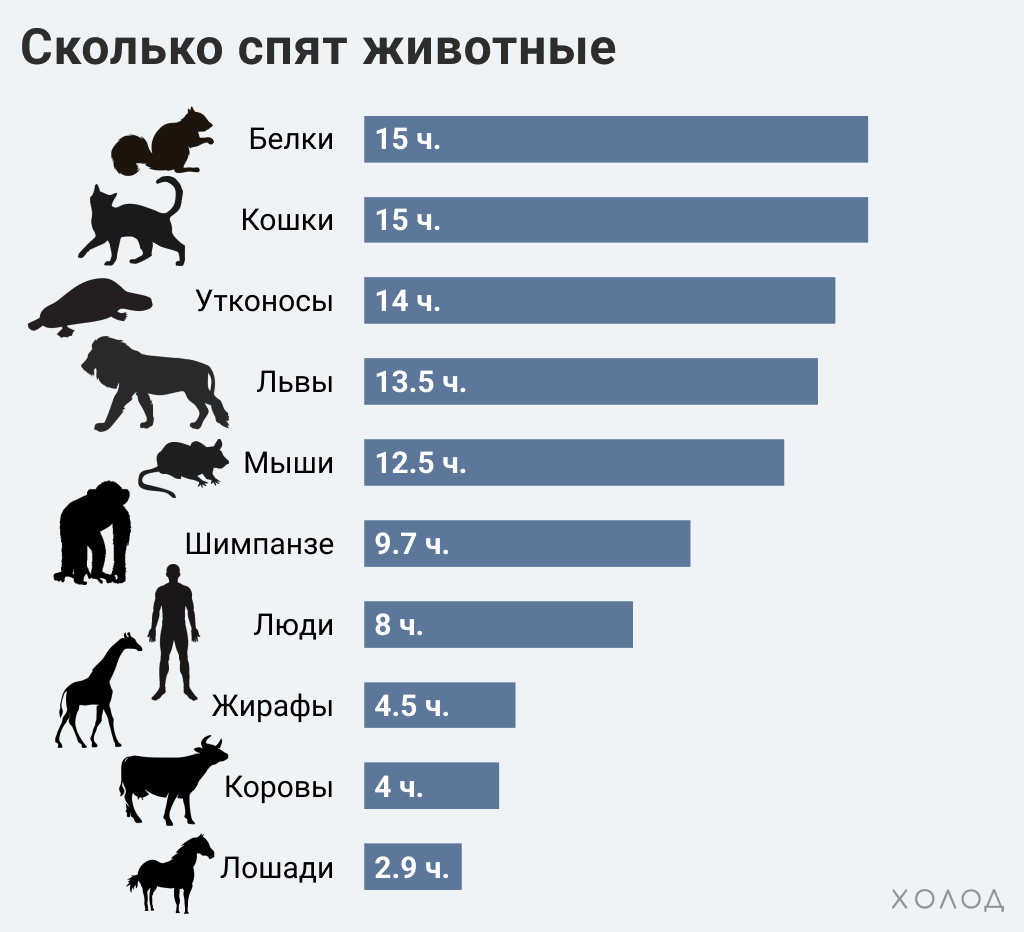
Scientists cannot definitely say why some animals sleep more than others. Small animals usually sleep more than large, and herbivores are less than predators, however, as can be seen from the infographics, there are exceptions. Moreover, the condition that is commonly called "sleep" is different in different species.
“Dolphins can sleep in one hemisphere,” says Vladislav Vyazovsky. - When you observe them, it seems that they swim all the time and never sleep. However, if you write cerebral waves, it becomes clear that the dolphins sleep alternately with each hemisphere. This example indicates how important a dream is: instead of getting rid of it, the dolphins adapted so as to sleep and remain active. ”
Studies of animal sleep help better understand the evolution and biological meaning of sleep.
A little about birds - owls and larks are there really?
Yes. Who are you, an owl or a lark, depends on the chronotype - that is, a person’s tendency to fall asleep at a particular time. To find out what kind of chronotype has, easily through the questionnaire - the generally accepted was developed by Jim Horn and Olaf Ostberg in 1976.
The chronotype is approximately half determined by genetics and is closely associated with circadian rhythms - the internal hours of the body. They are tied to the cycles of day and night. The time depends on the work of the internal hours when it is more convenient for a person to wake up.
The larks go to bed early and get up early - the maximum level of their mental and physical activity falls on the first half of the day. The owls are on the contrary: they lie down and get up later, and are most effective in the afternoon. However, there is a third type - pigeons. Their performance does not depend on the time of day.
Sometimes the rhythm of human life does not correspond to circadian rhythms, for example, when there are social responsibilities - to get up to school or to work early - and biological clock show that you still need to sleep in bed. In industrial countries, two -thirds of people working or students face such a problem. Scientists call this phenomenon a social jetga - and it leads to unpleasant consequences: a person’s vigilance is disturbed, productivity falls, and sleep deprivation occurs.
How did scientists find the inner clock (and received the Nobel Prize)?
All organisms on Earth live in rhythms. Sleep, eating, wakefulness and other biological processes are subordinated to the work of internal watches. For a long time, scientists rackled their heads: how do this watch work? Studies stretched for decades, but the scientific community appreciated their importance over time.
It all began in the first half of the 18th century, when the French astronomer Jean-Jacques Dorta de Meran laid the foundations of modern chronobiology. It happened so.
In 1729, the scientist studied mimosa. It was already known that this plant reveals its leaves in front of the sun and closes with the onset of twilight. However, the Meran decided to go further and wondered: what will happen if the plant is in a dark room constantly? It turned out that Mimosa hid and opened its leaves in accordance with the time of the day, although the sun's rays did not fall on him. Mimosa lived in her own rhythm.
For a long time, scientists continued to study biological rhythms on plants, but in the second half of the 20th century everything changed. In 1965, the American psychophysiologist Kurt Richter considered that the center responsible for biorhythms is located next to the hypothalamus - in a small area in the center of the brain. He conducted an experiment on rats: when this area of the brain was destroyed, the animals lost natural biological rhythms. In the afternoon they played and scoured in search of food, and at night slept peacefully. It would seem that what is amazing here? But rats are night animals.
Seven years later, the Richter hypothesis was clarified. Two groups of researchers independently found the exact place of the inner watches - the accumulation of neurons next to the audience nerves. They were called Suprachiasmen nuclei. They receive a signal about the level of light from the eye - this is due to ganglionic cells with melanopsin, which was discovered in 1991 by neurobiologist Russell Foster.
However, it was obvious to scientists for a long time that the mechanism of internal watches was tuned at the level of genes. In 1971, Seymour Benzer and his student Ronald Konopka found a gene responsible for the circus rhythms in fruit flies. They called him Per (from English Period ). But scientists could not describe how it affects circus rhythms.
After about 10 years, the work of Benzer and hemp was completed by their colleagues-Jeffrey Hall and Michael Rosbash from the University of Brandeis in Boston and Michael Young from the University of Rockefeller in New York. They allocated the Per gene in fruit flies - and it turned out that it is responsible for the production of protein, which accumulates during the night and is destroyed during the day. This protein blocks the action of the PER gene, which leads to the brake feedback mechanism - the basis of circadian rhythm. The whole process - from synthesis to decay - is just about 24 hours.
For the opening of molecular mechanisms that control the circadian rhythm, Jeffrey Hall, Michael Rosbash and Michael Young in 2017 received the Nobel Prize in Physiology and Medicine.
For problems with sleep, they are advised to drink melatonin. Does it help?
Before talking about melatonin is an important remark. Do not take any drug without preliminary consultations with a doctor: he will prescribe a dosage and determine whether he needs it at all.
Melatonin is a hormone that is produced by an epiphyse (pineal gland). The main task of melatonin is to regulate the cycles “sleep - wakefulness”, or circadian rhythms.
Usually the body is produced by melatonin itself. This process begins with the onset of night, and the peak is reached between 23:00 and 03:00 for hours: then the level of melatonin is 10 times more than the daily norm. But closer to the morning it becomes smaller, since the phase of wakefulness soon begins. Switching between sleep and wakefulness modes - these are circus rhythms. We talked about them in detail in the last chapter.
Sometimes circus rhythms are disturbed, and the body needs additional melatonin. For example, with jetgles-a sleep disorder that occurs due to a change in time zones. Although usually Jetlag passes itself: the body needs three to five days to adapt. Melatonin is also prescribed for sleep disturbances due to replaceable work.
Some scientists are looking for non -standard use melatonin. For example, this hormone can be used to facilitate the side effects of chemotherapy. The fact is that chemotherapy affects not only tumor cells, but also healthy, and after that there is a lot of active unwanted molecules in the body. Melatonin captures them and does not allow them to destroy the cells. As a result, the harm from chemotherapy is reduced. However, in order to confirm this theory, scientists still need to conduct more research.
How much should you sleep?
The recommendations of the American National Sleep Fund depend on age: newborn children need 14-17 hours of sleep, and adults-seven to nine. According to experts, such a amount of sleep needs a healthy person, but it can vary depending on individual characteristics.
Sometimes people need much less sleep than experts recommend. Scientists from the University of California at San Francisco studied an unusual family: its members were quite less than six hours of sleep. They took the biogrates from them and found a mutation in the ADRB1 gene. To learn more about the effect of the mutation on the brain, the researchers created mice with a changed genome: they slept almost an hour less every day than ordinary mice.
“Those who sleep less by nature, the quality and effectiveness of sleep higher,” said Dr. In-Juay Fu, head of the study. “Studying them, we hope to find out what contributes to good sleep so that we can all sleep better, leading a happier and healthy life.”
Due to the lack of sleep, memory worsens , cognitive abilities are reduced, and in extreme cases, hallucinations occur. In non-sleeping people, the risk of obesity , diabetes and cardiovascular diseases are higher.
"Answer the question" How much does a person need to sleep? " Very difficult. Sleep loss can be compensated by its quality or depth, ”says Vladislav Vyazovsky Oxford University. - In general, I believe that we can sleep less. After all, animals can, but in people there is nothing special. It is necessary to find the conditions under which it is possible. But there are no examples in the mainstream scientific literature. ”
How to sleep right
If it was not possible to sleep at night-disturbing thoughts did not allow to fall asleep or had to constantly turn on, then it is worth waiting for the consequences: lethargy, drowsiness and unwillingness to do anything. Specialists of the American Academy of Sleeping have prepared a list of recommendations that will help improve sleep. Here are some points:
Follow the graphics. Go to bed and wake up at the same time. Weekends and vacation are no exception.
Turn off electronic devices at least 30 minutes before bedtime.
Avoid large meals, caffeine and alcohol before bedtime.
Do not drink a lot of liquids before bedtime.
When you are going to sleep, limit the effects of bright light (you can use the mask to sleep or hang tight curtains on the windows).
Do sports or do exercises. Physical activity will help fall asleep at night.