
Translated material
No one writes to Girkin
Why did the arrest of the "patriotic blogger" not led people out into the streets
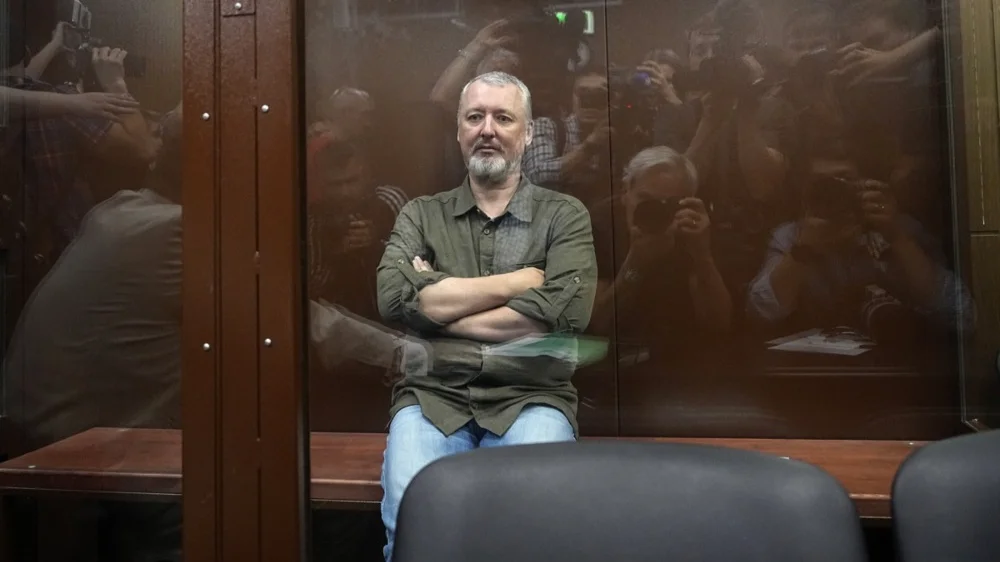
Igor Strelkov (Girkin). Photo: Era
The events of the last weeks - from the rebellion of Prigozhin to the arrest of Girkin - talk a lot about our country.
Three and a half people came out to support Girkin to the court. And only one decided to get into the picket at all-the former “people's governor” of something Pavel Gubarev. The rest dispersed immediately, as they were ordered, saying that they were, they say, law -abiding and will fight for Girkin’s freedom on the site. There were no thousands (hundreds of thousands) of angry patriots.
This, of course, is the best news of the last days, much more important and interesting than the arrest of this, in my opinion, is a manual clown (the clown does not deny the obvious fact that he is a villain and that the destruction of Boeing and the murder of 298 people, for whom he was sentenced to life in The Hague, does not exhaust the list of his terrible crimes).
The passivity of the “patriotic community”, which allows to doubt in its very existence, pleased many, especially those who fear that after Putin it would be even worse.
It seems to me that if you consider real, and not speculative scenarios, then there is nowhere worse, so you should not be afraid. But in the photo of an empty square in front of the court, - recalling how the squares were filled with people in front of the courts when real opponents of the regime were judged there - it’s nice to watch.
The fact of such a calm reaction of the “patriots” to the arrest of one of their most striking speakers requires both the analysis and the revision of some ideas about our society that we have developed in recent years.
The first hypothesis that comes to mind is that the “patriotic public” is actually not, as there is no Armata tank, the second army of the world and much more. That her, like the same “Armata” or the second army of the world, came up with the Kremlin to intimidate us and the whole world. If we believe in this, our attitude will become much more positive, and our image of the future is more optimistic than now. But I'm afraid this is not so: the “patriotic public” exists.
This is evidenced by serious sociological studies (statements about the impossibility of polls at public opinion in the conditions of tough authoritarianism come mainly from those who have not conducted a single survey in life and does not really imagine how this is done). The results of the few professional sociologists remaining in Russia must, of course, be critically interpreted, but do not reject them from the threshold simply because we do not like them.
The existence of the “public” also speaks of the obvious prevalence of the components of the patriotic syndrome: faith in the negative attitude towards us of the whole world and in conspiracies against us Anglo -Saxons and other Jews, neglect of the laws and agreements, contempt for other nations (from “stupid Americans” to “timid Georgians”), faith in any nonsense and lies with all responsibility and packed all responsibility for their responsibility to “Alien” (people continue to believe that Mariupol and Buchu was arranged by the Ukrainians themselves).
Finally, the joy of the annexation of Crimea that covered the country almost ten years ago speaks of this. Patriotic syndrome is a reality. From the fact that now he has not acquired the form of a protest familiar to liberals, he does not follow his absence, or that he is not dangerous.
You can, of course, make something else, is also quite a pleasant assumption for us. The patriotic community exists, but it consists of weak cowardly people who can only like crazy criminals, but not ready for a real struggle. Actually, the phenomenon is known in interaction with it. Now we see the result of this interaction: they challenged them - they were silent. Here we went out-both in August 1991, and in 2011–2012, and when we were judged by our comrades. And they are just afraid. And since they are afraid, then we do not have to be afraid of them - they do not pose any threat.
But this is also not so. Do not deny the presence of some of the so -called patriots of courage and readiness for risk and self -sacrifice. Among them there are people who believe in their, to put it mildly, strange ideas. And some of them voluntarily went to fight in Ukraine, some died there. Some - a much larger number - willingly pick up a weapon to destroy those who they do not like in Russia itself. It is dangerous and unconstructive to underestimate the enemy.
Of course, they are not as strong as many thought. Partially their image is really designed by the Kremlin, but partially, oddly enough, by ourselves.
The belief of the part of the Russian intelligentsia in the destructiveness of the Russian people, in its commitment to crazy ideas and the readiness of these crazy ideas - from straits to Crimea - is not based on any facts, but justifies not only passivity in the fight against power, but also cooperation with it. After all, in a sense, she is an emanation of the people, which means that you cannot go against it. It is necessary to limit ourselves to an improvement in what can be improved without encroaching on the foundations. That is, you, working for power and collaborating with it, are right, and those who are actively against, maybe good people, but do not understand reality. Actually, all this is described by Hannah Arendt: it is impossible, some German intellectuals said, to speak out against the Nazis - for them people, which means that they need to be understood by their truth.
But why didn’t they come out of the “patriots” who are not underpants at all? Already a couple of thousand in front of the court will definitely be set. This fact, I believe, allows you to clarify what they are and how they differ from us.
We are for freedom, and therefore for a person, for individuality and for ourselves. Our dignity is in our freedom, in independent decision -making. We focus on our ideas, and not on calls and orders. All my friends, for example, went to stocks not because someone called them to this-they only used the reason, feeling the complete independence of their decision.
Since we are for ourselves, we can oppose the system even when we feel it as a whole correct, come into conflict with the conditional “ours”. When Yeltsin began the war in Chechnya, the “democratic choice of Russia”, the party of Yegor Gaidar, immediately opposed - we were the first party to then organized a public protest. Yeltsin was our president, we voted for him, we helped him in his reforms as much as possible, but here we - each of us - told the head of the state that we did not give him a mandate for war and that here we are against him. We understood the risks associated with such a position (alas, they were fully realized then), but none of us had an internal conflict - we remained free people, and this feeling was many times more important than the sensation of ourselves supporters of the president. And to oppose the authorities, which we feel hostile to ourselves and everything that we believe in, for us does not at all represent a psychological problem.
“Patriots” are not for freedom, not for individuality, but for the community - for the state, for the nation or for the faith. Their dignity is in affiliation. Their degree of freedom is limited by the loyalty of community. They are "sovereign people." Yes, they can oppose the king, but only if “the king is not real,” they retain loyalty to the present. They can oppose the state, but only if their community is formed not by power, but by faith or people. But then they have a real or imaginary leader of faith or people to whom they remain true.
Our "patriots" are precisely statesmen. They are not nationalists and not religious fanatics - they are identified with the state (as, unfortunately, part of the intelligentsia serving the state).
The supporters of Girkin, apparently, either considered his escapades a coordinated game, which was conducted against bad people surrounded by the president, or assumed that Putin was no longer a king, but for example, hires a world backstage, while Girkin serves a real, more powerful tsar who will manifest himself in the near future. But when Girkin was arrested, they were in a state of deep internal conflict: there seems to be no other other than Putin, or he is too weak to free Girkin, which means that he cannot be considered the king.
Their leader was arrested by the very state with which they are identified. In this situation, they cannot protest - a protest would mean a rebellion against themselves. He can only hope for a mistake that the king will expose the intrigues of enemies, because of which he opposed his faithful servant (and indeed-a faithful servant!), Signing petitions and believe in the wisdom and mercy of the sovereign. But do not rebel.
And in this identification with community, and not with individuality, their main difference from us and, at this stage, their weakness. But do not reassure yourself: if someone appears in whom they will see the leader of their community, they will raise their heads.