
Translated material
Antitus Strelkov
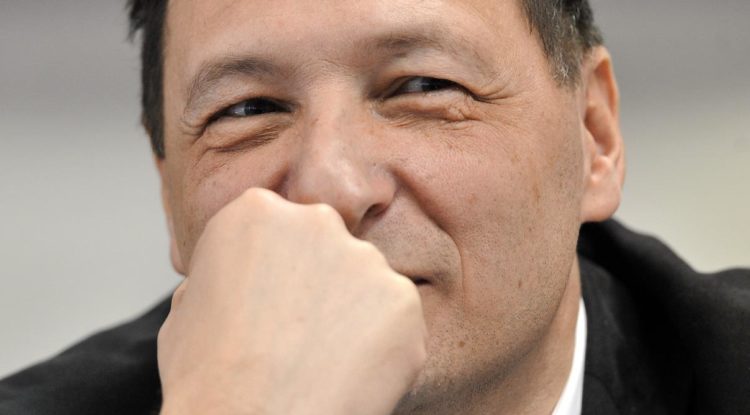
Who is Boris Kagarlitsky, arrested for “justification of terrorism”, and why his business is not discussed enough
On July 30, the journalist of Kommersant Andrei Kolesnikov asked Putin a question about the “arrests for words” as a new norm in Russia, leading in the example of the case against Zhenya Berkovich and Boris Kagarlitsky. “I hear these surnames for the first time and do not really understand what they did and what they did with them,” Putin answered Kolesnikov. Almost all independent media wrote a lot about Berkovich after her detention, but the most media pronouncing the sociologist Kagarlitsky of the sociologist Kagarlitsky only in the format of short news. Perhaps this is due to the ambiguous position of the scientist in the Crimea in 2014. At the request of the “cold”, the teacher of the RANEPA, the leading podcast “This is the basis” Alexander Zamyatin explains who Boris Kagarlitsky is and for which he is pursued.
In order not to miss the main materials of the "cold", subscribe to our Instagram and telegram .
Sociologist, political scientist, teacher, professor, scientist, theorist, Marxist, socialist, left -handed publicist and intellectual, blogger - these are just a few titles of Boris Kagarlitsky, who can be found in publications about his criminal case. Despite such an abundance of characteristics, it is difficult for a person who did not follow his activities, it is difficult to understand who he is and why the state pursues him. Everything becomes even more confusing, given how different people publicly made his support - from the opposition and leaders of the left -wing parties around the world to the ultra -right “patriots” and pro -government bloggers. Who is Boris Kagarlitsky and why did the repression collapsed on him? I will offer my answer.
Who is Boris Kagarlitsky?
Karelitsky began socio-political activities back in the 1970s and even left for a year in the Lefortovo pre-trial detention center in the case of “young socialists” in 1982-1983. He was a dissident of left -wing views, read and distributed neo -Marxist literature, which did not fall into the official Soviet canon and was prohibited. During the perestroika, Kagarlitsky became a public politician and elected to the Moscow City Council. In October 1993, he actively participated in the confrontation with President Yeltsin in the status of a deputy of the Moscow City Council. After the victory of Yeltsin and the dispersal of the Soviets, Kagarlitsky failed in political timelessness along with hundreds of thousands of other active citizens of our country.
In the next 30 years, Kagarlitsky did not fix it in some kind of political organization or institution and remained an independent figure. Therefore, it is difficult to explain in a nutshell what does it have to do with politics today. Karelitsky is not in the party, although he communicates closely and collaborates with various party leaders and deputies. After 1993, he no longer held any official positions in power, although he twice ran in the elections to the Moscow City Duma: in 1997 - from the Bloc of Nikolai Gonchar, and in 2019 - from Just Russia. He also has many attempts to create independent political and trade union organizations, which were unsuccessful.
The non -systemic position of Kagarlitsky speaks not so much about him as about the Russian political system itself, which at the institutional level blocks the entrance to politics to active people who do not want to integrate into the party structure collected by the Kremlin. Kagarlitsky obviously has the ability of a public policy, their own examination and the original point of view on socio-political issues based on his political economic research. In a free country, he would probably be the leader of a major political organization and a deputy of the national parliament. In Putin Russia, such as he, has to invent a political role for himself.
Karelitsky achieved much about the most success in the academic sphere. His books and articles made him perhaps the most influential modern Russian specialist in Marxism. Karelitsky is actively engaged in the import and promotion of left social thought on the unfavorable post -Soviet soil for this, where aversion to Marxism and the entire “Levak” until recently dominated. Several generations of activists and researchers have already grown in Russia, which were influenced by the texts and performances of Kagarlitsky: from candidates of sciences to young sociologists . Therefore, in an activist environment, he is considered the "patriarch" of Russian Marxism. In the same role, he overgrown with international contacts in left -wing circles around the world, which explains many speeches in his support from foreign politicians.
At the same time, in the biography of Kagarlitsky there are episodes doubtful for the opposition, and his political views are by no means indisputable in the left environment. Seriously understanding all the intricacies of his careers and positions should journalists and his future biographers. From my point of view, mention deserves his position on Crimea and Novorossia. In 2014, Kagarlitsky was among those who criticized the Maidan and the new power in Kyiv and believed in the liberation potential of the first lower anti -Maidan bursts in eastern Ukraine. This caused his demarcation with many left and liberals.
However, it would be incorrect to consider Kagarlitsky a hidden Putinist in connection with his position of 2014. It flowed not out of sympathy for the Putin regime, which he never had, but from that abstract style of political analysis, which he learned from the theory of the world system of Immanuel Vallestain. In this theory, the whole policy is described through global processes of historical scale, and mundane relations between politicians and local debates are of secondary importance. Therefore, Karelitsky usually begins to formulate his position on specific pressing issues not with current events, but from references to socio-economic transformations of capitalism of the 1970–80s, the economic crisis of 2008 and other large-scale events of the past. An example of an analysis of Russian politics through the prism of global economic crises can be found in his books “Between Class and Discourse” (2017) and “Long Dressing” (2023).
One way or another, in the eyes of some, Kagarlitsky played along with the Kremlin, and in the eyes of others expressed a truly internationalist point of view, equidistant from both the Western and Russian imperialisms. Although Karelitsky emphasized that the Kremlin’s intervention in the events in Ukraine does not carry anything good, his statements about Kyiv and Novorossiya distance him from the Russian liberal opposition, which he hardly spares about. At the same time, the left with close positions on these issues remained marginals. Kagarlitsky did not become his own for the Pro -Putin's circles, because it insists that the Russian oligarchic regime "is no better than Kyiv." Thus, he occupied his niche in the opposition, from which it is possible to be friends simultaneously with some liberals, and with the most radically opposition deputies of the Communist Party, and with Ksenia Sobchak.
By 2023, Kagarlitsky became popular in the political segment of YouTube by public intellectual. Its main platform is the Rabkor channel, which grew out of the online magazine of the same name, launched by it back in 2008. “Rabor” is not his personal channel, he makes a large team, there are different presenters there. But Karelitsky is definitely the face and leader of this media. If I were asked to explain in one sentence who Boris Kagarlitsky was on the eve of his arrest, I would say that he was the editor-in-chief and face of the Rabor YouTube channel. Who he will become during this criminal case is an open question. It is already clear that the brutal attack of the security forces mobilized the people supporting him and became a new milestone in his life.
What is he pursued for?
Despite his attitude to the Ukrainian events of 2014, Karelitsky took an unambiguous anti -war position in 2022. He consistently adhered to her all these months, remaining in Russia and developing his media appropriation. I think that this is the simplest and most plausible explanation of the launch of a criminal case against him. Kagarlitsky received the stigma of a “foreign agent” back in May 2022 and probably has been in the “waiting sheet” with the security forces since then.
The prosecution under the article on “justification of terrorism” formally indicates any specific statements that the FSB officers consider to be falling under this article and which we still know little about, because the materials have not yet been published. However, any person who at least once heard Kagarlitsky’s performances knows that he is very carefully selecting formulations. I have no doubt that the real reason for his persecution is in his public political position and activity of the Rabor channel, whose guests regularly voiced opinions unpleasant for the authorities. “In Ukraine they are shot for this,” President Putin answered the question of journalist Andrei Kolesnikov about the reasons for the persecution of Kagarlitsky. After these words, it is difficult to doubt that this is a purely political matter that is not related to the rule of law.
In the order of speculation, I note that the arrest of Kagarlitsky looks like a balancing measure after Strelkov’s arrest. The authorities are important that in society there is no impression that they would take on the disloyal patriots, because all should be punished for disloyalty. Karelitsky in this sense is a completely successful antithesis Strelkov. At the same time, Strelkov, being a much more well -known and discussed figure, has not yet received the same wide and loud public support in connection with his criminal case as Kagarlitsky. It is no accident that Kagarlitsky decided to take away Syktyvkar to the pre -trial detention center far from his native Moscow and judge there: in Moscow, there would be no doubt that many people would have been annoying, which always annoyed the security forces.
Now the supporters of Kagarlitsky are deploying a public campaign for his liberation, which is very important to support a person behind bars even if it does not achieve its main goal. From personal communication with Boris, I know that he always soberly assessed the risks and realized the price of his public anti -war position. In this, he belongs to the type of disagreed and free -thinking people, who at all times openly opposed injustice, despotism and imperialism. And for us, in solidarity with him in this, the moment came when we must support him.
The author’s opinion may not coincide with the opinion of the editorial office.