Date
Author
Александр Атасунцев; Редакция «Вёрстки
Source

Preserved copy
Translated material
Sanctions hole - Layout
Sanctions hole
Alexander Atasuntsev, “Layout” Editorial Board July 31, 2023 |Almost any sanctioned goods worth billions of dollars end up in Russia. Investigation of "Layout"
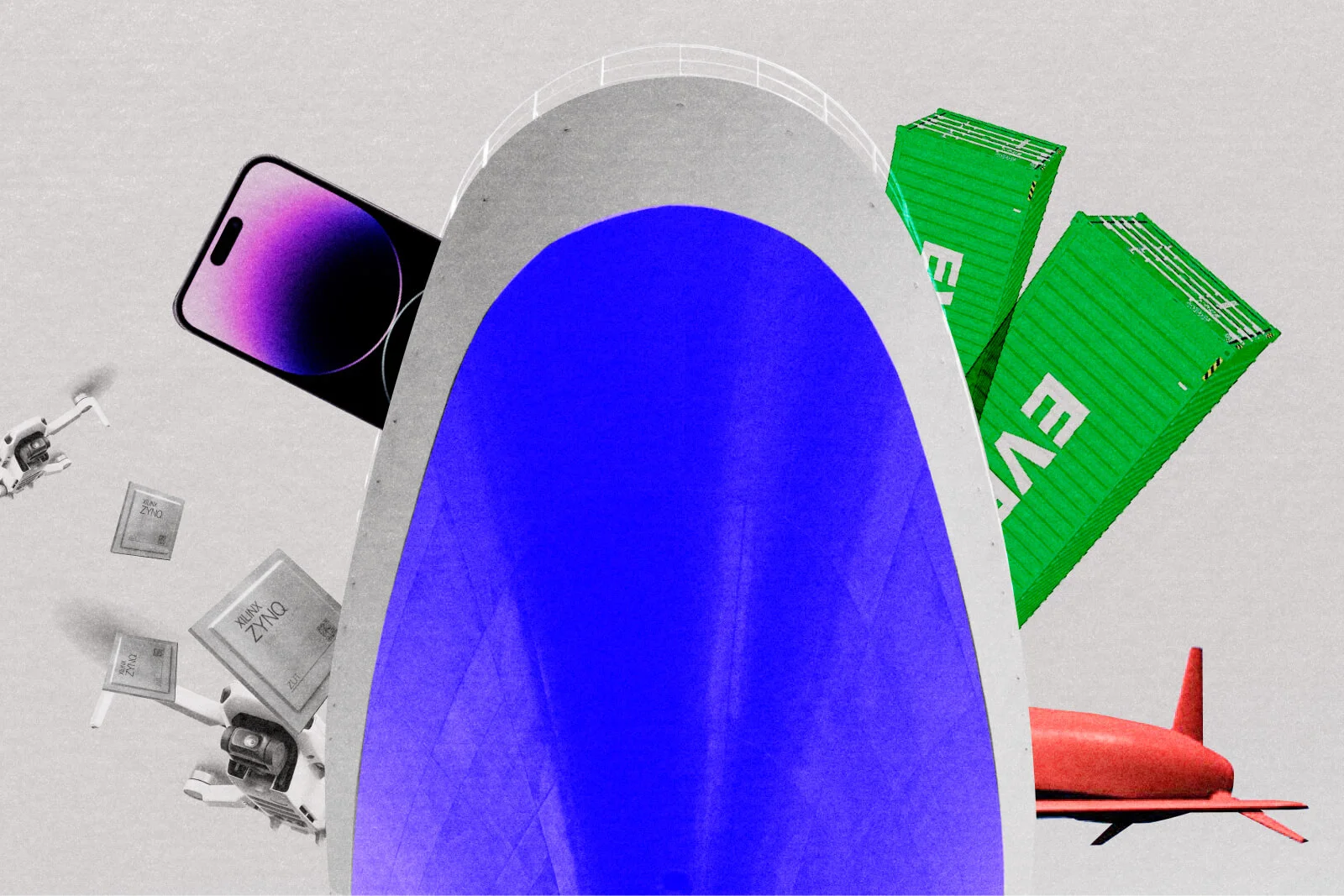
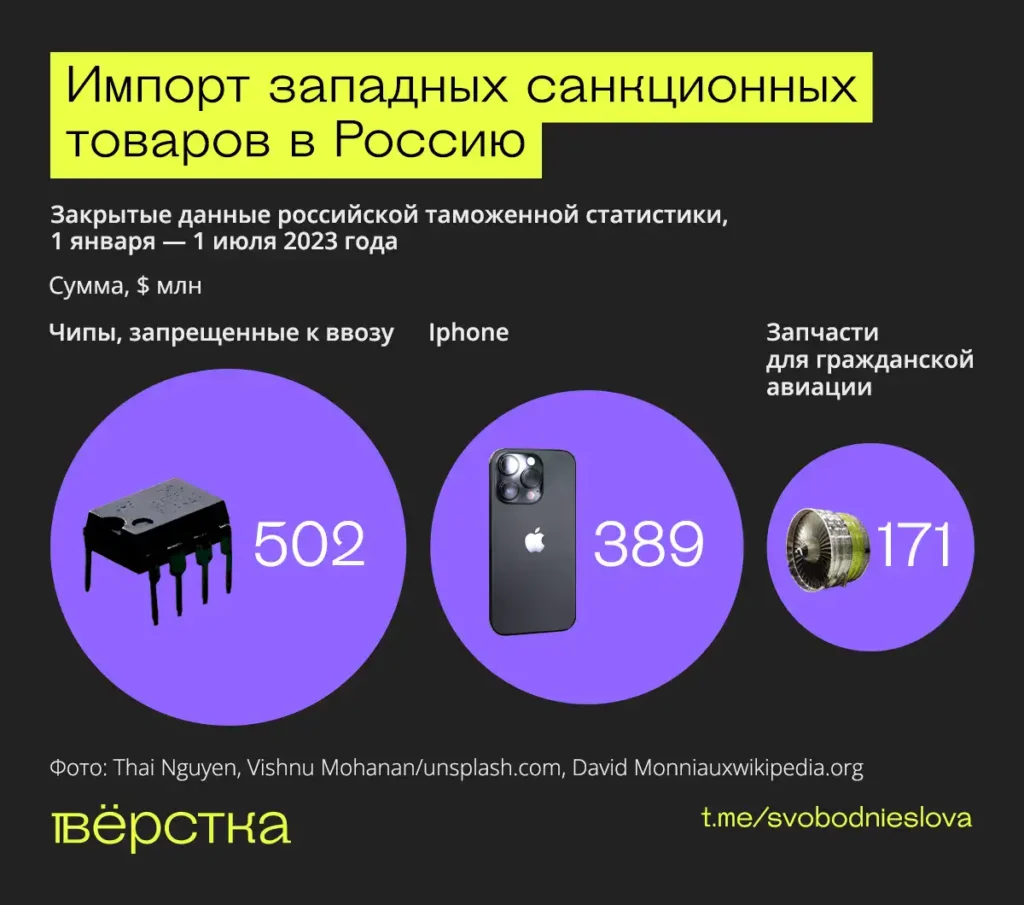
Over the past six months alone, Russia has imported prohibited chips from Western companies worth more than $502 million - they are used to produce missiles and other types of weapons. Millions of dollars worth of machine tools for the defense industry were imported, at least $171 million worth of Western spare parts for civil aviation, and $389 million worth of iPhones. “Verstka” studied classified data from Russian customs statistics, calculated how many goods prohibited by sanctions end up in Russia, and spoke with logisticians, freight forwarders and businessmen who explained how illegal supply schemes work.
In order not to miss new texts from “Layout”, subscribe to our telegram channel
Content
Having started the war in Ukraine, Russia came under a barrage of US and EU sanctions. Immediately after the war, it seemed that Russian industry, including the military, and business would be left without critical imported technologies. And European and American goods will disappear from store shelves. But this did not happen.
After the start of the war, Russia closed a significant part of its statistics, including ceasing to publish data on foreign trade. Using classified data from Russian customs statistics, Vorstka was able to calculate the volume of sanctioned goods since the beginning of 2023. These data, unlike customs services commonly used in this type of research (for example, Import Genius), made it possible to assess imports to Russia in real time and on a larger scale. We have calculated the categories of prohibited goods that relate to both the defense industry and the civilian sector - aviation, smartphones. For analysis, we took the period from January 1 to July 1, 2023.
According to Castellum's calculations. AI , since February 24, 2022, more than 13,500 restrictions and prohibitions have been introduced against citizens and companies from Russia, as well as sectors of its economy, and their total number, taking into account sanctions due to the death of Sergei Magnitsky and the annexation of Crimea, has exceeded 16 thousand. In terms of the number of sanctions, Russia is the absolute record holder in the world, it is more than 3 times ahead of Iran.
Our investigation showed that almost anything can be imported into Russia from anywhere in the world - from a dual-use chip to a turbojet engine for Airbus. Western companies participate in schemes through third countries, and Russian authorities successfully circumvent European and American sanctions.
Where does Russia get new missiles and modern weapons from?
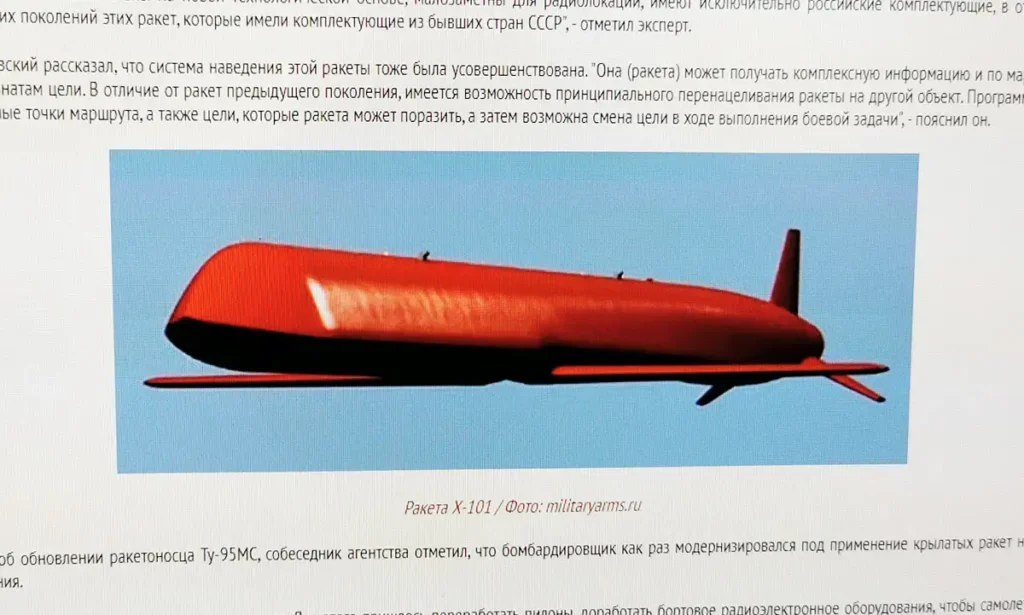
Dual-use goods were the first to be sanctioned. The Russian defense industry is critically dependent on foreign microchips and microprocessors . For example, the X-101 strategic cruise missile, which is produced by the Raduga IKB, part of the Tactical Missile Arms Corporation, and which is one of the most modern missiles in service in Russia i , has an Intel processor, Xilinx and Texas Instruments chips, and an Analog Devices Inc transceiver.
All these components are supplied to Russia freely up to the present moment. Over the past six months, Russian authorities have cleared customs components from American Analog Devices Inc. for more than $98 million, Xilinx - more than $75 million, Microchip Technology - more than $42 million, Texas Instruments - at least $38 million, as well as Infineon, Germany's largest semiconductor manufacturer - more than $28 million, according to customs data. Also imported to Russia were products from Marvell (a chip manufacturer) worth more than $11 million, Cypress Semiconductor - more than $3.8 million, and Atmel - more than $2.7 million .
In addition, products from American Intel and AMD, including microprocessors, worth more than $169 million and $35 million, respectively, were imported to Russia. Almost all Western electronics are sent to Russia through China and Hong Kong. For example, the top 3 largest senders of Intel components: Time art international limited (sent almost $40 million), Union Tech Inc. Limited (dispatched more than $17 million) and Dexp International Limited (dispatched almost $15 million) - all Hong Kong companies.
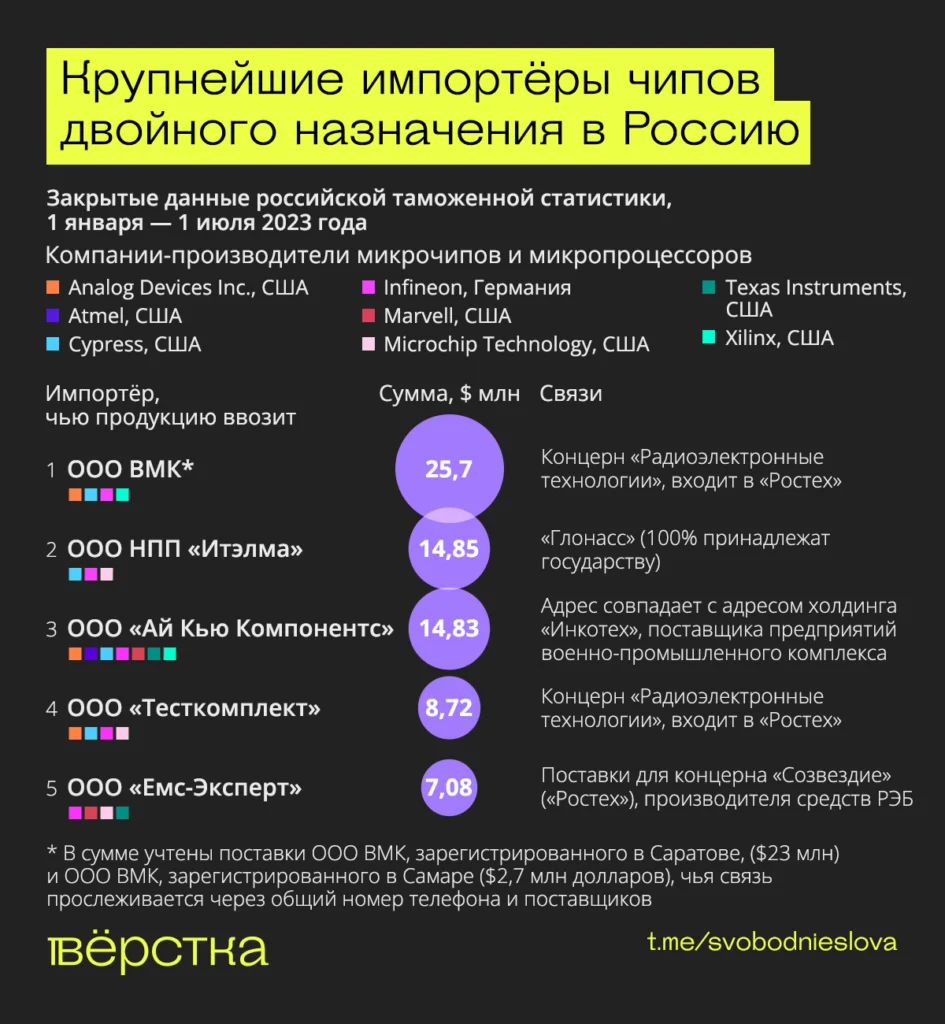
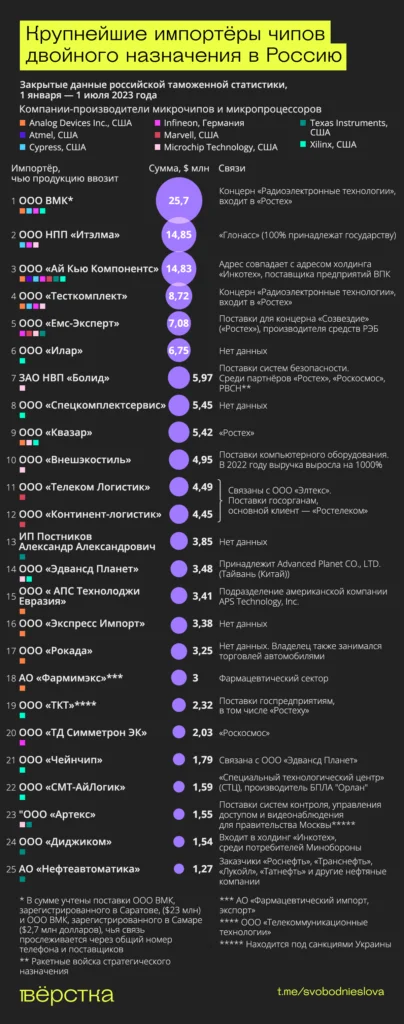
Hundreds of companies ship dual-use chips to Russia. “Vorstka” has compiled a list of the largest importers of these components. Of the 25 largest importers, as we were able to establish, 11 are direct suppliers of military-industrial complex enterprises, including the first five largest .
For a complete list of all 25 largest importers, see here .
The United States imposed sanctions against two companies from the top five (their participation in military-industrial complex supplies was previously covered by “Important Stories”). These are the importers of Analog Devices Inc. — “VMK” and “Testkomplekt” are companies that are suppliers to Rostec enterprises. The sanctions introduced in January did not hinder their activities in any way. Since the beginning of the year, they have imported components worth almost $20 million. VMK and Testkomplekt receive goods through Chinese and Hong Kong companies. For example, the main partner of VMK is the Hong Kong-based Tordan Industry Limited. In June, the EU imposed sanctions against the company. VMK is also the largest importer of Xilinx chips. The company imported more than $10 million worth of electronics to this American company.
These are not the only importers of key electronic components. Other major importers include Analog Devices Inc. — Kvazar company. Since the beginning of the year, it has imported components from Analog Devices Inc. for $3.3 million. Kvazar has several suppliers - mainly in China and Hong Kong. The largest shipment - worth more than $870 thousand - was sent in January by Hong Kong-based LL electronic limited. Moreover, the shipment was paid in dollars and came from Thailand. However, the company also had partners in Europe. For example, from January to May, the Estonian company Elmec Trade OU sent at least $250 thousand worth of prohibited electronics to Russia. In May of this year, both Quasar and Elmec Trade OU were included in US sanctions lists. But the Russian company freely continued to transport components through China. In June, the same LL electronic limited sent Analog Devices Inc. components to its partner in Russia. for $200 thousand. This time the components came directly from China.
Another company that is one of the ten largest importers of Analog Devices Inc., Texas Instruments, and Xilinx is IQ Components. She imported components from just these three companies worth more than $13.8 million. All deliveries were made through China and Hong Kong. i The phone number listed on its website is the same as the phone number of another company, Incotech. Which, in turn, does not hide its ties with the Russian defense industry and is engaged in the production of components, including those used in military radar systems. Its co-founder Pavel Grishanovich has been under American sanctions since 2012.
Xilinx chips aren't just used in rockets. Thus, the SMT-Ilogic company, which is part of the network of suppliers for the production of the Orlan UAV, has imported Xilinx chips worth almost $1.6 million since the beginning of the year. Among the senders are two Chinese companies and the Turkish Margi̇ana Inşaat Diş Ticaret Li̇mi̇ted Şi̇rketi̇.
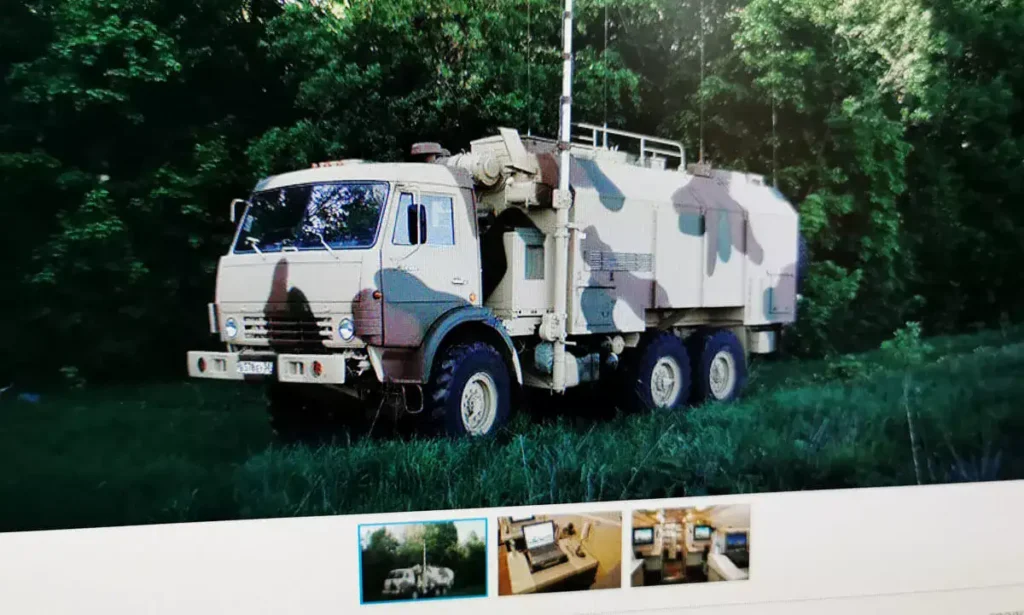
JSC Radiozavod, part of the Rostec holding, produces control points for Ranzhir-M1 anti-aircraft missile batteries. Among its suppliers was TD Symmetron EK. It is one of the largest importers of German Infineon chips to Russia. Since the beginning of the year, it has imported $2 million worth of these components. The company is directly connected with the Russian defense industry. It is part of the Symmetrion electrical engineering holding, but in June-May 2023 it changed owners. The organization came under sanctions when one of its co-owners was Igor Sukhanov. He is a graduate of the St. Petersburg Voenmekh, began his career at the Severny Press plant, recalled one of his colleagues. The first samples of the homing head for the Onyx missile were debugged at Sevpress. i
In total, since the beginning of 2023, chips from Western companies worth more than $502 million have been imported into Russia, Vorstka has calculated .
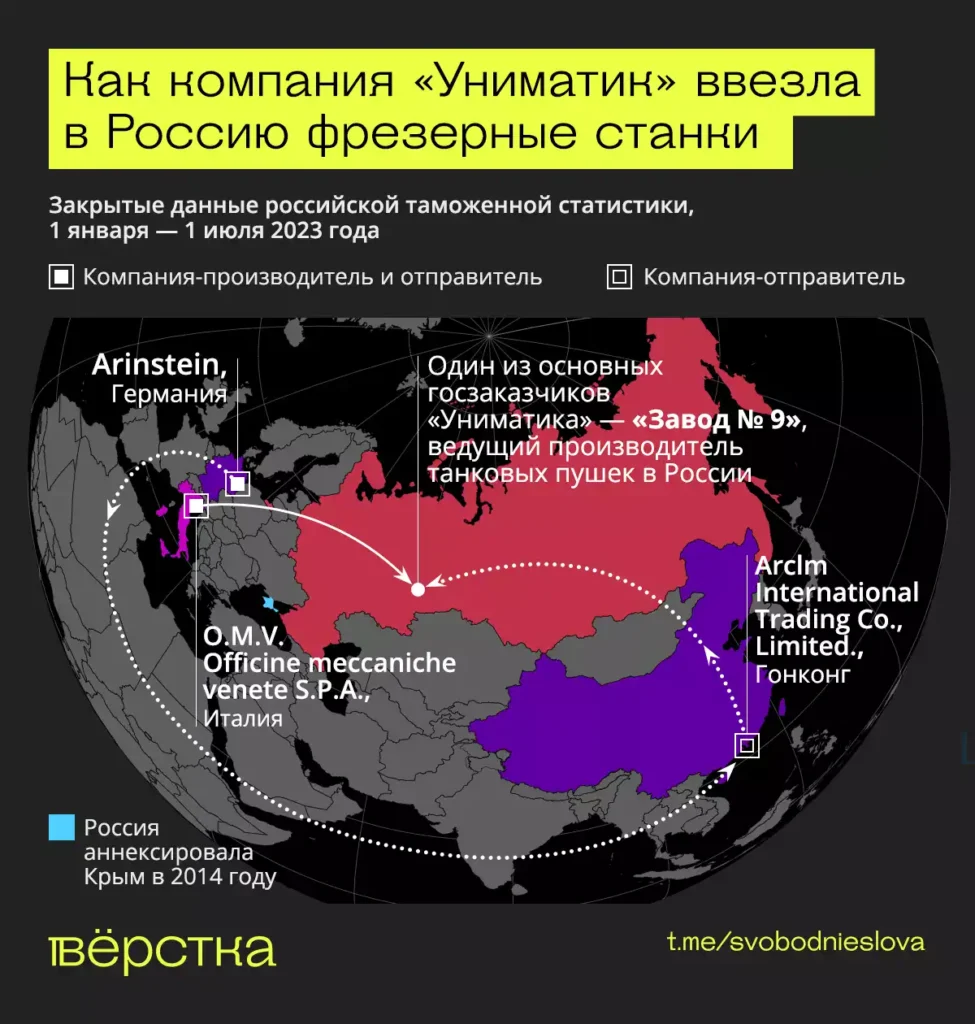
But chips are not the only type of prohibited product that is urgently needed by the Russian military-industrial complex. The sanctions concern hundreds of positions important for the Russian defense industry. Including machines. For example, since the beginning of this year, the Unimatic company has freely imported into Russia machine tools from Italian OMV and German Arinstein worth at least $5 million . Moreover, in some cases the sender was the manufacturing company itself. So, in May, Unimatic brought milling machines . They were sent from Italy by OMV Officine itself, despite the fact that this particular type of product is also under export control of the European Union. And one of Unimatika’s main government customers is Plant No. 9, Russia’s leading manufacturer of tank guns . In the case of German Arinstein machines, they were sent from China by the Hong Kong-based Arclm International Trading Co., Limited.
Simpler weapons parts are also imported. For example, Pointer LLC imported 52.4 thousand optical sights made in China, the USA and Japan to Russia in 2023 for $9 million. The company cooperates with Russian law enforcement agencies. In particular, in 2021 it supplied weapons consumables to the Federal Security Service. Another importer, CityImpex, imported 150 Chinese thermal imagers worth $1 million. i
The largest supply of thermal imaging sights was made by ART-ELV LLC - 15,728 units worth $13.5 million, where the cost ranged from 40 to 740 thousand rubles per unit. This wholesale company imports into Russia the Chinese manufacturer of thermal imagers Yantai Iray.
Why planes in Russia will continue to fly properly
Civil aviation in Russia has become one of the industries most affected by sanctions. Russian airlines lost foreign routes, leasing and maintenance, new foreign aircraft, and insurance instruments. At the end of last year, the International Civil Aviation Organization (ICAO), part of the UN, marked Russia with a “red flag” due to possible problems with flight safety. Apart from Russia, only Bhutan, Liberia and Congo have a “red flag”.
But it seems that Russian airlines have managed to solve the most critical problem - the shortage of spare parts. Parallel import, as customs data showed, allows the import of any parts.
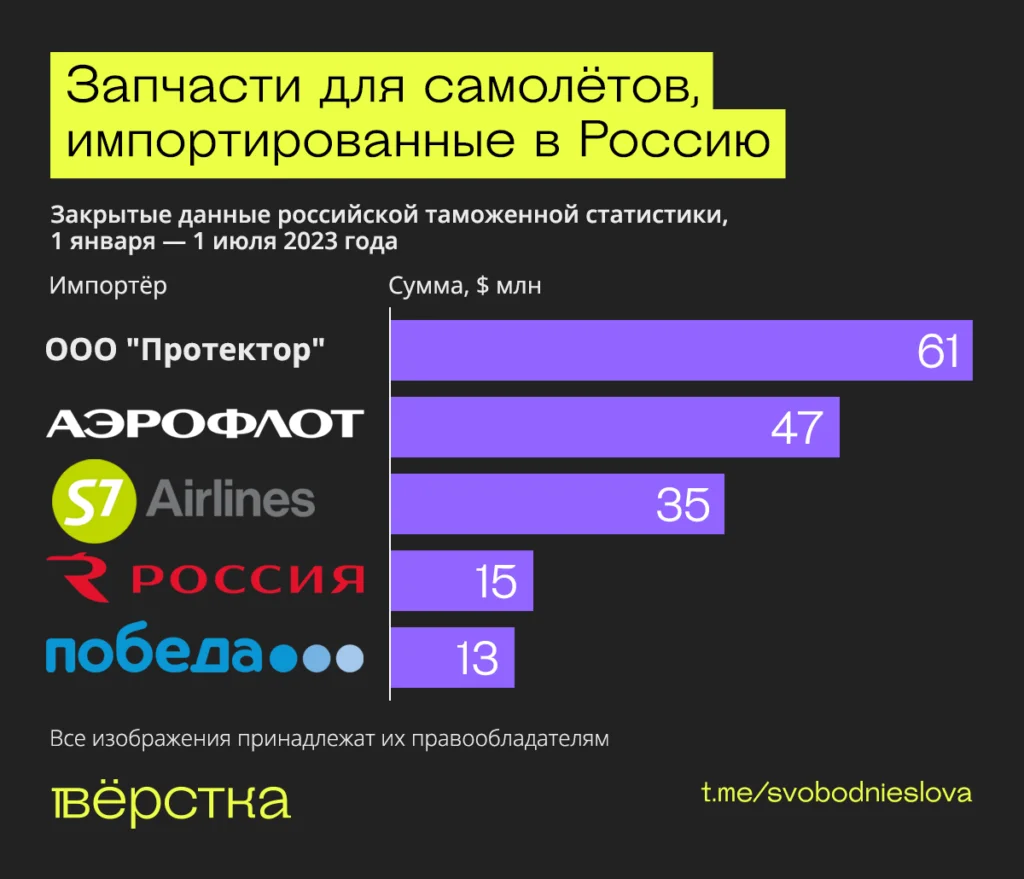
According to Vestka’s calculations, Russia’s four largest airlines—Aeroflot, S7, Pobeda, and Rossiya—have imported aircraft parts worth $47 million, $35 million, $13 million, and $15 million, respectively, into the country since the beginning of this year . Almost all components are from Western manufacturers. For example, Aeroflot brought spare parts to the country from the American companies Honeywell for $7.5 million, Woodward for $4.5 million and Boeing for $2.5 million, as well as the French Safran Nacelles for $4.5 million.
In March of this year, the S7 subsidiary Globus imported to Russia an entire turbojet engine used by the Airbus A319/A320/A321 family of aircraft. Such engines are produced by the French-American concert CFM International. The cost of one engine is from $7.5 million. It was sent by the Chinese DLA (GZ) Technology Co., Ltd. The company's website states that it "repairs" and "supplies" aircraft and spare parts, and is a "leader in the recycling and refurbishment of decommissioned aircraft in China." However, half of the sections of the site are missing. In the same month, S7 imported to Russia an engine for the passenger Embraer E170, produced by the American General Electric. It costs about $4.4 million. This time the engine was sent by the Desert sun supply company, registered in the UAE.
In January of this year, Pobeda imported two consignments of non-military radar equipment manufactured by Honeywell worth more than $580 thousand. The sender was the Armenian company A Trade service both times. And the goods themselves arrived from the UAE. In total, Pobeda has imported more than $3.5 million worth of Honeywell spare parts since the beginning of this year, and more than $2 million worth of Rockwell Collins Inc and Boeing spare parts.
Rossiya Airlines imported more than $6 million worth of Honeywell spare parts alone. For example, in February the company received a batch of pressure measuring instruments worth more than $1.2 million. They were sent by the Chinese Yunnan Rongjin agriculture China products.
Not all airlines order parts directly. Sometimes others do it for them. For example, with the introduction of sanctions, things went up sharply for the small company Protector. In 2022 alone, its revenue grew by 1000%. Since 2023, it has imported aircraft parts worth at least $61 million - including six aircraft engines for the Boeing 767 and Boeing 737 and Airbus A320, the cost of which ranges from $1.9 million to $10 million. Manufacturers are CFM and General Electric. The engines were sent by two Emirati companies, Desert sun supply (which also supplies spare parts for the S7) and Jam jum supply. In addition, Protector brought two helicopter engines for the French AS 350 Ecurey helicopter. They were sent by Thai KHWA wang parts. Manufacturer: French Turbomeca.
Why are iPhones in abundance in Russia and have hardly risen in price?
In 2021, more than 30 million smartphones were imported into Russia. After the start of the war, not only Apple, but also Samsung announced the cessation of supplies to Russia. At that time, these two companies accounted for more than 40% of the entire smartphone market in the country. In the first half of last year, imports of smartphones to Russia fell by 38%. By the end of the year it had recovered, but only partially. Compared to 2021, in the first war year, the Russian smartphone market decreased by 19%.
However, the share of Apple and Samsung changed only slightly. By the end of last year, every fifth smartphone sold in Russia was produced by Samsung, and every tenth was still made by Apple. At the same time, prices for smartphones increased by only 3%.
For a long time after the start of the war, the import of iPhones into Russia was completely legal. But on February 25 of this year, the United States still banned the export of smartphones over $300 to Russia. Using customs data, “Vorstka” calculated that since February 25 alone, iPhones worth more than $389 million were imported into Russia. They were mainly ordered from the UAE. In this case, we are talking only about deliveries officially declared through customs. Some smartphones end up in gray status in Russia (read more in a separate document)
How iPhones are imported into gray
Expand ↓Long before the introduction of sanctions, gray imports were operating in Russia. This is when goods are imported and cleared through customs in Russia under the guise of another product or at a reduced price. The Moscow Gorbushka shopping center has always had some of the lowest prices for electrical equipment in Russia precisely because the goods sold there were imported in gray.
This business has been operating since the 90s and continues to operate today. How it works. 100 - 150 devices, for example, Apple, are purchased through an intermediary company registered in the country where these devices have the lowest prices - in the USA or, say, Thailand. Then there are several opportunities to import gray goods to Russia. Firstly, in order to reduce the tax, you can, by agreement with customs, lower the cost of the cargo - as if the iPhone was purchased not for $1000, but for $100. The second way is to list the goods according to a cheaper item. Not like smartphones, but like something else, but similar to smartphones. It is possible, of course, to clear an iPhone through customs “in the guise of bricks,” but “only through lawlessness,” because “some kind of logic must be followed,” says a former customs officer.
In the case of small-sized electronics, the good old shuttle circuit is also relevant. As an ordinary tourist, the shuttle flies to the UAE (the country does not have strict tax rules that make Apple products expensive) and buys 4–5 smartphones for a total amount of no more than $10,000, so as not to declare the goods at Russian customs. Next, tax free is issued, and the smartphones fly to Russia in an ordinary suitcase, the owner of one of the retail outlets on Gorbushka told Vorstka.
In addition, other electronics continue to enter Russia freely. For example, Dell equipment. Before the start of the war, the American company was the main supplier of server equipment to Russia. The company left Russia in August last year. Since the beginning of 2023, Dell equipment worth more than $88 million has been imported into the country. Servers and spare parts for them were sent by Chinese, Hong Kong, Indian, Turkish, Thai, and Emirati companies.
In order not to miss new texts from “Layout”, subscribe to our telegram channel
How sanctioned imports work
In its simplest form, almost any scheme for the supply of sanctioned goods to Russia looks like this. A company is registered in a third country, several people who are involved in parallel import told Vorstka. Then this company either buys the required product on the domestic market, or itself orders it directly from the manufacturer and puts it for re-export to Russia. Such companies are registered by both Russians and foreigners. But the option with a foreign founder is more reliable, because some suppliers monitor this, several people who are involved in parallel import told Vorstka.
Businessmen working for re-export prefer to register intermediary companies in a neutral country with a large economy and active international trade. For example, in China or Turkey. Countries are selected by importers based on what goods and in what quantities they are going to import. Thus, China and Hong Kong are the most commonly used countries for electronics.
Taha Mousavi/unsplash. com
For some supplies, the UAE and the countries of the former Soviet Union are actively used, including Kazakhstan, Kyrgyzstan, Armenia and Uzbekistan . Each country has its own characteristics, say the businessmen with whom Vorstka spoke. For example, in the case of Armenia, if the shipment is large and it is not practical to transport it by plane, then it is sent overland to Iran. And then they are taken by ship across the Caspian Sea to the port of Astrakhan. Such a complex route arises because Armenia does not have a land border with Russia. And in Georgia, problems may arise with the transit of sanctioned goods, says Armen, a logistician at Right-flow.
Some goods reach Russia with the help of small businesses in small quantities. “It’s easy to bring some reagents and equipment,” continues Armen. — Difficulties arise with large batches. “When, for example, [goods] are shipped in containers, then China and Türkiye get involved,” adds Armen. “It’s just that those routes that were previously used to import small volumes of cargo are now used for all imports to Russia,” he explains the essence of how parallel imports work.
After the start of the war, imports to Russia fell, and in April 2022 reached minimum values. But by September it had reached the pre-war level due to the replacement of importing countries. By October 2022, imports to Russia from Western countries - Europe and the USA - decreased by 50 and 80%, respectively, Silverado analysts calculated . The space vacated after the departure of the Europeans and the United States was taken by China, Türkiye and the CIS countries. Trade with these countries increased significantly. For example, Armenia’s exports to Russia grew by 187% in 2022 and reached $2.37 billion. Kazakhstan’s exports to Russia over the past year increased by 25% and reached $8.78 billion. Exports from Kyrgyzstan increased by 250% and exceeded $960 million, including because these countries are transit countries for sanctioned goods.
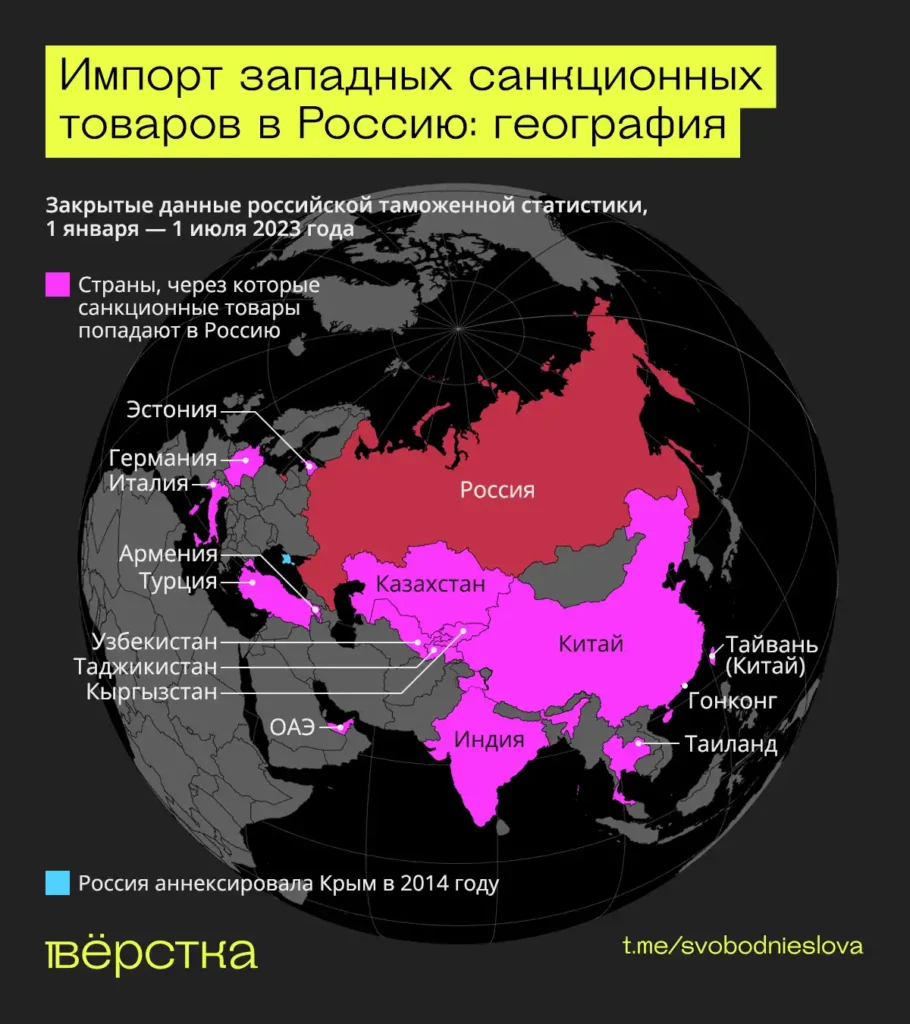
Now you can still bring anything to Russia, says businessman Sergei. He transports a variety of sanctioned goods to Russia, including car parts. There are always several route options, he says, through China, through Turkey, and through the countries of the former USSR. And there are also several payment options, he adds.
The payment method is an important element of any parallel import scheme, say importers interviewed by Vestka. One of the simplest and most effective options to pay for a relatively small purchase - up to several million dollars - is through offset. There is a certain organization with legal entities in Russia and several other countries. The client transfers rubles in Russia. And now a foreign company, registered in China, the UAE or generally in Kyrgyzstan, buys what the customer needs. “For example, we are currently working on a cargo that needs to be paid for in the Netherlands,” Sergei gives an example. — Everything is paid through Hong Kong. My friends have a company that has offices and warehouses in Hong Kong and here. I’m just giving them money here in Moscow, and then they’ll pay for everything through a Hong Kong company.” According to Sergei, his cargo will then be imported to Russia through Tajikistan.
This kind of “mediation” is also a business. A Russian company does not have the opportunity to register its own legal entity abroad. Then she will turn to those who will provide her with this service for a percentage. It costs from 1.5 to 5%, several people who earn money from helping pay for supplies from abroad told Vorstka.
More classic payment methods are also used - through interbank transfers. In the case of China, Russian importing companies sometimes don’t even need a layer. They can order goods directly from the factory, and transfer money using an invoice via SWIFT in yuan, one of the importers who works with China told Vorstka. But if you need to order something from Europe and the USA through China, then you will need a Chinese company that will order the goods and then supply it for re-export. But it is important that the beneficiary of this company is a Chinese, he says: “European companies, if you notify them in advance that the beneficiary is a Russian, they immediately refuse.” Often, such a company opens in Hong Kong, because money “flies” from Hong Kong to anywhere in the world in 24 hours, says the interlocutor of Vorstka.
However, not all Chinese banks accept transfers from Russia. A large one, for example, ABC (Agricultural Bank of China) will not get involved, because it is international, it has branches in the USA and Great Britain and it does not need problems. But smaller banks, “which are not well-known, some, say, Guangdong bank - they will gladly accept Russian money,” says Vorstka’s interlocutor.
Parallel import schemes work both ways. In the same way, Russian goods prohibited for import end up in Europe. For example, petroleum products. Since the start of the war, Russia has increased its exports of petroleum products to African countries by more than tenfold, according to a new report from S&P Global. They, in turn, re-export them to Europe.
Chinese trade route
China is Russia’s key hub for receiving sanctioned goods. Supplies from China in general provide a huge number of very different - not only military - needs of Russia. Including through the re-export of sanctioned goods from the USA and Europe. The example of China makes it clear how this works.
A Chinese company orders tractors from the United States - for itself or for further shipment to India, as one of Vorstka’s interlocutors, who works with China, gives an example. The goods arrive in Shekou and Guangzhou. These ports, he said, are known to everyone for the fact that “you can always reach an agreement there.” The ship enters the port, and the Chinese company suddenly decides that it has found another buyer - not India - or it can even refuse the cargo in favor of another buyer, and right there in the port these tractors are “transloaded onto other containers and re-exported to Vladivostok or Sakhalin, and then it’s already knocked down,” he says. As long as the goods have not crossed the duty free zone, that is, have not crossed the border or left the port, then everything can be resolved right on the spot. If he leaves him, then it will be much more difficult.
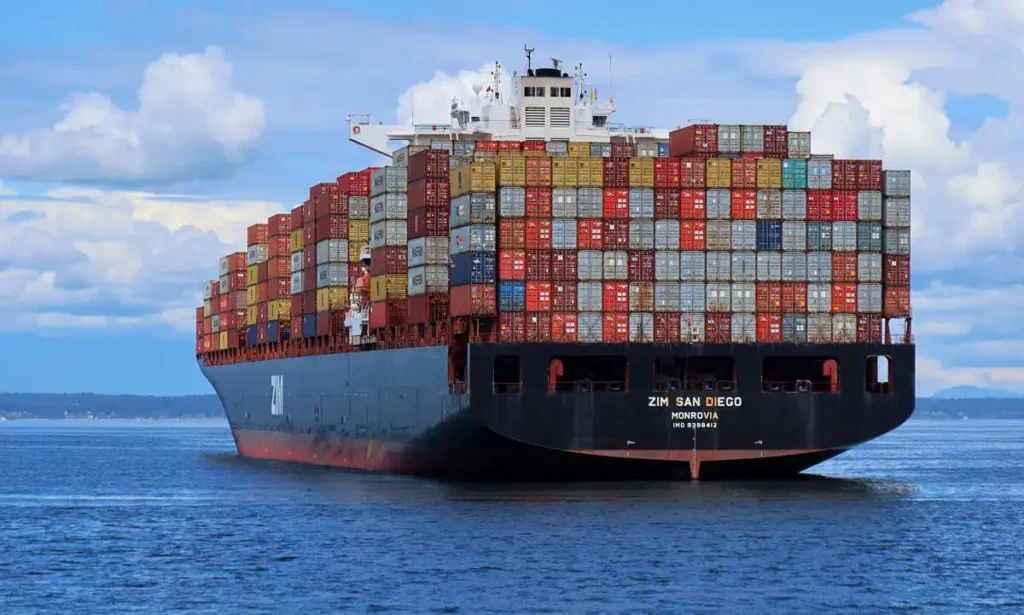
“And a foreign shipper from some Denver, who sent tractors to a Chinese buyer, fulfilled the terms of the contract, he sees that the Chinese company actually paid him everything, the shipowner sees that the cargo entered the port territory and was unloaded there. And it’s difficult to trace the ends further,” says the interlocutor of “Vestka”. “Because the container, say, Evergreen [in which the tractors were transported] went along other routes, and the Chinese container [in which the tractors were transported] went to the Far East to Sakhalin.”
According to him, now Russian Far Eastern ports are so loaded with Chinese ships that they are more reminiscent of inland Chinese ports. “You even tell the Chinese now Vladivostok. And he pretends that he doesn’t understand, and then: “Ah, Haishenwai!” (the area had this name until the middle of the 19th century, when it was under the control of China - editor's note). It wasn’t like this two years ago, but now they even correct you,” says the interlocutor of “Vestka”.
As an example of how re-exports can be controlled, the businessman cites the example of Japan. “There is the strictest control there,” he says. “They themselves double-check the destination of the cargo ten times and who orders it. They then even send their emissaries to the factories: “We sent you 10 boxes of such and such a product,” - they will come and check, did they really arrive at your factory, are they really installed? These are Japanese, these are pendants. And the America-China business, poof, cargo goes back and forth, and no one bothers.”
Russia actively imports Chinese products directly. Russian military volunteers and foundations work directly with the country and collect assistance for the Russian group in Ukraine.
Entrepreneur Roman Alekhin from Kursk says that since the beginning of the war, many companies have appeared in Russia that transport products from abroad for the Russian military, resell them to volunteer organizations, and they, in turn, deliver goods to the front. Alekhine is just one of these volunteers. According to him, “patriotic firms” are engaged in imports, and many import goods without extra charges. “Nowadays, none of the large volunteer groups purchase goods from retailers or through Avito, as was the case at the beginning of the operation,” says Roman.
From China, for example, drones, anti-drone guns, walkie-talkies, various spare parts, medical goods, anesthesia equipment and much more are imported, Alekhin lists. According to him, buying goods in China while being in Russia is now not much more difficult than buying something in Novosibirsk while being in Kursk. “In China there is a large group of runners, Russian people in every province of China. You call, say what you need, and they get it,” explains Alyokhin.
“Verstka” spoke with one of the entrepreneurs who transports goods from China for the needs of the war in Ukraine. Even before the outbreak of hostilities, our interlocutor, together with a Chinese citizen, registered a legal entity there, the main activity of which is construction. However, over the past few months, the company has been working not only on its profile, but also periodically purchases Chinese DJI drones for the Russian army. DJI drones are different: there are amateur ones, and there are professional ones that allow you to shoot from a long distance or even at night. They are used in a variety of ways. For artillery guidance, fire adjustment, reconnaissance, even for dropping shells. Most of the bird's eye videos you've seen from the war in Ukraine were most likely shot by DJI.
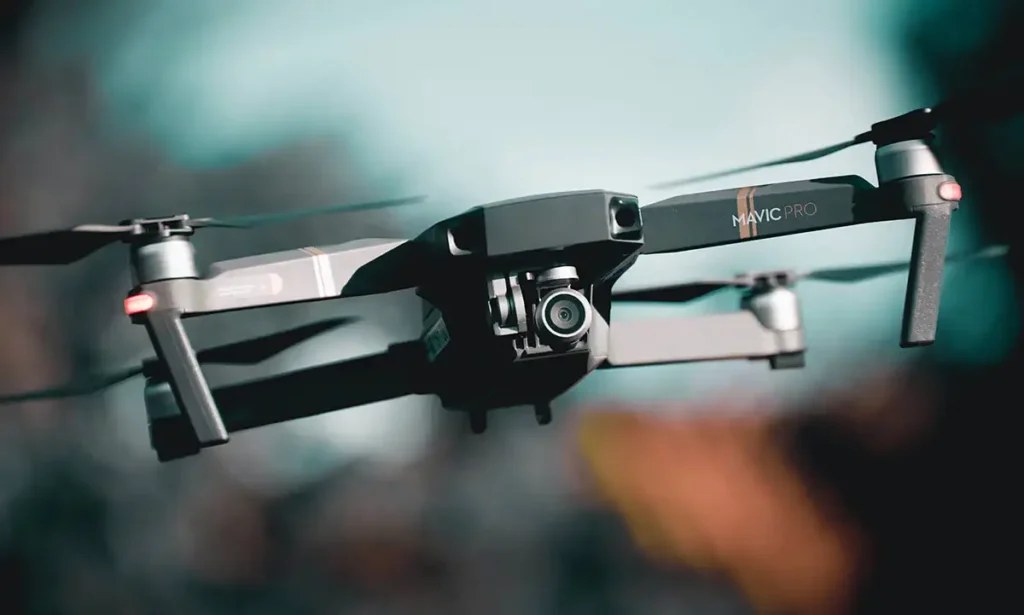
The drone manufacturer is the Chinese SZ DJI Technology Co., Ltd. — back in April last year, she announced that she would not supply her products to Russia. However, she freely sells them to Chinese companies, the co-founders of which are Russian citizens, several of our interlocutors say. Moreover, you can get a good discount if you order several batches. The most budget drone suitable for reconnaissance, the DJI Mavic 3, brought directly from China, will cost approximately 200 thousand rubles, say Vorstka’s interlocutors. This is almost two times cheaper than at retail - for comparison, at the official DJI retailer in Russia, Mavic 3 costs almost 345 thousand rubles.
In China you can buy not only drones, but also other equipment for war. For example, in general, all Russian communications depend on imports, our interlocutor notes. This is how our interlocutor describes the process of purchasing goods: “My guys came to the plant for the first time and went in there. There is a room there, a kilometer long, an exhibition hall. They look at prices, $150 for i [active] headphones. They want to buy. But when the Chinese find out why this is needed, they say: you don’t go through this door, you go through another one, and a Chinese must come. And there are the same headphones, only not in such beautiful packaging and without an American license - already for $19 when purchased in bulk.” Moreover, according to these rules, the Chinese trade not only with Russians, but also with those who support Ukraine. For example, our interlocutor says that he “came across the Poles at the next table” who were purchasing equipment and equipment for the Ukrainian army.
Most goods are imported into Russia officially, but in some cases importers have to work in the dark. “Many things, for example, walkie-talkies, are difficult to quickly certify [in Russia],” explains one of the importers. According to him, gray imports, that is, without customs clearance or according to the “left” nomenclature, are actively passing through Kazakhstan. “The fastest and worst delivery is road transport,” says another interlocutor of Vestka. In a simple car or a truck full of goods, several boxes of goods are simply disguised, which no one will notice or, by agreement, will turn a blind eye. “A lot of this crap” goes directly across the Russian-Chinese border, he adds.
Our interlocutor, who transports goods for the needs of the Russian military, does not make money from parallel imports. At first he carried goods only for volunteers. Then, he continues, the governments of several Russian regions contacted him. “We asked for our own, we supplied it. Then the *** region - I also fully equipped them with copters, helmets, thermal imagers,” he says. To speed up customs clearance, he uses his connections. “There are already contacts in the Federal Customs Service and senators. I’m bringing a shipment, I call and say that this needs to be cleared through customs, and they do everything for me within 24 hours,” he says.
Since the beginning of the war in Ukraine, the opinion has increasingly been expressed that sanctions against Russia are not working as intended. Russia is successfully bypassing them. In the latest, already 11th, package of sanctions adopted at the end of June, the EU included a mechanism for introducing restrictions on third countries that help Russia circumvent sanctions. He proposes, as a “last resort,” to limit the supply of goods to countries violating the sanctions regime.
Compared to last year, it has become more difficult to transport goods to Russia, notes logistics specialist Armen. Suppliers have begun to fight this. The fact is that manufacturing companies receive sales statistics by country. And suddenly, for example, they see that sales of their goods in Turkey have doubled. And then some companies, seeing such anomalies, may set limits on the sale of their goods to Turkey. “That is, they are already breaking the chain not directly to Russia, but through distributors,” he says. This is what happened with one of the companies whose goods were transported by the intermediary Right-flow. It is engaged in the production of geological equipment. In such situations, you have to find another country to transship the cargo, and this in turn leads to higher prices for the goods. Full export control to Russia is possible only with the involvement of private companies, Silverado experts also pointed out in their study.
Infographic: El
Alexander Atasuntsev, “Layout” Editorial Board