
Translated material
The birth of a Soviet woman
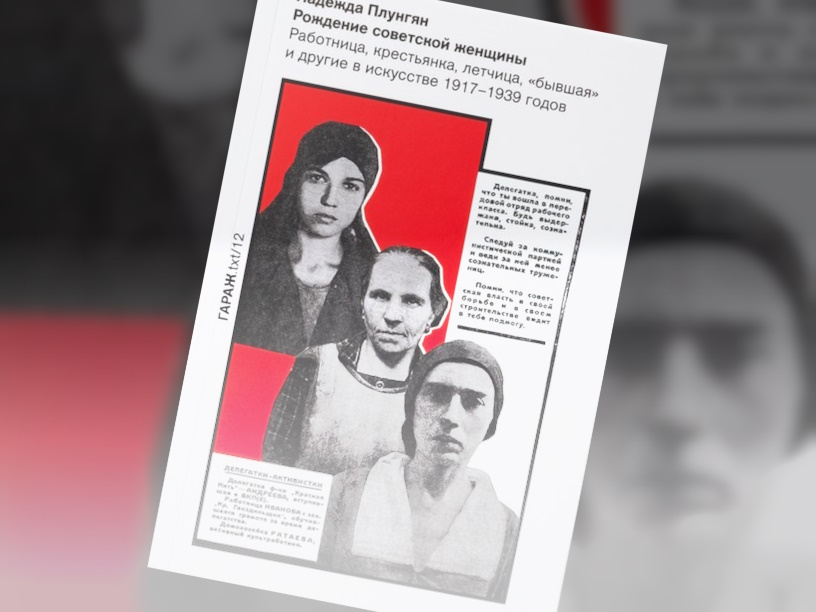
Polit.ru introduces readers with books included in the long list of applicants for the Enlightener Award of 2023. Twenty books of more than 130, put forward by various publishers, were selected into it. The short list of the Enlightener prize will be announced until the end of September.
The Museum of Modern Art “Garage” represents the book of Nadezhda Plungan “The Birth of a Soviet Woman. An employee, peasant woman, pilot, "former" and others in the art of 1917-1939. "
The book presents a detailed art history analysis of the whole spectrum of the types of “new woman”, designed by the Soviet regime in the 1920-1930 years. The author shows how closely propaganda and campaign tasks were intertwined with social changes and innovation in art, and also offers to look at the early Soviet gender reform as the basis of the variety of artistic decisions.
We offer to read the beginning of one of the sections of the book.
Flowers next to the lounges. "Wives of engineers" as a socialist showcase of the second half of the 1930s
A new turn of the pre-war party policy against women was the emergence of the so-called movement of the female community in 1936. Built into the general dynamics of socialist competitions, it was the personal initiative of the People's Commissar of Heavy Industry Sergo Ordzhonikidze and in many ways became part of the political campaign in his support. In 1934, during a trip to Uralmash, Ordzhonikidze visited a medical unit in Krasnouralsk and drew attention to the square arranged near the factory by the wife of the head of the substation Claudia Surovtseva. Having praised the idea, the People's Commissar noted that it should spread to the residential sector that needs to be “cleaned of dirt”, and therefore should be entrusted to other wives of leading workers to plant trees and flowers. In 1936, Surovtseva received an invitation to the first All-Union meeting of the wives of the commanders-Stakhanov’s heavy industry with the participation of Stalin, where she was awarded the Order of the Red Banner of Labor "as the initiator of the patriotic movement." The monument to this event was a huge (270 × 393.5 cm) picturesque canvas ordered by Vasily Efanov and known as the “unforgettable meeting” (“Party and Government Heads in the Presidium of the All-Union Meeting of Manager and Technical Workers of Heavy Industry in the Kremlin”, 1936-1937, GTG).
Efanov V. An unforgettable meeting (fragment). 1937–1938. GTG
Forgotten unforgettable
On the canvas of Efanov, a social activist is solemnly entered the gallery of Soviet types. This is an unremarkable young woman with her head uncovered, in a city dress. The features of her face are half -built, the main thing is not a character, but the plot: Stalin holds the heroine’s hand in his hands, they were surrounded by an applaising crowd of party members, the table of the presidium is forced by flowers. In the rays of irreal daylight, the light gray suit of Surovtseva compositionally echoes the dark gray jacket of the leader, also devoid of insignia. But if the role of the leader is known without explanation, then there is no instructions on her profession or social role, as if the reason for her appearance on the stage was precisely in the gender. According to G. Shubina, the picture is not so much a group portrait as a symbolic scene of the “rite of betrothal of the leader and people”, where much corresponds to the wedding scene, including the “presence of enthusiastic” parents, the role of which Kalinin and Krupskaya in the right corner of the picture take on. ” Krupskaya’s place on the canvas eloquently. Among the full forces of party heroes, he and Kalinin are represented by honored pensioners of the revolution, not busy in general action. In the symbolic marriage of Stalin and the “ITR Wife”, where “Stalin is Lenin today”, Surovtsev, undoubtedly, the new Krupskaya, corresponding to the era: pretty, enthusiastic and not claiming political participation. This message is strengthened by the clearly secondary images of the wives of government members: they look out from behind the spin of orderly husbands, lost among applauding hands.
The peculiar harmony of the erased “modesty” and the philistine-bell-shaped splendor reflected the aesthetic fracture of the second half of the 1930s with its neo-imperialism and nostalgia for the heavy-scale life of tsarist Russia with a strong emphasis on industrialization. The movement of the "wives" itself also reflected it. An obvious reference to early times, when the wife was the main social role of a middle -class woman, was combined in it with a demand for mobilization of women as labor. I think Efanov intuitively felt for the content of the method by which this eclectic movement began to advance to the masses: his picture was one of the first examples of the deliberate theatricalization of a historical event that replaced documentary in Soviet art.
A blurry plot that scatters the attention of the viewer is not accidental. It is no coincidence that - despite the name of the "unforgettable meeting"! - Its content was so firmly forgotten that so far it is still not really analyzed even in special texts about the picture: it is only clear that Stalin thanks and congratulates one of the Soviet women. The catalog of the exhibition “Agitation for Happiness” (1994) reports: “The reason was the reception” of the Presidium of the All -Union Congress of Women's Engineers and Technicians of Soviet Industry “Party and Government heads in May 1936 in Moscow. These women were concerned about the traditional distribution of roles between a man and a woman in social institutions and in factories. Izkefalia emphasizes the moment of equality. ” It seems quite logical that German art historians are confused in the corners of Soviet gender policy and accepted a meeting of the wives of engineers, landscaping factory courtyards, for the independent initiative of a certain All -Union Congress of women and technicians opposing discrimination in factories. Of course, such a congress would hardly have taken place under Lenin, but by the end of the 1930s, both the pre-revolutionary labor movement and the female movement were destroyed. Workers and workers were replaced by “Stakhanovites” and “wives”, who became only a tool of party control over husbands.
Male female movement
The movement of social activists had a number of strategic tasks: positioning as a lower thing, it was entirely controlled by the party. His Rupor, on the model of “peasant women”, “workers” and “communists”, became a specially created magazine “Social Code” - “The body of the People’s Commissariat of Heavy Industry of the USSR, the routes of the USSR, the food industry of the USSR, the light industry of the USSR”, and its installation texts were written not by the Zhenotdelovka, but by the People’s Commissars of Ordzhonikidze and Kaganovich. The target audience was also regulated. The authors of the magazine clarified that the “social activists” are precisely the middle class, that is, the “wives of business executives, engineers, workers-Stakhanovites”, as well as the wives of the commanders of the Red Army, professors, etc. “Wives” gathered in imitational activist structures, “tips of wives” who were attached to plants, construction sites and enterprises. The movement held meetings and congresses, including all -Union, had an internal hierarchy and its editions, also emanating from the Early University model. They published reports on the results of the work done and the memories of the exemplary “wives”.
Cover of the magazine "Social Code", 1940, No. 1
Among the duties assigned by the party on the wives of the ITR, the main thing was the “increase in the culture of life” and “production hygiene”. Social activists arranged “raids” at the factories, searched in the work “shortcomings” and the reasons for “disorganization”, after which they “took over the observation of cleanliness” of factory premises and jobs, organized canteens, shops and kindergartens at enterprises, drawn up clubs and rest rooms, led the repair, “brought into a cultural look” of the dormitory, raised worshipers, and established "Decaders of sanitary culture." The historian O. Khasbulatov remarks: “The problems that activists solved amazed their primitivism. <...> The thought does not leave why these purely industrial issues were dealt with by home housewives. <...> Why did <... men-leaders ”reconciled with ownerlessness, lack of culture, low level of organization and poor working conditions? There was not a word about this in the reports of the Soviets of wives. Although inattention to the needs of workers on the part of the People's Commissariat was evident. <...> There was an open substitution of production functions of officials. ”
In the journal "Social Code", the activities of wives are described as the heroic raking of "layers of dirt", familiar in the images of Okhmatmlad. An important difference from the 1920s is that, firstly, the “old world” unexpectedly turned out to be the era of the first five-year plan, and secondly, the “ITR wife” was not done by themselves. So, at the steam locomotive plant, their ideas (chrome the handles of drive mechanisms, hang silk curtains and washbasin in a steam booth) is realized by the designer of the plant, which the chief mechanic provides them. The clearing of the “drowned in the mud” is provided by the “head of the mine, housewives and workers”, with whom the wife “agree”, indicating the need to “restore order”. The cleaners are engaged in cleaning the sexes, who are instructed by the wives of the station commanders.
The wife of engineers
The main visual document that reflected the movement of the prisoners' wives was not so much a magazine as the luxurious export book of the Wife of Engineers (1937). Decorated with a portrait of Ordzhonikidze, his quotes and a special tab with chosen places from performances, the book became a tombstone of the People’s Commissar: in the same year, on the eve of the February-March Plenum of the Central Committee, Ordzhonikidze shot himself.
Elegantly mounted turns are not inferior to the magazine "USSR at a construction site." Here there are tabs-photo-historia, “boards of honor” and staged photographs about the ideal conditions of life of children, women and workers who use “now” attention and care. A monotonous emphasis on domestic comfort symbolically infantilizes heroes immersed in sick leave or sanatorium paradise of maternal custody. The epic story of the Semisilnaya worker, whose dream no one will be disturbed, ends with an exclamation: “There were no these snow -white beds, this peaceful rest of the guys did not work until the wives of engineers and technicians of Krasnoye Sormov started work! ..”
The wives themselves are also infantile, whose actions continue to be called activism, but do not differ from traditional female classes: they “consider toys”, arrange swings, children's matinees, musical and choreographic circles for girls at factories, “organize extracurricular leisure for the guys” - decorate the Christmas tree, and they show political consciousness in that, having read in the newspapers about the feat of the feat of the feat of the feat of the feat Papaninsev, "organize an Arctic room in a manger."
The title page of the album "Wife of Engineers", 1937
A decrease in the role of women in politics was also expressed in the new transformation of the holiday on March 8 - now it is a fertility holiday. “A wonderful gift by March 8 makes the plant to the women of the fifth galley workshop - a hygiene room. In this room, individual cabs are covered with Metlakh tiles, washbasins with hot water, medical consultation on female hygiene issues. <...> In comparison with January and February last year, the number of births has more than doubled. <...> The maintenance of pregnant women is organized directly at the factory. The services of women are a highly qualified consultation. Throughout the entire period of pregnancy, the employee is watching her and her workplace. ” The emphasis of the availability of “services” is closed with a heavy sensation of the human factory and a veiled, but strict requirement of the Stakhanov pace in production and reproductive work.
Invisible work
In many ways, the album of the People’s Commissariat of Heavy Industry (NCTP) illustrated the idea of the 1920s about the "new life", the organization of which will be assumed by the state. In all texts, impersonal forms are carefully, but persistently used, as if the work was done on its own: “A hearty, delicious breakfast awaits nursing mothers in a special room.”
The wives of engineers live like in a sanatorium: they do not prepare dinners, but “check the quality of dinners”; They “decorate the foyer of the new cinema”, “bring fresh newly, newly received newspapers to the rest room”, “bring workers, vacationers in cultural tickets, theatrical tickets”. In breaks, they “study with a cut and sewing in order to make their guys more elegant in order to sew their dress more beautifully. In the capitals and in new cities, there is a craving for this business by public men. ” In other words, by the middle of the thirties, the worker did not so much turn into a new person as she split into two personalities - a representative housewife performing at the congresses, and an invisible housekeeper. If the cook was supposed to be able to rule the state, then the ITR wife learned to oversee the workers and cleaners, to be “responsible”, but the lower boss, who will not compete with the male “guaranteed”.
Shor S. We learn to drive a car. Drawing from the album "Wife of Engineers." 1937
White
However, in the album, as in the magazine, the mentions of manual labor “wives” are constantly found: this is sewing linen, tablecloths, curtains, bags for dynamite (to help miners) or marshmallows (to protect against insects), “elegant embroidery” for kindergartens. The signature under one of the photographs reads: “The wives of the engineers of the Bolshevik plant in Kyiv sew bedding for exemplary hostels. <...> At one time there was a lot of hunters to equal about the fact that the wives of engineers would come to the hostel only as auditors and controllers - this did not happen! ” The text clearly contradicts the content of the album, but the illustration is more interesting: it refers to the suffrazhistic and revolutionary stories about women who embroider the banner, as well as to the early “red circles”, where peasant women were taught by political gram, attracting needlework lessons. Now the situation has turned over-attracting the “wives” by the illusion of socio-political activity, the party returned them to needlework.
Photo from the album "Wife of Engineers", 1937
Deineka A. Stakhanovtsy. A panel for the Hall of Honor of the Soviet Pavilion at the Paris World Exhibition. 1937. PGHG
The culture of the life of the era of poststructivism sought to freeze, to cover the specifics of the production process along with its shortcomings. The “boxed” architecture was lost behind the “elegant” elements, the niches and cornices of the buildings were filled with sculptures, the design of the machine was crushed by large plans for sparkling decorative details. Social activists hid the foundations of the Soviet female movement by a snow -white case: now it caused direct associations with court charitable balls or the visits of the Grand Dukes to prison or work house a . White color - the color of innocence, motherhood and hygiene - finally changed red in one more: the movement of wives was closed with the growing theme of the “Soviet aristocracy”, which received the disclosure in the huge (7 × 12 m) panorama of Alexander Deineki “Stakhanovites” for the Hall of Honor of the Soviet Pavilion on the Paris World Exhibition (1937). The panel was located between the smaller canvases of Alexei Pakhomov (“Children in the Country of Soviets”, 6 × 6 m) and Alexander Samokhvalov (“Soviet Sport”, 6 × 6 m). On an idealized group portrait of Stakhanovka and Stakhanovites in snow -white robes with orders go along Red Square at the head of representatives of Soviet nationalities: behind the light silhouette of the not yet built Palace of Soviets rises behind.
Earlier, in the “Slow Reading” section, the following books were presented, included in the long list of the Enlightener Prize:
Mikhail Velizhev. Chaadaevsky business: ideology, rhetoric and state power in Nikolaev Russia. - M.: New Literary Review, 2022.
Igor Lisov. Scouts of external planets: the journey of “pioneers” and “voyage” from the ground to Neptune and further. -M.: Alpina Non-Fikshn, 2022.
Alexander Mozhaev. The Great Posad of Moscow. The true story of Kitay-Gorod. - M.: Bombor, 2022.
Anton Nelikhov. Dinosaurs of Russia: past, present, future. -M.: Alpina Non-Fikshn, 2022.
Natalia to Oshoyan. Romanian myths. From slices and pharaohs to mummy Paduria and Dracula. - M.: Mann, Ivanov and Ferber, 2023.
Sergey Samoilenko. Probabilities and troubles. Mathematics of everyday life. - M.: Mann, Ivanov and Ferber, 2022.
Oleg Khlevnyuk. Empire corporation . Shadow economy and corruption in the Stalinist USSR. - M.: New Literary Review, 2023.
Oleg Shumakov. The kingdom of Cambodia. The prolonged journey of the zoologist. - M.: Fiton XXI, 2021.
Sergey Shumsky. Education of cars: a new story of the mind. -M.: Alpina Non-Fikshn, 2021.
Tamara Eidelman.The right to life. The history of the death penalty. -M.: Alpina Non-Fikshn, 2023.