
Translated material
Fatigue and disgust from work
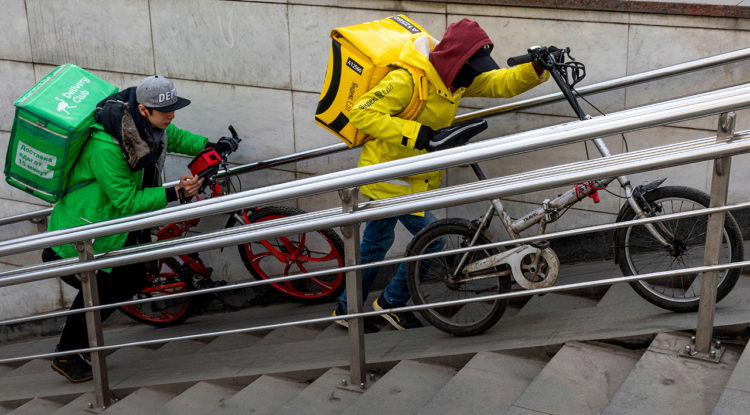
We tell you what the precariat is and why freelancing is not always your dream job
If you work informally or do not have a fixed income, you are likely to be part of the precariat. How do these working conditions relate to burnout and various protests around the world? Is it true that freelancers work less than permanent employees? telegram channel Katya Kiseleva answers these and other questions for Kholod Researcher and author of the “precariat” .
In order not to miss the main materials of “Cold”, subscribe to our Instagram and telegram .
What it is?
Precariat (precarious - “unreliable, unstable, risky”) are people who work in temporary jobs. Simply put, these are those who are not officially employed by the company. For example, self-employed people working under a civil process agreement or an offer agreement. Such people are socially vulnerable because they do not have the rights that full-time employees have: at their expense, an entrepreneur can save on taxes, pensions, vacation pay and health insurance.
The precariat is mistakenly called the new proletariat. However, the group of vulnerable workers may include people with completely different backgrounds, education and professional competencies. For example, these could be interns, retirees, creative workers, couriers, taxi drivers, call center employees, migrants and former prisoners.
The term began to be actively used by French sociologists in the 1980s. The transition to a global market economy required constant optimization from companies, which was reflected in the form of work: the classic career, when a person could work in one company until retirement, was replaced by short-term jobs with vague tasks and intricate names. For example, your grandfather was an engineer at the Vesna factory for 50 years, and you have changed seven companies over the past five years and worked your way up from an assistant to a junior creator to a customer service manager.
Massive conversations about the precariat began in 2011, after the publication of the book “The Precariat: The New Dangerous Class” by British economist Guy Standing. We will rely primarily on this work.
What classes is modern society divided into?
Standing identifies seven classes that make up the actual hierarchy: elite, salariat, professionals, workers, precariat, unemployed and socially disadvantaged.
The elite are the heroes of the Forbes list. The richest people in the world with enormous influence.
Next comes the salariat - full-time employees of large corporations and government employees. For example, top managers with a stable good salary, a full set of social benefits, corporate bonuses and the right to vote when deciding important issues in the company.
A step below are professionals (qualified personnel) - specialists with in-demand skills. They may work for themselves or act as independent consultants for high fees. This group includes, for example, art directors, IT specialists, founders of design or marketing studios, lawyers, and chefs. “They live in anticipation of something new and in perpetual motion; they do not need long-term, full-time employment in any one enterprise. Standard labor relations are not for them,” Standing writes.
They are followed by industrial workers (technical professionals) . These are, for example, auto mechanics, mechanics, carpenters, cooks, miners. They receive some social guarantees and feel their professional identity.
The same cannot be said about the next level of Standing's hierarchy - the precariat . People from this class lack stability, secure professional identity, and opportunities for growth. (But some sociologists still do not distinguish the precariat as a separate class, but speak of it as a group of people with different social characteristics who are united by labor instability.)
At the end there are unemployed and struggling people who have no jobs and no social security.
What are the main disadvantages of precarious work?
The main thing is that such people are not officially employed by the company . In this case, the employer does not guarantee the fulfillment of obligations established by law. For example, a person loses social support, his work experience is not taken into account, his pension does not accumulate, he cannot receive tax deductions, sick leave and vacation are not paid. There are no bonuses either. It is as easy to fire such an employee in one day as not to pay wages for months. But there are also consequences arising from such conditions.
The income of temporary workers is usually unstable and the work intensity is very high . Precaries rarely receive a fixed salary, more often they receive fees based on the amount of work or hours spent. This also includes the format of part-time employment, which in reality is never part-time. Temporary workers often work longer hours than regular workers.
The precariat is characterized by discontent and a sense of hopelessness : often their work does not cover even the basic need for security and only helps them physically survive. This quickly leads to mental exhaustion, addiction and apathy.
Standing pays special attention to the so-called work for the sake of work - the search for vacancies, which is accompanied by unpaid test tasks and a series of interviews.
You can also highlight status dissonance . It is faced by people who have received a higher education, but work not in their profession, but wherever they have to. In the English-language press and literature, such low-paying work that does not require special competencies is called a “McJob.” This was written about in The Washington Post back in 1986.
How do people protest against poor working conditions?
A wave of aversion to work (anti-work) arose as a logical, completely everyday reaction to something that does not coincide with people’s ideas about a good life. The precarious call for a rethink of the situation can increasingly be found in a variety of formats - from mass layoffs, strikes and art exhibitions to memes and ironic TikToks.
For example, in May, the Czech pavilion of the Venice Architecture Biennale presented the project The Office for a Non-Precarious Future. The authors ask, “How can architects design a better world if their work is part of a toxic work system?” According to a study on which the creators of the exhibition relied, about half of all young architects work as freelancers (that is, unofficially or without social guarantees), are constantly overworked and do not have a stable income.

Just six months ago, the Berlin gallery hosted the exhibition Class Issues - Art Production In and Out of Precarity. About 40 artists spoke out on the topic of class discrimination in the art environment. Can a talented author without a name claim the same opportunities in the industry as the conventional son of bohemian parents? What leads to success in the arts - an innovative idea or a successful background? The authors of the exhibition believe that the latter often outweighs so far and this is unfair.