
Translated material
Alternative to truth
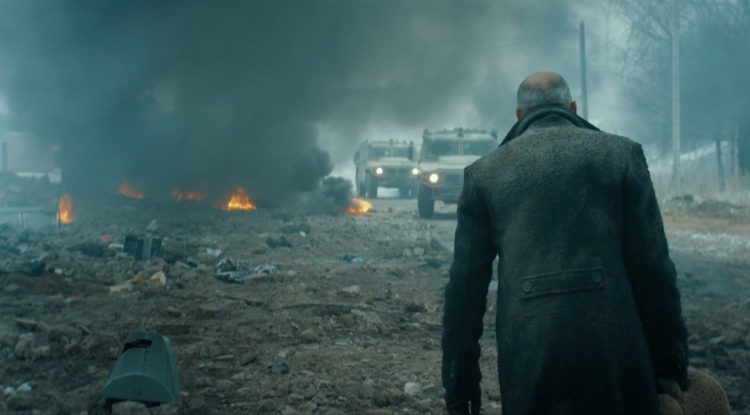
Producer Ivan Filippov read the synopsis of the propaganda film “Witness” so that you do not have to watch it
On August 17, the film David Dadunashvili “Witness” is released in the Russian rental - the first noticeable wire film shot in Russia after the start of a full -scale invasion of Ukraine on February 24, 2022. The producer and writer Ivan Filippov fell into the hands of the synopsis of this picture. Especially for the Cold, he tells a story that very soon can be seen on Russian screens, and makes assumptions about the rolling success of the picture.
In order not to miss the main materials of the "cold", subscribe to our Instagram and telegram .
The emergence of propaganda paintings about the "feat of Russian weapons" in Ukraine has always been just a matter of time. The need for such films spoke a lot and loudly both officials, for example, Minister of Culture Olga Lyubimova, as well as “patriotic” leaders of public opinion. Say, Zakhar Prilepin in his telegram channel and in speakers for state publications with enviable regularity complains about the lack of wire-sided works.
This year, the total amount of money that the state is ready to spend on supporting cinema and series amounted to more than 30 billion rubles. So much has never been in the latest history of Russia. That is, the situation at first glance is extremely simple: the state really needs films praising the war, and it has a huge bag of money that it is ready to share with any desire. In fact, there were very few directors who were ready to shoot agites about the war.
In order for the scale to understand - for 2022, 208 Russian films were released in the cinema rental: among them 18 animation, 17 documentary and 173 gaming. About the difficulties of Donbass and the war, the Ministry of Culture managed to find only 13 for all the time.
The film industry basically did not support the war. The vast majority of directors, actors and screenwriters either said nothing, or in one way or another - through Instagram, statements to the press or workshop collective letters - condemned the invasion of Ukraine. Many left, many were forced to suspend the work, finding themselves in unofficial stoplies or simply undergoing organized persecution from the Z-community. Be that as it may, significant names that are loudly and consistent in support of the war, there are not so many in the Russian film industry: actors Vladimir Mashkov and Anton Shagin (leading actor in another wire film, “militia” based on the book of Alexander Prokhanov), directors Sarik Andreyan and Eduard Boyakov, some of the scriptwriters, including the “witness” script for the scriptwriter. Sergey Volkov.
The "centrists" found a way to continue work. This method turned out to be extremely simple: to offer the audience uncompromisingly entertainment films, with which they can distract from sad reality. As a result, in the near future, dozens of family and romantic comedies, the adaptations of famous fairy tales and Soviet classics, stories in the genres of fantasy and science fiction are waiting in the near future. That is, all those genres that allow you to take the same state money, but not smack in the blood, since the experience of the film “Cheburashka”, which collected space 6.7 billion rubles at the box office, convincingly proved to all market participants that the money can be made on a peaceful escape movie.
And if, for example, to look at the results of the last public pitching, it turns out that without exception, all the Major company (that is, film companies receiving money from the state in a priority and having the right to “irrevocable funds”) to the Film Film were represented by films, in no way with the war and Donbass. And those few paintings that nevertheless praised the war were presented to the film companies of the second echelon.
The conversation about the “witness” will begin, perhaps, with the fact that in all public performances and statements the creators of the picture emphasize in every possible way - this is not a propaganda film, this is an attempt to “tell the truth” through an artistic statement. “Millions of people do not know the truth and, if we all be silent, they will never recognize her,” says Volkov screenwriter in an interview with 360TV, and RIA Novosti notes that he “has been in the Donbass.”
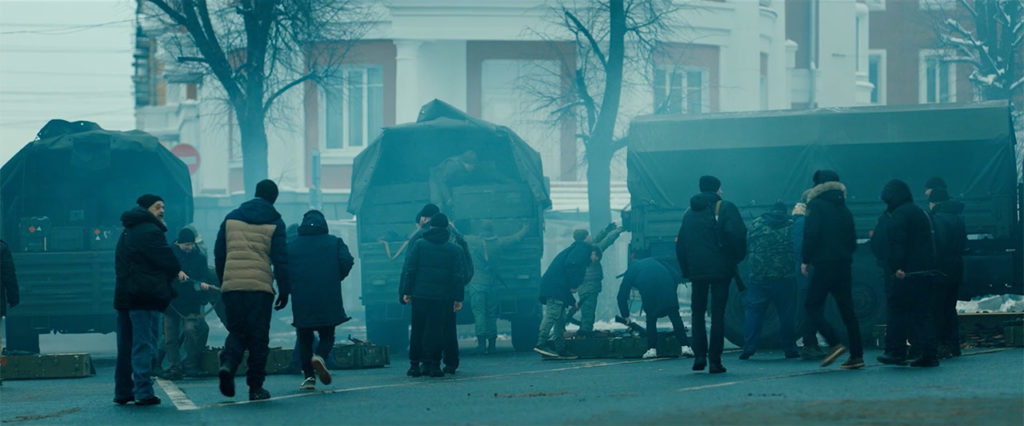
The director of the painting David Dadunashvili in a conversation with the same RIA is even more categorical : “After a brief presentation of the script, I replied:“ Yes! Yes, I have to take part and stay in the credits under my last name. ” I remembered the thesis: “Tell me, American, what is the strength? Is it in money? You have a lot of money, and why? I think that power is true: who is true, he is stronger!” ””
In order for Pravda to become even more true, the creators of the picture chose a protagonist, that is, the hero through whom the story is told, a man from the outside (they particularly emphasize) - a fictional character, Belgian musician Daniel Cohen.
The producer of the film Sofya Mitrofanova explains the hero’s choice as follows: “The team and I listened to the real, terrifying stories of people - real witnesses of events, from which we created a film. <...> Hearing the stories of people who survived all this, we created the story of the musician Daniel. According to the plot, he does not belong to any of the parties to the conflict, but he finds himself in his epicenter and becomes a witness. ” And in the commentary, all the same 360TV Mitrofanova says : “This is a dramatic film shown by the eyes of a person who does not understand the language, does not understand the motives of others. Initially, he does not occupy a draw of the side, but he is experiencing all the events. ”
“The film Dadunashvili will tell about the European musician who finds himself in Ukraine during the special operation of the RF Armed Forces and becomes a witness to the crimes of the Kiev regime against his people”-and this is already a quote from the ITAR-TASS agency that the Ministry of Cults of the Ministry of Channel summed up the results of the additional selection of “full-length films about global geopolitical and social changes in the history of modern Russia”. And according to the results of this most additional selection, the expert council “decided to recommend to the department of cinematography to include a project director David Dadunashvili and producer Sophia Mitrofanova“ Musician ”in the list of subsidies (that is, money from the state budget). So, by the way, until recently the film was called. The name was replaced, speculate in social networks, so that, God forbid, there were no associations with the PMC “Wagner”. True, the “musician” became “witness”, apparently, even before the rebellion of Prigozhin.
“The project was supported by the Ministry of Culture and Defense,” RIA Novosti writes in news of July 24, 2023. Actually, on this, it seems to me, the conversation could be finished: it is quite obvious which version of Pravda is supported by the Russian Ministry of Defense. Nevertheless, it seems to me important and useful to talk about the “witness” a little more.
My old comrade and a film industry colleague, who had already left Russia, shared with me an expanded (nine pages) by the Sinopsis of the Witness, from which you can learn many very interesting and eloquent details. And if it is impossible to talk about the artistic advantages or disadvantages of the movie before its release, then the idea of its content on the basis of this document can be composed quite complete.
So.
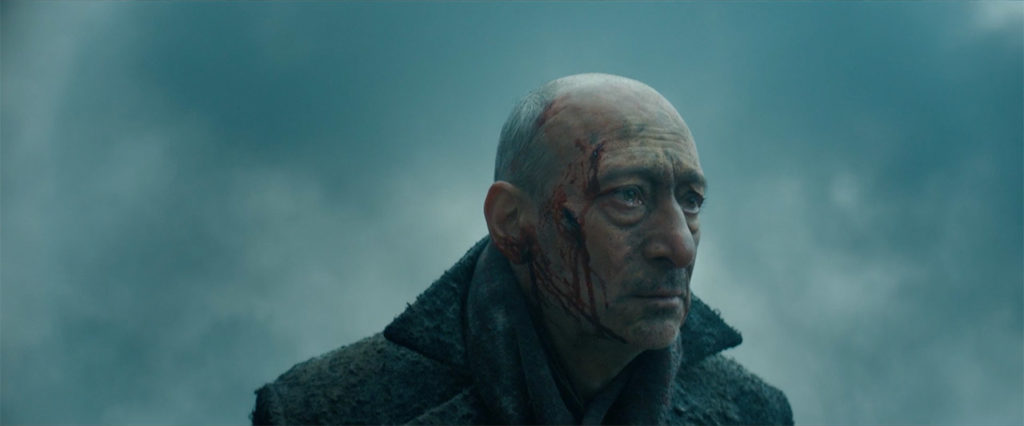
“Daniel Cohen, violinist virtuoso from Belgium, considers himself a citizen of the world, believes in good and justice. At the end of February 2022, he came on tour to Kyiv, and this trip will forever change his life. The events of a special military operation bring the musician to the Ukrainian village of Semidan, where he witnessed inhuman crimes and bloody provocations, ”the official description of the film in KinoPoisk says .
What do we see in an expanded synopsis?
The first thing that catches your eye is a list of references that the author Sergey Volkov gives for the convenience of the reader. Among them, not only the film “Watching” (Barry Levinson), but also the “Pianist” (Roman Polanski) and even the “Rabbit Jojo” (Taiki Waititi), that is, outstanding anti -war humanistic paintings banned in Russia. Well, then the story itself begins.
The main character from the music festival in Moscow arrives at Kiev- to play at a party at which the entire business and political elite of Ukraine is present. “Submitted to music, Daniel does not pay much attention to either the people around him or their conversations, although they talk about the upcoming offensive operation of the Armed Forces in the Donbass.”
Again, already in this place you can stop reading: the statement that Russia was forced to start a “special military operation”, because Kyiv itself was preparing to attack the Donbass-this is the cornerstone of not only Russian propaganda. In this, the whole world is regularly trying to convince that President Putin, that the head of the Foreign Ministry Sergei Lavrov. True, evidence of this statement was not either.
“The next day, Daniel wakes up in the hotel from the sounds of sirens - the Russian special operation for denacing and demilitarization of Ukraine has begun.” The author describes the situation in Kyiv: chaos, "parts of territorial defense are organized everywhere, many men and women who have changed into military uniforms instantly appear, weapons are uncontrollably distributed to them." The satellite of the protagonist Brigitt “perceives everything that is happening with enthusiasm - she believes that this is the real democratic resistance of“ Russian aggression ”, the true triumph of the“ civil society of Ukraine ”and the“ European spirit ”.”
“In Kyiv, shootouts take place every now and then - people who have received weapons, get scores with long -standing offenders, the detachments of“ patriots ”rob shops and jewelry shops, the city is struck by spy -addiction. Everyone catches “Russian saboteurs”, taking for them the janitors, “layers”, adolescents drawing graffiti, just passers-by, carefully taking something on the phone, and even owners of ultraviolet phytolamps for plants. Often the reprisal against “saboteurs” occurs right on the street. ”
“Daniel, a man of art, in horror from everything that has seen - there are still no“ hordes of Russian orcs ”, about which local propaganda constantly broadcasts, and bloody chaos and confusion are already reigned in Kyiv. At one of the checkpoints Daniel and Brigitte, they are detained and actually robbed, taking money, a laptop, Daniel's jacket. The indignant Bigitta begins to shoot what is happening on the phone. The Terbatovites immediately accuse her and Daniel of espionage, take away phones, documents and put “on the basement”. ”
I do not want to unnecessarily quote the entire synopsis in detail, it is enough to say that in the whole history the Ukrainian military, Ukrainian authorities and separately Ukrainian Teroborne are represented consistently by villains. There is practically no Russian army in history, this author emphasizes separately, describing the process of evacuation (of course, related to the cruelty and corruption of the TERBATS) of peaceful people from Kyiv: “Daniel sees the trampled people who have lost children, defeated wagons. At the same time, there are no “Russian invaders” anywhere, the main enemy of people is propaganda and panic. ”
Planted by the villains from the train, the protagonist with a violin wanders through the fields until he finds himself in a small town (fictional) seven -prove in the Kyiv region. Here, at the headquarters of Terborne Terborne, “Daniel sees different people, including foreign instructors, sees Nazi symbols and, after a“ convincing ”request, plays the anthem of Ukraine for the National Banits.”
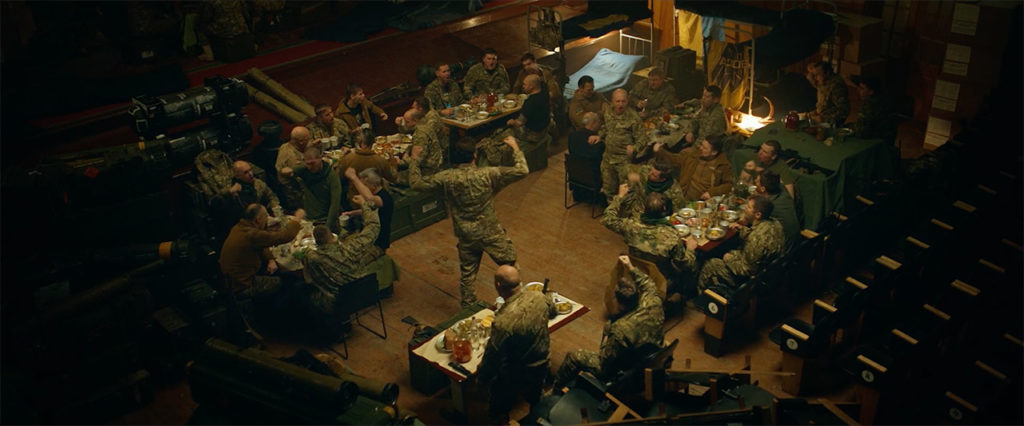
Further, our hero suffers with other residents of the seven-inversions from the atrocities and permissions of the Ukrainian “National Baby”, meets the girl Yana (the teacher of the German language) and her little son Misha and finally-again with other civilians-is at the station in the new evacuation (by this time the “National Banits” had already raped and killed ”). Russian tanks go to the city, and all residents are ordered to leave. Here, at the request of the commander of the “National Banits”, Daniel gives an impromptu concert for frightened citizens.
“Daniel draws attention to the incredible silence prevailing in the seven -divers in between the compositions. And in this silence, his unique hearing distinctly distinguishes the distant, characteristic rustling sound that turns into a buzz-this flies a “point-u” missile, and, judging by the strengthening of the sound, flies precisely in seven-prove. The score is several tens of seconds. ”
This episode completely repeats the tragedy at the station in Kramatorsk, when in April 2022 the rocket hit people waiting for the train for evacuation. Then at least 58 people and hundreds were injured were killed. The Human Rights Watch (HRW) international human rights organization, together with the Situ research group, conducted a thorough investigation of this episode of the war, which took 10 months and included a “thorough analysis of material evidence at the scene of the incident, interviews with the victims, those who survived, members of the deceased, rapid response groups and others; as well as analysis of video and satellite images. ” HRW and Situ came to the conclusion that the attack on the civilian population in Kramatorsk "was committed by Russian troops using a ballistic missile equipped with a cassette warhead."
In the script of the Witness, of course, the history of this tragedy is different.
Daniel turns out to be the only survivor in a terrible explosion. “Daniel discovers Russian intelligence at night. One of the Specanazov officers recognizes in the wounded, dirty, semi-slaughter man the famous musician Daniel Cohen: the special forces' wife is a big fan of classical music, and he was at a concert in Moscow. Daniel is assisted, evacuated to Moscow, then to Brussels. ”
The film ends with the scene in which Daniel should speak to journalists and tell them about what he saw: “False from journalists from different countries, many cameras. The host reports that the famous musician Daniel Cohen miraculously escaped from hell, arranged by the Russians in the town of Semidan, and now he will talk about how Russians kill civilians in Ukraine. Daniel plants a bearish man next to the microphone and says a deaf man with a high voice: “Yes, I’ll tell you now. I’ll tell you the truth. I have lost his hearing, but not a conscience.”
Perhaps the most obvious paragraph from the entire Sinopsis of the “witness” is as follows: “Daniel is solemnly met in the Ministry of Culture of the European Union, the media have already made it a hero. Daniel accidentally sees the release of Euronuis news. The announcers talk about the tragedy in the small Ukrainian town of Semidan, which is in a strange “coincidence” name with the English word Cemetry, that is, the “cemetery”, just like the name of the village of Bucha is called up with Butcher, which means “executioner, butcher”, and the name of the city of Kramatorsk, where the “point-U” struck at the station was also struck, Crematory, which means “crematorium” - so, on associations, Western propaganda works. ”
And perhaps there is probably no question about what kind of “truth” is going to tell the audience to the audience. It is this version of events for almost a year and a half that all Russian propaganda channels, from central television and Russia Today to Z-channels in telegram, broadcast. The most interesting question is different: what fate awaits the film at the box office?
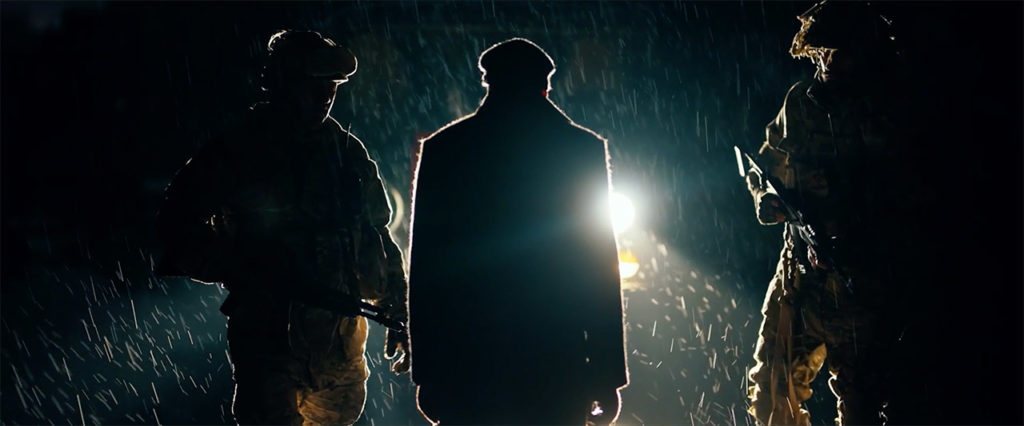
On the one hand, the Russian rental today is the fulfillment of the eternal dream of ex-minister of culture Vladimir Medinsky: no Hollywood films. That is, there is no competition and the viewer who really wants to see something new, including some paintings that he would not pay attention to in previous times. These circumstances clearly speak in favor of the assumption of the success of the “witness”. On the other hand - and this factor is seen much more important to me - the viewer does not want to look about the war. About Cheburashka - yes. About a peaceful life, which is very similar to the previous one, is necessary. About fairy -tale worlds or distant planets - undoubtedly. But about the "crimes of the Kyiv regime", about which he hears daily from each refrigerator ...
And in this sense, it is not by chance that the main wire-wire Z-channels and figures connected in one way or another related to the culture: “Voice of Mordor”, Alexander Frank , Peter Lundras, Marina Yudenich, “Media Kinese, Fuck You Torats” joined the promotion of the “witness” . Why, Roman Nosikov, “Cultural Front Z”, “OSSIN NECED”. For them, the success of the “witness” is very important, because it can be used as evidence of the support of the Russians of war. It’s not that far from the fact that the audience weary of military propaganda will want to watch it in the cinema, and even pay money for it.
The author’s opinion may not coincide with the opinion of the editorial office.