
Translated material
“The Investigative Committee is always nearby” - Layout
“The Investigative Committee is always nearby”
Anna Ryzhkova in collaboration with the Kidmapping project August 6, 2023 |In August 2022, the Investigative Committee brought dozens of teenagers from Donbass to its cadet corps. We tell the stories of Ukrainian children who are being trained as investigators in Russia

After the start of a full-scale invasion of Ukraine, the Investigative Committee, headed by Alexander Bastrykin, took patronage over children taken to Russia from the occupied territories of Ukraine. Investigators began visiting social institutions where Ukrainian orphans and children without parental care were temporarily placed, bringing humanitarian aid and giving gifts. And the head of the committee immediately instructed the departmental cadet corps to prepare to receive schoolchildren from the so-called DPR and LPR. By September 2022, more than 40 children from Donbass, including those with orphan status, had donned the cadet uniform. “Vorstka”, in collaboration with the “Kidmapping” project, found out what is happening to these children.
The names of the minors with whom “Verstka” spoke have been changed.
In order not to miss new texts from “Layout”, subscribe to our telegram channel
“This is Moscow”
In July 2022, fourteen-year-old twins Nikita and Denis were going to kickboxing training in their native Donetsk. Their grandmother, who was raising the boys alone, suddenly received a call from the school principal, and the telephone conversation dragged on. Nikita and Denis did not catch what they were talking about. While seeing the twins off to practice, the grandmother warned them: “When you get back, you’ll need to talk urgently.”
In the evening, the brothers learned that the school director invited them to submit documents to one of the cadet corps of the Investigative Committee and go to study in St. Petersburg or Moscow.
Cadet corps are educational institutions where children, in addition to the school curriculum, undergo initial training for military or public service. Cadets not only study in the corps of the North Caucasus, but also live. For orphans or children left without parental care, separate quotas are allocated in the cadet corps of the UK.
“The three of us sat down, started discussing what our plans were, and decided to agree,” recalls Nikita. — We chose Moscow because it’s closer and better. This is Moscow."
The next day, the boys woke up at eight in the morning and, together with their grandmother, “went to all authorities” in order to have time to collect a package of documents and a personal file. According to Nikita, they were given a day and a half to do everything . They were “very afraid of not being able to make it in time and by the evening they were completely exhausted,” but they submitted the documents on time - certificates from doctors, information about academic performance and school achievements. The brothers waited for more than a month for the results of the selection; they were worried that they would not be accepted. And in August the answer came: the brothers were enrolled.

At the end of August 2022, the twins went to Russia along with other eighth and ninth graders from the Donetsk region, who, like Nikita and Denis, applied and were selected. All of them were accepted into the cadet corps without entrance exams. The bus with teenagers, according to one of the parents, was accompanied by traffic police. In the Rostov region, the group split up: some of the children continued their journey to Volgograd by bus, and some flew to Moscow on a special plane.
A few months after getting to know the metropolis and cadet life, Denis will post a photo on Vkontakte with the chairman of the Investigative Committee, Alexander Bastrykin, who hands him a Russian passport. And Nikita will put a status on her page: “My life is Russia.”
“We will help you, support you”
The Investigative Committee became interested in the children of Donbass after 2014, when hostilities began in eastern Ukraine. Schoolchildren from the Donetsk region, for example, could apply for places in educational institutions of the Investigative Committee - teenagers from socially vulnerable groups passed a competitive selection and entered the Khimki boarding school of the Investigative Committee. Children who needed medical care were sent to the Moscow Roshal Clinic. But after the full-scale invasion of Ukraine by the Russian army, the Investigative Committee literally took patronage over the children of Donbass.
Investigators went with gifts and humanitarian aid to Ukrainian children, including orphans, taken to Russia - and visited them in at least 10 regions of the country , Vorstka counted together with the Kidmapping project. The project records information about the likely location of children taken from Ukraine in Russia, Belarus and the occupied territories and places the data on a map .
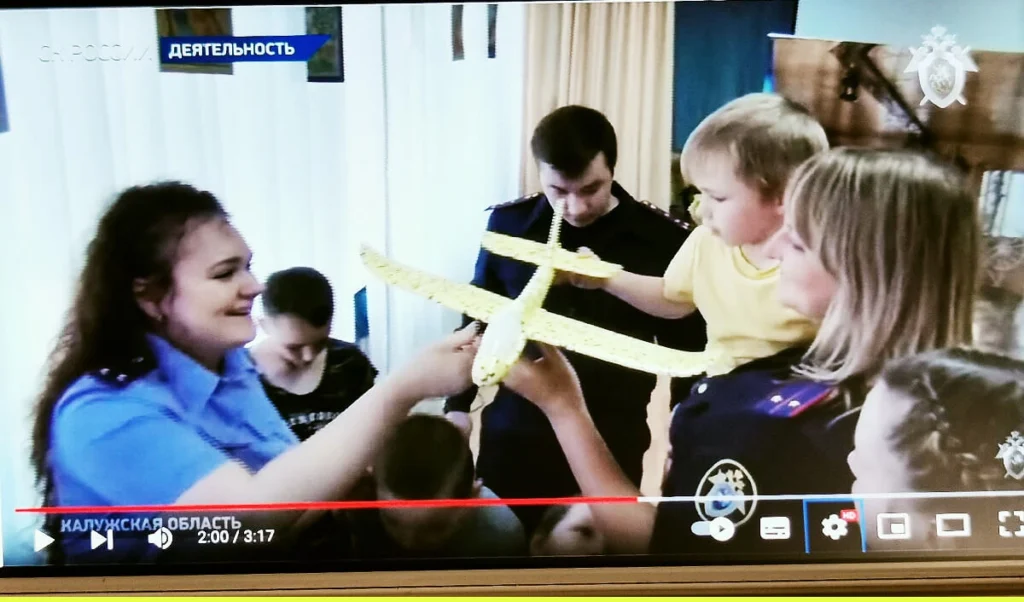
In the Kursk region, Investigative Committee officers helped orphans from the “DPR” get ready for school. Investigators came to schoolchildren evacuated to Nizhny Novgorod with balls, jump ropes, exercise equipment and table tennis rackets and played a game with the children. Bastrykin personally visited a group of Donbass children at the Roshal clinic - he came into their rooms and gave them soft toys. In various social institutions, Ukrainian children greeted investigators with concerts and performances.
The Investigative Committee staff told school-age orphans about cadet corps and cadet classes where they could go to study .
When mentioning Ukrainian minor citizens, representatives of the Investigative Committee often uttered the favorite motto of Children’s Rights Commissioner Maria Lvova-Belova: “There are no other people’s children.” The Ombudsman herself has more than once thanked the Investigative Committee for its help with the removal of children - for example, for the fact that they transported a group of minors from Mariupol to the Moscow region, among whom was her future adopted son Philip. By the way, according to Lvova-Belova, he plans to work in the judicial system and has already entered law college.
According to data published in the printed magazine of the Investigative Committee, from February 2022 to March 2023, department employees removed 323 children from the Donetsk, Lugansk, Kherson and Zaporozhye regions, including 181 orphans. 78 children entered educational institutions of the Russian Federation, including cadet corps and academies of the Northern Caucasus (28 orphans).
Under international law, the removal of minors to the territory of the aggressor country is in itself regarded as forced displacement anda crime against humanity . The International Criminal Court in The Hague (ICC) issued an arrest warrant for Vladimir Putin and Maria Lvova-Belova specifically for the illegal movement of children.
According to a report by the American New Lines Institute for Strategy and Policy and the Canadian Raoul Wallenberg Center for Human Rights , cases of orphan exports can be used as evidence of genocide. But the UN commission of inquiry stated in March 2023 that the international crimes that were committed against Ukrainian civilians were not motivated by genocidal intentions. The commission will continue to examine the evidence.
On Children's Day, June 1, 2022, Bastrykin performed at the Bolshoi Theater in front of schoolchildren from socially disadvantaged groups, including those who arrived from Donbass. He warned the children that the future of the country, “its power” and its “new victories” would depend on them. But he reassured: “The Investigative Committee is always there. We will help you and support you."
“Learn skills useful for a future wife and mother”
At this time, the cadet corps of the Investigative Committee in Moscow, St. Petersburg and Volgograd were already in full swing preparing to receive minors from the so-called DPR and LPR - Bastrykin instructed them to do this on February 25, the day after the start of the full-scale invasion of Ukraine.
On the eve of the Day of Knowledge on September 1, 2022, the press service of the Investigative Committee showed the faces of future cadets from Donbass - a story about them was published on the official Youtube channel of the Investigative Committee. Alesya Chalaya, an eighth-grader from the Lugansk region who entered Moscow, in a uniform and with large white bows, sits at her desk and talks about her dream profession.
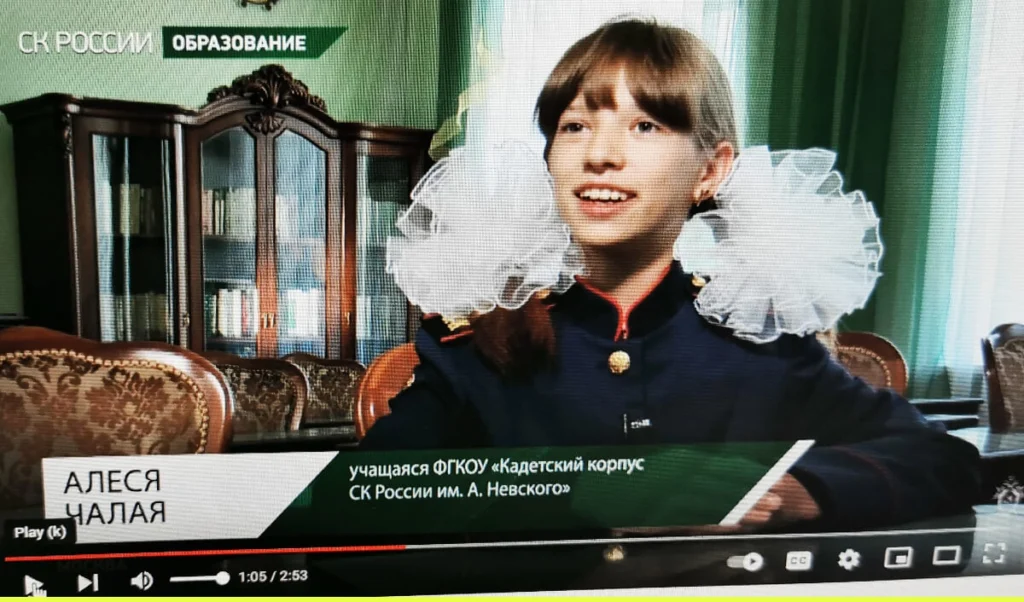
“I’m very happy, because I entered an institution where in the future I will be prepared for the Academy of SK. I hope that I will pass everything successfully and become a very good investigator,” says Alesya.
In the same story, another schoolgirl from the Lugansk region, Maria, is taken by an officer into a classroom with fabrics and balls of thread - the needlework room of the St. Petersburg boarding school for female students of the Investigative Committee. “Here, in the northern capital, Maria will continue her studies, and will also learn new and very useful skills for her future wife and mother,” says the voiceover.
On September 1, 2022, Bastrykin arrived at the boarding school where Maria was admitted from Lugansk and greeted the new wards from Donbass at the ceremonial assembly. Congratulating the students on the start of the school year, he suddenly assured them: “The Investigative Committee is fundamentally investigating the crimes of Ukrainian nationalists against the civilian population of Donbass and Ukraine, and all those responsible will receive the deserved punishment.”
The bell rang, the vocal ensemble “Girls” performed patriotic songs, and then the boarding school students presented Bastrykin with a wooden panel depicting the coat of arms of the Investigative Committee, which they had made for him with their own hands.
“I resisted, but gave in under pressure. This chance comes once in a lifetime."
When asked how many girls from the occupied territories were accepted into the boarding school, the press service of the SC “Verstke” did not answer. In September 2022, the Investigative Committee reported that 43 children from Donbass began studying in all departmental cadet corps in the fall of 2022. Most of them were not included in the official lists of admitted children published on the website.
“Verstka” identified 12 teenagers from the occupied territories who marched on the parade ground and studied the basics of law in Moscow, Volgograd and St. Petersburg.
Cadet Alexey from Makeevka, who entered the capital's cadet corps of the SK, says that every week he and his classmates begin by raising the flag to the Russian anthem. “We sing it with the whole corps on Mondays at 8 am. To be honest, at first I didn’t even know the words. I had to teach it, but I learned it quickly,” says Alexey to Vorstka.
Lyosha is an orphan, he is raised by his grandfather. In Makeevka, a schoolboy played for the city football team. He regarded football as “the main goal of life.” But after the start of the “special operation in Donbass,” as Lyosha says, regular training was interrupted. “It became clear that if I went to the cadet corps, I would have to leave football. But I had to agree, because I realized that in Moscow, especially in such an educational institution, there are great prospects . This was the best choice,” the boy told Vorstka.
Now Lyosha has a six-day workday, his schedule includes the basics of law and Chinese.

Ninth-grader Vlad from Donetsk, who went to Volgograd, had the hardest time learning Russian history.
“We only became part of the Russian Federation a year ago and used to study world history,” explains his mother.
The schoolboy, the eldest child in a large family, studied remotely before entering the cadet corps of the UK due to shelling in Donetsk, so his mother dreamed of a better education for her son. Vlad himself dreamed of becoming a cook or pastry chef.
“He’s my family child, until recently he didn’t want to join the cadet corps, he resisted, but gave in under pressure. Such a chance is given once in a lifetime, and you have to try it so that you don’t regret it for the rest of your life ,” Vlad’s mother told Vorstka.
In September 2022, a home child in Volgograd experienced the barracks regime of the cadets of the SK: early rise, strict curfew, formations, dismissal once a week and a mobile phone on a schedule.

Nikita from Donetsk, who was sent to Moscow by his grandmother along with his twin brother Denis, says that at first he felt uneasy with the people in uniform around him.
“At first it was even scary - everyone is in uniform, but you don’t understand anything. What if you do something wrong and they will scold you,” he says. He admits that he only learned on the spot that cadets were gradually being trained to become investigators.
“FSB, prosecutor’s office, everything. And you can even become a judge, if I’m not mistaken,” says Nikita.
Fourteen-year-old Andrei from Shakhtersk, who together with his brother was accepted into the Moscow Cadet Corps right in the middle of the year, was surprised that every lesson must begin with a formation.
“I haven’t yet understood what this is for and why you can’t just sit down at your desk when the bell rings, like normal children ,” he told Vorstka.
The press service of the Investigative Committee did not answer journalists’ questions about the life of children in cadet corps.
“Accept the fate of the fatherland as personal”
But among Donbass children there are those who like discipline.
Fourteen-year-old Sasha from Gorlovka, like Nikita from Donetsk and Andrei from Shakhtersk, was selected into the cadet corps along with his twin brother. Now they live together in Volgograd. The local newspaper “Kadetsky Vestnik” wrote about the brothers as witnesses to the horrors of war and victims of the “aggression of the Kyiv regime”: a shell fell near their house. Now the brothers are “learning the basics of military service.”
Sasha told Vorstka that during classes called “Be Prepared to Defend the Motherland,” they were taught how to assemble and disassemble a machine gun. For their academic success and exemplary discipline, the twins received the title of senior cadets in May 2023 - and this was the highlight of the year for them.
Among the values that appear in the statutory documents of the cadet corps of the UK are “loyalty to the Russian Federation” and “respect for public service.” The educational program describes the “ideal personality” of a child: he must not only be highly moral and creative, but also “ accept the fate of the fatherland as personal ” and be rooted “in the spiritual and cultural traditions of the Russian people.” According to the same canons, Ukrainian children also live in the cadet corps.

For example, Alesya from the Lugansk region, whom the Investigative Committee filmed in their story on the eve of Knowledge Day, participated in a civil-patriotic forum called “Russian Pride - Our Native Power” and, together with her classmates, made a presentation on the topic “My Beloved Fatherland.”
Extracurricular activities in the buildings are also centered around wars in which Russia participated. Since 2022, children have been told about the heroes not only of the Great Patriotic, Afghan and Chechen wars, but also of the “special military operation.”
In February 2023, cadets participated in a scientific and practical conference on “young anti-fascist heroes” and understood , according to the report, that they need to preserve the memory of their exploits and “counteract attempts to falsify history.”
In March 2023, Volgograd cadets of the Investigative Committee collected hygiene products, food and clothing for the Russian military who are fighting in Ukraine. Students sent them letters to the front.
At the end of the school year, students from the SK boarding school in St. Petersburg, which also included girls from Donbass, were sent to do internships in labor units in a hospital where “war veterans” are treated, including those wounded in the war with Ukraine.

Lawyer and international lawyer Olga Gnezdilova, who got acquainted with the extracurricular activities of the cadets of the UK, called such education “indoctrination” (indoctrination of ideas that does not involve critical perception - note “Layout”) and a violation of the International Convention on the Rights of the Child , which is still in force in Russia.
“Article 29 of the Convention states that the education of a child must be aimed at respect for the child’s parents, his cultural identity, his language and his country of origin,” says the lawyer. “No matter how much the state cares about the adaptation of Donbass children to the new reality, it is obliged to maintain respect for their country of origin. And measures to support those who are fighting against Ukraine, of course, contradict this. Children who were taken from Donbass retain this connection with Ukraine, at least through relatives, through childhood. This is a clear reforging.”
Another purpose of education, according to the International Children's Convention, is “to prepare the child for life in a free society in the spirit of understanding, peace, tolerance and friendship among all peoples.” Gnezdilova believes that this principle is also violated in cadet corps when they talk about a “special military operation” in lessons or extracurricular activities.

The lawyer emphasizes that consent on the part of parents or guardians - and all the children with whom “Verstka” spoke were admitted to cadet corps with the consent of relatives - cannot justify unethical or illegal actions against children.
“In Russian and international law , everything is subordinated to the interests of the child,” she notes. — Is it in the best interests of a child to face a difficult ideological conflict? And he inevitably encounters it when he is told that it is normal to fight with the people of the country in which he was born. Being in a dependent position, without parents, in a foreign country, he must agree with what the leadership of the cadet corps considers correct. Indoctrination of children in the education system is a powerful tool, it really works. The younger the child, the easier he absorbs ideological principles. The state will take advantage of this.”
The press service of the Investigative Committee did not respond to Vorstka’s request about how education in cadet classes is combined with international education standards.
“It’s a shame that I didn’t spend this year with my grandmother”
All the teenagers from Donbass with whom “Verstka” was able to talk admitted that the most difficult thing for them to endure is separation from home. Despite the fact that many children with orphan status study in the cadet institutions of the UK, as do some of the Donbass children, local students still have someone to go to during layoffs every week.
Teenagers from the Donetsk region who entered the Moscow cadet corps say that on their days off the teachers tried to come up with some kind of entertainment for them - for example, they could take everyone on an excursion or take them to a museum.
Children from Donbass were allowed to use touch-sensitive mobile phones, while other cadets could only use push-button ones. “Because others can see their loved ones during furloughs, but we only have video meetings,” explains Andrey from Shakhtersk.
On weekdays, only 15 minutes are allocated for talking on the phone, says Alexey from Makeevka. “The first month was especially difficult,” he says. “I was bored, but there was no time to talk.” Every night before going to bed you think how much you want to get home faster.”
Many saw their relatives only during the holidays, when Donbass children were taken home by accompanying persons. But some relatives themselves came to Moscow to meet the child. At the end of the school year, in May, Alexey’s grandfather came to see him from Makeevka - they rented an apartment not far from the cadet corps, walked together and went to football.

The grandmother of Donetsk twins Nikita and Denis decided to visit the boys early. She went to them in December 2022 to spend the New Year holidays together.
Nikita says that she and her brother were very bored, but they knew that their grandmother was happy for them and brags about them when in Donetsk they ask her where the boys are.
On the eve of the meeting, the mother of Nikita and Denis’s classmate helped them rent an apartment - in a high-rise building, on the 31st floor. The brothers almost got lost when they got to their rented accommodation for the first time - Nikita says that it was difficult for them to figure out the metro transfers.
“It was with great sorrow that we found it and unpacked it. We were so happy!” - the boy recalls.
They met and talked. In the evening, grandma went to bed, and the twins could no longer wake her up. “On the first day of the holidays, my grandmother died. She probably didn’t survive the journey; she wasn’t used to traveling so far,” says Nikita. According to him, death was due to blockage of the vessel by a blood clot.
The boy talks confusingly about what happened next. Nikita remembers that the company commander came to him and his brother on his day off and said: “Be strong, boys, you can do anything.” He tries to explain the word “cremation” in his own words and says that he had to look for money for the funeral, including withdrawing it from his scholarship card. According to Nikita, the grandmother’s ashes were taken to Donetsk by the mother of a classmate, who helped rent an apartment. The twins remained in Moscow.
“It was very disappointing to be in an empty cadet building during the New Year holidays . It felt like we were completely alone there. But a classmate and his family helped us - we visited Red Square for the first time and went to the skating rink. It’s just a pity that I’m already without my grandmother.”
When the brothers arrived in Donetsk in the spring of 2023, they immediately went to their grandmother’s grave. Their uncle took custody of the brothers.
“When agreeing to study in Moscow, I kept in mind that we would come for the holidays. But you know, this is not enough. It’s even a shame that I spent this year not with my grandmother, but in the cadet corps,” says Nikita.
In order not to miss new texts from “Layout”, subscribe to our telegram channel
“This is just friendship-friendship”
Children from Donbass, who have moved far from their relatives, often hear in institutions of the UK that the cadets are one family. Some of them find confirmation of this thesis in little things. For example, Sasha from Gorlovka recalls how, in the difficult first days of adaptation, his classmates taught him how to take care of his uniform, attach shoulder straps, and make his bed.
Nikita, who lost his grandmother, shared with the Vorstka journalist that he had found a true friend in Moscow, whom he met a year ago. Their communication began with an awkward situation. During the first trip from Donetsk to Moscow, the children were accompanied by an employee of the Investigative Committee, and Nikita incorrectly counted the stars on his shoulder straps and called the accompanying sergeant. He laughed and replied: “Yes, I’m a colonel.”
Nikita now regularly corresponds and sees each other with Colonel Dmitry Borisovich. The cadet says that the man takes care of him and his brother, despite the fact that he does not work in the corps. For example, one day the colonel, without any agreements, organized an examination for the brothers at the Russian Children's Clinical Hospital, and Nikita remembers this as a surprise.
“I’m sitting in the cadet corps, I’m bored - we haven’t seen each other for a week. And then my brother and I were called and sent to the Russian Children's Clinical Hospital - on the initiative of Dmitry Borisovich. It turns out I had a crooked nasal septum. And my brother, it turns out, had first-degree deafness. I was very surprised, because I didn’t say anything to Dmitry Borisovich about this, but he himself somehow noticed that I always use drops, that my nose is always stuffy. And my brother turns his ear to hear better.”
When asked by “Vestka” whether they really communicate as friends, despite the difference in age and the man’s high rank, the boy replied: “You’re mistaken, this is just friendship-friendship.”
Nikita said that he was looking forward to a vacation in Crimea, which the colonel organized for Donbass children. And on the cadet’s page on VKontakte, photographs from a trip to the south recently appeared - in several of them Nikita is hugging an adult man.
“Verstka” was able to confirm that the person in the photo is an employee of the Investigative Committee with the rank of colonel, head of the department for work with foreign delegations and correspondence, Dmitry Borisovich Gorbunkov.

Gorbunkov himself refused to communicate with the “Vestka” journalist and explained this by saying that “he is not authorized to give comments.” “But thank you for your interest in the lives of our cadets,” he added.
Nikita doesn’t know whether Dmitry Borisovich has a family, but says that after a year of dating, he and the colonel communicate “like family.”
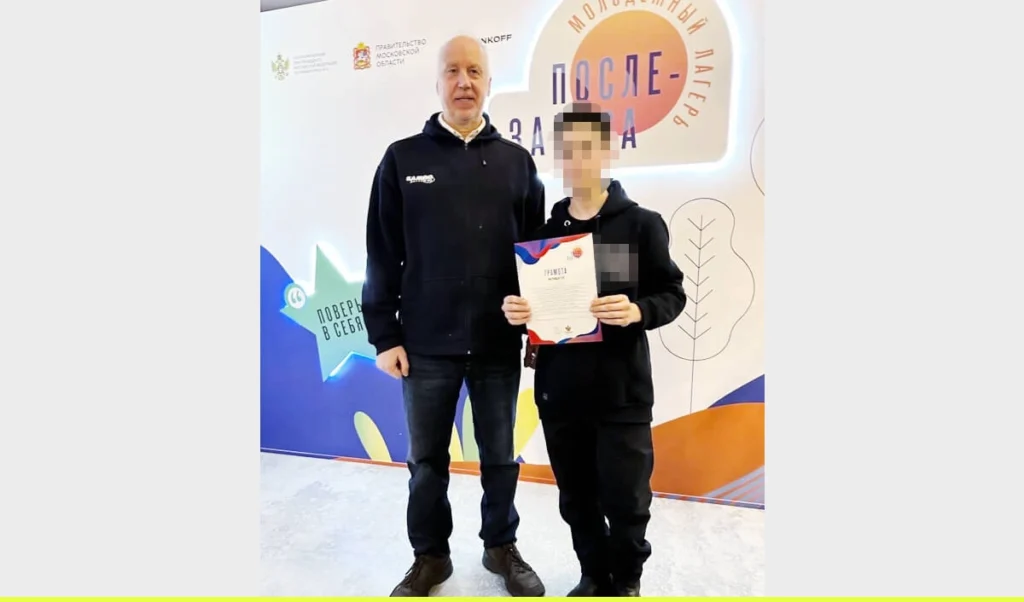
Andrey from Shakhtersk says that he felt “at home” in the integration camp “The Day After Tomorrow”, which was created by Maria Lvova-Belova for the psychological rehabilitation of Donbass children. Cadets from Donbass were brought to a boarding house for rest, where one of the camp shifts took place, in honor of the holiday on February 23. Speaking about why there was a homely atmosphere there, Andrei says: “There is no schedule and everything is convenient.”
In a conversation with Vorstka, another teenager recalled this trip with delight. The boys were especially impressed by Bastrykin’s visit - according to several cadets, the chairman of the Investigative Committee spent the whole day with them. They drank tea at the same table, talked, took pictures against the backdrop of the camp’s press wall.
“I wish you success in our common country - Russia,” the General of Justice wrote to cadet Ilya when the boy asked for an autograph.

The cadets liked that they were able to communicate with the chairman of the Investigative Committee in an informal setting.
“There was a sauna and a swimming pool. We, like Alexander Ivanovich, all went there,” recalls Alexey.
“After the pool we all went to the bathhouse together. And Bastrykin is with us. <> I really enjoyed communicating with him, it was unforgettable,” cadet Andrei told Vorstka and added that the general made a “very influential” impression on him.
Nikita regrets that he got sick during this trip of the cadets to the boarding house, while his brother and his classmates were “resting to the fullest.”
“A swimming pool and a sauna are a luxury and prestige for me! I had never been to a sauna or a steam bath before. But I remember how I went to Dmitry Borisovich on my dismissal, and he also had his own bathhouse. It’s so nice, I can’t describe the feeling,” Nikita said.
"Good, a little rude and without pretense"
Cadet Andrei says that after the conversation with Bastrykin, what he most remembered was his idea that one should not worry about unsatisfactory grades, because they are the norm.
“Someone may make mistakes, someone may be smarter, but the main thing is how you go towards the goal and how hard you strive for it,” Andrei retells the words of the General of Justice. At the same time, the boy does not remember that any of the Donbass cadets asked Bastrykin questions about his service in the Investigative Committee or about his work as an investigator.
The Investigative Committee is striving to increase the percentage of children who, after cadet corps, go to study a profession. If in 2017 only six people from the cadet corps entered the Academy of the Investigative Committee, then in 2022 - already 94. Cadets have an advantage - they are awarded 50 additional points at the entrance, which greatly increases the chances of admission. Bastrykin claims that in 2022, 100% of the academy’s graduates became investigators - they were distributed to 66 regions.
When in 2020, the educational institutions of the UK first agreed on cooperation with the authorities of the so-called DPR, ten teenagers - orphans and children of militias - were admitted to the Khimki boarding school "Cadet Corps" under the UK. Among those first cadets from Donbass was tenth-grader Margarita. She says that to be admitted, one had to successfully pass exams in history, social studies, physical education, military training and complete a package of Russian documents. After boarding school, the girl entered the Academy of the Investigative Committee and says that the selection was “unbearably difficult,” but the cadet mentors explained that it was better to stay within the structure and go further along the line of the Investigative Committee, “not to meddle with the Ministry of Internal Affairs or the FSB.”
Margarita says that with her peers from Donetsk, they tried to understand why the Investigative Committee was so eager to give them a profession, but no one could answer this question.
“To be honest, we wondered for a long time,” says the girl. “Maybe it’s just that the authorities from above told them so - to help children from our region.”

A source from “Vestka”, close to law enforcement agencies, noted that Bastrykin has several “points” and one of them is the problems of minors and crimes related to child safety. The source notes that the focus on various topics by the chairman of the Investigative Committee is usually associated with personal experience and his special attention to children has become noticeable since 2007 - presumably after he had children in his second marriage with Olga Alexandrova (now the rector of the All-Russian State University of Justice).
In 2023, after the first year, seventeen-year-old Margarita was already doing an internship in the internal department of the Investigative Committee in the Moscow region , but so far she was only doing routine work. She says that in her work as an investigator, “she is ready to face difficulties and condemnation, but is not afraid of anything.”
“Verstka” asked employees of the Moscow Cadet Corps, who are now raising teenagers from the Donetsk region, about children’s motivation to become investigators - and asked them to characterize these cadets.
“In short, the guys are no worse than others; they learn differently. Both good and satisfactory. The main goal is admission to the Academy of the Russian Federation Investigative Committee. But not everyone can do this. But there is a desire. Unfortunately, that’s all I can say,” one of the teachers wrote to “Verstka” and added that he was no longer young and valued his place of work, so he could not answer questions without the approval of management.
Another employee of the cadet corps, who also refused the unconsensual conversation, briefly described the cadets from Donbass as: “Good, a little ill-mannered and lacking in pretense.”
“It’s mostly just sitting and filling out paperwork.”
Teenagers from Donetsk, Makeevka, Gorlovka and Shakhtersk, with whom “Verstka” spoke, are still talking about the work of an investigator in clichés and do not think anything specific about the profession that the Investigative Committee offers them to master. But everyone agrees that this is at least “prestigious.”
Nikita says that after a year of studying in the cadet corps, his twin brother Denis has already made his choice and will try to enter the Investigative Committee Academy to become an investigator. He himself listened to the stories of eleventh-graders and began to doubt.
“We were told that it was mostly just sitting and filling out paperwork. It seems to me that you should like the job, and it’s not so important how much you get,” he reflects.

International lawyer and lawyer Olga Gnezdilova notes that over the past 20 years, the profession of investigator in Russia has changed, but for teenagers and their relatives this may not be an obvious fact - especially for those who have lived for many years in the territory of another state.
“If in the early 2000s the training of an investigator consisted of raising Sherlock, in modern Russia solving crimes is no longer such an interesting and subtle science. We see how truly complex cases remain outside the attention of the Investigative Committee, while poor pensioners who wrote on social networks what they think about the war are put on trial.”
At the same time, Gnezdilova believes that Donbass graduates, after graduating from the Academy of the UK, will be sent back to the occupied territories with which they are well familiar. “By this point, they will already have been instilled with loyalty and the right views on public policy,” she says.
The cadets themselves from Donbass want to build a future “in Greater Russia.”
Sasha from Gorlovka, who studied for a year in the Volgograd Cadet Corps and assembled machine guns in the discipline “Be ready to defend the Motherland,” would like to live in St. Petersburg, “simply because it’s beautiful there, he and his brother have never been there.”
Nikita from Donetsk is thinking about staying in Moscow, where there are “tall buildings, beautiful cars, a lot of people,” and is trying to figure out how difficult independent life in a metropolis can be.
“In fact, in Moscow, half the people are not exactly very rich,” the cadet argues. “The main thing there is to come to work, get money, pay rent, buy food, provide for your family.” And that’s how you can continue to live there.”

At least two Donbass children who entered the cadet corps in 2022 ended up giving up the chance to build a career in the Investigative Committee and took off their uniforms.
Alesya from the Lugansk region, who on video spoke about her dream of becoming an investigator to the press service of the Investigative Committee, and then participated in the “Russian Pride - Native Power” competition, dropped out six months later.
She did not answer questions and blocked the “Vestka” journalist. Teenagers who studied in the same class as Alesya say that she did not like living in barracks conditions and left on her own.
Vlad from Donetsk, who wanted to become a cook or pastry chef, but went to Volgograd on the insistent advice of his mother, encountered bullying in the cadet corps. According to the woman, psychologists and educators tried to facilitate the adaptation of Donbass children and smooth out emerging conflicts. But Vlad was never able to find a common language with the cadets and told his parents that he wanted to leave.
“This is probably my oversight,” says the woman. “I taught my child that there is no need to fight, that it is easy to hit, but it is difficult to verbally crush a person. But, apparently, at the very beginning it was necessary to fight with someone, to put yourself in a position. It turns out that the year seems to have been ruined.”
Vlad’s mother hoped until the very end that he would change his mind. She explained to him that he might “like the profession of an investigator after all,” and everything would be fine.
And when, after the ceremony and presentation of certificates at the end of the year, her son said that he was taking the documents and returning home, she cried.
At the beginning of the new academic year, specialized cadet classes, sponsored by the Investigative Committee, should now open in occupied Lugansk and Skadovsk in the Kherson region. The agreements on this were “ceremonially signed” by the directors of the two schools with the head of the department of educational and educational work of the Investigative Committee, Sergei Petrov.
Cover: El
Anna Ryzhkova in collaboration with the “Kidmapping” project