
Translated material
Homed and unforgettable: what practices of the Chinese cultural revolution adopted Putin's Russia
The outgoing 2023 ended with an absurd farce for the country. The train from the events in the Moscow Club Mutabor reliably obscured both economic difficulties and their reason - for almost two years a terrible war, which has an unfair, criminal character for the Russian Federation.
I, as an author of publications on historical topics, hooked a specific aspect of unpleasant in every sense “naked” history. We are talking about public apologies from the participants of the notorious Kinky Party for leading such a way of life as they like. And repentance to the camera did not bring good to any of those who took this step. Even on the contrary, immediately after the repenting sinners with renewed vigor, the anger of the Z-publicity, television producers and Russian law enforcement agencies (or, more precisely, power structures) fell.
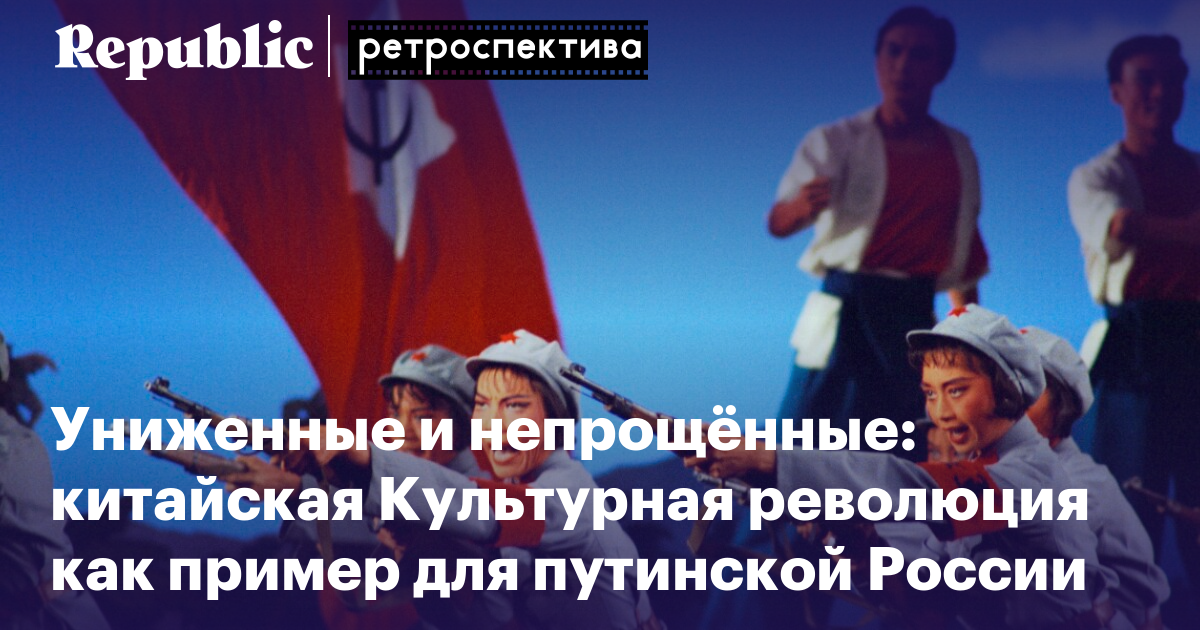
What is happening in Russia now involuntarily resembles that happened in China 60 years ago - albeit not on the scale. Then the local singers and artists, together with teachers, professors and old party members, also asked for forgiveness for imperfect sins. And the addressees of their repentance also did not worry the sincerity of their victims. Everyone perfectly understood that we were talking about self -repaid, and not the real desire to "obey how to be born again."
It will be fair to make a reservation that in China the times of the cultural revolution everything went much more brutal than in today's Russia. They repented not under the cells of the house, but on the squares, surrounded by the crowd. The victims were deliberately put in ridiculous poses, literally watered with sewage, and after torture, at best, concentration camps were waiting. However, in our country, too, apparently, is not yet evening.
Too dark academy
On August 5, 1966, a strange excitement reigned at a women's school at the Beijing Pedagogical University. Among the students there was an absurd hearing, which quickly turned into iron conviction. Allegedly, employees of the institution are not honest teachers, but the “black gang” of the conspirators, who intended unkind against the people's power. And the insightful students decided to act.
A group of seven sheet and deances was captured. They were placed on their knees, doused in ink, Shutovsky caps were put on their heads. Yesterday's wards forced mentors to repent of all conceivable crimes. The submissiveness of the victims only redressed tormentors. Boiling boiling water on the heads unhappy, batons flashed in the air.
After a couple of hours, the head teacher Bian Zhunyun lost consciousness from torture - her lifeless body simply threw into garbage, doctors soon stated death.
Biang's colleagues by that time held on the balance: beaten, wounded, with broken bones, an uninitiated observer, this might seem to seem some kind of perverted variation on the classical plot of Dark Academy . Surely the unfortunate students acted on the instructions of a certain destructive sect or secret order.
Hunweibons force Van Guanmei, the wife of moderate politician Liu Shaiocius, repent. An absurd outfit was deliberately put on a woman, designed to testify to her “bourgeoisness”. April 10, 1967
Photo: Wikipedia / Line.17QQ.com
But the harsh truth was that in the summer of 1966 the entire Chinese People’s Republic became one large sect. And they were refueling there not backstage puppeteers, but by the highest party leaders. On August 8, the Central Committee of the Chinese Communist Party issued a decree “On the Great Proletarian Cultural Revolution”.
The document rather did not establish something new, but legalized the already established practice. Throughout the country, hundreds of thousands of boys and girls lived in spontaneous ultranasil, sincerely believing that they serve this to Horn China and personally beloved chairman of Mao.
Crumpled to socialism - fell into hunger
Repressions and cleaning - on different scale - served as an integral part of the history of any pro -communist regime in the twentieth century. They were carried out in the GDR from the Czechoslovakia, and in the Kastrovskaya Cuba, and in the Hoshosh one Vietnam. However, the Chinese events of the 1960s are standing apart here.
Violence for the glory of Mao was not spent by people with a hot heart and clean hands - it became the fruit of the spontaneous creativity of the wide masses.
Back in 1981, in relatively hot pursuit, the Beijing regime itself condemned the cultural revolution. Moreover, not in the half -hearted spirit of the Soviet XX Congress of the CPSU, but quite unequivocally, without the traditional love for China for streamlined formulations and sophisticated allegories:
The “cultural revolution” was not and could not be [genuine] revolution or social progress in any sense. [...] She was a turmoil, caused from above through the fault of the leader and used by counter -revolutionary groups, a turmoil, which brought serious disasters of the party, the state and the entire multinational people "
- From the decision of the CPC Central Committee
This circumstance already testifies: it was about SUI Generis even according to the very blurry ethical ideas of autocracy. About something that gave rise to circumstances exceptional in their tragedy.
In the spring of 1950, a protracted civil war in the country ended with an unconditional victory of the pro-communist people's liberation army. Mao and his associates reigned in mainland China, having restored the power of Beijing even in the seemingly falling away from him Tibet and Sinjiang (Uyghuria). The new state started large -scale transformations in the Soviet spirit: nationalized the economy, socialized land, and suppressed a real and imaginary counter -revolution.
Participants in the "Big Hork" for steel smelting, 1959
Photo: Wikipedia / Sun Piyong
In 1958, Mao felt himself powerful enough to break his previous friendship with the Soviet Union and proclaim the "policy of three red banners." So the Chinese Communist Party dubbed an adventure course on the accelerated construction of socialism. The quintessence of the program was a “big leap” - forced industrialization. Her implementation into life turned into absurd initiatives like the destruction of sparrows and handicrafts became literally in peasant courtyards. The hunger of 1959-1961, which took off from 10 to 45 million lives, was published by a logical result.
“Unfortunately, Mao Zedong listened to the utopians, not marketers. The 70% of MAO victories accounted for 30% of errors, without which not a single thing is complete. [...] All the shortcomings in the private sector could be eliminated over time. However, this did not happen "
- Liu Zhang, official historian of the PRC
The PDA of those years in spirit greatly resembled the Bolshevik party of the 1920s. Inside it was enough of different platforms and open opponents of MAO, who initially criticized the “big leap”. Then the dictator showed himself an unsurpassed master of political intrigue. In the spring of 1959, he defiantly left the state posts, leaving behind him only party positions. Mao explained that he is more to his liking theoretical work, and let his comrades solve practical tasks.
According to a strange coincidence, “classes of theory” coincided with the fact that leading posts in the power structures began to get completely convinced Maoists.
The parliament chose the Moderate Liu Shaiocius with the new chairman of the PRC. His closest adviser was Dan Xiaopin, the future father of modern China. True, from the first attempt to realize his ideas, the politician did not come to life.
Subscribe to read the whole
Make a subscription Redefine.media to read Republic
Subscribe [you can pay for a Russian or foreign card. The subscription is extended automatically. You can unsubscribe at any time.]
Where are the money subscribers going