
Translated material
Two Autocrats of the couple. Why, 15 years after the war, Georgia and Russia became much closer to each other than they were before it - and what was wrong with this
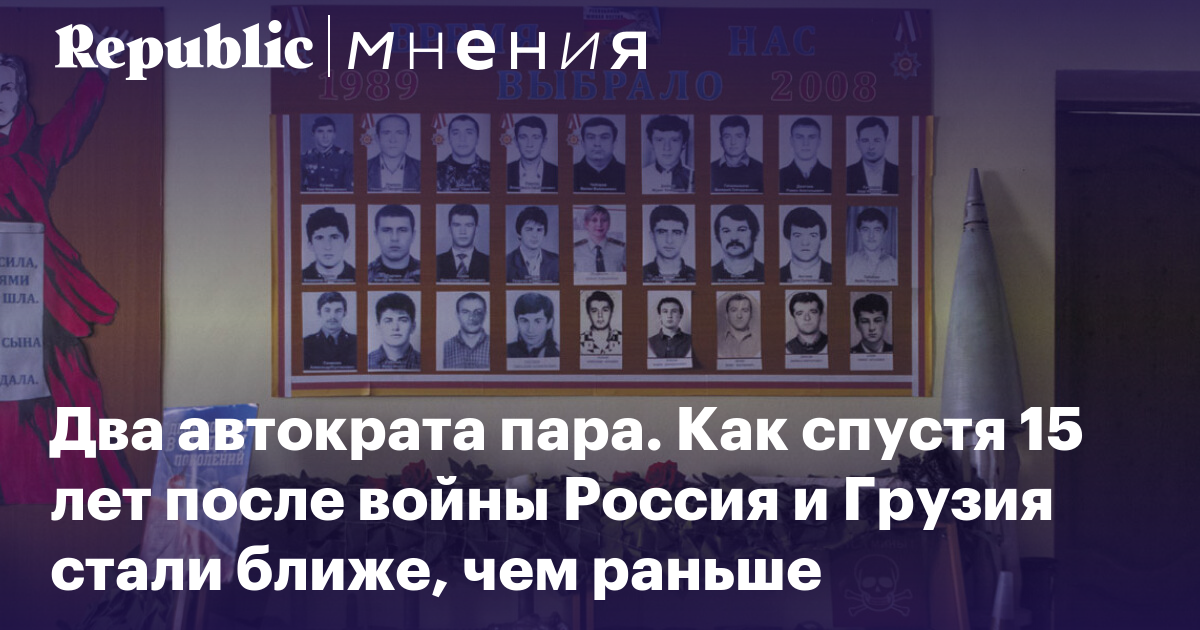
15+15: two wars in post -Soviet Georgia
The five-day Russian-Georgian war in August 2008, which formally ended 15 years ago, August 12, de facto issued the rejection of its rebellious autonomy from Georgia-South Ossetia. From the point of view of international law, the republic remains part of Georgia, but in fact it is not controlled by it since the collapse of the USSR.
The war happened when the desire of the then president of the country Mikhail Saakashvili coincided with finally returning South Ossetia and Russia's desire to completely “protect” the unrecognized territory from such attempts. For this, Russia helped the separatists “hybrid”: arms supply, military training, money and political technology. By 2008, Russia was drawn into support of South Ossetia so seriously that it became obvious : it would not allow Georgia to return the region either by military or peacefully.
15 years earlier, in 1992-1993, an attempt to maintain another rebellious autonomy as part of the Georgian SSR, Abkhazia failed according to a similar scenario. On it, South Ossetia, Transnistria and Nagorno -Karabakh, Russia honed the skill of inciting and managing ethnopolitical conflicts, which later “in all the splendor” demonstrated in the Crimea and in the Donbass.
In 2008, Putin considered the recognition of the independence of Abkhazia and South Ossetia to Europe a response to the recognition of Kosov’s independence: you “recognized Kosov’s independence“ absolutely unreasonably and in violation of existing norms ”, we made“ in the same way ”. To tie the republics even stronger to itself, Russia began to distribute its passports to their residents.
Georgia lost 20% of the territory, but there could be more losses. Both in the 1990s and after the 2008 war, Russia friendly forces attempted to reimburse separatist sentiments in Adjara and in the regions of Western Georgia, adjacent to Abkhazia-Megrelia and Swannia. These attempts were unsuccessful, since Georgia was no longer in the 2000-2010s, unlike the 1990s, which failed state, which cannot provide its citizens with legality, security, social support and elementary social order.
The paradox, but 15 years after the five -day war, Georgia became much closer to Russia than before it.
Now Georgia is actively trading with Russia, slightly helping it bypassing sanctions, restored direct air traffic and even thermal cruises from Sochi to Batumi, and sometimes tries to copy the political undertakings of the neighbor, take at least the law on foreign agents. How and why did this happen?
Subscribe to read the whole
Make a subscription Redefine.media to read Republic
Subscribe [you can pay for a Russian or foreign card. The subscription is extended automatically. You can unsubscribe at any time.]
Where are the money subscribers going