
Translated material
Navalny’s letter and Medinsky textbook: how to relate to 1990
Publicist Ivan Davydov - about the two main texts of the last week
Everyone continues to discuss the "confession" of Alexei Navalny. On August 11, a politician, convicted of 19 years in a colony of special regime, published a text about the fear and hatred that he "needs to be overcome." The fear and hatred of Navalny in this article are mainly aimed at the elite of the 1990s, which, according to the opposition, is to blame for both Putin and in the current war. Many immediately indicated Navalny that he allegedly directed his anger in the wrong way and offended many worthy people. But in the end, the dispute about Navalny's statement turned into a dispute about the 1990s. How to put a point in this dispute? The publicist Ivan Davydov answers this question at the request of the Cold.
In order not to miss the main materials of the "cold", subscribe to our Instagram and telegram .
The main (well, certainly most discussed) texts of the past week are the first letter of Alexei Navalny from prison after a new cannibal sentence, “My fear and hatred”, and a single history textbook for the 11th grade from Vladimir Medinsky and Anatoly Torkunov.
All of Navalny’s letter, probably, they read the whole - and did the right thing, of course. It is a short, bright, beautiful Russian language and even signature jokes from a person who, after all that the state did with him, manages not to lose a sense of humor. By the way, there are no doubts that he is a genuine author of the letter. We learn the lion by claws, says the Latin proverb.
The textbook is a long, dull, written in a cloth language, a product in the best Soviet traditions (believe, young, I managed to learn from Soviet textbooks and I remember what it is). We recognize the donkey by the ears, says the Latin proverb, although the authorship of Medinsky seem to be no longer eager to dispute.
And, in general, it is clear why attention is attracted primarily by the last paragraph - “Russia today. Special military operation (SV). " 37th, by the way, paragraph. I report to those who appreciate the magic of numbers.
Nevertheless, there is something that is related by the main texts of the past week. Hatred by 1990. And yes, do not rush to spit, this is an invitation to a serious conversation.
***
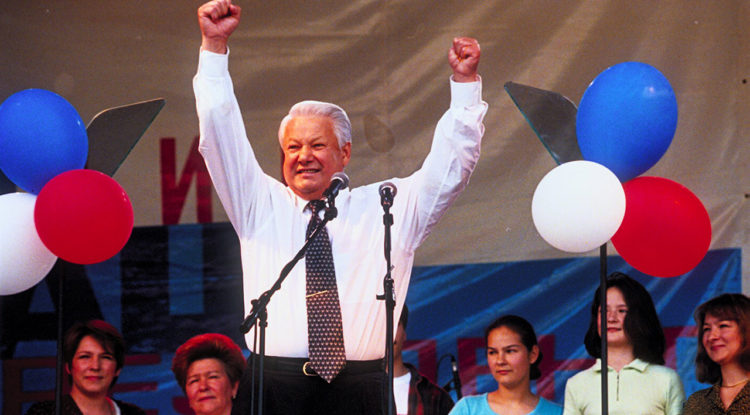
“Day and night television and a number of most influential printed publications convinced voters that, in the event of Yeltsin’s defeat, the Communists would return to power, and did not spare colors for the painting of the upcoming horrors and upheavals in this case. Yeltsin was supported by the seven largest oligarchic financial groups of Russia (Semi -Bankirshchina), which ensured the financing of his election campaign. "
Textbook of Medinsky, page 299.
“I hate“ independent media ”and“ democratic public ”, which ensured the full support of one of the most dramatic turning events of our new history-a fake of the presidential election of the 96th year.”
Navalny's letter.
And so on. Those who wish can study the paragraphs of the second chapter of the textbook-“The Russian Federation in the 1992-early 2020s”, dedicated to the 1990s, and detect a certain number of the same strange rhymes.
The difference is also clear. For Putin's propaganda (and the textbook is just the sum of the theses of propaganda, and the dashing nineties set out extremely primitively) have long become one of the key concepts. The 1990s are darkness, poverty, crime, collapse and disaster. And right at the junction of centuries from nowhere, or from the heavenly holy sovereign Soviet Union, which is the same thing, he, the Savior, Vladimir Red Sun, is heated in its rays, and the path to prosperity begins.
For Navalny (and for any person who has not yet been wiped out) the 1990s is the time that has formed a lot of what determined the essence and nature of the Putin regime. Propaganda denies this continuity based on his own reasons, but Putin is a successor literally chosen by Yeltsin, it was in the late 1990s that this word entered the Russian political vocabulary. And everyone who surrounded Putin in the 2000s, in the 2010s, everyone who runs us now, in the 1990s, was not partisaled in the forests. And the future president himself in Moscow, not with the "march of justice" from St. Petersburg came. A man was quite systematic and felt great in the City Hall of the criminal capital under the leadership of Anatoly Sobchak.
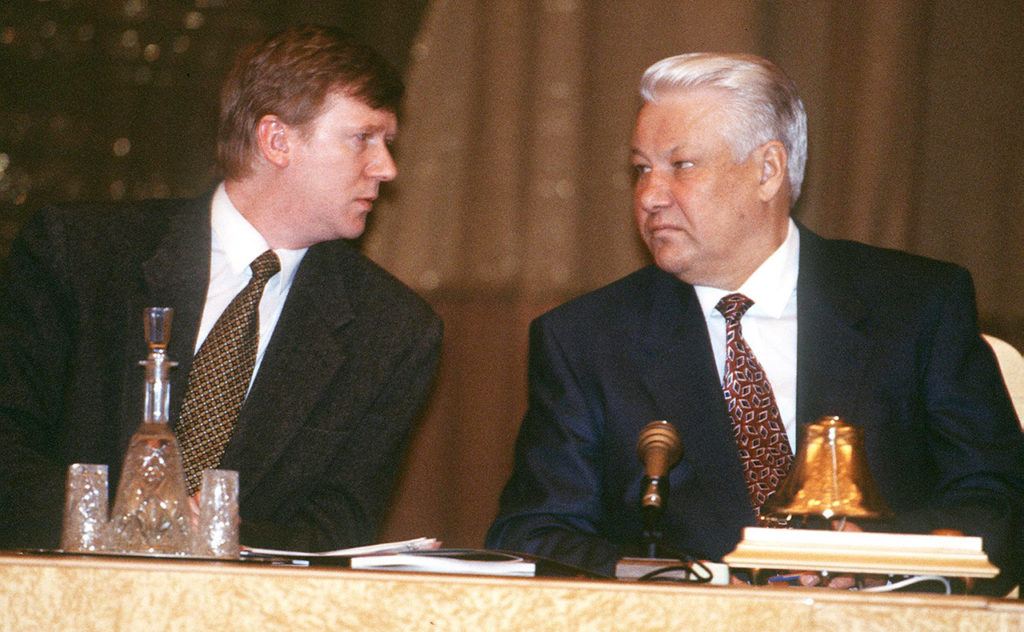
However, these are all common truths, and by the way, Navalny is not the first to voiced them. Of the new in his letter, only emotional intensity, but you try to imagine yourself in his place. I can’t do it, I couldn't. In general, the intensity is quite explained, and otherwise, review, for example, the debate of 2015. Navalny then on the rain (which is now declared the media, the “ino-agent” and is included in the lists of “undesirable” organizations) argued with Anatoly Chubais (which is now known as an independent researcher from Glasgow, Scotland). Including about the 1990s.
But what do we see? We see how very respected people from the opposition rushed Navalny to refute. To prove that the 1990s were, despite some difficulties, the time of unprecedented freedom and that no one had falsified the election of 1996. How does it happen?
I think there are several explanations at once. There are explanations of the political plan, but there is a human plan. By the way, Remarka. Culturologist Alexander Etkind writes: “We need to polemize with the living. You can discuss the dead. And the letters of those who are sitting for you must be silent. Or teach by heart. " Beautiful, but slightly manipulative - we take off to ethical heights, but Alexey, fortunately, is alive, and, among other things, he is also a politician. Still-now, in prison, and after a wild sentence-the first politician of the Russian opposition. And in his letter it remains a politician. And the politician, with whom it is impossible to discuss, we already have, and he is not in prison, but in the Kremlin. Why another one?
Remember what Putin did at the start of his career? Confiscated the rhetoric of the “red-brown”, the very revengeists who scared the layman in the 1996 elections of the newspaper “God forbid!”. He twisted it inside out, appropriated, showed the bewilders to be confused by the inhabitants of the poor Russia, that sitting in the Kremlin can speculate about the lost greatness and the need to return greatness. He saddled the resentment and for more than 20 years from this horse does not get off (although who would undertake to guess in the March 2000, where he will call on this horse; it seems that even the most consistent of the then critics of the “Chekist’s arrival in power” predicted only to Russians, but not to neighbors). So, Navalny does the same - privatizes the rhetoric of the Putinists, swearing the "dashing nineties." Shows everyone who wants to see that the 1990s are not necessary at all if you do not like the current state of affairs. This is actually a powerful political move.
However, back to our critics. Rather, to the critics of Navalny.
That is what, I suppose, that repels some. And this is a political plan for rejection of his theses. Someone here see an attempt on the purity of principles: with the current authority it is impossible to solidarize in anything. And in the attack on the 1990s, it is also impossible. Even if no attempts are in reality in fact and the attack is from completely different positions. Slogans are more important.
And someone probably fears that this powerful move is too Putin. So it was already once, and now we know how the matter ended. Rather, we don’t know yet, but we are not waiting for good.
***
Now - about the human plan of rejection. I had to talk with people who just determined a lot in the Russian politics of the 1990s, and was directly related to the 1996 elections. And I did not meet anyone who would admit that a catastrophic mistake was then made. “You don’t understand, it was an honest struggle, but, of course, a special, not in a primitive democratic sense ... We had a resource, the red governors had a resource, and it was necessary to show the indefinable governors with the resource that we are stronger. In the first round, we showed this, in the second they went over to our side. Isn't that competition? " Such something had to be heard.
Large -scale stuffing then, they say, there were no elections, Zyuganov was simply cut off from the TV and money. Just cut off. And then the architects of the Putin system realized that a good word from the TV and stuffing is much better than just a good word from the TV. Yes, and the TV is worth taking. It will be more reliable.
Yes, oddly enough, this is a human dimension. What is not in these reasoning? There is no voter in them. Only "Governors with the resource." An ordinary voter for people from the 1990s-for well-intentioned people with the most liberal views-this is something such a terrible, dangerous savage that will certainly lead to power of monstrous fascists, and any attempts to draw attention to it is an unworthy populism. This fear, probably, in the results of the Duma elections of 1993, when 23% received Zhirinovsky (however, in the mandates, at the expense of single -mandate, the Gaidarovsky “Choice of Russia” caught up with the LDPR). By the way, Navalny, after all, in those days when he had not yet been in prison, but tried to participate or even participated in the elections, often called a populist. And by the way - I’ll say a dangerous thing now - not always groundless.
Or maybe the roots sprouted deeper, but I won’t dive into historical abysses, I am not Medinsky. I’m just stating: this fear was, and even now it has not gone anywhere. This can be seen, for example, from many current descriptions of the fictitious “people”, which, according to these descriptions, is entirely consists of imperials who are dreaming of endless conquests of adjacent territories.
And the point is not only in those who in the 1990s sat in high offices, not in the then "people with the resource." In the end, they are now well arranged - if not in Moscow, then in Glasgow, Scotland. The problem is wider, and it concerns everyone ... I will not pick up the right word, well, let's say, all those who have entered. It was just in the 1990s that such a phrase was in use-"entered into the market."
The fitting are those who appreciated the freedom that fell upon the country. It is not necessary (perhaps even in the second place) those who reached the redistribution and cuts, overgrown with great money and serious property. The those who entered did not want to turn into a political class, did not want to take responsibility for the country. There were many things more likely. The time of postmodern did not like pathos at all, the words about responsibility would then seem to be a vulgarity that is suitable only for the former nomenclature rushing to the Kremlin, closer to the redistribution and cuts, or for the city crazy, eager to reveal the Masonic conspiracies and find out the real name of Yeltsin.
Politics was given to residents and marginals. And they took. And the rest did it. And a normal person, even engaged in politics (with the authors of the famous newspaper “God forbid!” I also had to talk), treated this as a fun game, which they pay well for.
But in fact, politics is responsibility.
***
It is all scary to admit it. Right now - scary. Because everyone actually understands that the basic theses of Navalny are undeniable and the current regime has grown from the free, funny and happy 1990s. It grew because these free and happy 1990s did not want to notice and take into account the other 1990s-poor, lost, frightened. It is now fashionable to talk about collective wine, but it is always scary to admit your own guilt. In the team, it’s easier to even repent. But here you don’t think about the “class of those who have entered”, dealing with the diagnosis, you think to yourself.
The reasoning that that era was complex and draw it only with black paint - intentional primitivization does not work. Yes, it was. And yes, of course, even those who were then in power did not have the experience of normal human life (by the way, the Medinsky textbook specifically emphasizes that the Gaidar team did not have real experience in managing the economy), which means that mistakes were inevitable. And yes, the 1990s are not only collapse and poverty, it is also new and old books, previously inaccessible, it is music, it is an open world, which yesterday’s Soviet people looked at, bulging eyes ... This is my youth, in the end, believe me, I could find many beautiful words for her. But, remaining within the political limits, we fix it-it is from the 1990s that it began to germinate what has grown here.
However, this is still not Panegirik Navalny. I think the main problem with his letter is that he (quite, excuse me for the expression, in Putin) overturns his thoughts about the past into the future, cutting off from this hypothetical future unpleasant people. I really understand the fear that Alexei is talking about in his letter. If Russia suddenly has another chance - although this is not at all obvious, maybe there will be no longer any chance - then it is very likely that the Russia's impoverished, enthusiastic and covered with a new wave of restification (and it is impossible to consider the other) will again choose a walk around the rakes. And certainly - the last time.
But the main threat to Russian freedom is definitely not Ksenia Sobchak. And not even Alexei Venediktov, whom the current government, by the way, wrote down in “foreign agents”. Of course, it’s easy for me to reason from this: I am not in prison, although the Russian proverb does not tell me from prison. Nevertheless, the current situation with the situation of the 1990s is incomparable. And certainly incomparable our sad situation with the one that has developed after the collapse of the Union in the countries of Eastern and Central Europe. The chance to start the non -impaired project is lost irrevocably from scratch, because we are inside the non -Soviet project. And what a person says and thinks now is really more important than what he did in 1996 or even in 2019 (or when there were famous Moscow elections with large-scale use of DEG). We are in such a pit that it is more appropriate to recall the gospel parable about employees of the 11th hour. There, the owner paid equally to those who worked on his vineyard in the morning, and those who came among the latter. The first, of course, was insulting, but he knows better.
The exit to the future is not through the continuation of the Cold Civil War, about which Alexei writes a lot, avoiding, however, these heavy words, and through the most diverse, possibly unpleasant compromises. He spectacularly mocks the “solid Sobyanians” in his text, he knows how. But it is likely that in the normal Duma of the faction of unbending navalnists will have to just sit next to the fraction of the solid Sobyanians.
And most importantly, the future is not me, not well -deserved critics of Navalny, who defend the 1996 elections from him. And not even Navalny. The future is the current 20-year-old and those who are younger than 20 years. People with multi -colored hair and piercing in the most unexpected places, speaking a language that seems to be Russian from afar, but which I personally do not always understand. Perhaps when they begin to build their Russia's future, until the 1990s they will have as many things as before Mamaev. And it is possible that we will only benefit from this.
The author’s opinion may not coincide with the opinion of the editorial office.