
Translated material
Is the Crimean Bridge indestructible?
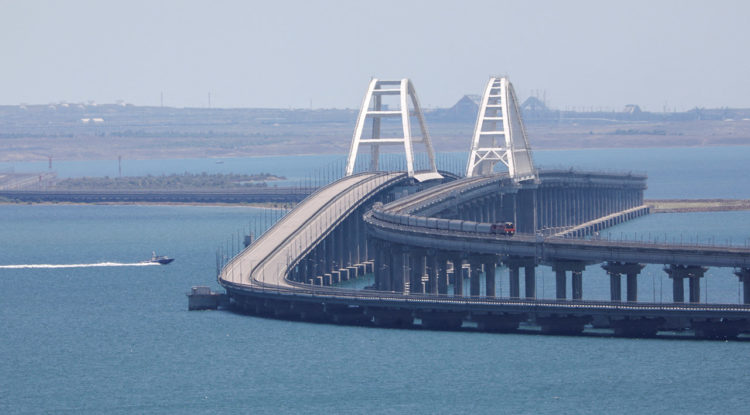
Why, in almost a year and a half, the Ukrainian Armed Forces failed to destroy the main symbol of Russian power
On Saturday, August 12, the Ukrainian Armed Forces once again attacked the Crimean Bridge. This is at least the third attempt to undermine the bridge that was built to connect Russia with the occupied territory. Why has Ukraine still not been able to destroy it? And why is he so important for both the Russian army and Putin?
In order not to miss the main materials of “Cold”, subscribe to our Instagram and telegram .
Why can't Ukraine destroy the Crimean Bridge?
The first explosion occurred in October 2022, when a truck loaded with explosives driving across the bridge detonated . As a result, several spans of the roadway were damaged, part of the railway track was destroyed, and four people were killed. It took about seven months to completely restore the damage to the bridge.
The second successful attack was the explosion of surface drones in July 2023. The part of the road that was damaged at that time is still being repaired. And on Saturday, August 12, the bridge was attacked by converted S-200 anti-aircraft missiles.
The attacks that Ukraine carried out on the Crimean Bridge have already caused significant damage to it. However, this is still not enough to disable the bridge.
The fact is that Ukraine does not have long-range missiles to attack the Crimean Bridge, military researcher Kirill Mikhailov told Kholod. “From the mainland of Ukraine [to the Crimean Bridge] it would be possible to finish off with the help of Storm Shadow (long-range cruise missiles that the West provides to Ukraine. - Note from Kholod) . But, probably, suppliers of Western weapons have established either an unspoken restriction, or even a completely formal ban on the launch of such missiles in Crimea and Russian territory, says Mikhailov. — But the Ukrainian Armed Forces do not have missiles of their own production that would reach targets at such a distance. Because of this, the Ukrainian army has to resort to all sorts of tricks.” For example, Ukraine has to construct its own drones from jet skis or modify existing missiles designed for air defense for other purposes.
The blowing up of the Crimean Bridge in October last year can be considered a successful operation: the railway part of the bridge was put out of action for almost seven months.
However, it is hardly possible to launch a truck with explosives a second time, Mikhailov believes: “At the cost of reducing throughput, the Russian authorities were able to increase security.” There are more checkpoints at the approach to the Crimean Bridge, and the quality of inspections has also increased: traffic flows are limited daily, the inspectors at the checkpoints are doing their job and so far they are no longer allowing cars with explosives through. Ukraine is looking for other ways.
“Surface drones have proven to be quite effective, but the Russians are successfully using countermeasures against them - special floating barriers,” says Mikhailov.
Another method used by the Ukrainian Armed Forces is the modification of S-200 anti-aircraft missiles. These missiles are intended primarily for defense against bombers, but the Ukrainians have learned to convert the missiles to attack ground targets. In the current battle, the S-200 are already outdated missile models (for example, the Russian side uses a more modern version of the S-300 to attack ground targets). The air defense systems that the Russians use are currently capable of intercepting them.
Why is the Crimean Bridge so important?
The bridge to Crimea has an important symbolic meaning for Russians. The Crimean Bridge, also known as the Kerch Bridge, was built after the occupation of Crimea in 2014. Official Russian media called the project “the construction of the century”; it carries the only railway connecting Russia with the occupied territory. Its destruction could be a significant blow to the reputation of both the Russian army and Vladimir Putin ahead of the 2024 presidential elections.
During the full-scale invasion, the bridge became a critical logistics route for the Russian army. This is the main way to supply units of the Russian army deployed in the Kherson and Zaporozhye regions. Literally everything is transported across the Crimean Bridge: from ammunition to food, water and medicine. “There are no other railway routes through the newly occupied territories of mainland Ukraine,” says Mikhailov.
Disabling the Crimean Bridge is a priority goal for the Ukrainian Armed Forces. If the bridge is blown up, the supply chains of the Russian army will be disrupted, and the military will soon be critically short of the weapons necessary to repel the attack. Kirill Mikhailov believes that Ukraine will continue to try to undermine the bridge.
Russia, realizing this, uses air defense systems, smoke screens, ships and floating barriers to protect it.