
Translated material
How minors are sitting in Russia
HTML
<Div class = "Single-Story__main-info_authors-Block"> <Div class = "Author -ite"> <a href = "https://cherta.media/nn_author/lena-skvorcova-i-redakciya-cherty/"> <img class = "Author-item__img" SRC = "https://cherta.media/wp-content/uploads/2023/08/avatar-for-rticles-sqd³rey-300x300-1-150x150.jpeg" Alt = ""> <DIV CLASS = "AUTHOR-TEM__TEMSTEMTEX"> <PAN> Author </span> <p> Elena Skvortsova and the editors of the "features" </p> </div> </a> </div> </div>
How minors are sitting in Russia
Briefly
Since the beginning of the fall of 2022, a third of the detainees about diversions on railways are minors. They expect a sentence in a pre -trial detention center for adults, serving deadlines in colonies with peers, and in addition to the warders and escorts, there are educators with them. How does the life of children in correctional institutions work, and how to help your child survive the arrest? The “line” together with the “first department” spoke with relatives and the minors themselves.In 2022, 14,214 teenagers who committed crimes under 18 years old were convicted in Russia. At the same time, more and more minors become defendants in political affairs. Prior to the start of a full -scale invasion of Ukraine, adolescents were often accused of terrorist articles - leaflets in support of political prisoners, three notes stuck at state institutions could become the reason for the persecution to impress a girlfriend. And the court found the evidence of guilt - an ironic message to friends "if only this ball exploded."
"There were two killers in the cell at once"
Alexander from Nizhny Tagil ended up in a bad company when he was 17 years old. Now he is 22 years old, he recalls about adolescence that he was left to himself and often did not spend the night at home. Together with his friends, he began to use drugs, then sell them, and later his company began to rob and steal. Then he did not think that they could be planted for this. But adolescents were soon caught, and everyone was in prison: Alexander himself was charged with theft (part 2 of article 158 of the Criminal Code of the Russian Federation) and robbery (part 2 of article 162 of the Criminal Code of the Russian Federation). He was sent under house arrest.
At home, a teenager spent ten months, but, according to him, “in four walls his head went around,” and he began to violate the conditions of house arrest. After one of the sorties to the street, the inspection demanded to change the preventive measure and detain Alexander. Already in conclusion, the young man regretted that he violated the conditions of house arrest: “It’s one thing to sit in four walls of the house, you can eat when you want, and sleep, and it’s quite another to live in four walls according to the prison regime.”
The state lawyer who defended the teenager could not do anything. After the trial, Alexander was immediately taken into custody: the escorts removed a chain from him, they took the phone. He only managed to hug with his mother.
The first six months, while the investigation lasted, Alexander sat in the Tagil PFRSI , operating in the mode of the investigative insulator. - This is a pre -trial detention center in the educational colony. The conditions immediately turned out to be difficult: the camera for four beds, a bench, a table. Lifting at 5:30 in the morning, and during the day you can not lie or sit on the bed. The situation became more complicated by the radio. And daily walks took place in a small box, and often lasted only ten minutes.
The cellmates changed from time to time, but the first teenager remembered well: “When I just went into the camera, there were two killers at once. If you want, you don’t want, you start to communicate, because for a long time you have to sit with them in the same space. ”
Then the young man was sent to the Kirovgrad educational colony, where he spent almost two years.
What awaits a minor in a pre -trial detention center
Criminal liability in Russia has been coming from 16 years old, but according to 32 articles of the Criminal Code of a teenager, they can be convicted from the age of 14. This, for example, is murder, rape, theft, robbery, robbery, participation in the riots, an encroachment on the life of a statesman, a number of terrorist crimes. Moreover, if a minor “lags behind in mental development” , which is why he cannot realize the social danger of his actions, he cannot be held accountable.
A teenager, like any accused or suspect, can choose a preventive measure - in 2022, minors were most often sent to investigative insulators.
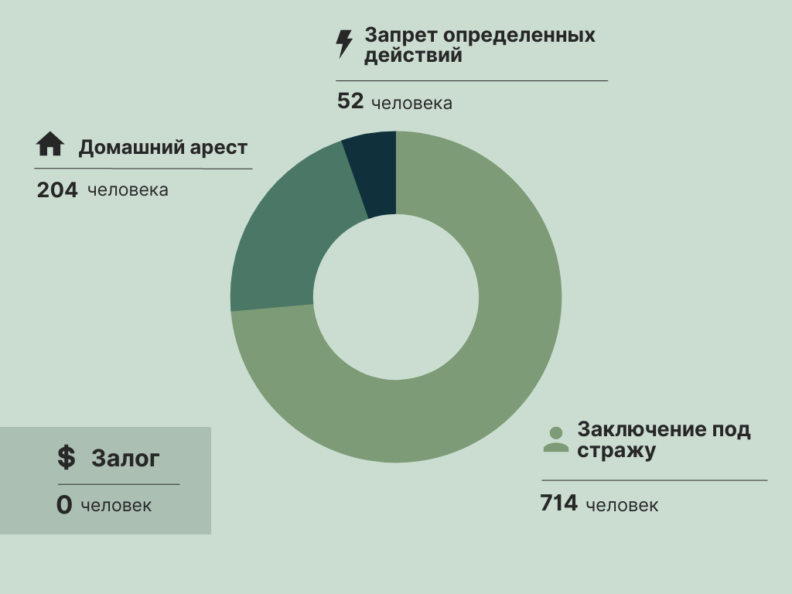
If the child is taken into custody, then it should be kept in a regular pre -trial detention center separately from adults. As in the case of adults, accomplices cannot be kept together. The prosecutor may allow you to put it into the camera to the minor of the adult, the accused or the suspect, but only if several conditions are met:
- An adult neighbor has a positive characteristic (did not come into conflicts with the FSIN employees and other prisoners, did not violate the internal regulations);
- He is first prosecuted and necessarily under an article of small or medium severity.
Sometimes adolescents are placed with adults due to lack of places. This happened with Yegor Balazyukin -a 16-year-old student of the humanitarian gymnasium in St. Petersburg. He was in custody on February 28, 2023 after he threw the Molotov cocktail , the teenager was first accused of “intentional destruction or damage to property” (Article 167 of the Criminal Code of the Russian Federation), then the case was re -qualified and Balazeykin was accused of committing a terrorist attack (Part 1 of Article 205 of the Criminal Code of the Russian Federation). to the military registration and enlistment office.
Egor spent the first eight days of imprisonment in the temporary detention center along with five adult prisoners. The mother of the political prisoner Tatyana was afraid that they could offend her son, but he came across good cellmates.
“These prisoners reacted to him in aidal, tried to give him all the information that will come in handy further in the pre-trial detention center,” says Tatyana. - They taught him how to go into the camera, how to use the toilet, so as not to interfere with anyone, which words cannot be used. At the same time, they took care of him, treated them with tea and sweets. Egor constantly recalls these men, says that he is very grateful to them, because when he drove into a pre -trial detention center, he knew how to behave. ”

Despite the official ban on the joint maintenance of adults and adolescents in pre -trial detention centers, they can be taken to court in the same car carrier. Most often on the way they are allowed to communicate. If during the teenager’s travels they want to isolate from the rest of the prisoners, they are placed in a glass-this is a mini-camera inside a car gut of 50 by 80 cm with a welded bench to one of the walls.
Julia, the mother of the ex-confined Yaroslav Inozemtsev, the teenager was detained in the case of the preparation of Columbine in June 2020, when he was 14 years old. He was released in January 2022 under the ban of certain actions. He says that all humiliating procedures are also extended to minors before and after a trip to the car carrier: “We need to undress naked, sit down, spread the buttocks - they check that there is nothing prohibited. In Avtozak, Yaroslav traveled with adults: so he got acquainted with all the famous killers of Volgograd. ”
"Why did you give birth to parents?" The life of adolescents in a pre -trial detention center
Despite the fact that adults and minors contain in the same pre -trial detention center, according to the law, they have different conditions.
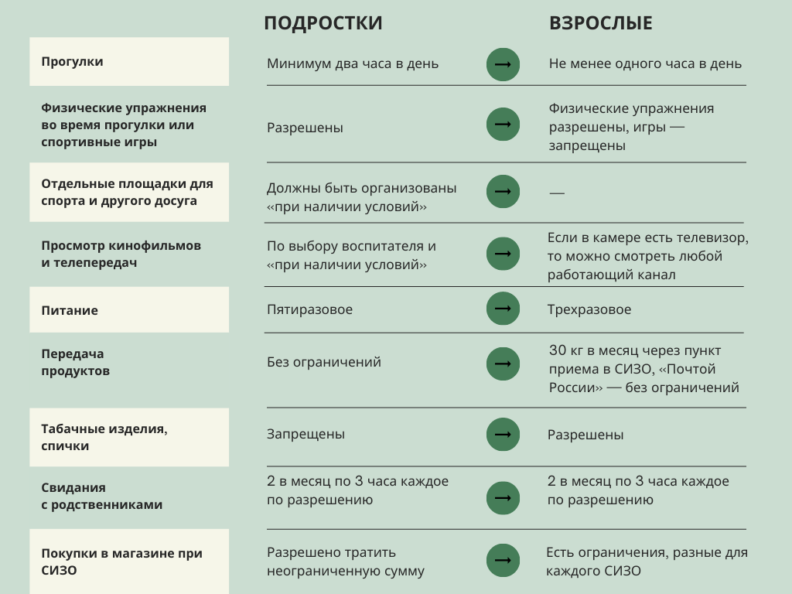
Yaroslav Inozemtsev was in custody in pre -trial detention center No. 1 of Volgograd. There, dates with parents lasted an average of 40 minutes. Once, Yaroslav and his parents were lucky - on the day of the meeting, the FSIN employees were on shift, who allowed to talk with the arrested son for two hours.
And the mother of Yaroslav tells what works it was worth just getting on a date. At night, she came to a pre -trial detention center, where a piece of paper and a stone lay near a closed insulator. It was necessary to enter your name there, then wait for the next person to photograph the list and give it to him, and only after that you can go to sleep. Early in the morning she came back to the date.
“Only 12 people were accepted per day on this list. If you are not the first to sign up, then you get on a date after dinner, but you can’t go home, you need to sit in a pre -trial detention center, ”she recalls. - The glasses in the dates for date are very dirty, you can talk through the phone, the FSINESS sits nearby - they listen, observe, laugh. ”
 Is the prison still different from the colony? How many kilograms of packages can you get there a month? Test "features" for knowledge of prison schedule
Souls in the pre -trial detention center are allowed once a week, but sometimes it is not possible to wash for several weeks in a row. If on a bath day the investigator appointed familiarization with the case file, then a person may remain at all without the ability to wash. Yaroslav Inozemtsev, shower was allowed only a couple of times a month. Sometimes the employees of the insulator abolished the bath day, referring to the shower breakdown, it was not possible to wash themselves periodically due to the lack of hot water.
When Yaroslav returned from Moscow, he asked the educators to let him in from the road, but he was not allowed. The next day, his parents were refused a date, but when the journalists wrote about this, they still allowed the meeting.
“We saw our son in a terrible state - all dirty, under the eyes of blackness,” says Julia. - Yaroslav said that he was sitting alone, it is cold in the cell, there is no heating, water is running from the pipes, they don’t let go into the shower, there is no socket, so even the tea is not heated. After the meeting, one of the employees of the Federal Penitentiary Service called Yaroslav to her and asked: “Why did you press your parents? You are not a man, a man must endure”. Thanks to publicity, after 5-7 days, Yaroslav was transferred to another camera with slightly better conditions. ”

Unlike the shower, prisoners can wash clothes at any time, but only with their hands in a small sink or a basin with eternally cold water. Dry linen on schools. When Yaroslav was released, the parents threw all the clothes - she smoked with mold and cigarettes, as they were smoking in the cell.
Julia complained about the conditions for keeping her son in a pre-trial detention center, asked to conduct a check due to the fact that he was administered drugs, after which it became bad. What kind of medication were, neither Yaroslav nor parents know. Also, according to his mother, he was not given the necessary assistance after the body's reaction to unknown medicines, although Yaroslav was on the examination at the Institute. Serbian - that is, there were doctors nearby. The FSIN answer has always been one - everything is legal, there are no violations.
Tatyana Balazyukina, on the contrary, notes that in a pre -trial detention center where her son sits, they are good at minors: the administration tries to brighten up their life in conclusion. According to her, the colony employees buy basketballs with their own money and stretch volleyball nets so that children can play.
“How many times have we crossed with the colony staff, they communicate without aggression. Egor is still quite clearly at an anti -war position. I thought that the administration supports everything that does the authorities are now, and should be aggressive towards Yegor. But this is not. I was afraid that employees of law enforcement agencies are brutal people who were pleasure to mock the prisoners. But when we met them, we realized that this is not so, ”says Tatyana.
In the pre -trial detention center, Yegor is progressed by the liver disease: before the teenager was concluded, the first degree of disease was diagnosed, and in August 2023 he was already put a second degree of fibrosis. According to Tatyana, in a pre -trial detention center, the child is not refused medical care: doctors take blood tests from Yegor. The head of the colony personally promised her to take her son on an ultrasound as often as necessary. But it is still impossible to improve the condition of Yegor in the conditions of pre -trial detention center, Mom says: “He needs to regularly show the results of blood tests to the attending physician. But in order to get them, you need to make an official request by Russian Post, the letter is walking back and forth for two months, so we miss the deadlines. ”
In addition to bureaucratic delays, objective obstacles interfere with medical care: the pre-trial detention center has one autosak that constantly breaks-because of this, employees cannot bring Yegor to the children's clinic.
Life in the educational colony: conditions of detention, punishment and encouragement
According to statistics, in 2022, the courts of Russia carried out acquittal sentences to an adult in 0.19% of cases. Those who are not yet 18 years old are justified a little less often - with a probability of 0.18%. At the same time, adults are sent more often in the colony - in 29% of cases - against 17% in cases in relation to minors. The most popular punishment for Russians is 14-17 years old is a conditional term.
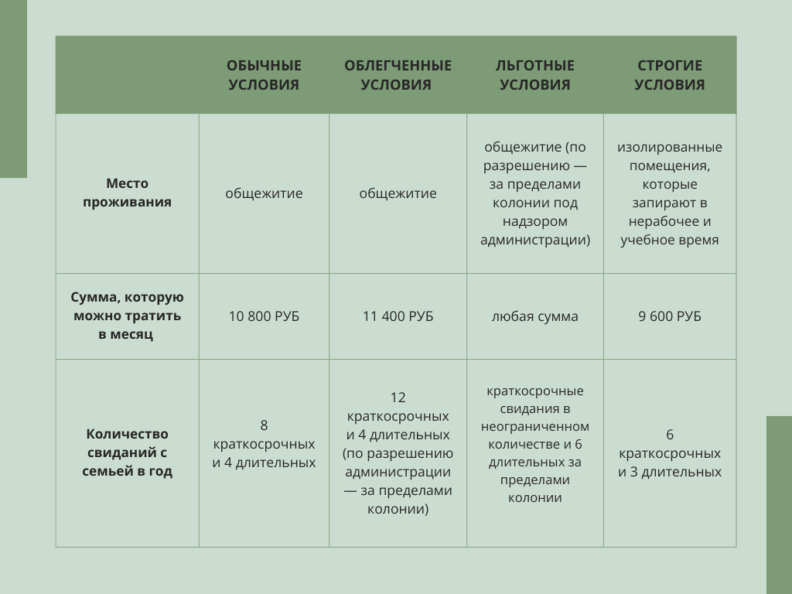
Convicts to imprisonment are sent to educational colonies. As in ordinary correctional institutions, women are contained separately from men, and the conditions for serving sentences are divided into ordinary, lightweight, preferential and strict.
In strict conditions they contain:
- convicted of intentional crimes who violated the law while already in a colony for another act;
- Those who are serving a sentence not for the first time;
- "Malicious violators of the procedure for serving a sentence and translated from ordinary and lightweight conditions."
Conventional conditions are intended for everyone who is serving a sentence for the first time. From ordinary conditions you can transfer to lightweight. For this, the first people and all the girls should spend three months under ordinary conditions without penalties and with a “conscientious attitude to work and study”. Young people who have fallen into the colony repeatedly, this period is twice higher. In the preferential conditions of minors, they are transferred from lightweight conditions for preparation for release.
The hostels in educational colonies look different. In some, these are two -story buildings with rooms for four, where in addition to the beds there is a toilet and a sink. You can move freely only by your own floor. Each detachment is placed on a separate floor, prisoners from different detachments usually cannot communicate with each other. But such hostels are not everywhere - in some colonies up to 50 people live in the same room.
For “good behavior, a conscientious attitude to work and study”, adolescents may allow cultural or sporting events outside the colony (but accompanied by colony employees), take a walk with relatives (maximum eight hours) or resort prematurely from strict conditions to ordinary conditions.
For violation of the rules of the convicts, they can be punished: it will be forbidden to watch films for a month or send to a disciplinary insulator for up to seven days, while they will still be taken to study. This isolator prohibits long dates, telephone conversations, buying food and hygiene products, receiving parcels, board games and cigarettes, but daily two -hour walks are allowed.
But in some colonies, punishment goes far beyond this framework. In the Kirovgrad educational colony, where Alexander was sitting from Nizhny Tagil, the administration did not apply physical violence to children. For them, “looking” did it - adolescents who were appointed to follow the order. “These are the most healthy, desperate guys, the same convicted children, just older and the largest,” says Alexander.
“Watching” punished other prisoners for any violation of the rules: for example, for obscene abuse or smoking in a wrong place. At the same time, the “watchmen” themselves could behave as they considered it necessary, they had complete permissiveness, the former prisoner recalls: “The most frequent punishment is the vulture. This is a stick from the horizontal bar, which was taken in the gym. The one who talked on the floor, four people from the detachment held him, and the look beat him with all his might in the back place. Or wound bandages in their arms, wetted with water so that there were no bruises, and beat on the face. Once, one 18-year-old convict called the head of the colony by an obscene word, this came to him. The guy was so beaten that they didn’t let out anywhere for two weeks so that no one saw his bruises. ”
Alexander himself also once beat “looking”. This happened after he, along with other convicts, decided to take a picture on the occasion of the birthday of one of the friends. Teenagers printed photos in the school office of the colony and hid them, but when checking, one of these pictures found. All captured in the photograph was beaten with an iron stick.
How and why prisoners are trying to occupy
By law, accused minors should receive school education. There are two options - to finish eleven classes, pass the exam and enter the university for absentee training, or finish nine classes and enter the school at the colony.
The correctional institution should invite teachers and allocate a separate room for a class where children could study. The level of teaching depends on the human factor. In some pre -trial detention centers, teachers conduct lessons in good faith, in others - this is a formality, in others they do nothing at all.
In the St. Petersburg pre-trial detention center No. 5, where Yegor Balazyukin is serving sentences, teachers from a boarding school nearby conduct lessons. Children are taught mathematics, Russian language, literature and English. But classes go only three days a week, so it is impossible to catch up with a program of a comprehensive school in a pre -trial detention center. In addition, the level of children is very different-among those with whom Balazyukin sits, there are those who do not know how to read in English or solve simple mathematical problems, and those who went to a gold medal.
По словам мамы юноши Татьяны, ребята очень уважительно относятся к учителям: «Егор говорит, что даже в той гимназии, где он учился в 10-м классе, не было такого отношения. Не спорят, не огрызаются, каждый в силу своих возможностей старается учиться».
У многих подростков 14-17 лет начинается пубертат, в этом возрасте дети даже на свободе сбиваются в стаи и проявляют агрессию. Если у взрослых есть уровень критического мышления и способность договариваться, то у детей эти навыки еще не развиты. Поэтому подростков стараются занять, объясняет Надежда Сидорова, правозащитница и мама фигуранта «Ростовского дела» Яна Сидорова.
Когда заключенному исполняется 18 лет, его, как правило, не отправляют во взрослую колонию. Попасть на зону или в изолированный участок ВК, который функционирует как обычная колония, можно не раньше 19 лет. Исключение — восемнадцатилетний осужденный с отрицательной характеристикой (но для этого нужно решение суда).
Но проблемы несовершеннолетних заключенных не ограничиваются СИЗО и колонией. Самые серьезные испытания их ждут и после освобождения. Время, проведенное в заключении, меняет их социальный статус и сильно влияет на психику.
«Тюрьма еще никому не пошла на пользу в психологическом плане, а подросткам тем более. Опыт заключения сильно отражается на их психике. У несовершеннолетних еще не выработана полноценная индивидуальность, и они часто попадают под влияние неформальных лидеров, от которых перенимают правила жизни и следование определенным ритуалам. Поэтому после тюрьмы для подростков очень велик риск рецидива. К рецидиву подростков толкает еще и высокий уровень стигматизации бывших заключенных в нашем обществе», — объясняет директор фонда «Независимость» Алексей Долгалев.
«Очень много зависит от того, в какую среду подросток попадает после освобождения, — утверждает Долгалев. — Если подросток возвращается обратно в ту же компанию друзей, с которыми совершал преступление или употреблял вещества, то он будет вновь и вновь повторять свой криминальный путь. Но если он попадет в окружение, где будет чувствовать заботу и внимание, если он не будет чувствовать презрения или опаски со стороны близких, если к нему будут относиться на равных, то у него появляются очень хорошие шансы выйти из замкнутого круга криминала и нормализовать свою жизненную ситуацию»
После освобождения из кировградской колонии Александр, с истории которого мы начинали этот текст, переехал из родного Нижнего Тагила. Он сменил город, чтобы порвать связи, которые могли снова привести его за решетку: «Я понял, что если я останусь, то снова куда-нибудь попаду. Переехал в Екатеринбург, перестал со всеми общаться, начал работать на производстве, женился», — рассказывает бывший заключенный.
Моего ребенка арестовали. How can I help him?
Координаторка психологической помощи «Открытого пространства» Екатерина Абрамова советует заранее проговорить план действий на случай возможного обыска и ареста. Если вы понимаете, что риски давления на вашу семью высоки, проинструктируйте подростка. Расскажите об основных правилах информационной безопасности (например, как устраивают провокации в соцсетях), объясните как себя вести во время обыска, напомните, почему не нужно открывать дверь незнакомым (в том числе людям в форме). При этом не стоит нагнетать ситуацию, запугивать и паниковать.
Но что делать, когда подросток уже в СИЗО или колонии?
Совет 1. Оставьте нравоучения на потом. Вы имеете право высказывать свои обиды или отчитывать ребенка за ошибки, но лучше сделать это после освобождения. Период заключения — не время для ссор.
Совет 2. Будьте рядом. Пишите письма, приезжайте на свидания и отвечайте на звонки, если их разрешают. Дайте подростку понять, что несмотря на произошедшее, вы все еще его любите и готовы поддержать словами и действиями.
Совет 3. Будьте честны и приготовьтесь к честности в ответ. Если вы не знаете, хочет ли ребенок получать от вас письма каждый день или ему достаточно одного в неделю, — спросите об этом. Если вы не уверены, стоит ли делиться с ним новостями с воли (к примеру, впечатлениями об отпуске), — спросите об этом. Но будьте готовы к тому, что ответ может отличаться от ваших ожиданий.
Совет 4. Не забывайте про отдых. Истощенный морально и физически родитель не сможет быть опорой и поддержкой. Чтобы были силы помогать ребенку, нужно сначала помочь себе. Если чувствуете, что не справляетесь самостоятельно — не стесняйтесь обратиться за психологической помощью.
Совет 5. Помните, что заключение обязательно закончится. В моменте кажется, что жизнь навсегда превратилась в ад. Но следствие, во время которого подростка держат в СИЗО, не бесконечное. Как и срок наказания, назначенный судом.
Совет 6. После освобождения обратите внимание на психологическое состояние подростка. Вот несколько красных флажков, при наличии которых стоит обратиться за помощью к психологу, психотерапевту или психиатру:
- Повторное проживание произошедшего (флешбеки): ночные кошмары на тему заключения, ощущение стресса и тревоги от чего-то, что напоминает о пережитом (например, страх при виде человека в форме или паника от запаха на улице, который напомнил запах в камере СИЗО).
- Aviation. Неспособность вспомнить детали произошедшего — нормальная реакция на пережитый стресс. Но если диссоциативная амнезия затянулась или подросток избегает переживаний с помощью зависимостей (речь не только об алкоголе или наркотиках, человек может сутками играть в компьютерные игры или читать книги по 15 часов в день), стоит обратиться за помощью.
- Нарушение сна, аппетита, замкнутость или повышенная агрессивность.
Елена Скворцова и редакция «Черты»