
Translated material
FBK, A.U.E. and citizens of the USSR. Who is judged in Russia for "financing extremism"
Two years after the recognition of the FBK, an “extremist organization” in Russia was condemned by only a few people for its financing, although everyone who continues to help the organization unequivocally threatened. Probably, the security forces could not establish the sacrifice (except for several people whose data became known to banks due to a technical failure). At the same time, the number of criminal cases under the article on “financing extremism” is constantly growing - the incomplete 2023, as Mediazona found out, has already become a record. But they are not persecuted by opposition: most often they judge the “Jehovah's Witnesses”, and this year the number of affairs against prisoners, whom the security forces consider supporters of the “extremist movement” A.U.E.
When, two years ago, in August 2021, the Mosgorsud decision on the ban on the Breast of Corruption as an “extremist organization” entered into force, many of the who have had given the FBK have had concerns that they can be attracted under an article on financing an extremist organization (Article 282.3 of the Criminal Code). Fear was reinforced by leaks, for example, the base of “FBK Donators” appeared on the network, apparently , created with the participation of security forces.
The Navalny team turned off the opportunity to transfer donations into old accounts in advance, and later announced the beginning of a new anonymous collection of donates through the American STRIPE service. Only a year later, in August 2022, the first criminal case of the FBK donates appeared: the journalist of Novaya Gazeta and the co -founder of Dissernet Andrei Zazakin was detained.
Then, from the materials of the Mediazona Zayakin case, she found out that the journalist was probably the victim of a technical failure on the first day of the anonymous collection of donates: in at least several cases, Russian banks received information on the appointment of payment - this is what allowed the security forces to initiate criminal cases of financing extremism.
Simultaneously with Zayakin, the investigators installed five more people who donated the money of the FBK on August 5, 2021. Two of this list, according to the Mediazons, did not return to Russia, Zayakin left the country and now on the wanted list . Nothing is known about the criminal prosecution of another young man (his name is not mentioned either in court decisions or in the basis of the search for the Ministry of Internal Affairs).
But two of them courts pronounced the sentences last winter.
In December 2022, the Koptevsky District Court of Moscow fined 56-year-old Sergei Shiryaev for 500 thousand rubles, the press secretary of the court Anastasia Vasilieva told Mediazone. According to the security forces, the Muscovite transferred the FBK 5 thousand rubles. In court, he did not plead guilty.
A month later, in January 2023, the Magadan City Court fined the same 500 thousand rubles 51-year-old Alexei Konovalov; He transferred the FBK 10 thousand rubles. The defense insisted that Konovalov sent Donat when he was lying in the regional hospital and, due to taking drugs, "could not fully realize and control his actions." The court did not agree with this. From the sentence, Konovalov follows that with a search, they came to him two weeks before Zayakin - August 13, 2022.
Recently, in the Krasnodar Territory, the court found the 29-year-old Andrei Kovalenko guilty of financing extremism and the distribution of malicious programs; According to investigators, he not only made purchases in online stores using stolen data, but also transferred money to the FBK.
If this is true, then the security forces were likely to go to Kovalenko not thanks to the technical failure on August 5 (as on Zayakina, Shiryaev and Konovalov), but during the investigation of computer hacks.
In addition, an article on the financing of extremism - among many others - was charged with Alexei Navalny himself and his associate Daniel Cold (in early August, the court sentenced Navalny to 19, and cold to eight years in prison).
It seems that in two years the security forces were not able to establish other Russians who made donations from the FBK after the ban. Mediazona studied all the decisions made by the courts under this article and did not find other cases related to the donates created by Alexei Navalny.
But she found out that 2023 had already broken records for the number of cases of financing of extremism, and under this article now they are actively pursuing not only “Jehovah's Witnesses”, but also people whom the security forces are ranked to the movement of “citizens of the USSR” or the criminal world.
Cases against A.U.E. There are more than against the "Jehovah's Witnesses"
An article on “financing extremist activity” (282.3 of the Criminal Code) is more and more actively used by security forces every year. It appeared in June 2014, but the first few years was almost not used, they began to actively pass the sentences on it in 2019.
In most sentences, it was about Jehovah's Witnesses. Believers throughout the country have been persecuted since 2017, when the Supreme Court forbade their organization (according to the calculations of the “witnesses” themselves, during this time more than 750 people have passed through criminal prosecution).
A significant part of the cases of financing extremism also concerned these believers: 36 cases out of 81 are known (often several people are judged at once, among the defendants in “witnesses” there were 93 people out of 157). But nationalists and Muslims under this article are rarely haunted (despite a huge number of ultra -right or Islamic organizations recognized as extremist).
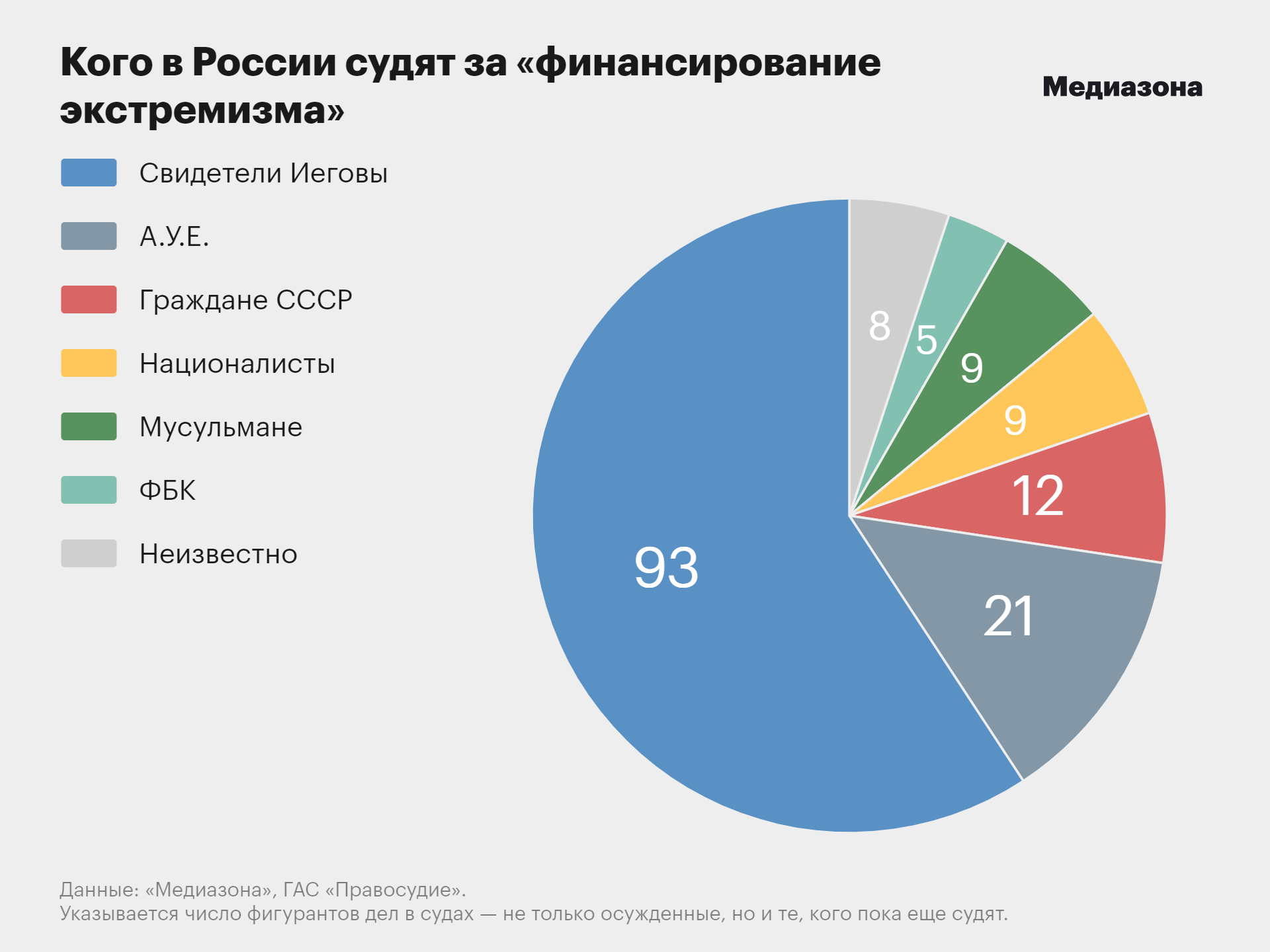
Recently, the number of accusations of extremism, made against adherents of various currents of “citizens of the USSR”: all of them are united by faith that the USSR is still a legitimate state, unlike the Russian Federation, the laws and authorities of which they are not obliged to obey.
The security forces have been fighting them for the past few years, consistently prohibiting the organization’s extremist created by “citizens of the USSR” and pursuing their supporters.
The persecution under this article is generally constantly gaining momentum: only in the first seven months of 2023 the courts already received a record number of cases of financing extremism (25 cases against 18 for the entire 2022).
The number of accused is also growing: if by the end of 2022 60 people were convicted in Russia, then by mid-August 2023, 97 accused were already in the courts (29 people were convicted, the processes over 68 are still ongoing).
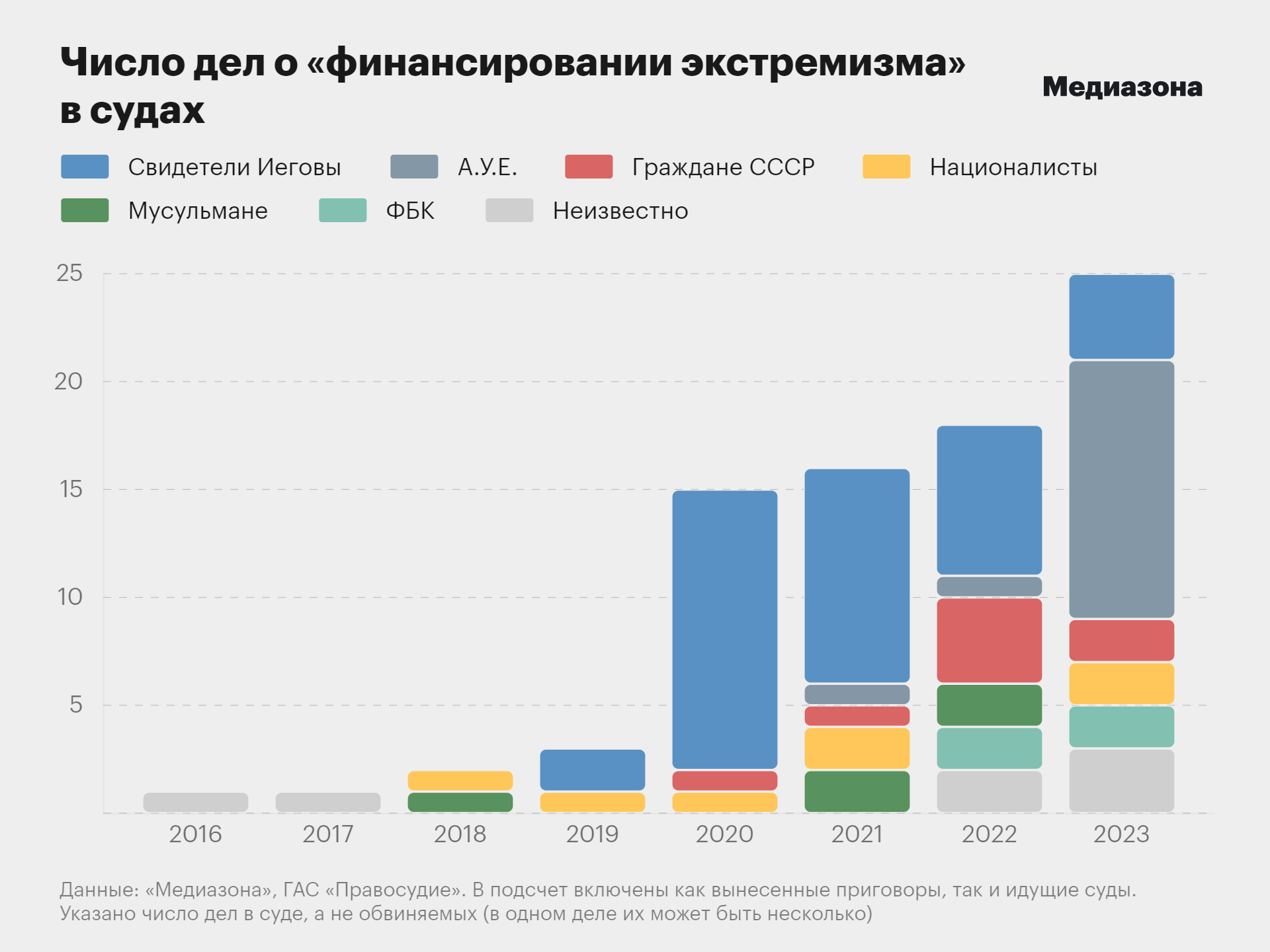
The share of cases against representatives of the criminal subculture has sharply increased - three years ago the Supreme Court, at the request of the Prosecutor General’s Office, banned the “youth movement of an extremist orientation” by A.U.E. (The department deciphens this as a “prison criminal unity”).
Since then, the security forces began to consistently initiate criminal cases of participation in an extremist organization or its financing against prisoners, who somehow attribute themselves to the “thieves' world”.
A typical press release of the Investigative Committee on such a case is as follows : “One of the defendants, serving a sentence in the IK-29 GUFSIN of Russia in the Primorsky Territory, committed deliberate unlawful actions aimed at the formation of prisoners in contact with the criminal environment, opinions about its belonging to the criminal environment in the criminal hierarchy in the prohibited hierarchy in the prohibited. The Supreme Court of the Russian Federation Auie movement. <...> In addition, six prisoners who have informal statuses in a prohibited organization and committing organizational actions aimed at continuing the illegal activities of the prohibited social movement were held to criminal liability.
Apparently, convicts and crime can become the main goal of fighters with extremism along with “Jehovah's Witnesses”, now on cards in the courts it is clear that such criminal cases are investigated against dozens of people.
With the participation of Anton Vshivtsev
Editor: Dmitry Tkachev