
Translated material
War - dick, ship - dick, Putin - huilo
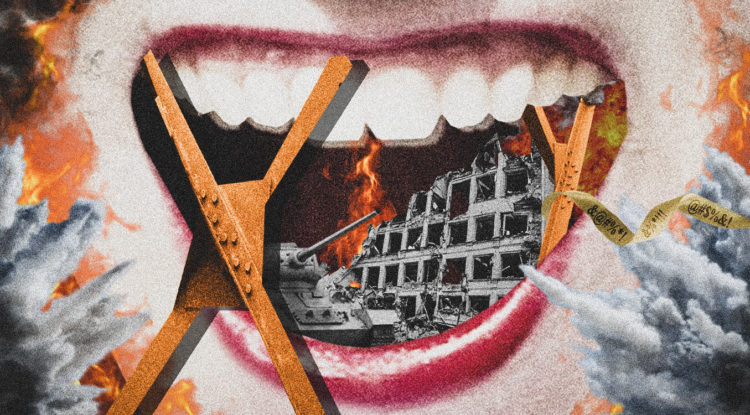
Philologist Ksenia Turkova - about how the war shot a taboo from Mata
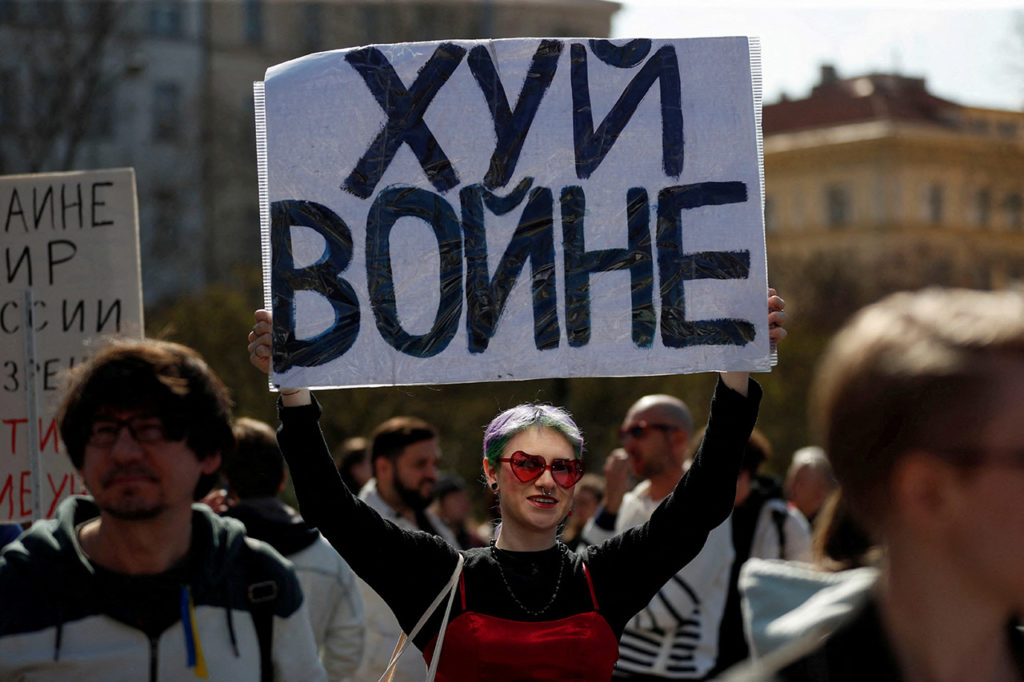
The war changed the attitude towards the Russian mother in an environment that understands the Russian language. "Russian ship, go to the dick!" - One of the main slogans of anti -war movement. “Dick War!”, Once used by the Tattoo group as a provocation, now an absolutely legitimate phrase on public actions. Many media blocked in Russia, including the “cold”, abandoning the implementation of the laws of military censorship, also refused the ban on mat. If we were already banned, then why limit ourselves in words? Philologist Ksenia Turkova explains how obscene vocabulary stops being obscene during the period of social shocks and why there is nothing wrong with this.
In order not to miss the main materials of the "cold", subscribe to our Instagram and telegram .
Odessa journalist Julia Gorodetskaya was recently recognized on the street in New York Brooklyn-and all thanks to the Flashmob “Dick you, not Odessa!”, Which she launched in social networks during the recent massaged shelling of the city by Russian troops. Julia has been living in New York for several years, but spent the last six months in Odessa. When shelling began, she put on one of the most “screaming” shirts, painted her lips and recorded a video on the streets of the city about what anger and what aversion to the Russians bombing the city is overwhelming her. “We are not afraid of you. Dick you, not Odessa! " - Yulia concluded and urged everyone to take part in this flash mob. The video became viral, it was translated into English, and later souvenirs with the famous phrase even appeared.
According to Gorodetskaya, this flash mob has become for her a therapeutic act of liberation from a bunch of pain. “Before the war, I used obscene vocabulary,” admits Julia, “in the most acute moments, from the category of a hammer that has fallen on the leg. But the capital phrase of a flash mob, even for me, was a certain breakdown. She became a lakmus showing that I am not ready to give up, even despite the fact that I am very bad now. ” According to her observations, even those who never swear the flash mob: people admit that the flash mob allows them to cope with emotions, returns the illusion of control over the situation.
With the outbreak of war, Mat for many ceased to be a taboo. The other day I asked my Facebook subscribers if they began to swear more in the last and a half years; I received about 250 comments, and most of them were affirmative. Here are just some of the quotes:
"The mat began to be perceived as a necessity, without it it is difficult to describe reality."
"For 50 years, I have not swore as much as for the last one and a half years!"
“I’m swearing like a shoemaker, before that everyone knew me as a person who did not swear at all. Surprisingly, the mat supports. ”
“Get swearing more at the beginning of the war from horror, anger and inability to describe differently.”
Interestingly, even those who actively used it even before the war noticed changes in relation to Matu. The mat for them turned from a seasoning into an obligatory ingredient - in the sense that it began to be perceived as a necessary vocabulary to describe what is happening. “I swore before, but after the war it became like swearing. Everything turned out to be hypocrisy and cynicism, my mat is just baby babble in comparison with everything that happens, ”one of the subscribers wrote. In her quote, an important sign of time is noticed: the obscene language is much more honest than the language of propaganda, hatred and aggression.
The mat has ceased to be taboo vocabulary and in independent media - the same reading of which is actually taboo in Russia. The publication of the Mediazon was launched by the podcast “Dick War!”, Which, as the description, is trying to comprehend “this new reality”. Apparently, for the new reality, there were also new (for public space) language means. The mat has become larger on the numerous YouTube channels, the leading of which actively use obscene vocabulary on a par with neutral.
In many families, the mat has ceased to be a taboo even for children. “I introduced an amnesty for children if this is connected with the invaders and military aggression of Russia,” one of the comments on Facebook wrote to me (author's spelling is preserved). A familiar Professor-Slavist recently told me about the same thing: with the outbreak of war, he allowed the use of a mature-toejer mat-for example, at rallies in support of Ukraine, when the audience holds posters or chanting the “Dick War!” Or the famous phrase about the Russian warship.
A participant in one of the Russian-speaking Facebook groups of Washington recently complained that from time to time she sees Fuck Putin on local cars. "How so? Children look at the same! " -She was indignant and asked if it was impossible to write a complaint about the mother. Her post did not find support: most commentators wrote that it is impossible to hide what is happening from children and it is better for them to honestly explain everything, and not bashfully block the inscriptions, claiming that "there are no such words." They are, and now they are more relevant than ever.
It is interesting that if, for the Russians actively opposed to the war, the mat became, first of all, it was a way to honestly describe reality (“How is it, perhaps?”-Vladimir from Caste on the anti-war album “lasts February”), then for Ukrainians, the Russian mat was “weapons lubricant or a guide-ashes”.
It is these metaphors that leads philologist Hasan Huseynov in the article "How did the Ukrainians dare to assign a Russian mat?" :
“The Russian army may have a numerical advantage before the Ukrainian. But, like the Greeks in the battle of Salalamin with the Persians, the Ukrainians are now fighting off, like free people from the stinks, from the obelled slaves of the Russian king. As a reincarnation of Xerxes, Ukrainians branded this king with a public obscene word. ”
Huseynov recalls that the use of a mat in the public sphere in Russia was officially banned in 2014 - just a year of the annexation of Crimea and the beginning of a hybrid war. And it was then that the Ukrainians endowed Putin with a mother nickname Huylo, who became known all over the world.
However, now, a year and a half later, many Ukrainians feel that they already need another “weapon grease”, another amplifier. The Ukrainian artist Eduard Mezhul in the comments to my post admits: “At first we picked up the phrase about the Russian warship, but now we are already looking for Ukrainian sharp words that would help us express strong emotions.”
Political scientist Sergei was also written about this: “I have now switched exclusively into the Ukrainian language (I communicate with literally a few people in Russian), but it’s impossible to swear in Ukrainian.”
The teacher of the Ukrainian language and speech technique Victoria Khmelnitskaya, who conducts a popular blog about the language on Instagram, confirms that the longer the war is, the less indispensable the Russian mat. According to her, the Ukrainians began to be actively interested in Ukrainian curses. “Of course, people began to swear more, because we believe that we don’t need to restrain ourselves,” says Khmelnitskaya. -But also Ukrainians are very interested in how you can swear in Ukrainian. I even had a lecture for subscribers in which I translated all abusive words (not obscene). So many now want to use not Russian mat, but Ukrainian curses, and so that it is so ... delicious! ”
It turns out that for Ukrainians, the mat at the beginning of the war really became a kind of weapon that was taken from the enemy and sent against him, and successfully: the address at which the Russian warship went is now known all over the world.
At the same time, in Russia, for those who opposed the war and supports Ukraine, the mat acts as a kind of “valve”: when all other freedoms are destroyed and the simplest words were banned, the freedom of observant self -expression remains as the most honest way to describe their feelings and reality.
However, many admit that they do not like the new habit of swearing in themselves. “Now, when I constantly pray for Ukrainians, for the end of the war and for the termination of repression, the mat is generally inappropriate,” one of the subscribers wrote to me. And the other added: “I really respect those who keep themselves from the mat. I can't. In the end, she gave herself a vow (a real oath) that I would stop swearing when the war ends. ”
The author’s opinion may not coincide with the opinion of the editorial office.