
Translated material
Civilization state on the planetary mission
Following the school textbook of Medinsky and Torkunov, the new textbooks of the course “Fundamentals of Russian statehood” for universities were published. In them - nationalism, conspiracy and xenophobia
Photo: Sefa Karacan / Anadolu Agency / Getty images
In the 2010s, the Russian authorities loved manipulating symbols. It was possible to call this an imposition of an “official narrative” only by recognizing that they do not have a consistent description of history and modernity. But after February 24, authoritarian Russia has such a narrative, and an integral one, even with a fascist soul, should have already arisen.
The task is not easy, but they are gradually trying to solve it. In a war organized by adults and old people, youth does not want to die? So, with her, one must work first. The first to have a hastily concocted school textbook of Medinsky and Torkunov. But the repetition is the mother of the teachings, and therefore a new blow to the psyche who moved to the student bench awaits the course “Fundamentals of Russian statehood”. Especially for Novaya Gazeta Europe, historian Konstantin Pakhalyuk dared to read and study three options for this course-students of “general” profile, humanitarian students and “techies” students. That's what he returned to us.
"DNA" Kiriyenko
Manuals for the course were prepared under the auspices of the DNA of Russia project, which are under the patronage of the curator of domestic policy, Sergei Kiriyenko ( First Deputy Head of the Presidential Administration. - Approx. Ed. ). Today, the project participants are instructed to form “new meanings” for the “beautiful” Russia of the Putin’s future.
The “general” educational and methodological manual was done at the Yaroslavl State University with the participation of Vardan Baghdasaryan, the former speechwriter Vladimir Yakunin. At one time, he wrote a dissertation about the “theories of a conspiracy” - and this experience, apparently, laid the foundation for his career.
The author’s team of a textbook for humanitarian students was headed by Sergey Pereverzentsev, a well-known Orthodox thinker and participant in the World Russian People’s Cathedral. Among six co -authors are almost all political scientists, except for Tatyana Evgenieva. The authors are affiliated with the State Academic University of Humanities and the Faculty of Political Science of Moscow State University.
The latter is the basis of the "Expert Institute of Social Research" - the structure through which the presidential administration has been interacting with "correct" political scientists for several years.
The manual for the Technicians is written under the leadership of Hieromonk Rodion (aka Alexei Rodionov) from MEPhI. 7 out of 13 co -authors are also associated with this university. The choice, most likely, is not random, since Andrei Polosin , one of the real leaders of the “DNA of Russia”, a person from the Kiriyenko circle, also works here. The author’s team includes a number of truly deserved and respected historians, and the corresponding member of the Russian Academy of Sciences Pavel Uvarov acted as a scientific editor.
Hard mix
All three manuals are a mixture of political geography, Russian history and political science. The student does not really find out anything about how modern Russia works. Modern intellectual discussions of even Russian -speaking scientists are completely unfamiliar to the authors. The problem “We do not know modern Russia” is solved mainly due to a cheeky story about history.
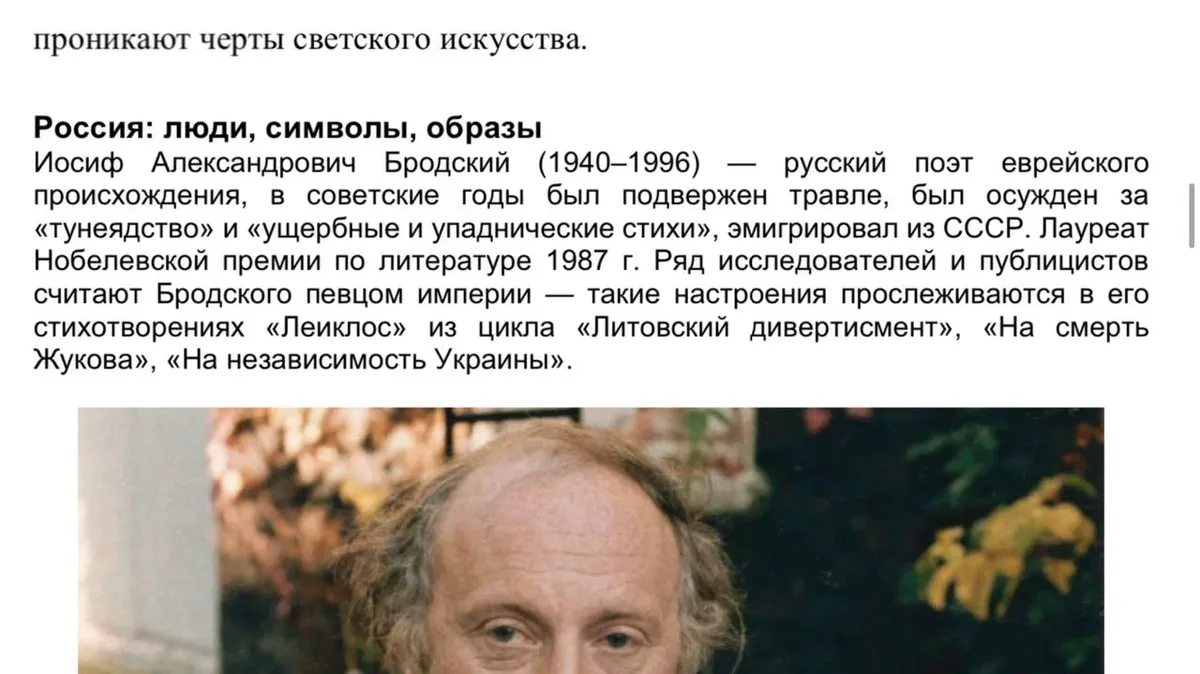
Like the textbook of Medinsky and Torkunov, the “Fundamentals of Russian statehood” intend to reduce Russia to the state, and citizens to the “faith and truth” to him. In the "humanitarian" manual among "their own" - even Brodsky. His persecution does not be silent, since the poet is assigned as a "singer of the empire."
The main difference is that dentisting theoretical thoughts, as if the authors themselves do not fully understand what they write about. The rhetoric of Medinsky resembles a patriotic coaching, this is not there.
But continuity appears. Almost 10 years ago, the Minister of Culture made many enemies among historians who were outraged by the fact that his dissertation was written through the prism of “national interests”.
Today, the authors of the “general” manual in the introduction quite frankly write that national interests are one of the key “framework” of this course.
In comparison with the mentioned school textbook, another end -to -end idea sounds more clearly: the history of Russia is primarily the history of the Russian people. Russian ethnic nationalism, however, is ashamed of itself, hiding behind the images of the state and civilization, justifies, honors its tolerance, but is madly hating the “West”, liberals and all who allegedly destroy “basic values”. Peaceful declarations sound convincing only thanks to the silence of the long history of ethnic conflicts.
Of course, there are stylistic differences. In the “general” manual, Russian ethnic nationalism is more compared to the clothes of statehood. In the “Technical” this is strengthened: “civilian nations” are freely replaced by “state”, and the Slavs are declared a super -ethnic group (but “Russians” are the main and liberators). The “humanitarian” textbook is dominated by Orthodox and monarchical images, which allows you to be a little more critical of the Soviet era. Among the "Russian thinkers", Ivan Ilyin, who did not shy in the 1930s, is named. To give a lecture for the Nazis on the "Jewish-Bolshevik" conspiracy, as well as Oleg Platonov. This is a modern conspiracyologist, an anti -Semite and a renovator of the Holocaust, whose books were recognized even by the Russian court extremist.
What is Russia? ..
The first chapter of each manual is devoted to the question: "What is Russia?"
The answer is a territory where, under the canopy of the state, many peoples who have their own heroes are worthy of. But do not rush to rejoice at diversity.
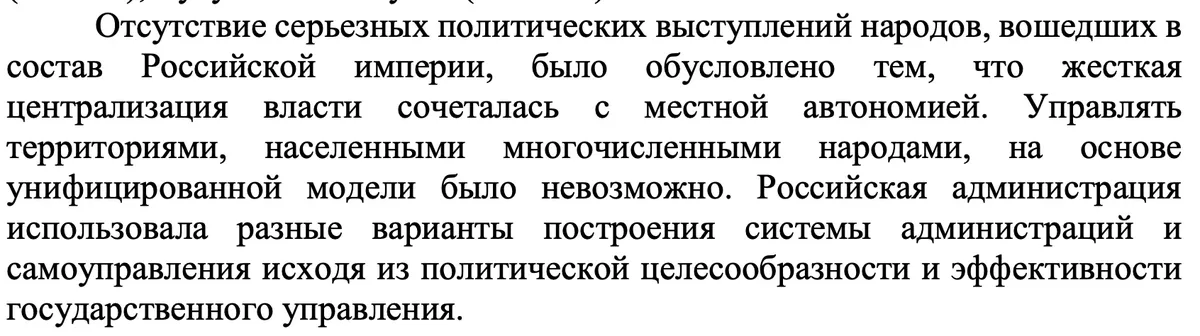
In the “general” textbook “Russia” was reduced to a variety of reference information, and the ethnic “wealth”-to administrative-territorial division. The authors draw a picture of prosperity: “The absence of serious political speeches of the peoples that became part of the Russian Empire was due to the fact that the rigid centralization of power was combined with local autonomy” (p. 18).
The textbook “For Technicians” edited by a member of the RAS and Hieromonk ROC is distinguished by a more detailed story about non -Russian ethnic groups, the essence of which is numbers, ethnographic details and history, but no modernity.
But the poetized image of the Russian space takes the form of a patriotic tour. The text wrote only as an Orthodox mystic, which offers on the map to find Nizhny Novgorod, Veliky Novgorod, Novgorod-Seversky, draw a triangle between these spiritual centers of the line: “In its center with the Kremlin towers, bells, Stalinist skyscrapers and Presnean skyscrapers, the resulting ( as in the text . (p. 9). The Southern Urals is represented by the refuge of "Russian mysticism." Arkaim, Dyatlov’s pass, “gloomy rock”, Bazhov’s tales are adjacent to other, according to the authors, “mythologized stories”: about the Kyshtym nuclear disaster, pollution of medical tanks and Uralmashev bandits. As if the screenwriter was kicked out with Ren-TV, and he got a job to write a textbook. City legends and real tragedies merge into one narrative, so as not to interfere with the "power-territorial symphony."
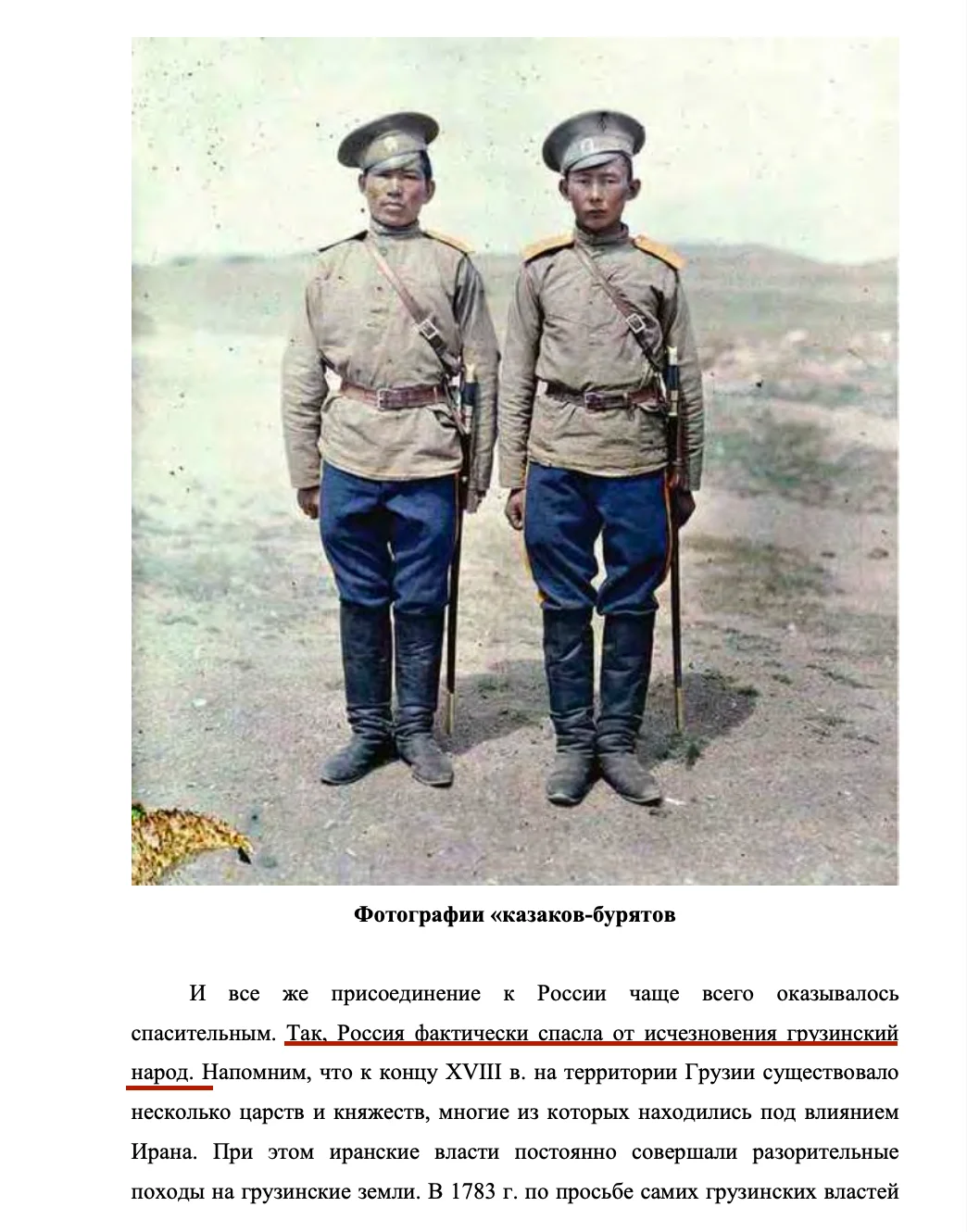
The “humanitarian” textbook only looks more serious. It is more immersed in history, where the national state appears already in the 15th century, and the spaces are such that “the contribution of our country to maintaining the stability of the global ecosystem than the United States and Canada combined, Brazil and Australia” (p. 30). The authors admit that the peoples on these lands did not always want to be part of Russia, there were uprisings, but “nevertheless, joining Russia most often turned out to be saving. So, Russia actually saved the Georgian people from the disappearance ”(p. 86). The Russian power in the Caucasus is also a good, and the hero-symbol is General Ermolov, who gave the Caucasians culture, economic development and civil equality.
A physician must draw triangles between the cities, and the “humanitarism” immediately explain: the basis of Russia is a historical memory, its task is “justification of the greatness of the country and the people” (p. 60). This memory was expressed in the form of different official historical doctrines, but “not all interpretations of history are“ equally useful ”” (if they are not from the state), and therefore the historical pluralism of the last decades undermined the country (p. 74). If you throw off the lyrics, it will be simple: the falsification of history for the sake of the state is a good matter, so it is no coincidence that a positive example is Ivan the Terrible, who invented his origin from Emperor Augustus. To lie for the sake of status is such a “historical norm”.
The fundamental priority
The following two chapters are devoted to civilization and values. They take up a lot of space, but meaningfully the most muddy. Everything is used: quotes from Danilevsky, Spengler, Sorokin and Huntington, Losev, Ilyin, Berdyaev and Dostoevsky, as well as several dozen authors of about the same time. The result resembles a student abstract written on the night before the surrender. There is also the concept of Russia as a pentabasis with which Polosin was worn last year. The boss needs to be respected, but again-in a statistically, formally, technically adding to the narrative.
The meaning is quite obvious: Russia is something special, culturally rooted, soldered by special values, and therefore you want it, but a person cannot rethink this heritage, otherwise - collapse and crash.
Freedom has a framework, they are also cultural and at the same time authorized by the state. This leads to the revival of ideas about the “national character”, which is actually denied once, because Russia-civilization is not the same as the Western “ethnic nations”, therefore, there can be no “national (ethnic) character”.
In the manual for the "techies", the authors dare to even say that there are other approaches to history. For example, the theory of modernization, which is allocated half a page. Large -scale discussions on this subject - abroad, in a century long - remain unknown. It is understandable, “Russian civilization” is deeply provincial. But the future physicists and biologists are invited to believe, as if annually, only on Orthodox Easter and only according to the prayers of the Jerusalem Patriarch, the fertile fire descends in Jerusalem. This is claimed by two candidates and one doctor of philosophical sciences.
Locking reasoning on civilization is adjacent to the notorious Russian nationalism. The ethnic diversity of the first chapters is forgotten, since Russia is only Russians civilization. Here is a quote from the “common” textbook: “Russian people, Russian culture, Russian - the foundations of Russian civilization. The Russian civilization is united by a common cultural code - basic values and the Russian language, the native speaker of which is the Russian people. The large space of the Earth formed the large space of the Russian soul ”(p. 31). How did these territories form? Yes, everything is simple: “Russia did not turn to military force when expanding its own territory, the use of power tools to retain the territory already included in its composition” (p. 33) was not a systemic nature. Once again, I pay attention to the fact that this is a university textbook, not cheap journalism.

We find the same thing in the “humanitarian” textbook: “For centuries, the Russian people have carried on their shoulders the main severity of state construction, the creation of the country's economic and cultural wealth. At the same time, the Russian people did not use in the Russian Empire any privileges - neither economic, nor legislative, nor social, nor political. Rather, on the contrary, it was the Russians at all times that were used by the rulers of Russia as the main material and human resource for the performance of various state tasks ”(p. 156). It is difficult for me to imagine what feelings such words will cause in Russian national republics.
The groups of the authors did not agree on the basic values of Russia-civilization, so their lists do not coincide at all. The guidelines are studied in the works of writers and philosophers of the XIX-early XX centuries, from more or less modern they recall A. S. Panarin and V.V. Putin.
In the “general” textbook, Russia is united by solidarity, collegiality, community, unity, as well as healthy conservatism (p. 61). In the “humanitarian” other features are distinguished: freedom and truth (justice), the unity of diversity, strength and responsibility, consent and cooperation, creation and development, as well as love and trust (p. 312). The "technical" textbook is more pragmatic. There, the authors simply quoted one of Putin’s recent decrees and it turned out: “Faith, household, house -building, ministry, collegiality, power, truth, justice, love, compassion, conscience, freedom as good will, beauty, dignity of man” (p. 123). Of course, this is not an exhaustive list: many other “values” are scattered in the text of each manual. You can even arrange a quest.
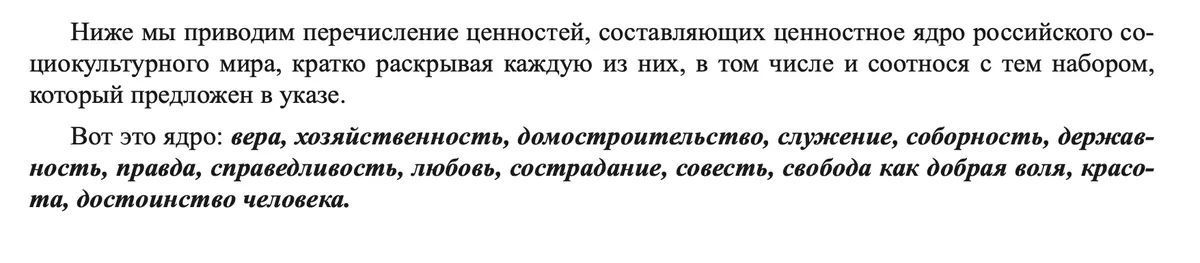
The worst thing is that the conversation about culture and values is reduced to declarative phrases. As if according to the patterns of the Soviet era, the authors are trying to “speak” history and modernity, to draw a marvelous world of stable timeless entities. It is impossible to comprehend this logically - you can only accept, store and believe. How the culture “works” in practice, how it connects people, how value views affect the behavior of a person - the benefits do not tell about this. The authors do not find knowledge of either modern intellectual discussions, or the work of colleagues in the workshop. From the case presented at the beginning of the case with Brodsky, it is clear that the authors are more aware of the Facebook-dishes.
Modern Russia and the world
It would seem that in the latest chapters about the political structure and challenges of modernity one could tell about the levels of power in Russia, about how the political system functions, what globalization is, how Russian foreign policy develops. Alas, but no.
In the “general” textbook, we find a certain compressed retelling of the course of the theory of state and law - about public state bodies, in which discussions are added about how it would be good to predict the future. As a result, the student comes to the idea:
“For the successful development of modern world civilizations, Russia offers the world its planetary project. This project is that the power of each civilization is a support on its traditional spiritual and moral values. ”
And if in September 2022 Putin announced the danger of the Anglo -Saxons, then the authors thought in advance and stated that there was no such civilization at all (p. 131).
The “technical” textbook is more interesting, since it represents a detailed story about how Putin fought with various elites and groups for the approval of external and internal sovereignty. Here, thank God, there is already nothing about Orthodoxy, nor about civilization, nor about spirituality. The author clearly demonstrates that modern Russia can be written without Orthodox-conservative demagogy. True, gradually near political conspiracy thespaper goes into an overview of various state programs. About modernity, in only two registers are expressed: “high” servant patriotism with quotes from Putin and the dry language of bureaucratic documents. Practical-oriented education.
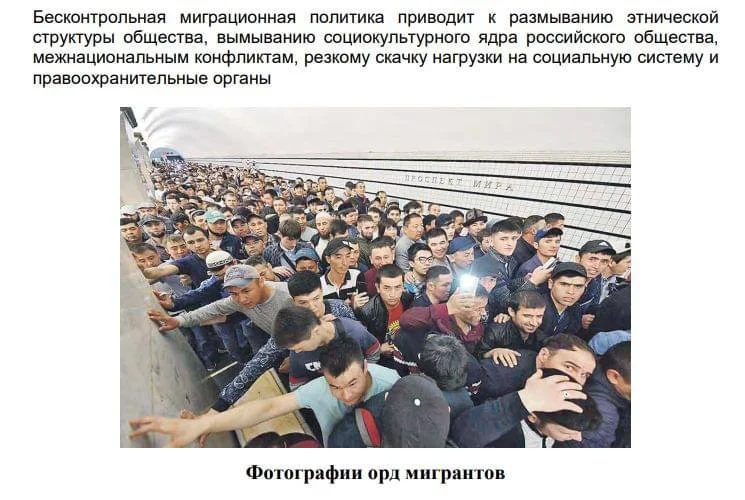
“Calls of Russia” also vary. In a “general” textbook, these are various “global trends” (from a demographic transition to neo -punishism), in “technical” - everything is spinning only around geopolitics and security, but the “humanities” are taught to think that the country and its “traditional values” undermines: illegal migrants are also added to the liberals.
But not "everything is clear." In this stream of consciousness, we sometimes find completely unexpected things. So, the authors of the “general” textbook write about the rooted democratic tradition. In the "humanitarian" there are lines that historical memory can be built on repentance. “Technical” generally deduces a developed democratic tradition and in every possible way pokes it in the nose of the “notorious” West. If desired, you can find even more seditious.
What is not in the manuals
These publications cannot be called "educational." It will be difficult for a student to get through a mixture of pseudopolitological rhetoric and dubious statements. This is a virtual world where there is no criticism of the state, an idea of nonlinearity of development. Following Medinsky and Torkunov, the authors amicably throw out from the history of man, with his interests, problems, hopes and suffering. The Russian state is, alas, not about citizens. Fatherland is an independent category.
The authors did not have a direct attitude to justify state violence - and they prefer not to notice it. In some cases, however, they are ready to admit, but only including in the general concept of fame. For example, in a “technical” textbook, the introduction of serfdom was a blessing, as security strengthened. И его отмена тоже оказалась благом, поскольку ускорила развитие страны.
Спору нет, тяжелые и преступные страницы истории могут вести и к неожиданным последствиям. Скажем, «Кишиневский погром способствовал росту сионизма». Но сказать только так — и забыть про жертв разъяренной толпы или государственного геноцида — это переиначить историю, представить преступников чуть ли не благотворителями. Увы, авторам этого пособия сложно подняться до такого осмысления российской истории.
Ничего студент не узнает про современную Россию. Авторы спутали «основы государственности» с историей, а культурное многообразие — с народными костюмами. Мне вспоминается, как я вел курс об исторической памяти магистрантам — школьным учителям. Одна из них с упоением рассказывала, как они работают над тем, чтобы подростки из разных регионов учились межкультурному многообразию, устраивая этнические концерты: русские народные танцы, дагестанская лезгинка и прочее. И как же это помогает в реальности понимать культурные отличия? Вы рассказываете русским ребятам о системе тейпов на Северном Кавказе? О неформальных правилах взаимодействия между разными возрастами и полами? Нет, потому что оказалось, что она сама имела об этом только смутные представления. Такое восприятие, конечно, сводит «культурное многообразие» к этнографическому артефакту, игнорируя повседневную (и важную) реальность.
Зато нет и другого: тема Украины и современной российской агрессии сведена к минимуму. Это — «проходной» эпизод на пути развития России как государства-цивилизации в планетарной миссии. Да, здесь нет агрессивной Z-повестки, которая в блогах тех же телеграм-«военкоров» выдается за русскую консервативную революцию.
При всей кровожадности она имеет стержень: пафос насильственных преобразований, культ мужественности и силы, самоотверженной борьбы, увлекающей вперед.
Изученные пособия логически и эстетически отрицают это. На страницах выплеснуто что-то смутное, обрюзгшее, самодовольно-бюрократическое, увязшее в трясине случайных цитат из текстов, которым обычно 100 и больше лет. Может, в этой оторванности от реальности, где как мантра повторяются слова о добродетелях русского народа, и есть подлинный смысл: заболтать радикализм сегодняшнего дня и вообразить, что ничего не происходит — нет ни войны, ни агрессии, ни государственных преступлений?