
Translated material
Why did the Luna-25 fly?
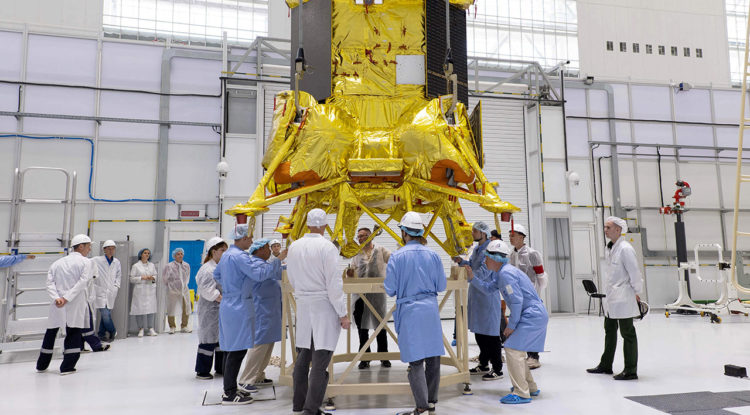
After half a century, the world began a new lunar race to build colonies and space gas stations. Russia is losing
Last weekend, the Interplanetary Automatic Station "Luna-25" crashed on the lunar surface. Russia sent the station to the moon for the first time after the Soviet launch of 1976. It was planned that on August 21, she will land in the area of the southern polar region of the moon and will begin to collect scientific data there. "Cold" tells why people strive for the moon so and what successes and failures had humanity in the lunar race.
In order not to miss the main materials of the "cold", subscribe to our Instagram and telegram .
To begin with, a simple geometric fact: the axis of rotation of the moon is inclined by only 1.5 degrees (for comparison: the slope of the earth's axis is 23.4 degrees). That is why space agencies and engineers are developing plans for returning-more than 40 years after the Apollons era-to the Moon, the construction of bases and robots there, which is why the Indian Sonda “Chandrayan-3” and the Russian “Luna-25” are now flying to the moon, and therefore Ilon Musk and NASA are building and experiencing the largest missiles in history . We explain how exactly the lunar race and the angle of inclination of the axis are connected.
Cold traps
The conclusion from this geometric fact was the first to make an American physicist and participant in the Manhattan Project Garold Yuri . In 1951, in a book about the origin of the planets, he casually noted that thanks to this orientation of the axis of the moon rotation of its poles, there may be a decrease, where the rays of the sun may never look, and flying substances can accumulate in such cold areas. This was the first logical step, but Yuri did not take the next step. “Water in neither liquid nor a solid form could have been present on the moon longer than a very short period of time,” he wrote.
After 10 years, after the start of the space era, the second step was taken by Kenneth Watson, Bruce Murray and Harrison Brown from the California Institute of Technology. They correlated the possible temperature in constantly shaded areas (not higher than 153 degrees below zero), their area, the speed of ice evaporation in these zones, reminded that meteorites falling on the moon (about 0.1% by mass) and can replenish water reserves on the moon, and came to the conclusion that it was water ice that should first be accumulated and preserved in the lunar areas Eternal darkness for which these three came up with the term “cold traps”.
However, the theoretical research of scientists went on as usual, and the lunar race of two superpowers - their own. Scientific tasks in this race were of secondary importance, even third -rate - after political and engineering. The main tasks were political: get to the moon, set the flag, show who is technologically and economically stronger. And in this era, it was primarily necessary to solve engineering problems: to build a rocket capable of sending a probe to the moon, to be able to get into the moon (that is, simply not to miss-the Soviet “Luna-1”, for example, did not hit, only “Luna-2”), and make a soft landing. For example, the locations of the Apollo were chosen close to the equator: this was how it was possible to use a simpler and more safe trajectory of free return, that is, a trajectory that does not require the engine on guaranteed return to the ground. And when the winner of the lunar race decided, there was no reason to continue it.
In August 1976, Luna-24 delivered 170 grams of lunar soil from the sea of crises in the north-eastern part of the lunar disk. In these samples, the Soviet geochemist Maya Akhmanov and its colleagues found water - from 0.1 to 0.2% by mass, but their article remained unnoticed, and for many years the moon was considered “dry as a bone”: as part of trials brought by the “Apollo” in 1969-1972, even negligible amounts of moisture were found .
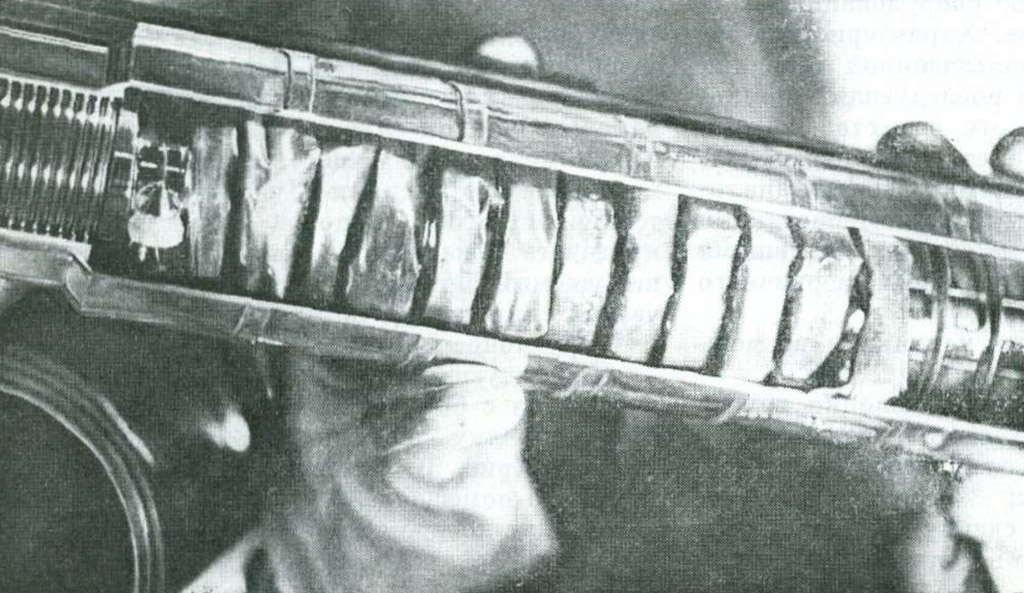
After the winner of the lunar race was determined, the United States turned the lunar program; Plans for new flights, the construction of lunar orbital stations remained on paper. The Soviet Union also lost interest in continuing the lunar program. "Luna-24" was the last apparatus of the era of the lunar race, which visited the lunar surface. The studies of the moon froze for almost 15 years . The already built Luna-25 station with Lunosta-3, the launch of which was planned for 1977 and which, after the cancellation of the mission, was renamed Luna-25a , remained on Earth and now decorates the NPO Lavochkin Museum: missiles were needed by more promising missions for Venus and Mars.
The moon is on a pause
This is not to say that the moon was completely forgotten. In 1989, 20 years after the landing of Apollo-11, US President George Bush, the eldest announced the initiative of the cosmos study, which included the resumption of the construction of the Freedom orbital station (Reagan first announced the construction of the Freedom in 1984), the return of people to the moon and the construction of the station there , as well as a flight to Mars. But already in 1992, Bush lost the election, and Congress launched a plan under the knife. As a result, on the basis of the Freedom project, after cutting the budget, an American ISS module was created.
In 1990, after a long pause, the Japanese Khiten station went to the moon, but its tasks were mainly technological and engineering: Japan caught up with the leaders of the space race, the scientific program of the apparatus was limited to the study of micrometeorite dust in the lunar surroundings.
The pause ended partly thanks to military research. The Lunar Mission “ Clementine” , which started in 1994, was a joint project of NASA and Pentagon, the purpose of which was to check and development during observations of the Moon and Asteroid geographer of new sensors and cameras, which were then planned , in particular, in missile defense programs.
In the 71st day in the near -moon orbit, Klementina received about a million color pictures of the moon in the visible and infrared region of the spectrum, thus creating the first color atlas of the moon - and it was needed not just for beauty: the surface of the surface allowed geologists to draw conclusions about the mineral composition in different regions.
The probe also specified the data on the lunar gravitational field, and most importantly - thanks to the features of the orbit, he was able to recall the polar regions of the moon for the first time in the details, including looking into the coldest traps - craters where, over billions of years of eternal darkness, water ice, for example, from the falls of the comets, which are mainly from ice and consist.
In the optical pictures in the cold traps, there was nothing but shadows, but Klementina had a trump card: scientists aimed the antenna of the apparatus at the lunar pole, she broadcast radio waves from a certain angle to the surface, and the reflected signal caught the antenna of the far cosmic communication station on Earth. The study of this echo allowed scientists to assume that water ice can really be present in polar cold traps. Later, already in 2001, having collected the data of the radio zanding of the moon from the Earth, the same group of scientists concluded that a field of 10 square kilometers of ice could extend in one of the walls of the crater.
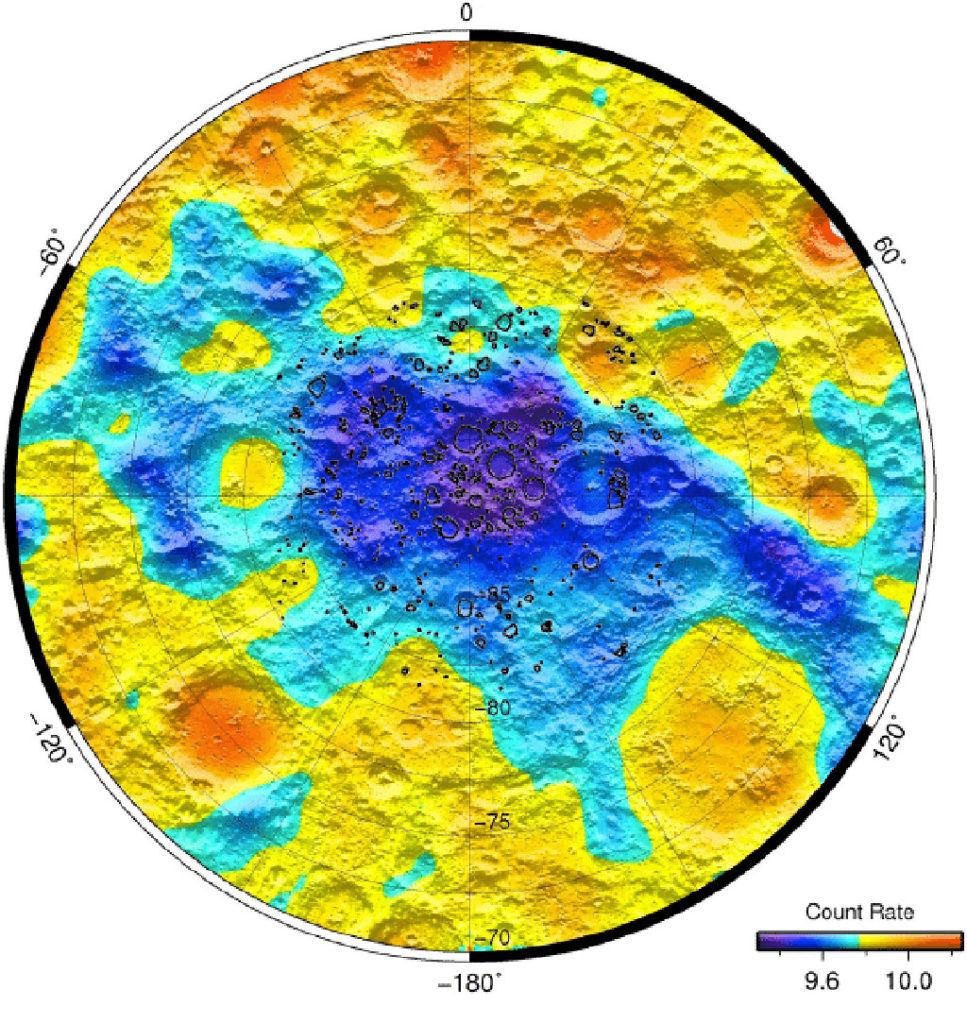
However, by that time, a new confirmation had a new confirmation hypothesis: in 1997, the American apparatus Lunar Prosperator, measuring the stream of neutrons from the surface of the moon, found that this stream was very sagging in the polar regions. Neutrons are well absorbed by the substance rich in hydrogen, which means that the lunar poles have a lot of water - as scientists said , up to several billion tons of water ice.
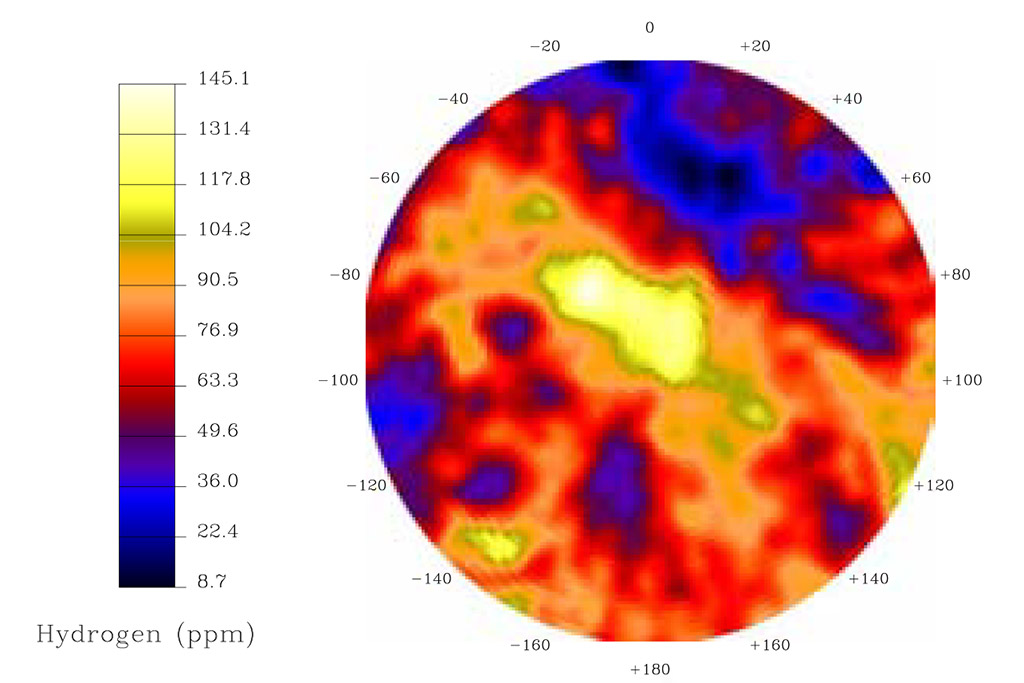
These hints, as well as indirect data from the Nasavsky probe of Deep Impact and the Japanese probe “Kaguya”, were enough for scientists to finally begin to plan experiments and missions that should have been an accurate answer, whether there are water on the moon.
There is why to fly
However, why is it at all important? We talk so much about the water ice on the moon, and what will change if we find it? First of all, this will greatly facilitate the task of creating a inhabited base. A person needs from 6 to 20 liters of water per day - depending on whether you are going to take a shower and wash off in the toilet or are ready to do without it. If you can get water in place, the task of supplying the inhabited lunar base is greatly simplified.
In addition, water is a source of fuel and oxidizing agent - hydrogen and oxygen, which can be obtained by electrolysis (and electricity can be obtained using solar panels, especially since the lunar poles have not only constantly shaded areas, but, conversely , constantly lit).
Finally, if people manage to use the lunar reserves of water, this may mean that we can acquire cosmic gas stations with oxygen-hydrogen fuel not only on the moon: constantly shaded areas where there can be ice, there are on other bodies of the solar system, for example, on a cereal (and 10 years ago, commercial companies were seriously making ice production on asteroids, and the ice was made by production itself Not the ultimate goal: they were going to make fuel for missiles from the water to export platinum metals from asteroids to Earth).
Orbital scout and m 3
In 2008 and 2009, scientists were finally able to get certain data. The first of them was brought by the Indian Sound “Chandrayan-1”: a small shock probe separated from it fell to the moon, but before the fall he transmitted clear data indicating the presence of water there. The NASA device on Chandrayan, the Moon Minellogy Mapper (M 3 ) spectrometer, also saw water on the surface of the moon (though in a rather low concentration). Radar on board “Chandrayana” made it possible to collect data on topography of constantly shaded zones - and ice supplies in them were estimated at 600 million tons.
In June 2009, two probes went to the moon - the LCROSS orbital orbital apparatus (Lunar Reconnaissance). LCROSS and the developmental block "Centaurus" was deliberately sent to the shaded area of the Cabeus crater near the South Pole. On October 9, 2009, the Centaurus fell there. The gas -flower cloud that rose during the fall was observed LCROSS and Lro. A few minutes before Lcross himself fell, he managed to explore the chemical composition of the cloud - about 155 kilograms of water vapor and ice fell in his field of view. Calculations showed that in this area in the regolitis - the upper layer of the lunar surface - the proportion of water ice can reach 5-6% by weight. In addition to water, ammonia, hydrogen, methane and some other substances that, according to scientists, indicated the cometary origin of these deposits.
Another device on board Lro - the Russian neutron telescope Lend, created at the Institute of Cosmic Research of the Russian Academy of Sciences - compiled a detailed neutron map of the moon and was able to show the areas rich in hydrogen (and therefore water).
Lunar race - 2
Devices of different countries, launched to the moon in the 21st century, can only be listed. The probes were sent by Europeans, Indians and Chinese. In 2019, the Israelis tried to put the apparatus on the moon, but the Bereshit probe created by the private company as part of the Lunar X-Prize competition and then received the support of the state. Already this year, the Ispace Hakuto-R landing device also crashed . The Indian landing apparatus "Vikram", which went to the moon in 2019, along with the orbital apparatus "Chandrayan-2", was also unable to crash safely.
Against this background, the successes of the Lunar Program of China, which was able to plant three planting probes on the moon, are stunning, two of them with lunar drives, and one of them for the first time in history landed on the reverse side. In addition, China for the first time since the 1970s was able to deliver samples of lunar soil to Earth. Thus, since 2007, China has been able to repeat all the achievements of the era of the lunar race - with the exception of the manned program (that is, when a person is sent to space).
The US -pilot flights to the moon is prepared by the United States - the new lunar missile SLS with the Orion ship has already fled - but so far without a crew. Astronauts should fly around the moon in November 2024, and the landing is planned at the end of 2025. True, it is unclear whether Starship’s landing module will be ready by this moment, which is being built by Ilona Mask SpaceX. The first flight of the "foreman" and the returned stage of Super Heavy, as we recall, ended in failure.
And what about Russia?
24 to 25 - half a century
The first references to Russian plans to send automatic planting probes to the moon dates back to 1997. Then the alleged appearance of the devices was radically different from the one that was implemented in practice.
In particular, it was planned that the orbital and planting probes would immediately fly to the moon-they were called “Luna-Glob”. The feature of the then project was penetrators - discarded probes, which were supposed to fall into the moon at high speed, plunge into the ground and play the role of a network of seismic research stations. Similar probes stood at the Mars-96 station, which had crashed due to the failure of the accelerated unit, but this exotic very quickly disappeared from the project.
Actually, the landing device was supposed to be quite modest and resembled the Soviet “Moon-9”: it was a ball that laid out “paws” during landing and released antennas. He was not supposed to be solar panels, according to the plan, the probe should not have survived the moonlit night.
At that time, a whole line of lunar devices was already worked out, which included a new lunar rover, a mission to deliver lunar soil to Earth and, like the crown of this unmanned program, the Lunar Polygon project, a kind of lunar robots, consisting of a scientific research units, official apparatus, and energy systems.
In 2021, Roskosmos planned to create such a “village of Robotov” together with the PRC-this project was called the International Moon Research Station, and Luna-25 was part of the very first-intelligence-the stage of creating this station, that is, we can assume that the future station would be in the same area.
However, in the 2000s, the main Russian interplanetary project was Fobos-Gront-the station was intended to deliver soil samples from the satellite of Mars, Fobos, and to Earth. In 2011, the launch of the Phobos Gront, like Mars-96 a half decades before, ended in failure. This had great consequences for the entire Russian interplanetary program, especially for the lunar, since in the projects of lunar stations, nodes and developments made for Phobos Gront were widely used. After failure, it was necessary to redesign all lunar probes in order to remove potentially vulnerable nodes from there.
Following the Luna-Glob, the Moon-Resource was supposed to go, and this was already a joint program with India.
However, in 2013, the Indians left the project , and the Russian lunar program continued to evolve independently-about the same time, the naming of interplanetary stations came back to the Soviet tradition: Luna-25, Luna-26 and Luna-27 came to the place of the Luna-Glob and Moon-Resource. (It should be noted in brackets that the Soviet AMS names were received only if the mission was successful. About stations lost during launch or not reached orbit, they did not report at all; if the device reached near -Earth orbit, but did not go to the moon, it became a license plate of space - and no one found out about its interplanetary purpose. And only if the station reached the moon, it has it to the moon, it has it. The official name "Moon" appeared.
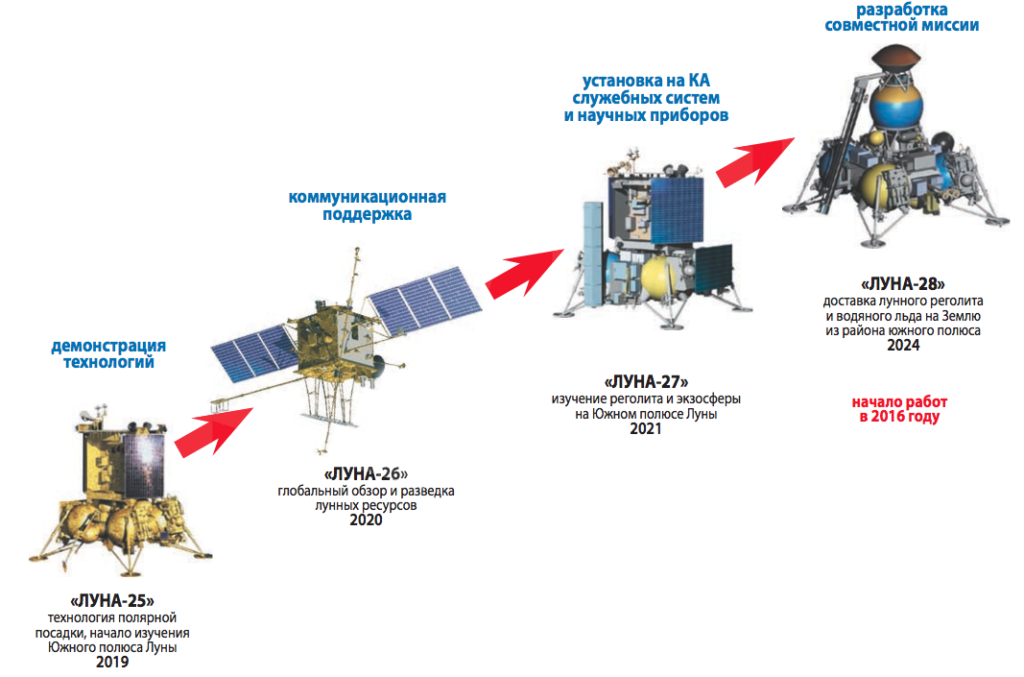
In the current form, the Russian plan looked like this: the landing “Luna-25” was the first to fly. Its main task is not so much research as engineering. The mission was supposed to demonstrate that Russia had all the necessary technologies in order to successfully put the device on the moon, and in the spacing latitudes, and not at the equator.
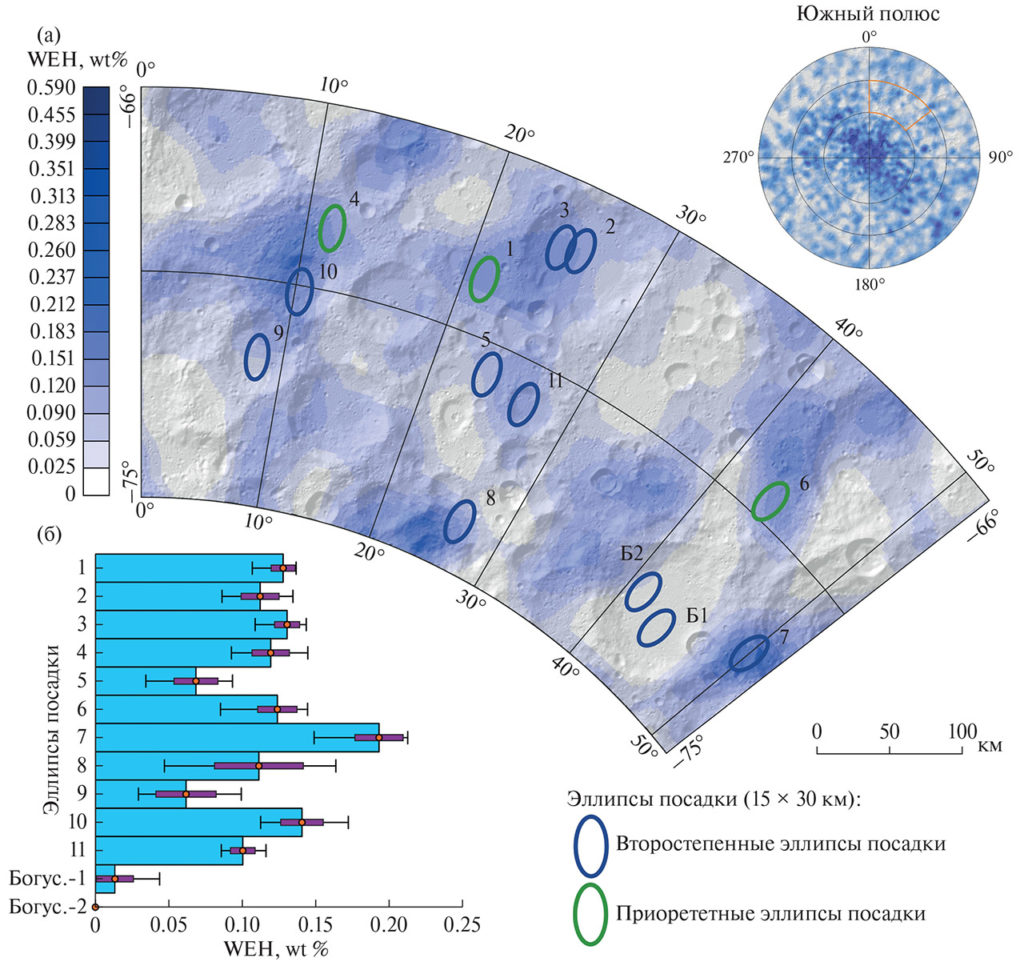
Many media wrote that this would be the first apparatus in the spacing zone. Indeed, the Luna-25 was supposed to sit in very high latitudes (where it is difficult to break)-69.5 degrees of south latitude. On earth at such a latitude (only northern) is Murmansk. However, the study of directly cold traps, that is, constantly shaded areas, there is no speech yet - scientists chose a place for landing , focusing primarily on its safety. There should not have been too steep slopes, large boulders in the planting ellipse zone, that is, nothing that would lead to overturning the device when landing. And in this zone there should be quite good illumination, otherwise the device that receives energy from solar panels will simply not survive there. However, in this zone, according to the Land, there are about 0.1% of the water, and the devices for studying the soil samples on board the "Moon" may have been detected.
The orbital “Luna-26 ” was supposed to follow it (now its launch is planned for 2027 ), which, in addition to performing scientific tasks, should play the role of a retransplant for the following landing missions. В первую очередь — для посадочного аппарата «Луна-27» (бывшая «Луна-Ресурс», в 2028 году), который должен был стать «“Луной-25” на стероидах» — с массой в 2,2 тонны вместо 1,6 тонны, с почти 20 научными приборами вместо семи.
Главной фишкой «Луны-27» должна была стать буровая криогенная установка — то есть устройство, способное не только пробурить скважину и получить образцы с глубины, но сделать при этом так, чтобы вода и другие летучие вещества не ускользнули из них и были зафиксированы сенсорами. Эту установку, получившую название PROSPECT , создали для Луны специалисты Европейского космического агентства. Именно с ее помощью ученые рассчитывали впервые на месте изучить лунную воду.
Competitors
Практически одновременно с «Луной-25», причем примерно в том же районе, должна совершить посадку индийская станция.
Индийское космическое агентство ISRO, в отличие от «Роскосмоса», может похвастаться успешными межпланетными миссиями за последние два десятилетия: после успешной лунной миссии «Чандраян-1» в 2008 году, обнаружившей свидетельства существования лунной воды, в 2014 году индийцы вывели автоматическую станцию MOM на околомарсианскую орбиту.
В 2019 году ISRO запустило новую лунную миссию «Чандраян-2», которую ранее предполагалось реализовывать совместно c Россией. Она состояла из орбитального модуля и посадочного аппарат «Викрам» с мини-луноходом «Прагъян». Орбитальный аппарат успешно вышел на окололунную орбиту, но «Викрам» 6 сентября разбился при посадке. Если бы посадка была успешной, он бы стал первым в истории аппаратом, совершившим посадку в лунной приполярной зоне, около 70 градусов южной широты.
Новая миссия «Чандраян-3» во многом повторяет предыдущую — это основа (посадочный аппарат с мини-луноходом) плюс перелетный модуль, главная задача которого — довезти посадочный аппарат до окололунной орбиты. Поскольку грузоподъемность носителя была ограниченна, индийским инженерам пришлось использовать схему долгого полета с постепенным увеличением высоты околоземной орбиты, а затем столь же постепенным снижением. Поэтому, хотя аппарат стартовал еще в середине июля 2023 года, он еще летит — посадка планировалась 23–24 августа.
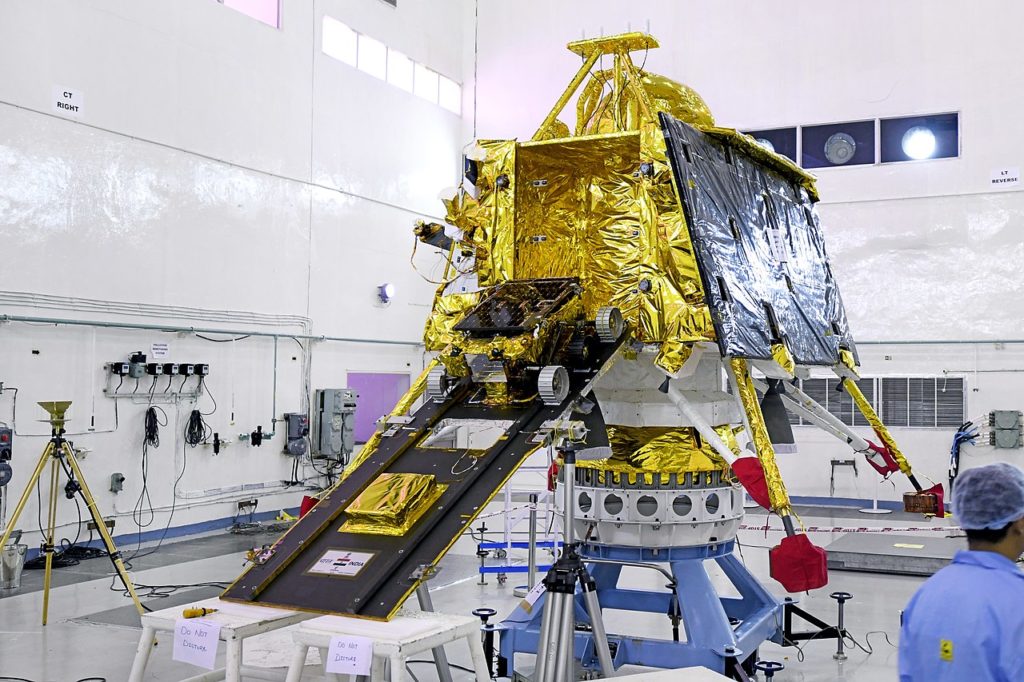
Возможности индийского аппарата значительно скромнее, чем были у «Луны-25». На борту посадочного аппарата три научных прибора: сейсмометр, прибор для измерения температуры и электрических свойств поверхности и инструмент для изучения плазмы. На луноходе прибора два: альфа- и рентгеновский спектрометр, который позволит судить о минералогическом составе грунта, и лазерный спектроскоп для поиска ряда химических элементов в грунте.
Если «Луна-25» должна была прожить на Луне год, индийский луноход и посадочный аппарат рассчитаны на один лунный день — то есть на 14 земных суток. Однако, если посадка индийцам удастся, они станут четвертой страной в истории после СССР, США и Китая, которые смогли посадить аппарат на Луну.