
Translated material
Ontological tragedy of being
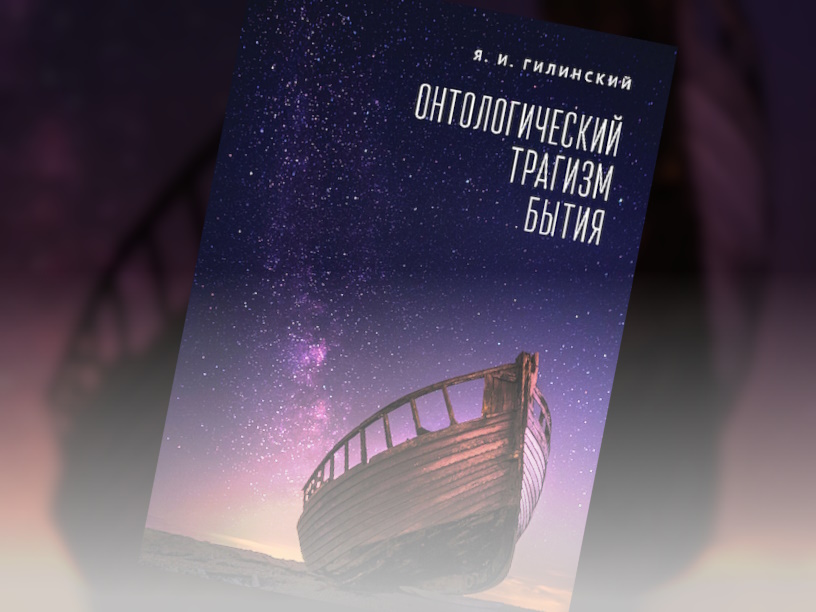
Polit.ru introduces readers with books that are among the applicants for the Polit -Posvet Award - a special award of the Enlightener Award. This year, twelve books written in Russian about the current socio-political process claimed for her. The finalists of the Enlightener Prize Group will be announced until September 30.
The Alethey Publishing House is presented in this list by the book of the famous sociologist Yakov Gilinsky “Ontological tragedy of being” . The book continues the author’s tradition to publish the most significant articles in the form of collections (2004, 2009, 2013, 2017, 2020). Unlike all previous ones, it was built not on the principle of “in recent years”, but thematically, including not so much professional-legal, criminological-articles, how much philosophical and historical thoughts of the author about Russia, about humanity, about its fate. The collection includes copyright articles published earlier from 1990 to 2021.
The book discusses the author’s ideas about liberalism and totalitarianism, tolerance and intolence, socialism and capitalism, and some features of the modern society of postmodern and the development of mankind. The book is designed both for specialists - lawyers, sociologists, political scientists, historians - and on all those interested in modern problems of public life.
We offer to read one of the articles included in the book.
Tolerance in Russia: the possibility and impossibility of 1
For centuries in Russia, a slave, slave spirit, combined with contempt for foreigners, foreigners and foreigners, I consider the greatest disaster, and not by national health.
Andrey Sakharov
At the last conference, “The limits of tolerance in modern society” I made a few provocative reports - “Tolerance without borders”. Today I am convinced that without a high level of tolerance, the very existence of mankind itself is problematic, and instead of the search for the “national idea” in Russia, you should turn to the so -called “universal human values”, a well -known civilized world. These are liberal, democratic values .
With today's active discussion about liberalism in Russia, it should be emphasized that the problems of liberalism and tolerance are closely related.
Etymologically and historically liberalism is associated with freedom (lat. Libertas - freedom) 2. As any concept, liberalism has many meanings and meanings, depending on the era, political orientation of the researcher, knowledge of knowledge (for sociologists, liberalism is associated with the assertion of personality freedom, for lawyers - with equality of rights, observing the rights of personality, for economists, this is, first of all, freedom of entrepreneurship - Laissez Faire , etc.) 3. Not being clearly defined, it is intuitive . According to the British Encyclopedia, "we are all not aware of this, we have been breathing the air of liberalism for four centuries." And this air is the "spirit of freedom." Liberalism, on the other hand, acts as a political, social, philosophical, legal reflection, the awareness of the inextricability of man and freedom, freedom as a necessary prerequisite for humanity . Liberalism includes the defending of human freedom, his rights and political, social, economic freedoms, the equality of all, tolerance (tolerance) in relation to dissenting and dissenting, freedom of action, so far and since this does not violate the freedoms and rights of others. Liberalism is “this is a belief that everyone has the right to live as he wants if he respects the rights of others” 4. And the attitude towards “other” is the best indicator of civilization/non -cylocity of society. Liberalism as an intellectual, political (and not just economic - freedom of entrepreneurship - Laissez Faire) The phenomenon includes tolerance, tolerance for dissent and dissent as an integral component. Of the liberal-democratic values are especially relevant today:
• non -power (for without it - death, both individual and ultimately humanity as a kind);
• tolerance, tolerance - political, racial, ethnic, confessional, ideological (because without this “non -power” is impossible);
• Internationalism or cosmopolitanism (for without it is intolerance).
Nationalism entails intolerance, xenophobia , and it leads to violence .
Another thing is the actual implementation of these "eternal" values in the modern world. Alas, in Russia not these values are now in fashion.
And this is not surprising, because in the thousand -year history of Russian slavery and poverty, the corresponding national mentality has been developed. Collectivism, community instead of a cult of individuality; Orthodox collegiality instead of the Protestant ethics of a strong personality, a person “making himself” (in order to avoid misunderstandings, I note that the author is an atheist and the above is not a “propaganda” of one denomination to the detriment of another; being a liberal, the author is tolerant of all religions and faiths); national limitation, “patriotism”, converting into nationalism and xenophobia instead of internationalism or cosmopolitanism; faith in the "good king" (master, governor, president) instead of defending democratic, liberal conditions of existence; The expectation of the “manna of heaven” instead of hard work for a worthy reward (and hence the envy of those who are rich, even if wealth is reached with hard work).
During the years of totalitarian rule, deplulation, declaration, marginalization, and alcoholization of a significant part of the population have occurred. Where is it to liberalism, democracy and tolerance.
<...> 5
The authorities are more and more betting on strength, unanimity, the search for “scapegoats” for their own impotence and “strengthening the struggle” with them. Accordingly, intolerance and violence give rise to response intolerance and violence (by the way, terrorism is, as a rule, the reaction of the most poor and the rich in the terror of the rich and those in power) 6.
Skinheads, nationalists, neo -fascists are raging in the country. The murder in St. Petersburg (“Cultural capital”!) Of the Azerbaijani merchant, then a 9-year-old Tajik girl, Vietnamese student, desecration of Jewish cemeteries, Muslim mosques.
The authorities of Dagestan, and then Tyumen banned the tour of Boris Moiseev on the motive "in defense of Orthodox morality." The concert of the Swedish quartet Army of Lovers was canceled. But the responses of the inhabitants of Tyumen to these prohibitions: "I can’t stand Boris Moiseev, they did the right thing that they canceled." The townspeople also offered to cancel the concerts of the Leningrad group (they sing “All women of the creatures”), Katya Lel (“She did not come out a little face”).
The only church in Moscow is demolished, and “indignant citizens” categorically object to the construction of the new.
In Moscow, Jehovah's Witnesses are prohibited by a court decision (it was no coincidence that in one of the newspaper response to this message there was a reminder that in Nazi Germany the persecution of “Jehovah's Witnesses” preceded the so -called “final solution to the Jewish issue” ...).
But some objective indicators of both inelerance in modern Russia and its (inelerance) consequences.
• in 1987, 25,706 people died at the hands of criminals, in 2001 - 78,697 people (more than 3 times), and in only 17 years - over 1 190,000 of our fellow citizens (Table 1); Only killed (not counting the victims of other crimes) in 2002 over 40,400 people, in 2003 - over 38,800 people7;
• The level of murders with attempts (to 100,000 population) increased from 6.3 thousand in 1987 to 23.2 thousand in 2001 (22.5 - in 2002, 22.1 - in 2003). And this, according to police data, in medical statistics, the level of murders amounted to 30.8 in 2002, in 2003 - 29.5. For comparison: in 1999–2001 The level of murders in some countries was: Australia - 1.9; Austria - 1.2; Hungary - 2.3; Germany - 1.1; Denmark - 1.0; Spain - 1.1; Italy - 1.5; Canada - 1.8; Netherlands - 1.5; Norway - 0.9; Poland - 2.0; USA - 5.6; Finland - 2.9; France - 1.7; Japan - 1.08. Since the 1990s. Russia firmly occupies the third place in the world in terms of murder after Colombia and South Africa;
• second place in the world (after Lithuania) in terms of suicide (in 2002 - 39.5 per 1000 population);
• first place in the world in shower consumption of alcohol (overtaking the traditional leader - wine -making France);
• In Russia, one of the highest mortality rate in the world (16.4 per 1000 inhabitants in 2003). For comparison: the average mortality rate in the world is 9, in America and Asia - 7, in Europe - 12, in Africa - 14; And only in such African countries as Liberia, Niger, Guinea-Bisau, Mali, Angola, Uganda and some others, the mortality rate is higher than in Russia99;
• 136th place in the world in terms of life expectancy , and then only thanks to women (72 years), because the life expectancy of men is 59 years old-one of the lowest in the world (below only in African countries: Burkina-Faso, Sudan, Benin, etc.) 10.
In fairness, it should be noted that nationalism, xenophobia, intolerance, to a greater or lesser extent, exist in many societies. Sometimes manifestations of intolerance are being built in the principle of a common or “industry” policy. So, for a number of years the slogan of the New York police officers is “zero tolerance” (Zero Tolerance) as a manifestation of intolerance policy for criminals. In other countries, intolerance to other (“strangers”) on national, confessional, social, ideological features is realized only at the level of everyday consciousness and behavior.
World concern of violence on the basis of xenophobia is manifested in serious scientific research of the so -called “crimes of hatred” and relevant publications11. Far from the relatively recently meaningful category of "Stoker" (Stalcks - pursuers, "hunters") 12. We are talking about people pursuing someone. The potential and real victims of the stockers can be once close people (former wife, former husband, children, parents, former friends, etc.), colleagues, colleagues by profession, “foreigners”, “foreigners” and other “strangers” (ethnic, confessional, ideological, etc.). Often, “stoker” is the result of mental deviations (subjectivity, sexual perversion), but it may also be a consequence of jealousy, envy, ideological intransigence. The latter include the pursuers of “black”, “people of Caucasian nationality”, anti -Semites. It is important that the manifestations of intolerance (unlike Russia) are worried about society and the state.
Unfortunately, I do not see objective and subjective conditions for the growth of tolerance in modern Russia.
To engage in forecasts in the field of politics is an ungrateful business. There are too many factors on which the development of certain processes depends. However, it can be assumed that in the foreseeable future the fate of Russian liberalism and the associated tolerance is sad. Most of the population relieves a miserable existence. It is unrealistic to sharply and quickly increase the welfare of tens of millions of people. Consequently, the social base of extremism, nationalism, xenophobia, neo -fascism is great . In other words, “anti -liberalism” and intolerance. Moreover, the objects of envy, “class hatred” and xenophobia are always at hand-“oligarchs”, “owners of factories, newspapers, steamboats”, “faces of Caucasian nationality”, and now also the “fifth column” ... At least since 1999, there has been an obvious rollback from the liberal-democratic conquests of the Gorbachev and Early Elmus Yeltsin. Independent media are destroyed, the information field is sharply reduced, censorship is actually introduced (if not official-such as the notorious Soviet Gorlith-then the “internal” censorship of publishers and editorial offices), the rattle of weapons and playing with the muscles, the search for “enemies” in the country (“spy”, “fifth column”) and the liberal-democratic field of quite a completely completely completely renew. "Statched." As for the remaining adherents of liberalism, they have a very familiar place - in the kitchen ...
1. Published in the source: Actual aspects of the problem of tolerance in modern society. SPb., 2004. S. 53–58.
2. See also: Duden. Lexikon von a bis z. dudenverlag, 1988. S. 402; Petit Larousse. Illustré. Paris, 1980. P. 593.
3. See, for example: Bowz D. Libertarianism: history, principles, politics. M., 2004; Das Neue Taschen Lexikon. In 20 bänden. Band 9. Bertelsmann Lexikon Verlag, 1992. S. 125–126.
4. Bowz D. Libertarianism: history, principles, politics. S. 2.
5. Hereinafter, the sign denotes a reduction in the text repeating in a number of articles. - Ed.
6. For more details, see: Gilinsky Y. I. Deviantology: the sociology of crime, narcoticism, prostitution, suicide and other “deviations”. St. Petersburg: Law Center Press, 2004. P. 248–255.
7. The socio-economic situation of Russia in 2003 // Issues of statistics. 2004. No. 2. S. 33.
8. Barclay G., Tavares C. International Comparisons of Criminal Justice Statistics 2001 // Home Office Statistical Bulletin. Issue 12/03, 2003. P. 10.
9. All countries of the world (2003) // Population and society. Information bulletin of the Center for Demography and Ecology of Human Ecology. M., 2003. No. 74.
10. Ibid.
11. Jacobs J., Potter K. Hate Crimes: Criminal Law & Identity Politics. Oxford University Press, 1998.
12. Mullen P., Pathé M., Purcell R. Stalkers and Their Victims. Cambridge University Press, 2000.
Table 1
The number of dead people in Russia as a result of various crimes (1987–2003)
1987 | 25 706 | 1996 | 65 368 |
1988 | 30 403 | 1997 | 65 598 |
1989 | 39 102 | 1998 | 64 545 |
1990 | 41 634 | 1999 | 65 060 |
1991 | 44 365 | 2000 | 76 651 |
1992 | 213 590 | 2001 | 78 697 |
1993 | 75 365 | 2002 | 76 803 |
1994 | 75 304 | 2003 | 76 921 |
1995 | 75 510 |
Total: 1 190 352 people
Earlier, in the heading “Slow Reading” the following books were presented from a long list of the Polit -Pesvet Prize.
Alexander Baunov. End of the regime: how the three European dictatorships ended. M.: Alpina Plisher, 2023.
Dmitry Gromov. AUE*: Criminalization of youth and moral panic. M.: New Literary Review, 2022.
Mikhail Davydov. Proceed of utopia: the history of Russian modernization. M.: New Literary Review, 2022.
* The AUE movement is recognized as extremist and is prohibited in Russia.