
Translated material
The Russians are involuntarily
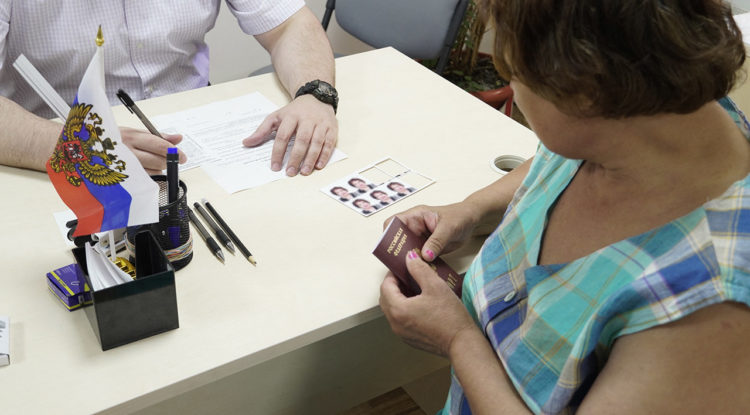
The Kremlin forces Ukrainians to receive Russian citizenship. Threats, blackmail and even insulin are used
The occupation authorities of Ukrainian territories are trying with all their might to demonstrate a stir among Ukrainians who "stand in lines behind the Russian passport." According to them, in a year and a half of the occupation of the Kherson region, 120 thousand Ukrainians received Russian passports. But local residents are not at all happy to come the Russian military, and the words of the occupation authorities are called an exaggeration. Most of the “new Russians” received a passport as a result of threats or urgent need: without a passport of the Russian Federation in the occupied territories, it is impossible to send a child to school, receive pensions and even insulin. "Cold" tells how forced passportation is undergoing in the Kherson region.
In order not to miss the main materials of the "cold", subscribe to our Instagram and telegram .
The names and surnames of the heroines are changed for the sake of their safety.
A little more than a million people lived before a full -scale invasion of Ukraine in the Kherson region: about 300 thousand in Kherson itself, the remaining 700 in the region. It is difficult to say how many people are left there now, because over the past year and a half the region has survived three waves of evacuation: after the attack of Russia in late February - March last year, before Kherson’s de -Kupupation in October - November and after a flood as a result of the breakthrough of the Kakhovsky hydroelectric power station in June.
The occupation authorities for a year and a half are desperately trying to demonstrate a stir among local residents who allegedly want to obtain Russian citizenship. For example, in July 2022, the Kherson official Vladimir Saldo, appointed by the Kremlin, claimed : “The line for obtaining Russian citizenship is already tens of thousands of people, we feel guilty of people for not going quickly enough.”
The first Russian passports in the Kherson region were issued on June 11, 2022 - then 23 people received them. Probably, those pioneers were really loyal to the Russian invasion and the application for a change of citizenship was submitted voluntarily. The first 10 thousand passports were issued in a month - by mid -July, and then the pace of certification has decreased sharply. Over the next three months, only three thousand inhabitants of the Kherson region received new citizenship. In November, the Ukrainian armyliberated Kherson and settlements on the right bank of the Dnieper. On the eve of the pro -Russian government organized the evacuation of residents on the left bank (the one closer to the Crimea). How many Kherson collaborators were then transported, it is unknown. Vladimir Saldo once expressed an approximate assessment: in mid -June 2023, he stated that about 200 thousand people lived on the left bank.
Forced passportation
After several hundred people who sincerely wanted to become Russian citizens, people began to come for Russian passports only in cases where they could not do without it.
“Of course, there were those who fled the Russian passport forward, but there were few such people. And now [after the Kherson's de -Ukrainian de -captain] they are no longer in Ukraine, they have left for Russia because they understand that they can wait for their accusation of collaboration, ”says Maria Golubeva, who spent all nine months of Russian occupation in Kherson. “Kherson, who did not need medical care, pensions and social benefits, could live quite calmly without a passport of the Russian Federation.”
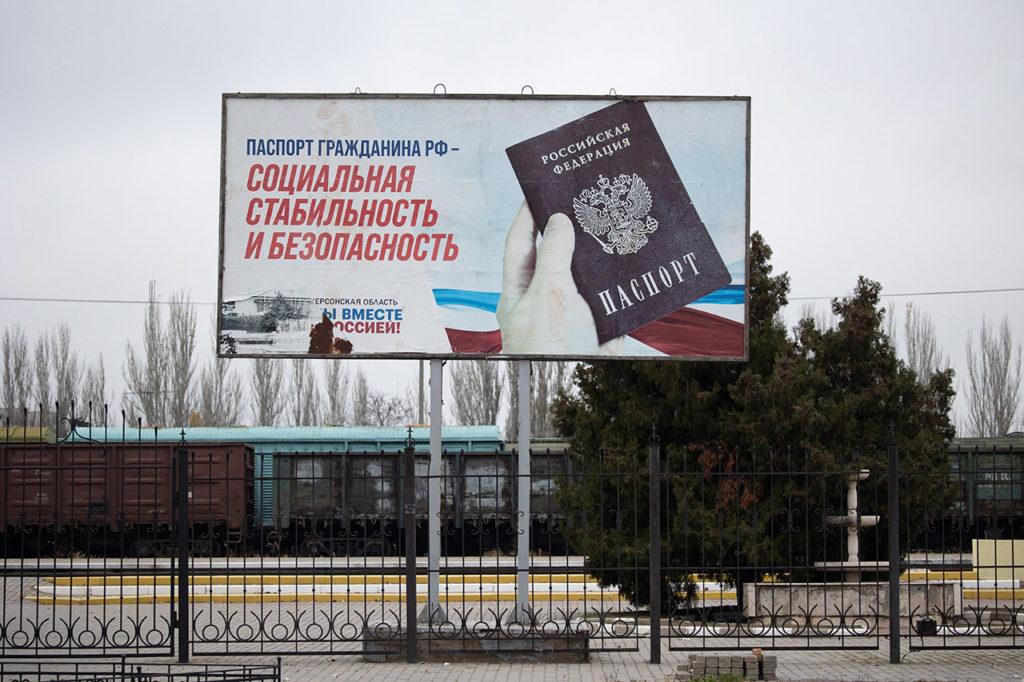
The same says a resident of Kherson Tamara Kutsenko: "Those who had to officially work or receive payments are really forced to receive [Russian citizenship] in order to survive." Tamara herself, when in occupation, did not receive a Russian passport.
“I did not receive a passport and would never have taken it. She worked hard, one for the whole family, but she did not take the Russian humanitarian fundamentally, ”says Anastasia Perova, Khersonka, who managed to leave the city. “Fortunately, I have an adequate leader, he did not force me to receive a Russian passport for work.”
According to Maria Golubeva, by the end of the summer of 2022, the occupation authorities began to force entrepreneurs to re -register companies in the Russian tax system. Information about such a requirement was in the Ukrainian Kherson Regional Administration. It was possible to register with the tax only if there was Russian citizenship - so forced passportation began in the Kherson region. “If you wanted to continue to work and make money, you had to get a Russian passport,” says Golubeva.
Ulyana Sergeyeva, who lived on the left bank of the Dnieper, said that her family, who still lives there, does not plan to receive Russian citizenship: they have not accepted the idea of the “Russian world” and are waiting for the region’s deaccuration. However, in July - August last year, her grandmother, who needs to regularly receive insulin, refused to give medications if she does not receive a Russian passport. “At first they said that they would not pay a pension, but grandmother has children, grandchildren, we would help her,” says Sergeyeva. “But when she did not receive insulin, she had to follow this document, it already became vital.”
Incomplete list of restrictions that the Russian authorities in the Kherson region have to make people apply for the Russian passport (data from the General Staff of the Armed Forces of Ukraine and the Ukrainian Center for National Resistance):
- It is possible to receive a Russian pension only after receiving a passport of the Russian Federation . At the same time, many people in the occupied territories have lost the opportunity to receive a Ukrainian pension due to Internet blocking in an area that is not working and, as a result, the inability to enter the personal offices of Ukrainian banks;
- Free medical care can only be obtained according to the compulsory medical insurance policy - which in turn can only be issued for the passport of the Russian Federation;
- the issuance of vital drugs, such as insulin , also became possible only according to the Russian passport;
- The movement between the regions and travel to Russia is often prohibited from Russian checkpoints to people who have not received a Russian passport. According to the General Staff of the Armed Forces of the Armed Forces, after the flood due to the undermining of the Kakhovskaya hydroelectric power station from the flooded territories, they made it possible to travel to Russia only to those Kherson residents who managed to get a Russian passport;
- You can register vehicles only if there is a passport of the Russian Federation;
- Parents of schoolchildren have to receive a Russian passport: without it, children are not accepted to school. At the same time, the occupation authorities seek families in which parents do not let their children go to study at Russian schools, conduct searches in such houses and force Russian citizenship;
- The Russian military conduct raids on settlements : they enter houses, force people to hand over fingerprints and write an application for a Russian passport. And those who refuse, threaten to deport the “depressive regions of the Russian Federation” with the subsequent deprivation of property rights ;
- on checkpoints intentionally spoil Ukrainian passports and other Ukrainian documents;
- Women with young children are denied payments for children without a Russian passport;
- the occupation authorities threaten property withdrawal;
-adolescents who have reached the age of 14 are threatened not to issue certificates without the presence of a passport of the Russian Federation.
Hurrying before the elections
By mid -October 2022, 13 thousand Russian passports were issued in the Kherson region, and five months later, by March 1, 2023, there were already more than 70 thousand. The pace did not decrease further: on March 31, Vladimir Saldo announced 90 thousand Kherson residents who received Russian passports, and on May 31 it was already about 150 thousand.
True, two weeks later, Saldo gave the back and said that Russian passports received 120 thousand - 30 thousand less than in the last statement. “The process continues, people have an accelerated possibility of obtaining a passport. The president ordered that this occupies no more than 10 days ... We expect that until the end of summer all residents of the Kherson region will be able to receive a Russian passport ” - Vladimir Saldo made such a loud statement at the St. Petersburg International Economic Forum in mid -June.
Relatives of Maria Golubeva lived on the left bank of the Dnieper under the Russian occupation seven months: from November to May. They managed to get into the territory controlled by Ukraine, on the eve of the undermining of the Kakhovskaya hydroelectric power station. Another part of the relatives of Golubeva remains on the occupied part of the Kherson region until now. She says that Ukrainians living on the left bank are very intimidated due to repressions from the Russian military. “Even if they are now forced to take passports, no one will tell you about it, because all the phones are listening. And any person who said “something is wrong” said immediately to the basement, from where he may not return, ”says Golubeva.
Many Ukrainians who were able to move to Europe after the Russian occupation, in a conversation with the “cold” refuse to talk about life in the occupation.
“Excuse me, I do not want to worry again in the stories what I experienced in reality. Let everything remain as it is, in my memories, ”wrote one of the residents of the Kherson region. “I left, but my father is still on the left bank. For safety reasons, I will not tell you anything, ”wrote another interlocutor of“ cold ”. Another resident of the Kherson region wrote: “While my loved ones are in the occupation, I will not say anything so as not to harm them. The Russians do not force them to force passports, but create living conditions such that people have to go and take citizenship themselves to survive. ”
Ulyana Sergeeva, who was able to leave the left bank to Europe after almost a year and a half of the occupation, said that, despite the great pressure on her and her parents about the receipt of Russian citizenship, they never received it.
“I lived with my parents, the Russian military came to our house at least 10 times: they searched the house. Once they beat my father, found a book on the history of Ukraine, shouted at me, threatened that my father would be taken to the basement. They said that we have 10 days to receive a passport, but in order for we to live calmly at that time, we had to pay three thousand dollars. We did not have that kind of money. They said they would come the next day by 12 o’clock in the afternoon and so that we would prepare everything. We were very afraid. But then arrivals began, and the military, apparently, were busy with something else, says Sergeyev. - I was able to leave this summer, my parents are still there. They do not want to leave their house, but do not intend to receive Russian citizenship. It is said that for them it is very difficult to morally: in addition to obtaining a passport, the Kherson people are forced to sing a hymn and give some oaths, and all this is recorded on the camera. My parents are not ready for this. ”
Ulyana told the cold that she even persuaded her parents to get a passport for the sake of their safety: “If they receive it now, everyone will understand that they are not traitors, they have already held out so much. But parents do not want to yet. ”
The issuance of Russian passports in parts occupied by Russia Donetsk, Lugansk, Kherson and Zaporizhzhya regions was planned to be completed by September 1, 2023. Probably, such terms were set due to upcoming elections, which should take place from September 8 to 10. But even forced passportation did not help, and at the end of July it became known that the occupation authorities allowed local residents to take part in the elections, including according to the Ukrainian passport .