
Translated material
The millennium of imperial ceramics
Polit.ru introduces readers with books included in the long list of applicants for the Enlightener. Transportation Award of 2023. The prize for the fourth time notes the best works of editors and translators of popular science literature into Russian. In total, twenty books were included in a long list. A short list of the Enlightener. Transportation Prize will be announced until the end of September.
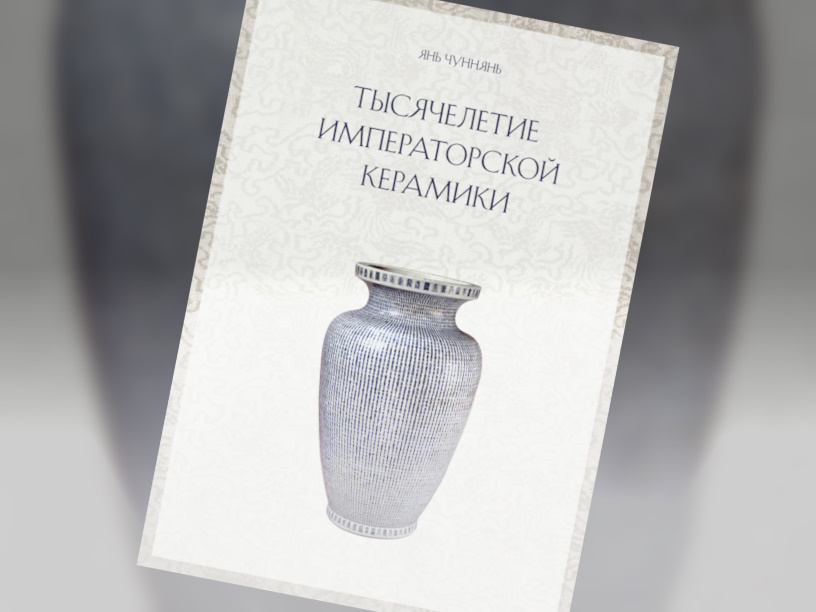
The Shance Publishing House represents the book of Yan Chunnyan “The Millennium of Imperial Ceramics” (per. From Kit. - Olga Fituni, Dmitry Khudyakov, Viktor Stepanenko, Maria Sukhorukova, Anastasia Korshunova; Scientific editor - Vera Belozerova, editor -in -chief - Alexander Matveeva, Delgir Lidzhieva).
Porcelain became the greatest symbol of Chinese culture. This is one of the outstanding inventions that have made an invaluable contribution to world civilization. Imperial ceramics, that is, ceramics of imperial ceramic workshops, is an important bearer of palace culture. It was a product of the monarchical era, and state power served as the basis on which the culture of porcelain flourished magnificently. Therefore, for a deep understanding of the historical culture of China, especially its nuclei - palace culture, it is necessary to know the culture of imperial ceramics. The millennium of imperial ceramics is not a course in the history of ceramics. In this work, the historical and cultural relationships of the imperial palace with ceramics of imperial workshops are studied. The main attention is paid to the ceramics, which the funds of the Beijing Museum of the Imperial Palace (Gugun) are most rich; the one about which the most accurate archival documents and the largest number of literary monuments have been preserved; The one that most affected society. Here, the history of porcelain, the associated personalities, events, regulations, technologies, objects, culture, art, its influence on life are considered. The author reveals the traditional culture of China and conveys the spirit of its outstanding masters.
We offer to read a fragment of the book.
Porcelain qinhua
Yuan era
On July 12, 2005, such a ceramic product from China was announced as "a large vessel of the Yuan era from the porcelain of zinhua" Guy Gu-Tzu descends from the mountains "." At the Christis auction in London it was sold for fourteen million pounds, after adding the commission, the vessel began to cost 230 million yuan. It was the highest price that the subject of Chinese art received in those years in the international auction market. The stunning quality of zinhua porcelain of the Yuan era aroused widespread interest.
In the late period of the Yuan era, porcelain zinhua was sold to the eastern, southeastern, southern, middle and Western Asia and other areas. The era was replaced, the world has changed. After the fall of the Yuan dynasty, the image of the porcelain of this great era was gradually erased from the memory of subsequent generations. For six hundred years, it was believed that porcelain of zinhua appeared in the era of mines. Until the 1920s and even until the 1950s, scientists from Europe, America and Asia adhered to this position. Finally, the clouds scattered and seemed the sun, water subsided and stones were exposed, revealing the entire beauty of the porcelain of Qinghua Yuan, leaving behind exciting academic and art stories and legends.
A large vessel made of zinhua porcelain with the image "Gui Gu-tzu descends from the mountains"
How was the porcelain of the zinhua of the Yuan era? Here it is necessary to mention the British scientist Robert Hobson.
The find of Robert Hobson
At the beginning of 1929, in the British newspaper “Old Furniture: The Interior of Life Space”, a scientific article “Porcelain Qinghua before the Ming era was published: a couple of vases with a stigma of the Yuan era”. It consisted of seven pages - about five thousand hieroglyphs translated into Chinese. This was the first report in international scientific circles, which mentioned the existence of the porcelain of the zinhua of the Yuan era and which became an epoch -making contribution to the study of the history of ceramics. This article demonstrates that the value of scientific articles is not in length, but in innovation.
The author of the article is a researcher at the British Museum in London Robert Lokhart Hobson (1872–1941). He entered the service of the British Museum at the age of 25, retired at the age of 66, holding the position of guardian of the eastern monuments of antiquity and ethnography of the British Museum. Three years later he was gone. For 41 years in the British Museum, Hobson first studied British ceramics, and then Chinese porcelain. He wrote an article about ceramics for the British Encyclopedia, becoming a universally recognized authority in this area.
The work of Robert Hobson in the British Museum fell on the heyday of the British Empire. Each time the British Empire affirmed its power in new territories, there was a search for new artifacts and jewelry, which were reduced to London through the seas and oceans. A large amount of Chinese porcelain was no exception. The Beijing Temple of Zhihuasy was built by order of the powerful eunuch van jen in the era of min. The temple was donated by a pair of "vases from zinhua porcelain with an engraved image of clouds and a dragon and handles in the form of elephant heads." These vases were stolen in the 1920s and taken to England, where they were bought by the British Fund of Chinese Art of Persival David. The deal took place in two stages1, the vases became part of the exposition of the fund. Therefore, they are sometimes called "David vases."
The porcelain vase of Qinghua with the inscription “The eleventh year of reign under the motto of Zhizh”, with handles in the form of elephant heads, painted by the election of dragons and clouds. Persian Chinese Art Fund David (Great Britain)
The height of the first vase (original number B614) - 63.5 centimeters, throat diameter - 14.3 centimeters, legs diameter - 17.5 centimeters. The exhibit has a thin and high shape, on both sides there are handles in the form of elephant heads. The ornament is applied over the entire surface of the product from the bottom up, there are eight frizes in total, most of the image of the dragon and phoenixes flying in the clouds, there are also chrysanthemum flowers, banana sheets, lotus flowers, peony and other plants. The ornament includes a vertical inscription of the six lines in 62 hieroglyphs: “Zhang Wenzzin from the community of the Zintan of the village of Dezianooyo Volost Shunchen County Yuishan County Sinzhou, the student of the gods joyfully presents a smoker for firing incense and a couple of flower vases as a prayer for the protection and blessing of the whole family and for calmness sons, daughters. Carefully recorded precisely on the good day of the fourth month of the eleventh year of reign under the motto of Zhizh. General Hu Jing in the temple of the ancestors of Sinyuan. "
The second vase (original number B613) has a height of 63.4 centimeters, engraved by a vertical inscription of five lines of 61 hieroglyphs. The inscriptions on the vases are slightly different: on the first it is written "carefully recorded on a good day," and on the second - "donated on a happy day."
From the inscriptions on the vases, we learn that both products were used for ritual purposes and belonged to the “cult utensils”. Where was this donation committed? In the "Temple of the ancestors of Sinyuan." After some textological surveys, we find out that the temple of Linshun Uyuan of the Province of Jiangsi is implied here. This place is located about 68 kilometers from Jindejan. To whom is this temple dedicated? Five Spirits-brothers Xian-Xiantsuna (显聪, wisdom), Xianmin (显明, purity), Sianjan (显正, Pravda), Xiangzhi (显直, sincerity), Syande (显德, virtue). Wisdom, truthfulness and sincerity, the presence of a morale - people seek these qualities in search of spiritual and moral perfection. The worship of the five spirits of Syan reflects the degree of admiration and the desire to acquire such high qualities. The cult of five spirits, Xian, originated in the County of Uyuan and spread to the city center Linjin. From the era of Sun to the era of Min2, faith in them received official status from officials of different eras, people began to build them churches-sacrifices.
In the temple of Linshun, General Hu Jingi3 was also worshiped. He took care of the temple during his lifetime and entered it when he gained immortality. The imperial court gave the general the posthumous title, a place to worship and provided the opportunity to make him sacrifice. A pair of porcelain vases became the introduction of the spirit of the Linshun temple - General Hu Jing.
After the firing of the VAZ, it was necessary to choose a favorable day in order to hold ritual ceremonies with all its zealousness. The inscriptions “Good Day of the fourth month” and “Happy Day of the Fourth Month” indicate the eighth day of the fourth month according to the lunar calendar. On this day, the Buddhist holiday is celebrated by the day of the Buddha's wash, and the day of prayers for mercy in the Linshun temple.
On the eighth day of the fourth month of the eleventh year of reign under the motto of Zhizhzhen (1351), during the only magnificent ceremony in the year of prayer, both vases solemnly brought as a gift to the Linshun to the Province of Uyuan. They were sacrificed by the jealous believer Zhang Wenjin. He presented such an elegant and worthy product, spent considerable means to pray to the spirits to keep the “peace and happiness of the whole family”, “peace and peace of sons and daughters”. There were good reasons for such prayer: only seventeen years have passed since the fall of the Yuan era. When the nest is ruined, do the eggs survive? How could an ordinary resident independently protect the “peace and happiness of the whole family”, “peace and peace of sons and daughters”? Soon the uprising of the red bandages broke out, and after the departing era of Yuan, farewell bells sounded. In the second year after the sacrifice of Zhang Wenzin, the Linshun temple burned in the flame of peasant uprisings. However, indifferent people were kept by the gifts, so the products have survived to this day.
Robert Hobson in his article described this pair of vases from the porcelain of Qinghua, as well as the inscription on it "The Visitor -year of reign under the motto of Zhizhn." Zhizhzhen was the motto of the Emperor Shun-di Yuan. The eleventh year Zhizhzhen is 1351. Thus, no later than this date, in the Yuan era, vases were released from Tsinhua porcelain.
Robert Hobson accurately determined the place of the origin of VAZ from the porcelain of Qinghua - Jindezhen. According to the inscription, their owner lived near the city. The scientist advanced the hypothesis: Tsinhua porcelain began to burn in Jindezhen back in the late period of the Yuan era.
In history, documentary records on the porcelain of Qinghua Yuan have not been preserved. The detection of Robert Hobson VAZ, their study was excited by the society of scientists interested in ceramics and culture. Two vases of zinhua porcelain with a pattern of clouds and dragons and with handles in the form of elephant heads became a starting point for dating such porcelain utensils of the Yuan era, had a very important scientific and innovative significance.
In 2012, one of them was delivered from England to the exhibition at the Shanghai Museum. Thousands of people sought to see her in a festive atmosphere.
According to academic norms, one artifact does not yet confirm the hypothesis. Is it really a pair of vases that can be judged by the presence of utensils from Zinhua porcelain in the Yuan era? The American scientist John PUP discovered and investigated new samples of such ceramics and provided other evidence of its existence at that time.
John Pope's rationale
The American scientist John PUP continued research after the death of Robert Hobson and proved to the world scientific community of ceramics researchers that in the Yuan era there was not one paragraph of VAZ of Qinghua porcelain, but a separate group of similar porcelain products.
In the 1950s, John Pup took two vases found by Robert Hobson for the control sample, analyzed the porcelain utensils stored in the Turkish palace of Topkapa and the Iranian mosque Ardebil, and identified 40 similar objects in the Turkish palace and 32 similar objects in the mosque as “the utensils of the XIV century from porcelain from porcelain Qinghua ". This ceramics later became known as the ceramics of “Tykhzhin” and laid the research base for the study of the blue-white ceramics of the Yuan era.
John Alexander Pup (1906-1982), American, graduated from Yale University with a bachelor's degree in literature. In this university, American synology originated. In 1876 (the second year of the reign under the motto of Guangsu), Chinese language courses, the department, as well as the library of oriental literature were opened there. John Pup at the university became interested in China. He went to the north of China by a volunteer, settling the driver of an ambulance in the Red Cross.
Then John Pope went to Harvard University to study Chinese applied art, where he received a master's degree. Further, with the financial support of the Beijing Society of Harvard University, he went to London to engage in research. There, John Pope got acquainted with the results of Robert Hobson's studies on the porce of zinhua of the Yuan era. Returning to America, he began to teach lectures on Chinese art at Columbia University. In the Second World War, John Pope served as a translator in the naval landing troops. After the restoration of power in Beijing, his military unit was not yet stationed there. The trip there was the beginning of the research path of John POUP in the footsteps of the Yuan porcelain of Qinghua. He perfectly understood the amazing significance of Robert Hobson’s research, but from a scientific point of view, the couple of VAZ could not be considered universal evidence of the existence of such porcelain. John Pope wanted to find more such products of the Yuan era, in shape and color similar to the found vases, and confirm that the find of Robert Hobson was not one of a kind.
In 1950, John POUP during a long trip to Tehran (Iran) and Istanbul (Türkiye), began new studies of the porcelain of Zinhua Yuan.
He was the first to visit the Iranian National Museum. According to the Persian chronicles, in 1611, Shah Abbas I the Great (1578-1629) came to the Chinese porcelain utensils stored in the palace since 1162. Most of these products were later placed in the collection of the Iranian National Museum.
John Pup also reached the Topkapa Turkish Palace in Istanbul. This city is located at the intersection of roads between Europe and Asia. Initially, it was called Constantinople and was the capital of the Eastern Roman Empire. After the conquest of the Ottoman Empire in 1453, the city changed the name. The Topkapi Palace belonged to the Sultan of the Ottoman Empire and served as the residence of the Sultans for four hundred years since 1478, when it was built. The authorities of the Turkish Republic turned the palace into a museum in 1942, now it is included in the list of objects of world cultural heritage. The collection of Chinese porcelain products of the Topkapa palace has almost twenty thousand exhibits. This is the world's largest collection of porcelain outside China, as well as the best in the world in quality. Basically, these are products covered with celebona glaze, or cinhua porcelain products, some with color and painted glaze. The collection is represented by objects of the Eras of Yuan, Ming and Qing and covers a period of six hundred years.
On the wall of the huge kitchen of the Topkapa palace in Istanbul there is an image of a feast, which the Sultan arranged for his courtiers. In the picture, the courtiers are sitting at round tables, some extend their hands to eating on blue-white porcelain dishes (Pan), others scoop up soup from large bowls (Pen) from cinhua porcelain soup. Huge porcelain dishes (Pan) of the Yuan era, which were then used, are exhibited in the same kitchen. Each reaches 40-60 centimeters in diameter.
After the study of two museums in Iran and Turkey, John Pup published scientific articles in 1950, 1952 and 1956. He chose 72 porcelain products, compared with other porcelain objects of blue-white color and concluded: these porcelain products in shape, quality of ceramics, color, pattern and other criteria have many identical, homogeneous, close and similar features. They are very different from the porcelain of Qinghua of the 15th century, made during the reign of the motto of Yunle and Xuande, the era of mines, but belong to the same category of porcelain as the finds of Robert Hobson. This category is called the porcelain of zinhua sample of the XIV century.
A large dish (Pan) made of zinhua porcelain with clouds, a dragon and a water nut. Yuan era
The bottle of Maypin made of zinhua porcelain with pations in the form of peonies, interwoven stems and flowers (Changi)
A large dish (Pan) made of zinhua porcelain depicting white flowers, water nut and Phoenix
The first criterion is the forms of found samples. John Pup found that these large massive porcelain products are performed by greatness, artistic expressiveness, natural simplicity and solidity. Compared to later products, this porcelain of zinhua is a little massive and less frivolous, slightly more natural and more professional.
The second is the quality of the workpiece. John Pup found out that the quality of the blanks of this porcelain in density, the color of the glaze is in no way inferior to the quality of the utensils, made during the reign of Yunle or Xuande. Thus, the technology of firing the porcelain of zinhua in the Yuan era was already mature. A distinctive feature of these products is the absence of a layer of glaze on the outside of the base.
Third is the color of the glaze. John PUP found that he found by him porcelain zinhua was made with the addition of cobalt (smalt) as a dye, which gave the products a more saturated blue color compared to the utensils of later eras.
The fourth is decorative elements. John Pope revealed that the plots of decorative elements of zinhua porcelain compared to ceramics of later eras are more saturated and diverse, but sometimes their immaturity is also noticeable. For example, the oversaturation of the plot in the central part of a large dish leads to a loss of clarity and randomness of the lines. Another example - bamboo leaves are painted in one movement, simply and clearly; Late masters painted their edges with two thin features, and the leaves themselves applied a thin layer of paint.
Facsimile of John Pope's book
As a result, John Pope proved that a pair of VAZs from the porcelain of zinhua with Hobson Hobson with handles in the form of elephant heads was not the only find in its kind, but belonged to a separate group of porcelain utensils of Qinghua. He further revealed that in the XIV century it was not the origin and the sunset of blue-white porcelain, but its development. The technology of firing blue-white ceramics has already reached a high level. The opinion about the absence of these products before the Ming era has changed. For an exceptional contribution to the study of Zinhua porcelain, John Pope was awarded the title of Professor Harvard University, and later took the position of curator of the American art gallery Freer5.
The sudden discovery of Yuan porcelain of the XIV century stunned Europe and Asia. In the 20th century, the porcelain of the zinhua of the era Yuan survived the second birth, excited the whole world. The seven -hundred -year -old porcelain of Qinghua Yuan witnessed the mixing of cultures of the East and West, the elevation and fall of states, causing universal amazement and admiration.
1. The purchase of vases took place in 1927 and 1935. In the future, for the convenience of presentation, both vases will be marked with numbers B614 (vase 1) and B613 (vase 2). - approx. aut.
2. According to the “Notes of the Uyuan County” of the Board of the Board under the motto of Kansi, “for the twenty-fifth year of the reign of Kansi (1686), the province of Jiangsu Tan Binjow destroyed the Celestial Church of the five spirits of Xian and replaced it with the temple of Guan-di.” - approx. aut.
3. Hu Jingi (胡净一) - according to “Notes on the search for spirits” and other books, his name was recorded as胡靖一. The hieroglyph净, apparently, is demotic for a given area. - approx. aut.
4. The uprising of the red bandages (1351–1368) is the movement against the Mongolian Dynasty of the Yuan, the reason for which was national discrimination against the Chinese population. Led to the overthrow of the ruling dynasty and the establishment of a new, Chinese, dynasty of min. - approx. Ed.
5. Pope Ja Fourteenth-Century Blue-And-White: A Group of Chinese Porcelains in the Topkapi Sarayi Müzesi, Istanbul // Freer Gallery of ART OCCASIONAL PAPERS. Vol. 2. No. 1. Washington, 1952.
Earlier, in the heading “Slow Reading”, the following books were presented, included in the long list of the Enlightener. Transportation Prize:
Peter Godfri-Smit. Metazoa: The origin of the mind in the animal world / Per. from English: Galina Borodina; Scientific editors Anna Vinkelman, Mikhail Nikitin; Editor Andrey Zakharov. -M.: Alpina Non-Fikshn, 2023.
Siddhartha Mukerji. Gene. Very personal story / Per. from English: Olga Volkova, Ksenia Saifulina; Editor Olga Volkova. - Corpus, 2023.
Sarah Manning Peskin. In the molecule from madness: stories about how the brain breaks / per. from English: Anastasia Smirnova; Scientific editor Olga Ivashkina, editor Ekaterina Ivankevich. - M.: Alpina Plisher, 2023.
Marta Nussbaum. Political emotions: why love is important for justice / Per. from English: Sofya Porfiryeva; Scientific editor Dmitry Turko, episode editor Arseniy Kumankov. - M.: New Literary Review, 2023.
Roland Paulsen. What if? .. Anxiety: how she controls us, and we - she/ per. from the Swede: Elena Teplyashina; Scientific editor Polina Tsygankova, editor Alexei Andreev. - M.: Livibuk, 2023.
GERLLINDE PAUER-STUDER, J. David Welleman. Conrad Morgen: Conscience of the Nazi judge / Per. from English: Yuri Chizhov; Scientific editor Dmitry Gurin, editor Natalya Narcisssoa. -M.: Alpina Non-Fikshn, 2023.
Anil set. Be yourself: a new theory of consciousness / Per. from English: Maria ten; Scientific editor Olga Ivashkin, editor Natalya Narcisssoa. -M.: Alpina Non-Fikshn, 2023
Nicholas Stargardt. Mobilized nation: Germany 1939–1945 / Per. from English: Alexander Colin; Scientific editor Anton Zakharov, editor Anna Zakharova. -M.: Hummingbird, ABC-Atticus, 2023.
Robin George Andrews. Supervolkans. The unexpected truth about the most mysterious geological formations of the Universe / Per. from English: Valentin Frolov; Responsible editor Anna Zakharova, editor Oleg Bocharnikov. -M.: Hummingbird, ABC-Atticus, 2023.
David Anthony. A horse, a wheel and a tongue: as a bronze age riders from the Eurasian steppes formed a modern world / Per. from English: Andrey Fomenko; Scientific editor Anton Ryabov, Literary Editor Konstantin Zalessky. - M.: Ed. House of Higher School of Economics, 2023.