
Translated material
"Putin project." How in August 1999 the old king chose a new king and why it was Vladimir Putin
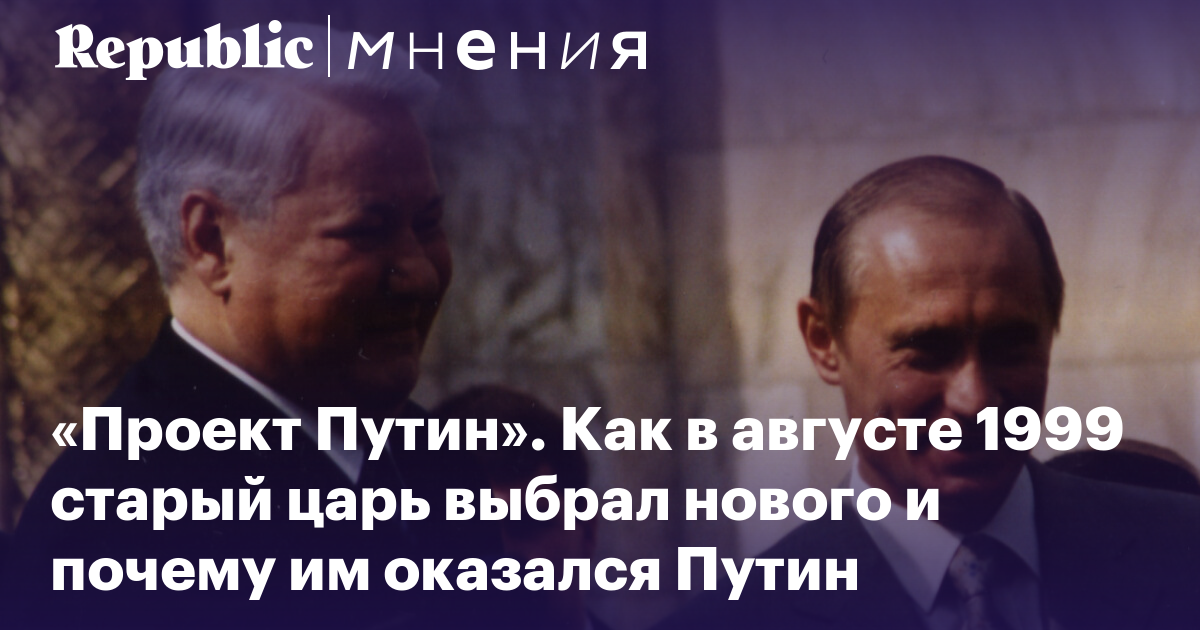
24 years ago, in August 1999, Russian President Boris Yeltsin appointed Vladimir Putin Prime Minister and immediately declared him his successor. The new king was not chosen by the population, but by the old king. And almost everyone liked it. The approval by the population of the Yeltsin course was then neared to zero, but the important task that the Yeltsin environment, choosing the successor, was the continuity - the veiled preservation of the oligarchic rule.
The power in the country did not change instantly, but was intercepted over the next 3-4 months. The brutal second war in Chechnya, the explosions of houses , proved, as NTV said in March 2000, Arkady Mamontov, that only strong and strict power can save, it was already a new era. Explosions and war launched society to mobilization - the observer remained with the hope of monitoring how Russian troops approached Grozny, and Putin conquers the State Duma and the Kremlin. Putin immediately came like one who can protect and save. The December Yeltsinsky “I'm tired, I am leaving” (the words that were not sounded in that New Year's appeal , but nevertheless went down in history) and the elections in the spring of 2000 only recorded the transfer of power actually made in August-November.
Putin, who has become the second Russian king in the post -Soviet era, rules Russia for 24 years. The first, Yeltsin, is only 8 years old.
Uzurpation of choice
“In the Presidential Republic, the president is selected in a competitive election, where programs, development strategies, individuals, social groups with a different vision of the future are fighting for the attention of the voter. To win, they need to join the coalition, agree on priorities and compromises ... "
In 1999, all this abstract and banal political wisdom from textbooks seemed invented for other countries, not for Russia. Or even just to take the eyes: to cover the real backstage political procedure. With whom do we have to negotiate here, what coalitions and compromises? With the Communists? With Social Democrats? And where are they?
In 1996, it seemed that the main political goal was to prevent political opponents to come to power that would cancel the market economy and again drag the country into socialism. Elections-96 were interpreted as elections between life and death-and in such a fight before democracy?
Presidential candidate Boris Yeltsin dances at a pre-election concert in Rostov-on-Don on the eve of the first round, 1996
Video screenshot / YouTube
In 1999, there were no reasons for the return of the Communists. But the Yeltsin environment, not without reason, was afraid that the “wrong” president in 2000 would begin a revision of privatization results.
Neither the population, nor political analysts, nor Western leaders almost expressed dissatisfaction with the fact that the change of power in Russia is so strange. The king will choose the successor, then his choice can be confirmed by our vote, but this is a formality-how to sign on some bureaucratic piece of paper, in the meaning of which to delve into-only to rack. It is quite strange to blame the authorities of the usurpation, the one who was going to leave power. Vice versa! Yeltsin no longer holds power, does not insist that 60%, not 3%approve of his activities. The king finally admitted: he did not succeed.
But it was precisely the usurpation of power.
Subscribe to read the whole
Make a subscription Redefine.media to read Republic
Subscribe [you can pay for a Russian or foreign card. The subscription is extended automatically. You can unsubscribe at any time.]
Where are the money subscribers going