
Translated material
Of the "traitors" to "Heroes"
Than spontaneous memorials Prigozhin look like promotions in support of Ukraine
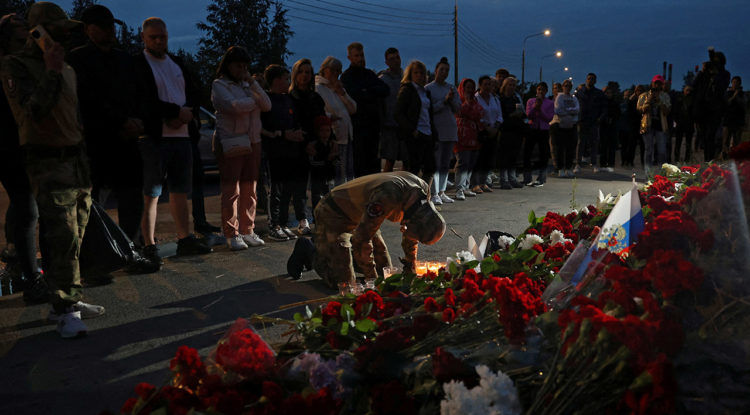
The Russians create spontaneous memorials in memory of the founders of the Wagner PMC, who crashed in the Tver region. On August 30, the anthropologist Alexander Arkhipov, the author of the telegram channel “ (NOT) Entertaining Anthropology” , counted 77 memorials in 59 cities. The Prigozhin, mourning in Evgeny and other dead, carry flowers, candles, toy aircraft, and even a sledgehammer in St. Petersburg and in Belgorod is a symbol of Wagner's cruelty. What conclusions can be drawn by studying these natural memorials? Arkhipova wrote about this specifically for the "cold" with psychologist Yuri Lapshin.
In order not to miss the main materials of the "cold", subscribe to our Instagram and telegram .
What is a spontaneous memorial and why study it?
To carry candles, photographs of those who died in public places and thus talking about death has become, alas, a familiar part of city life. However, this was not always the case. The tradition of commemoration through the creation of "folk" memorials is not just new, it is the latest. She is about 50 years old. It was the first to investigate and described the American anthropologist Jack Santino. He noticed that people who experience the death of representatives of their community begin to attract attention, bringing candles and photos to where they can all see them: "We remember."
But the demonstration of memory is not the only goal.
Participation in the creation of a spontaneous memorial in a public place can be considered as a replica in a dialogue with the authorities. If a person died an unnatural death, a memorial is an opportunity to express his attitude to what happened and, for example, to demonstrate discontent with the course of the investigation. The more memorials and the longer they live, the stronger the attention is attracted to the fact of the “wrong” commemoration.
The most long -lived memorial of this type in Russia is still supported on the Big Moskvoretsky Bridge, on the site of the death of Boris Nemtsov on February 27, 2015. On the website of the memorial created by volunteers, there is even a duty schedule. The most massive movement of spontaneous memorials arose in March 2018 after a fire in the shopping center “Winter Cherry” in Kemerovo, where 60 people were killed, and the authorities first did not declare nationwide mourning. Then, during the week, at least 246 settlements of Russia appeared 335 spontaneous memorials (more about this can be read here ) - in this way people talked about corruption among officials, ignoring safety rules, and indifference to the authorities.
Memorials as a protest in 2023
We already wrote in the Cold about Flower Protest, which arose in Russian cities after the Russian missile hit the apartment building in the Ukrainian Dnieper on January 14, 2023, killing at least 46 people. Then the tradition was very quickly: people brought fresh flowers and children's toys mainly to the memorials of the victims of political repression or to monuments and places, one way or another connected with Ukraine (see the table below).
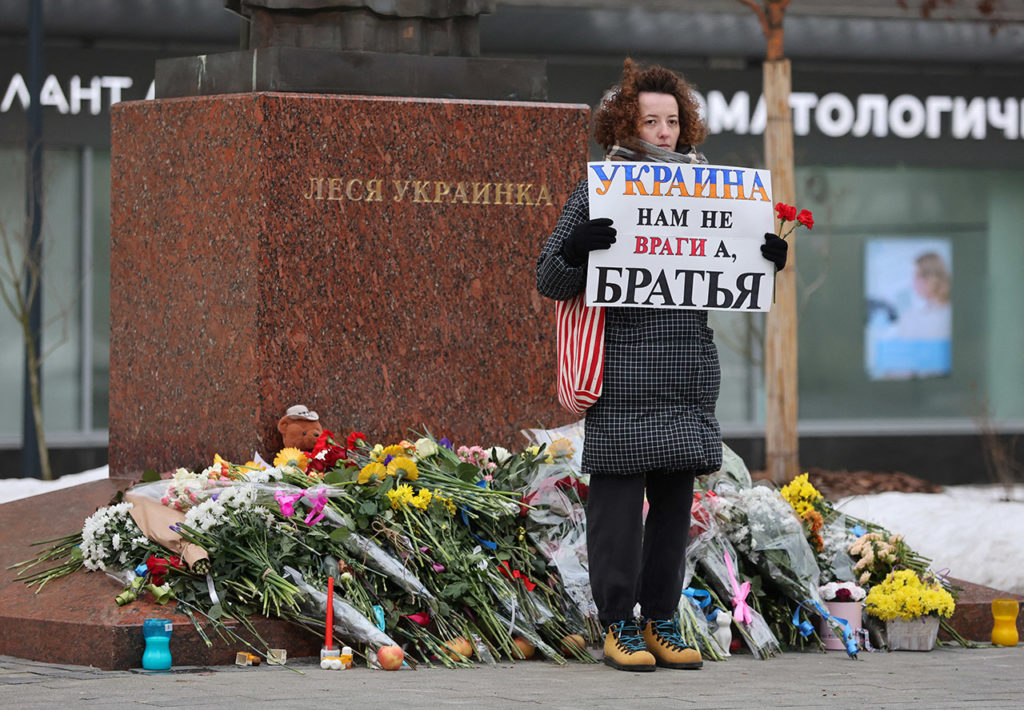
In a situation of dictatorship and political repression, when a direct public statement is prohibited, such an expression of sympathy has become almost the only possible and relatively safe way to express its position.
True, this method did not remain safe for long. Some layers were delayed by the most absurd accusations, including a violation of covid restrictions.
Nevertheless, the tradition is fixed. During 2023, loners still created small memorials every time, as it became known about the victims of the next missile shelling of Ukrainian cities. And on August 24, on the Independence Day of Ukraine, a new wave of colors laying on the "Ukrainian" monuments swept through the cities of Russia. Some were detained for this.
"Family" Wagnerians and the memory of Prigozhin
One of the authors of this column, ending in February 2023 in Penza, recorded a conversation in a reserved sector. Random fellow travelers discussed the war and losses in it. “The neighbor’s husband was brought in a zinc coffin,” the woman said, “but five million were given, they did not deceive.”
“They paid, did not deceive” - this is almost the formula of the new public agreement, which was signed by some Russian citizens with the state. “You are fighting - the state pays you, including for injuries and death.” The topic of payments is one of the most important wives and relatives of Wagnerians in telegram chat. Husbands and sons not only receive a new, prestigious status, but also become the breadwinners of their families. It is not without reason that volunteers-contractes from small cities were sometimes called "mortgages." And the prisoners who have passed the "purification of the war" - "our heroes."
The rebellion blew up the public status of Prigozhiners. Some still call them "brave warriors", others - "traitors." PMC offices in Russian cities were closed, advertising billboards fell, and songs about them stopped rushing from each iron.
On August 23, when the aircraft with the top of Wagner crashed over the Tver region, the “family” is a word from the same chat of wives and relatives of Wagnerians - I experienced a huge shock. People wrote that their “new”, “acquired” life is destroyed with such difficulties.
"Who are we now ?"
The Wagnerians after the rebellion ended up in the gray zone. It was necessary to justify yourself before society. The general intonation of needlework leaflets and graffiti, which appeared during this period in different cities, sounds something like this: "We are not traitors."
After the crash of the aircraft, this conflict came out and worsened to "We are not traitors, we are heroes!" The expectation of the funeral of Evgeny Prigozhin aggravated this conflict even more. Will he be buried on the protocol as a hero of Russia or not? The slurred information about future funerals and their status only increased stress. And on August 30, Prigozhin’s funeral took place in St. Petersburg - almost in conditions of complete conspiracy .
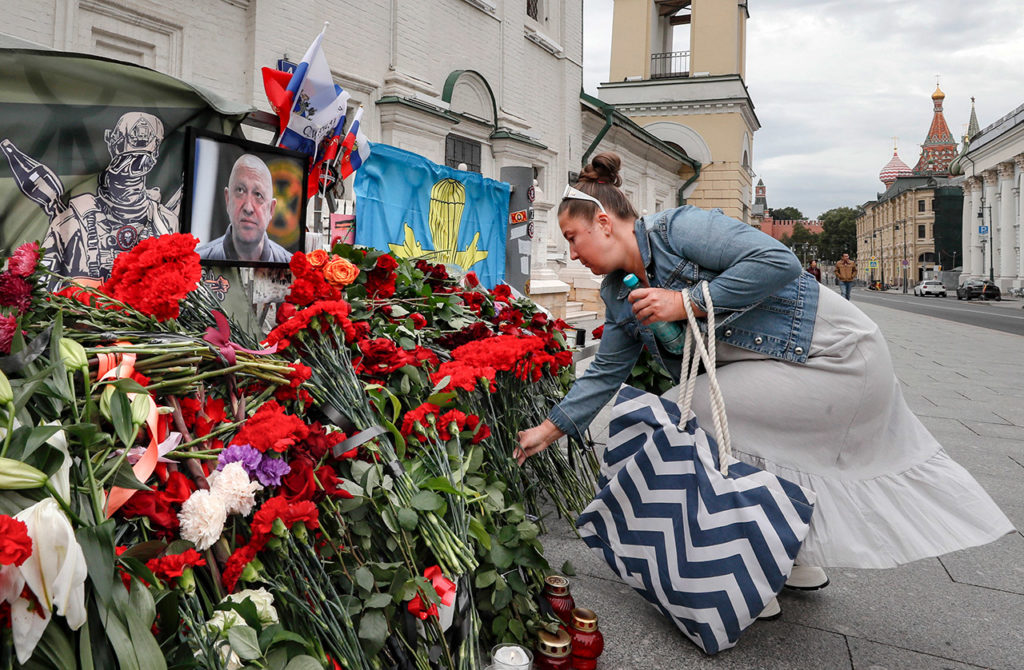
When the official heroization is refused, the heroization of mercenaries begins to work spontaneous memorials that appear in a wide variety of settlements: from Anapa to Yekaterinburg, from Kaliningrad to Novosibirsk, from Sevastopol and Simferopol in the occupied Crimea to Tver . And although memorials arise after the collapse of the Prigozhinsky aircraft, their filling is constantly expanding: they put photos of other people who died from the “Ukrainian terror”, for example, Daria Dugin, or just dead in the war. A photograph of the deceased student of HSE Taras Alekseev appeared on the Barvarka memorial in Moscow.
The choice of the city and the number of memorials in each of them are not accidental. If for sympathetic Ukraine a simple dependence works “The more the city, the more memorials” (after a missile strike on the Dnieper in Moscow and St. Petersburg, nine memorials appeared), then in the case of Wagner there is no such correlation. There are two Prigozhinsky memorials in St. Petersburg, as much as in Belgorod and Blagoveshchensk, and in Ryazan, for example, there are three of them. The reason is understandable. In addition to prisoners, people from small cities crushed by a mortgage were recorded in mercenaries. And it is in small cities that the Wagnerians and their loved ones especially want to declare themselves.
Prigozhinsky memorials are almost always - the initiative from below. No public instructions from the authorities are visible on how to remember the dead, and information about official funeral is silent. True, traces of unification are visible on the memorials: the same banners, typical carnations, but this is rather a way to declare their identity than the signs of the organization from above. Sometimes (but not always) some local patriotic forces are connected to the creation of the memorial: for example, in Tomsk, on the third day of the spontaneous memorial, the Unarmeytsy flowers came to him.
How did local authorities react to Wagnerian memorials? Bewildered. They did not particularly interfere with their creation, except that they looked through the eyes of the police, but in some places the memorials were removed immediately after the creation .
People involved in the creation of spontaneous memorials - both men and women - are trying to thus become visible in the Russian public space. Let not as an individual, but as a community. They use bright symbols associated with Evgeny Prigozhin, and thus declare their value landmarks: in St. Petersburg, you can see both banners with a form and a sledgehammer in St. Petersburg. And next to it - a can of Zarozhino stew. The name that appeared, which appears, the stew visualizes the metaphor of cannon fodder: the breadwinner-the “Prigiron” literally becomes a food product.
What is the choice of a place about the community?
The choice of a place for spontaneous memorials is another way to articulate your message to the “city and the world”, fellow citizens and power of the emerging.
How to read this hidden message correctly? To answer this question, we compared the commemoration of passengers and crews of Prigozhinsky aircraft with the commemoration of people who were killed in the Dnieper on January 14, 2023. We took the same time period - five full days after the event. After the tragedy, 85 memorials appeared in the Dnieper, after the death of Prigozhin - 77. And here's where:
Sympathetic to the dead in Ukraine and supporters of Prigozhin, through the choice of a commemoration place, formulated completely different messages. It was important for those who remember the victims of the Russian missile in the Dnieper, it was important to focus on the fact that people are killing the state (therefore most often-in 42% of cases-they choose monuments to the victims of political examination) and that we should remember about Ukrainian victims (therefore memorials arise near the whole Ukrainian-27%).
For supporters Prigozhin, it is most important to enter their heroes who died in the paradigm, therefore, in 17 cases, memorials arise in monuments related to the Great Patriotic War, and in 20 cases, among monuments dedicated to the participants in the “local wars” (bashful euphemism for the Afghan and Chechen wars). In second place - and with a significant margin, only 12 cases - memorials arise near the offices of the PMC of Wagner or the headquarters of Zakhar Prilepin and thus emphasize the identity of the Wagnerians. And the monument to the victims of politics was used only once (in Tver).
The same difference in the use of monuments to the civilian victims of wars and disasters: 11 cases of commemoration of victims of bombing of Ukrainian cities, and only one for Prigozhin, and this is a monument to the police who died in the performance of duty.
It is no coincidence that in 11 cases the memorials were made in a “place without a place”: in a square, on a bench, on the beach. Do not think that the Wagnerians simply did not find where to stick portraits. The memorials of the stone, which stands on the outskirts of the village, an empty square or bench show the impossibility of Vagnerians somewhere legitimately fit. They feel that they do not belong to any community, and therefore create a memorial in a space free of other signs. Sympathetic Ukraine does not have such problems, so the “place without a place” is found only once (a sign in the snow in Kursk).
It is interesting that in both cases, temples are rarely commemorating the dead: there are only two such memorials in each case (in Moscow at the maxim of the confessor in Barvarka). Neither one nor the other community builds its identification through a religious component.
In the past year and a half in several cities and regions (Kaluga, Kostroma, Ulan-Ude, Rostov Region), gigantic installations with the letters Z and V, which, as planned, were supposed to invite participants in folk patriotic actions. However, Prigozhinsky memorials do not seek to arise around them at all: the only memorial under the letters arose (as we see in the table) in Feodosia, in the occupied Crimea. Moreover: in the memorials themselves, the letters Z and V are quite rare, which means that they are not used as signs of identity.
***
Of course, those who mourn about the dead civilians of Ukraine and the dead Wagnerians are completely different people, and in order to fix it, no anthropological research is needed.
It was important for us to understand how exactly they build their identity and how they talk to the public. Spontaneous memorials help to do this. Those who support Ukraine are betting on sympathy for the victims and the struggle of loners against the state, through the choice of the place of the memorial they say: "The state kills us all." The Wagnerians and their supporters want to stake their place among the “defenders of the middle name” and integrate into the patriotic hierarchy of the heroes of “Russian military glory”, which they began to refuse in the past two months. Their uncertainty in their status and the stuck between the “heroes” and “criminals” are expressed in the fact that memorials often appear from scratch, literally in a place without a place.
We thank the author of the Svodka Material channel for help in searching for memorials.
The author’s opinion may not coincide with the opinion of the editorial office.