
Original Material
Reserves and reservations
Combat within the Robotyne–Verbove–Novoprokopivka triangle may well determine the outcome of Ukraine’s entire summer campaign
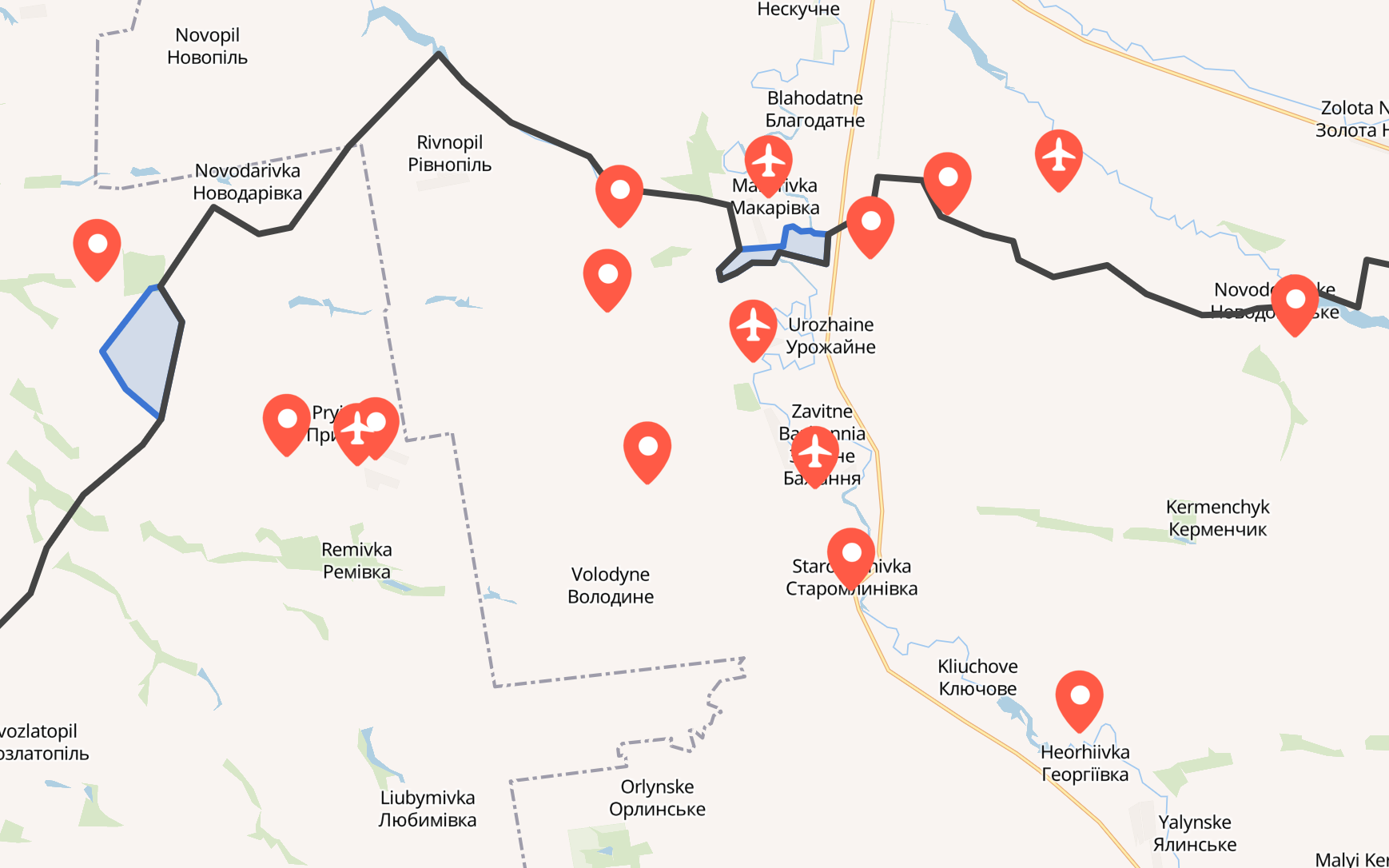
Like our earlier reports on the combat situation in Ukraine, this article takes stock of the recent developments in the battlefield, based on open-source information. Meduza has condemned Russia’s invasion of Ukraine from the very start, and our detailed military analyses are part of our commitment to objective reporting on a war we firmly oppose.
Our map is based exclusively on open-source photos and videos, most of them posted by eyewitnesses on social media. We collect available evidence and determine its geolocation markers, adding only the photos and videos that clear this process. Meduza doesn’t try to track the conflict in real time; the data reflected on the map are typically at least 48 hours old.
What we knew about the state of combat as of 1 p.m. GMT on August 30, 2023
After liberating the village of Robotyne in the Orikhiv operating area, the Ukrainian Armed Forces (AFU) continued their offensive on the fortified Russian defense lines east and south of the village. Russian defense positions have already been ruptured east of Robotyne, and Ukrainian units have been spotted several kilometers to the southeast, near the village of Novoprokopivka.
The Russian artillery, whose fire covers a bulgе in the front line between Robotyne and Orikhiv from both flanks, keeps the AFU from advancing even further. This complicates delivering supplies and reinforcements, as well as evacuating wounded personnel. To secure the flanks, the Ukrainian forces are trying to gain control of the villages Verbove and Kopani, east and west of Robotyne. On August 30, they entered the outskirts of Verbove.
The Russian command is aware of being in danger of a Ukrainian breakthrough since significant Russian reserves are now being sent to the area. A major part of the reserves of the Southern grouping of the Russian Armed Forces (RAF) has already been sent into battle, meaning further reserves would have to come from other operative areas.
Robotyne and Verbove
- Between the villages of Robotyne (liberated by the AFU last week) and Verbove (still controlled by the Russian troops), a gap seems to be emerging in the Russian defense line. The forces covering it now may well not be sufficient for the task. In the engineering sense, this location is also the weakest link in the fortified chain of the Russian defense’s main line. The situation here is critical for the Russian Armed Forces.
- On August 29 and 30, Ukrainian units were spotted on the outskirts of Verbove and on the elevations east of Novoprokopivka. Capturing Novoprokopivka will open up the space for their further progress towards Tokmak, but to get there, the AFU would first have to secure its Verbove flank.
- In the coming weeks, action within the Robotyne–Verbove–Novoprokopivka triangle may very well determine the outcome of the whole summer campaign. For now, the AFU are retaining initiative, thanks to having introduced several new brigades into action in late July and early August. The problem faced by the Ukrainian command is, however, that it has already used up close to all of its available reserves, while the Russian side has only just begun moving fresh new units to the main combat theater.
How to read this map
The map shows the positions of the “regular” AFU units, the National Guard of Ukraine, and the Russian formations.
The “regular” AFU formations traditionally comprise brigades, including tank, mechanized, motorized infantry, assault, jaeger, marine, and airborne troops. The size of the icons corresponds to unit size on the map.
Brigades of different composition are normally assigned to operational areas without being attached to a particular corps. Open sources and leaked Pentagon documents show that, by the summer of 2023, two permanent Army Corps formations (the Ninth and the Tenth) were going to be created, comprised of eight brigades formed in 2022–2023 and trained in the West. (Some of these brigades are armed exclusively with Western-made heavy equipment.)
Several more AFU brigades formed in 2023 were not included in either the Ninth or the Tenth Army Corps, but they’ve already been seen in combat on different fronts. Four new brigades, for example, were included in a separate Marine Corps. In addition, a National Guard formation was created specifically for the offensive, consisting of six light National Guard brigades, Interior Forces, and the Border Guard of Ukraine.
About three-quarters of the newly-created brigades (joined by several older formations) are already on the offensive in southern Ukraine.
The map shows that nearly all known Ukrainian brigades were thrown into battle by mid-August, based on open-source evidence. Only a few units (including, likely, the 44th Mechanized Brigade) remain in the rear.
The brigades differ in personnel number. The largest are the mechanized and motorized infantry brigades, with about 5,000 troops in each such brigade). Tank, paratrooper, jaeger, marine, National Guard, and other types of brigades have fewer troops, the normal range being 2,500–4,000 troops. Still, it’s not uncommon for certain brigades to get additional units in wartime, almost doubling in size as a result.
The map doesn’t show the supporting units operating in each of the operational areas: artillery brigades, drone-operator detachments, separate strike and assault battalions, special operations forces detachments and battalions, separate units of foreign volunteers, or the numerous (and populous) territorial-defense brigades. Although essential to both offensive and defensive operations, they cannot engage in intensive large-scale combat operations on their own. It is the “regular” brigades that bear the brunt of the fighting, especially in offensive operations. At the same time, it’s mainly the territorial-defense brigades that protect large stretches of the front while there isn’t active combat.
The Russian forces are comprised of armies consisting of “regular” divisions (made up of motorized rifle and tank regiments), separate motorized rifle and tank brigades, as well as separate airborne and marine units (brigades and airborne divisions, comprised, in turn, of regiments) provisionally attached to the army headquarters. For simplicity’s sake, the number of personnel in a separate brigade of the Russian Armed Forces (RAF) is conventionally assumed to be 4,000 people, while a regiment is assumed to have 2,000 troops. Real personnel numbers, however, may differ significantly from these conventional values.
RAF units are described on pop-ups according to their place in the military hierarchy:
- army – division – regiment
- army – brigade
- branch of troops (Airborne Forces or Marines) – division – regiment
- branch of troops – brigade
The map doesn’t show RAF supporting units — artillery and missile brigades within armies, artillery regiments within divisions, detachments of drone operators, battalions and brigades of special-operations forces, battalions of “reservists” (the so-called BARS), or separate regiments of territorial troops formed from the newly-mobilized. “Assault-Z” detachments and battalions formed mostly from pardoned prisoners also don’t appear on the map. While these units are significant, they cannot fight independently.
The accuracy of locating AFU and RAF units can vary from highly accurate to presumptive, depending on the source.
The map doesn’t amount, then, to an estimate of the number and density of the troops in any given area, but it can be used to assess the distribution of the key combat units involved in an offensive or in active defense, as well as the reserves available to both sides.
- Over the past week, the reserves of the RAF’s Southern grouping have appeared in the area of Robotyne and Verbove. These are the airborne regiments of the 7th Airborne Assault Division and the 503rd Motorized Rifle Regiment, which in June and July repelled the AFU offensive in Pyatykhatky, 30 kilometers (or 19 miles) west of Robotyne. There, the Russian forces managed to stabilize the situation, which freed up the troops to be redeployed to the Orikhiv direction.
- Still, Russia’s Southern grouping may not have enough reserves of its own to deflect the Ukrainian offensive. The Russian General Staff will likely have to send in additional reinforcements, and some analysts believe that at least two of the three regiments of the 76th Air Assault Division have already been sent south, from Kreminna in the Luhansk region. Although evidence of this is inconclusive, it’s true that, since late July, the 76th division has been absent from reports of combat in Kreminna.
- The larger share of other airborne troops and marines routinely used as stopgaps by the Russian command are already tied up in combat elsewhere. Still, the RAF has even further reserves, including the still-unexpended reserves of the Western grouping (now trying to advance towards Kupyansk, though not very effectively). Yet transferring these units to the southern theater would mean giving up on the offensive in the Kharkiv region or any intent on recapturing the initiative in that operative area.
Meduza is careful in working with data, but mistakes are still possible, and perhaps even inevitable. If you spot one, please let us know by sending an email to reports@meduza.io. Thank you!
Translated by Anna Razumnaya.