
Translated material
Sovereign Russian education: hypocrisy, “partisanship” and fascisation of the school - Layout
Sovereign Russian education: hypocrisy, “partisanship” and fascisation of the school
What awaits schoolchildren and teachers in the new school year
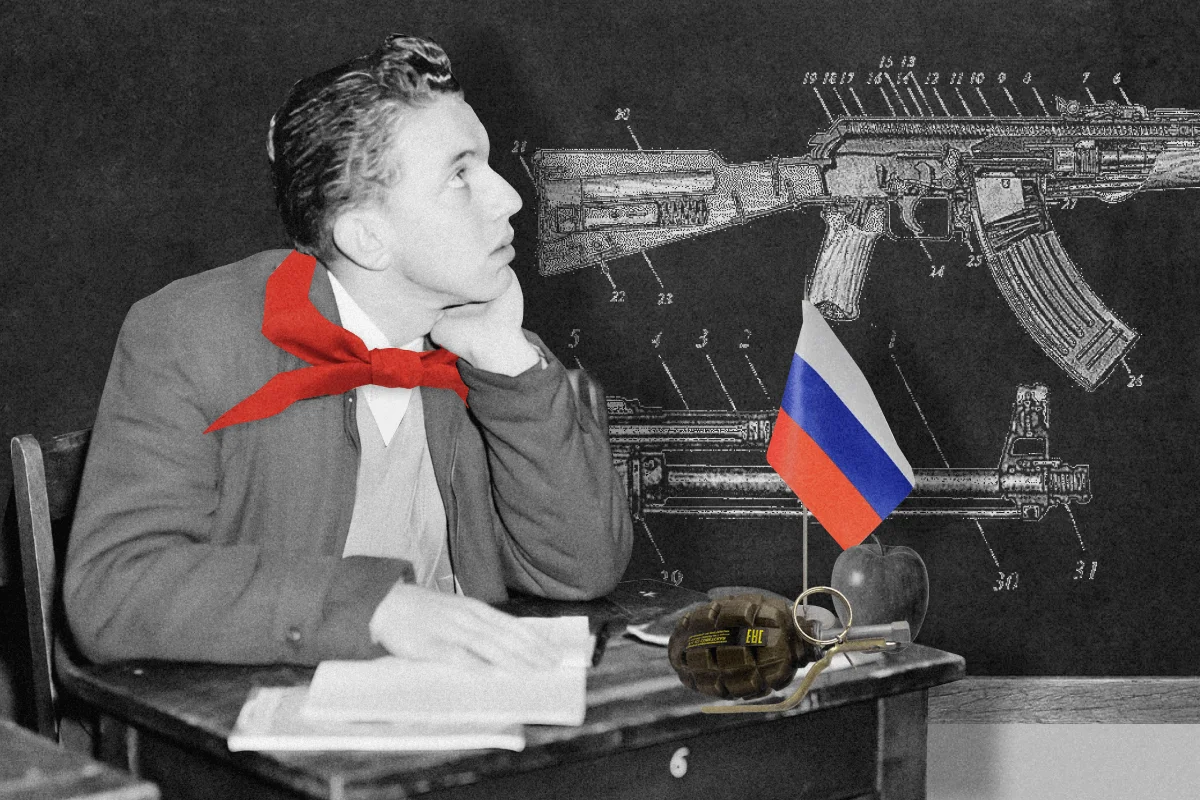
Unified educational programs for everyone, textbooks with a chapter on “special operations”, war with Ukraine in exams and active involvement in the “new pioneer” - this is only an incomplete list of innovations that Russian schools, both public and private, will face. What to expect from September 1, 2023 for teachers and students and whether it is possible to resist the inculcation of patriotism in schools, Vorstka found out.
In order not to miss new texts from “Layout”, subscribe to our telegram channel
One program for everyone
From September 1, 2023, Russian schools will switch to the Federal Basic Educational Programs (FOEP) in six subjects. They are planned to be introduced into Russian schools everywhere and in all disciplines within two years. In the coming academic year, these programs will begin to be used in teaching geography, life safety, Russian language, literature, history, and social studies.
According to the Minister of Education of the Russian Federation Sergei Kravtsov, the new programs are aimed at “ strengthening a single educational space and forming a sovereign education system ”: “Now, if a child moves from one region to another, he will definitely have a certain qualitative level of knowledge, which is given to him taking into account the unified federal educational programs.”
Previously, a school could use its own curriculum, and each teacher could choose textbooks and interpret topics at his own discretion. The new laws assume that curricula and textbooks will be approved at the legislative level: they will become identical and mandatory for all schools.
A school may not teach according to federal programs, but then its own programs must be “ not lower ” than the national ones - that is, something “from above” can still be given, but the mandatory requirements must be fulfilled unconditionally.
The founder of the non-state “Novoshkola” and “Novokolledzh”, Novosibirsk resident Sergei Chernyshov (he was recognized by the Ministry of Justice of the Russian Federation as a foreign agent, after which he left administrative positions at “Novokolledzh” and “Novoshkola”) told Vorstka that the new programs are extremely ideological : “They are the same for all schools and colleges, they describe in detail what topics to cover, why this or that subject is needed (“Spoiler alert – for patriotism, of course!”), and what books to use.”
Such unification, according to Chernyshov, is a symptom of “systemic fascisation of education” and “the fight against any uniqueness.”
“The Russian language, according to this program, must be taught for the sake of ‘awareness and manifestation of all-Russian citizenship and patriotism,’” says Chernyshov. - And, for example, history - in order to “repel falsifiers of Russian history.” Social studies is needed for the education of “all-Russian identity based on the ideas of patriotism, pride in the country’s achievements,” geography and literature are needed for the same.”
Anna Sleptsova, a teacher of additional education at one of the gymnasiums in Siberia (last name changed at the request of the heroine), also agrees with Chernyshov.
“I teach electives in physics and chemistry for those who want to. Before the start of the school year, the administration reported to the teachers' council: the federal general education program is good. Life will become better, life will become more fun! Soviet traditions are being revived and all that,” she recounted to Vorstka. “I consider FOOP an absolute evil, because textbooks must compete, teachers must choose an approach based on experience and qualifications.”
However, not all teachers consider the unification of educational programs to be evil . For example, in a large professional chat for history teachers, where there was a heated discussion of the FOOP and the corresponding history textbook, many teachers argued that the state has the right to set strict limits for teachers.
“A person who takes upon himself the responsibility of teaching children history must be in solidarity with the state whose future he is educating,” wrote one of the teachers.
Unified textbooks - and the only correct answers in exams
New textbooks will be created for unified educational programs, the authors of which will be approved by the Ministry of Education, and the exclusive rights to them will belong to the Russian Federation. Previous textbooks will be allowed to be used during the validity period of expert opinions, which is five years.
At the beginning of August 2023, the Ministry of Education of the Russian Federation presented a new unified history textbook for high school students, published by Prosveshchenie, which, according to Minister Kravtsov, costs 849 rubles. It “drastically rewrote” the section about the history of Russia in the 1970s, 80s, 90s and 2000s. “ A section has been added from 2014 to the present, including a special operation ,” said one of the authors of the textbook, Putin’s assistant and chairman of the Interdepartmental Commission for Historical Education of Russia, Vladimir Medinsky.
History teachers discussing a new textbook in a thematic chat on Telegram differ in their assessments of this manual. Some believe that it is impossible to teach modernity and talk in class about the events that are happening now, that is, about the “special operation”. Others are sure: “if we don’t introduce modernity into the school history course, the fifth column will continue to multiply.”
“Children should know and understand that the world around us is not at all cute and fluffy, that we must defend our country,” says one of the teachers. “Perhaps this is not felt so much on the mainland, but in Crimea the omission in the study of contemporary issues is acutely felt, unfortunately.”
In response to the objection of one of my colleagues that a unified interpretation of history without room for maneuver will not allow children to develop critical thinking, another chat participant asked: “Is critical thinking necessary in relation to the history of one’s homeland?”
“It is clear that right from the first days of the war with Ukraine, propaganda penetrated into schools. But with a history textbook, it is important that the Russian version of events is now included in the compulsory curriculum,” Daniil Ken, head of the Teachers’ Alliance, told Vorstka. “This means that teachers will be required to teach using this textbook, and students will have to give the “correct” answers provided by the textbook as part of the assessment. That is, the history exam itself will relay propaganda.”
After the delivery of new history textbooks, the Unified State Examination will include tasks about “special operations,” said the head of the Ministry of Education of the Russian Federation, Sergei Kravtsov. True, so far new textbooks have not arrived in schools everywhere (the school “doesn’t have money” for new textbooks, a teacher from Kuzbass told Vorstka) - or they will arrive late. And questions about SVO have already appeared in the demo version of the Unified State Exam.
New unified textbooks for other subjects are still being developed; they are planned to be prepared by 2025. A teacher of Russian language and literature at one of the Novosibirsk schools, who asked Vorstka for anonymity, believes that the unification of textbooks is harmful to learning .
“Previously, the program was quite variable and provided the teacher with a lot of room for maneuver. A separate question is how many people have used this, but now everything is moving towards a strictly fixed list of works for each class,” explains the teacher. - Why is this bad? Because this list of references, firstly, is already overloaded, and secondly, if you follow it strictly, it will not allow you to take into account the characteristics of a particular class.”
The teacher draws attention to the fact that in future textbooks the question of interpretation is especially important: “How exactly will the same “War and Peace” be presented in it, for example? What details of the biographies of writers will be given and what will not, what accents will be placed there? For example, Akhmatova can be introduced not as the author of “Requiem,” but through the poem “I Was a Voice,” where she says that she will never leave Russia.”
“Partisan” bypassing textbooks, hiding from denunciations
Motivated teachers who do not agree with the propaganda bias of educational programs will, in any case, “partisan” and teach as they see fit, a teacher of Russian and literature from Novosibirsk is sure.
“It seems to me that the role of the textbook is greatly overrated . Not all children go there at all, and much more depends on the teacher. If the teacher is “for”, this is one situation, and if against, then no textbook will force him to go against his beliefs. But there is still a layer of those who don’t care what or how to teach (and there are quite a lot of them), and it’s them – and not the children – that the textbook will influence.”
His colleague on the subject, Mikhail Pavlovets, associate professor at the Higher School of Economics and literature teacher at the HSE Lyceum, also suggests that teachers, who are not methodologically and ideologically close to a single literature textbook, will give one in class and write down in a journal what is expected of them.
True, Pavlovets notes, “schools are already being checked for program implementation”: “If a teacher spent more hours on one piece and missed another, he can be punished for this,” he said in an interview with Pravmir.
Teachers interviewed by VERSTKA are confident that teachers will be “punished” because of children’s denunciations and related complaints from parents.
“ Schools do not need teachers who create problems for the institution . Therefore, if something appears about a specific teacher, they try to fire him due to dereliction of duty,” Dasha Shikhova, a history and art history teacher from St. Petersburg, told VERSTKA. “But more often the pressure comes directly from the team: in the teaching environment, the level of intolerance towards the ‘other’ can go off scale.”
“Previously, at my school, the teaching process was minimally controlled; I had quite a lot of freedom in choosing the methodology and aspects of the teaching topic,” a history teacher from a large educational center subordinate directly to the Ministry of Education told Vorstka. — This year, positions that need to be voiced and that are correct from the point of view of the authors of the textbook and, naturally, from the point of view of the state, are clearly regulated. And if there are signals that history is being told incorrectly, I’m sure the teacher will be sanctioned for this.”
Anna Sleptsova, a chemistry teacher from a Novosibirsk gymnasium, told Vorstka that a biology teacher from her school was fired for the phrase “war is always bad, we must strive for peace,” said in class. “The kids knock, the parents tell the principal—that’s how it works,” she explained. “The biological scientist formally resigned of her own free will, but everyone knows why she left.”
Natalya Tikhonova, a history teacher from Kuzbass (last name has been changed - note from “Layout”), believes that the transition to the public educational program “does not change anything in the work, the main thing is to write everything on paper.”
“We haven’t purchased new history textbooks, but we still prescribe them as the main ones. I’ve been teaching classes without a textbook for ten years now, through lectures. I won’t voice my analysis of the new textbook to the children, otherwise I’ll puke,” she told Vorstka. — Regarding the inspectors, if everyone’s documents say what they should, as they should be, then they won’t find fault, because the papers are the main thing in our business! But you can’t just walk into anyone’s class, it simplifies things.”
Natalya says that she intends to teach history to eleventh graders for the last year in order to graduate from her favorite class. Then she is going to teach history only up to the 19th century - up to and including the seventh grade. She will not follow the propaganda program in class. Although, if a child intends to take the Unified State Exam in history, Natalya says, the situation is more complicated - there is no escape from questions about the war with Ukraine. “We will engage in hypocrisy: teach how to write, and keep what we think to ourselves.”
“Defense of the Motherland” instead of life safety
Another innovation this year, the Life Safety Fundamentals subject is officially expanding to include a basic military training course. At the NVP, schoolchildren will study weapons, personal protective equipment and the rules for handling them, drill training and military salutes, as well as control of drones.
However, teenagers have already been involved in assembling unmanned aerial vehicles that are intended for Russian soldiers in Ukraine, although during the summer holidays and not at school, for example, inthe Perm region and Sakhalin .
In the next academic year, the subject of life safety will be completely renamed “ Fundamentals of Security and Defense of the Motherland .” Employees of the Ministry of Defense and the Ministry of Emergency Situations are helping to draw up the curriculum for the new subject.
A graduate of one of the pedagogical universities in Siberia, who last year worked in a secondary school as a life safety teacher, told Vorstka on condition of anonymity that she sincerely does not understand why “life safety” is so actively replaced by “defense of the Motherland.”
“The high school students I taught were already doing pre-military things with their previous teacher before I came to school. Or they would play boring movies about a fire and leave them alone to watch while they went about their business. “I tried to give them really useful knowledge: how to protect their reproductive health, how not to fall for the tricks of scammers who scam people out of money,” she says. “My subject is about life, about security, but the “defense of the Motherland” and the non-government military order in today’s situation - well, it’s as if it’s not very good anymore.”
Federal educational program: labor, anthem, “new pioneer”
From September 1, 2023, amendments to the law “On Education in the Russian Federation” also come into force, which provide for the official possibility of involving schoolchildren in socially useful work depending on age - maintaining order in classrooms, organizing events.
Chairman of the State Duma Committee on Education Olga Kazakova said that special emphasis will be placed on developing everyday skills. What exactly the children will do, according to Kazakova, will be determined by the federal education program, which is currently being developed by the Ministry of Education.
“It seems to me that they talk too much about compulsory socially useful work, and the importance of this topic is overestimated,” Daniil Ken told Vorstka. “As if the school can now force children to work without asking their parents’ consent.” In fact, according to the Family Code, parents have complete priority in the right to raise a child, and at any time a parent can release a child from labor duties, no matter if it is cleaning a classroom, territory, or planting trees. You can slack off and not take it seriously.”
In addition to social work, the unified program for the education of Russian schoolchildren includes the continuation of “ Conversations about important things ”, and the ceremony of raising the national flag, and the performance of the Russian anthem at the beginning of the school week. As part of educational work, cells of the movement of children and youth “Movement of the First” will be opened in schools and colleges, and by 2024, theaters and sports clubs will appear in every school in the country, the government promised .
19 billion rubles were allocated from the federal budget for the “Movement of the First” . This amount, as Groza found out , exceeds the annual expenses of some Russian universities and research centers. The movement’s website says that being a member of it “is the choice of the strong and ready to write their name in the history of Russia”, that for participants in the “Movement of the First” “respect for the traditions and cultures of the peoples of Russia, historical continuity and involvement in the fate of the country, in which the main value was, is and will be, is important.”
New school political officers
To monitor the implementation of the new federal education program, the Ministry of Education is introducing a new position - advisor to the school director on education. They will coordinate the interaction between the school and the “new pioneers” - as the founder of the Novosibirsk “Novoschool” Sergei Chernyshov called the movement.
As an experiment, advisors to educational directors have already appeared in some Russian regions; from September 1, 2023, they should appear everywhere. The head of the Alliance of Teachers, Daniil Ken, believes that “ the worst people will be hired for the position of advisor to the director of education, created for propaganda work .”
“The functionality of the educational adviser is quite clear - it’s everything related to patriotism, youth movements, Youth Army and so on. In elementary school, they will be responsible for leading “Conversations About What Matters.” In a number of regions, regional ministers said that they would try to attract military personnel returning from Ukraine to these positions.” These advisers will be recruited by school directors.
The correspondent of “Verstka”, introducing himself as a “veteran of the Northern Military District,” called several schools that published vacancies for educational advisers on the HH.ru service, but almost everywhere, having a pedagogical education was a mandatory requirement for employment. However, in order to communicate with schoolchildren in “lessons of courage”, “veterans of the Northern Military District” do not need pedagogical education - they came to schools across the country throughout the last school year. Teachers who disagree with such patriotic education quit , but there are few such examples in Russia.
The salaries promised to educational advisers range from 20 thousand rubles in Rostov-on-Don to 90 thousand rubles in Moscow. For this money, they should “not only be able to talk about basic values, but also with their whole appearance, lifestyle, attitude to assigned tasks, to people, to the Motherland, to be an example for their students,” said Sergei Tarasov, rector of the Russian State Pedagogical University named after A. I. Herzen, where educational advisers take advanced training courses.
“Verstka” spoke with one of the educational advisers from a rural school in the Krasnodar region. Anastasia Kolesova (name changed) said that schools still have little understanding of how the functionality of an educational adviser differs from the tasks of a head teacher for educational work.
“Most schools perceived advisers as assistants to the head teacher—the one who does the paperwork. And the adviser - he goes to work with children directly, organizes events, opens up new opportunities for children,” says Anastasia.
To take this position, she passed a competitive selection on the website navigatorsdetstva.rf, and then received training, including at the Mashuk center. Part of her salary - 15 thousand rubles - is paid to her by the school as an educational adviser. The second half - another 15 thousand - she, as an “expert in patriotic education and the implementation of programs and projects of patriotic education”, receives from the Rosdetcenter. For thirty thousand a month, she must carry out educational and patriotic events, the plan for which is sent to her from the Rosdetcenter.
Anastasia is upset that she is warned about some events literally a couple of days in advance: because of this, she has to work “for show and formally.” The themes for the events, she says, are very different: for example, September 3 should be the Day of Solidarity in the Fight against Terrorism, and September 8 should be Animal Protection Day.
Anastasia doesn’t like all the activities in the plan, but she fully understood what they wanted from her when she applied for this position: “You may not like something from the point of view of your worldview. But if you have such a categorical point of view, you won’t get a job where you have to do something unacceptable to you.”
Among the events held by Anastasia are a school-wide assembly and a “historical hour” dedicated to the “return of Crimea,” a “Requiem” lesson about genocide during the Great Patriotic War, and others. She also conducted master classes, for example, on making a model of a satellite on Cosmonautics Day or on making heart-shaped talismans for SVO participants, in which the children “invested their support and gratitude to the fighters.”
According to Anastasia, educational advisers cannot be considered agents of propaganda in school. “I won’t say that every event in our educational plan is saturated with propaganda. Those that are connected with history, war, Russian public holidays - yes, there is such an element there, of course.”
How to avoid militarization at school?
Propaganda lessons and extracurricular activities, the content of which does not suit parents and children, can be skipped, Daniil Ken from the Teachers' Alliance told Vorstka.
“There is Article 17 of the Federal Law “On Education,” which gives the right to combine full-time and family forms of education. And Article 34 of the same law gives the right to study according to an individual educational plan (IEP), regardless of the reasons, he explained. — Often an individual education plan is chosen in the event of a child’s poor academic performance or serious illness. But even if a child does not have such difficulties, he has the right to this.”
Parents or legal representatives of a student can write an application addressed to the school principal with a request to transfer the child to a mixed form of education and with a request to agree on an individual curriculum for him. To be sure, the application must indicate which topics in which subjects from the curriculum will be covered in family education, and the IEP will agree on the dates and form of certification. The Teachers Alliance says it can help with this if parents have questions.
“We don’t yet know how schools will react to this. Probably, the resistance from schools will be stronger than when parents tried to refuse to attend “Conversations about Important Things.” - Ken suggested. “But this method is completely legal.”
Anna Sleptsova, a teacher of additional chemistry from Novosibirsk, herself transferred her daughter, a middle school student, to correspondence education.
“Even if children remain resistant to the rays of propaganda, they will not receive knowledge from school. Initially, I took my child out of the system not because of war or propaganda, but because the education system collapsed and rotted,” she told Vorstka. — Teachers, even the best ones, are already completely burned out . But when the war started, I was just glad that we weren’t at school.”
Subpoenas right after school
In a series of recently adopted laws relating to education, no one notices “the most important one,” says the founder of the non-state “Novoshkola” and “Novokolledzh”, Novosibirsk resident Sergei Chernyshov: “It means that it is now physically unsafe to be in a significant number of educational institutions. We are talking about changes to the Code of Administrative Offences, which tighten the liability for organizations for violating the rules of military registration.”
A summons to the military registration and enlistment office, for example, can be legally served not only at the place of residence or work, but also at the place of study, he explains. “And since resistance to all current militaristic “innovations” is somehow not particularly noticed among schools, colleges and universities, then rest assured that they will definitely hand you a summons ,” Chernyshov is sure.
Schools, says the founder of Novokolledzh, have previously actively collaborated with military registration and enlistment offices. Now, for failure to serve a mobilization summons or failure to appear at the military registration and enlistment office, they face a fine of up to 500 thousand, and for “failure to provide to the military registration and enlistment office lists of citizens subject to initial military registration” - up to 400 thousand.
“Therefore, do not be surprised if the director of the educational institution will do everything to ensure that you or your boy receives a summons. This will also affect 18-year-old school graduates: they can receive summonses even before entering a university or college, and a contract with them can be concluded immediately after school,” Chernyshov told Vorstka.
Cover: Dmitry Osinnikov