
Translated material
"It is not necessary to be special to fall under repression"
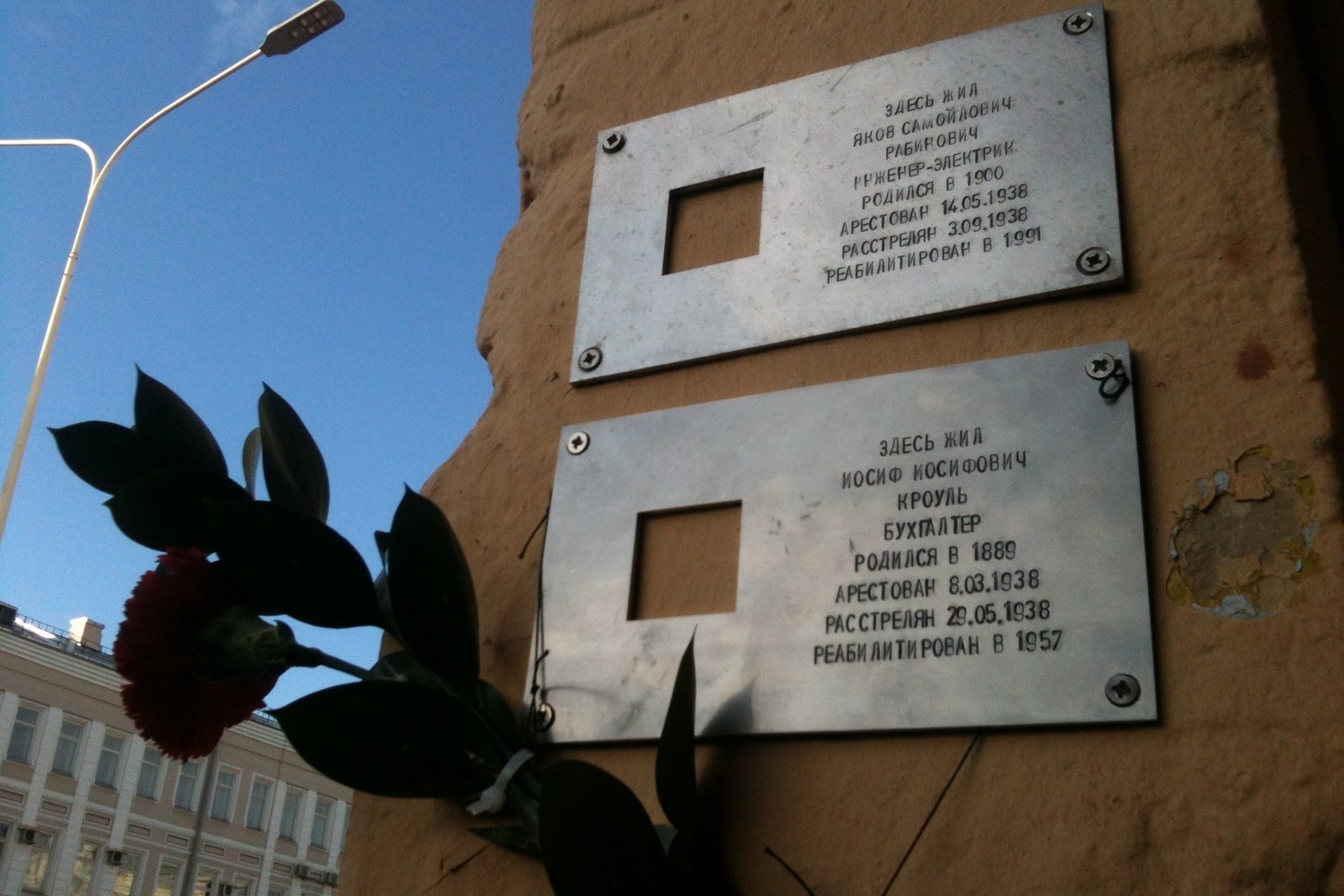
At the end of August, 34 signs of the “last address” with the names of the residents repressed during a large terror of residents were disappeared from the “Specialists' House” in the Vyborg district. Memorial signs were removed by the management company. Then the residents of the house installed cloves in place and hung a list of names on a sheet of paper.
The coordinator of the “Last Address” in St. Petersburg Evgeny Kulakov and the project employee Marina Demidenko told “Paper” , who usually opposes the tablets, how recently the availability of archival affairs of the repressed and what new meaning had the project after the start of the war.
- Who complained about the signs on the "House of Specialists" on Lesnoy Prospekt?
Evgenia Kulakova: In the last days of August, one of the residents of the house sent us a letter about the loss of 34 tablets. We started to understand and found out that the tablets are at the Management Company Seven Key. There we were told that the signs had to be removed due to the complaint of Alexander S. The man asked to check the legality of the tablets-he believes that they are associated with the “ino-agent” “Memorial”. However, we cannot check if this is a real person.
The management company, having removed the signs, only completed the order of the administration of the Vyborg district. We plan to take them from the office of the Criminal Code and leave them yet.
- How did the residents of the house react to the removal of the tablets?
Evgenia Kulakova: Instead of signs, the tenants hung a sheet with the names of the repressed and set in the remaining holes in the walls of the cloves. They were upset because of what happened, because the owners were present at the opening of each tablet. And the first of them was installed there back in 2016, there were 34 of them.
Residents very much supported the "last address". When their house was on major repairs, they called us and warned us that the workers took off the signs and that they were all right.
- On September 4, a sign in the house on Vasilievsky also disappeared. Is this a trend can be traced?
Marina Demidenko: The signs periodically disappear - they are removed by residents of the house, management companies or random passers -by. But in St. Petersburg, at the same time, they did not disappear more often recently.
The situation in Moscow is worse - the signs are constantly disappearing.
- Since 2022, did St. Petersburgers become more often or less likely to submit applications for installing signs?
Marina Demidenko: Applications began to be sent less often from the beginning of the Pandemia of Coronavirus. Since 2022, the situation has become even worse.
Evgenia Kulakova: The project has existed since 2015 - during this time we have installed 434 signs throughout the city.
Since 2022, the “Last Address” has acquired an unexpected function - a community association. When many left, and the usual connections collapsed, the installations of the signs became some kind of outlet for like-minded people. The project has a therapeutic meaning.
- Who usually asks to install signs - relatives of terror victims or people outsiders for them?
Evgenia Kulakova: both of them. Most of the signs are installed on the initiative of relatives of the repressed or residents of the house, who accidentally learned about its history.
At the initiative of the townspeople - relatives of the repressed - the signs hung , for example, on the 19th Dobrolyubov Avenue. In this house, a very active HOA - the residents were one of the first to send us an application for installation of a tablet and even called us to visit with the rest of those who came to the event.
And on Pestel Street, 11 resident asked to hang a sign when she found out that a student who was shot in this house was shot in the 1930s. The woman said that her story hooked her greatly and she wanted to install a sign in memory of a young man.
Once, a woman who lives in the house on the Petrograd side asked to hang a tablet. She helped her daughter with homework in local history - it was necessary to talk about a repressed resident of her house. The woman learned everything about the shot in the 1930s and even contacted the Memorial with her daughter. It turned out that she did not know about the cause of the death of her mother.
Also often we receive applications from Petersburgers who do this because of their civic position-they consider it important to preserve the memory of the dead people.
- How do most residents relate to the idea of signs? How do you discuss this with them?
Evgenia Kulakova: Ideally, the idea to install a sign must be discussed at a meeting of residents, which the owners or management company must initiate independently. However, such cases are single, because often all people cannot be collected.
For example, on 23 Rubinstein Street, all 16 plates were removed in 2020, because they were installed without a formal protocol of the meeting of residents. But they themselves cannot collect quorum (half of the residents), because the building is huge - it has more than 400 owners.
Because of this, we walk around the apartments and achieve answers from the residents. However, in most cases, we get not clear refusal or consent, but indifference or fear of signing.
Marina Demidenko: I have been in the project for seven years and most of them have been engaged in residents of residents. During this time, I identified several groups of people, based on their positions about the installation of signs: those who are unlimited, who know about the “last address” and supporting it, Stalinists, those who, for some reason, do not know about repressions, and people “outside politics”.
There are still those who never open the door. They usually make up about a third of the residents of the house. After them, the unqualified people go by the number - they know little about repressions, but are open to the dialogue and generally regret such a past. There are quite few Stalinists and ideological opponents - they usually do not believe in repression or speak with stamps about their need at that time.
The plate can be hung if it is possible to collect consent more than half of the residents.
Some people begin to swear or say so that we better repaired something in their house. But I restrainedly continue to ask them a question about the signs and tell the history of the repressed tenant of their house.
In Russia, the topic of repression is withdrawn from the public field, which is why people have no knowledge about this part of the past. They do not know about extrajudicial reprisals, documents on the beginning and termination of repressions and shooting lists.
- How do the authorities of St. Petersburg relate to your work?
Evgenia Kulakova: I would say that they ignore us or try not to deal with us. All the time since 2015, the authorities adhere to a rather detached position.
In the early years, we tried to receive approvals for the installation of tablets on houses, which, for example, are monuments. All committees - seals, protection of monuments, architecture, culture - said that they were not engaged in this, and redirected from one department to another. We tried to contact the committees several times, but then stopped doing it.
On the one hand, the authorities are removed from us. But on the other hand, in 2018 there was a scandal, after which the Law Committee under the Government of St. Petersburg stated that it was necessary to develop a special regulations for agreeing to install signs. At the same time, no one has developed anything.
- Why can the “last address” signs can be installed without approval?
Evgenia Kulakova: All committees indicated that our signs are not memorial boards for which special permits are needed.
Firstly, the tablet is tiny in size-10 by 15 centimeters. Secondly, the law on memorial boards states that they should be established by “outstanding personalities”-the authorities need to prove this with documents.
However, the “last address” suggests that it is not necessary to be special to fall under repression. This is a fundamental difference between a plate and a memorial plaque.
We believe that our tablets belong to the elements of the facade of the building. Therefore, the owners make decisions about their installation.
- Has it become more difficult to find information about repressed recently?
Evgenia Kulakova: There is a common trend for closing information and preventing the archives. But I would not say that a sharp deterioration in the situation is happening now. Slowly covered everything, but not catastrophic.
In the “Last Address” we check the data through a few sources. First, we contact relatives and collect all the documents from them. Then, if something is missing, we turn to the security forces.
The archive of the FSB and the region stores data on those who were arrested and executed, and the Ministry of Internal Affairs - if the repressed was sent to the camp. I write requests and receive certificates for a person, I can often get acquainted with the case. But the Ministry of Internal Affairs more often asks to provide a power of attorney from the relatives of the deceased.
Cases in the FSB archives can be noted, but you can not take pictures or make them copies. Copies are issued only to relatives and in limited quantities. The materials of the affairs usually hide the data of the participants of the group business, the correspondence of the NKVD employees, the testimony of witnesses and other data - they have their own internal rules, but it seems to me that a lot depends on the employee of the FSB archive.
It has become more difficult to get acquainted with the materials of cases from other regions. Previously, it was possible to order documents in another region and they were sent by mail to the FSB of your region. But now they say that it is supposedly expensive.
- Why is it important to continue to install the tablets with repressed?
Evgenia Kulakova: It is important for me to make visible people who have become victims of state terror. It seems to me that with the help of such a memory the city becomes more responsible and understanding in relation to its past and occurring processes.
When I was just starting to work in the “last address” in 2015, I did not feel such an acute connection between history with today.
I can’t say that the same thing is happening now as in the 1930s. There are great differences between the eras. But a feeling of helplessness before the state machine and its terror remains. It is important to remember and talk about this.
What else to read:
- Boris Vishnevsky asked the St. Petersburg authorities to protect the “last address” signs. Over the past week, 35 of them disappeared.
- The “last address” signs were removed from the house in the Vyborg district due to an anonymous complaint.