
Translated material
The European Union confiscates Russians' cars
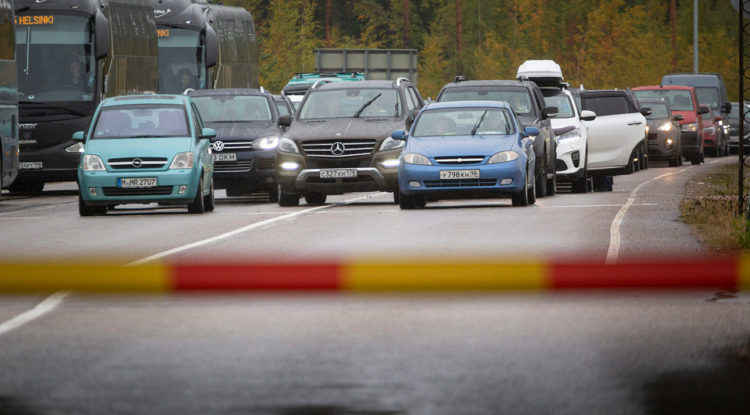
The import of personal belongings is also under threat - this is considered a violation of sanctions. Propagandists use EU actions as “proof” of Russophobia
Customs officers in some European countries began to confiscate cars from Russians under the pretext of enforcing sanctions. The law that guides local authorities has existed for a long time, but they began to use it against Russians only recently. Now they will be able to confiscate not only their cars, but also virtually any personal belongings upon entering the EU. The European Commission has already issued a clarification that the sanctions apply only to Russian cars, but each country continues to interpret the rules in its own way. Stories of victims about police convoys and car confiscations in the night are no longer fictional plots of Russian propaganda, but harsh reality - something that pro-Kremlin media are already happily using. “Cold” tells whether you should be afraid for your belongings when entering the EU.
In order not to miss the main materials of “Cold”, subscribe to our Instagram and telegram .
Dozens of Russians have already fallen under EU restrictions - for example, St. Petersburg resident Irina Belyaeva, who, along with her dogs, was returning to Russia from the Geneva World Dog Show, where her pets won several prizes. On August 29 at 11:30 pm, she was detained by German police on the highway towards the port of Travemünde. On the way to the port, a police car overtook her and indicated to follow him onto a forest road, where several more patrol cars were parked. Belyaeva obeyed and got out of the car. 10 policemen surrounded her.
They examined Belyaeva’s car, asked where she was going, whether she was carrying money, alcohol or drugs, after which they confiscated the car, guided by the law on the embargo on the import of cars from Russia, and left her and four dogs alone on the night highway. Belyaeva claims that the police behaved rudely and did not allow her to approach the agitated dogs and film the inspection.
“I felt like I was in a movie about the fascists: they walked around my car and spoke German, the spaniels inside barked until they were hoarse, and they didn’t let me approach my dogs... They provoked me for an hour and a half, monotonously asking: “Where are you coming from?” - with the same intonation from films about the war, and I understood: if I break down now, they will put handcuffs on me and take me away, and the dogs will be taken to a shelter,” Belyaeva told Komsomolskaya Pravda.
Belyaeva, according to her assurances , was in the EU legally: she flew to Helsinki with transfers in Istanbul, Madrid and Munich, since Finland does not allow Russians with a tourist visa to enter its territory directly. In Helsinki, she was reunited with her dogs: her friend from the Czech Republic brought them from St. Petersburg in Irina’s car. In Helsinki, she got behind the wheel of a car and drove the dogs to Geneva. To do this, they had to travel on three ferries: from Finland to Estonia, from Estonia to Sweden, from Sweden to Germany - and then go to Switzerland, crossing the borders of several more European countries. Kholod tried to contact Irina Belyaeva, but did not receive a response at the time of publication.
Pro-Kremlin publications use such stories as examples of Russophobia towards Russians in Europe. The Komsomolskaya Pravda article about Belyaeva is replete with comparisons of German police officers with the Nazis of World War II, including analogies with the torture of the child of radio operator Kat from the series “17 Moments of Spring.”
Other publications also cite these examples as evidence of Russophobia. This is what Izvestia and RT did, and the speaker of the Russian Ministry of Foreign Affairs, Maria Zakharova , called the arrests of Russian cars in Germany arbitrariness and Russophobia, and the explanation of the European Commission a manifestation of racism .
Seized vehicle fleet
The peak of arrests of Russian cars occurred in mid-summer - it was then that cars with Russian license plates began to be confiscated more often in Germany under the pretext of sanctions. In June, Russian Ivan Koval’s car was seized , which he tried to register in Germany, a Russian teacher’s car was confiscated on the way to France - she was going to visit her daughter living there, and a Belgian citizen’s car with Russian license plates was confiscated when, on the contrary, he was returning to family to Russia.
In all these cases, customs was guided by the EU Council sanctions regulations of 2014 and amendments made to it in 2022 in connection with Russia’s invasion of Ukraine. This document prohibits the import of cars from Russia to the European Union, among other goods that bring “significant income” to Russia. Then the German customs explained that any passenger cars and other vehicles that can accommodate no more than 10 people and are registered in Russia are subject to the embargo, even if they are owned by specific people and are not imported into the EU for sale.
Some Russians manage to appeal such decisions of the German authorities. So, a month and a half after the arrest of Ivan Koval’s car, the Hamburg prosecutor’s office decided to return the car to him. And a lawyer representing the interests of Russians in a similar situation won several courts in Lübeck, forcing the judge to declare the confiscation of cars illegal. However, this has not yet helped return the cars to the owners; the prosecutor has appealed the court’s decision and now the case will be considered in a higher court.
It's not just cars that are under threat of seizure. Thus, residents of Latvia said that on the way from Russia to Latvia in Estonia they were detained by border guards and offered to burn their luggage - mainly suitcases with clothes. They allegedly refused to let them go further with them. Despite the fact that journalists were subsequently unable to confirm the authenticity of this case, Russians may indeed be prohibited from transporting personal belongings to the EU. We are talking about suitcases, cosmetics, laptops, phones, hygiene products, perfume, fur products and women's clothing. In the same clarification, the EC confirmed that Russians are prohibited from entering in private cars registered in Russia, regardless of the purpose of the visit.
Russian gas is possible, but things are not
The practice of confiscation at European borders has caused a stir among Russians living abroad. Many call the EU decision unfair and hypocritical, saying that countries that continue to buy Russian gas should not so harshly infringe on the rights of ordinary Russians and confiscate their personal belongings. European Commission representative Daniel Ferri, however, assured that Russians will not be stripped at the border, and clarified that only personal cars of Russians are subject to strict sanctions followed by confiscation.
“Clothing worn by a person crossing the border is unlikely to be intended to circumvent EU sanctions. I think this is common sense. This is a completely different situation than with an expensive car, and I think this is taken into account when EU member countries apply sanctions,” he said . Despite Ferri's assurances, the Lithuanian customs service warned of the possible confiscation of personal belongings of Russians at the border. Decisions on the seizure of items will be made on the spot depending on what and in what quantity the Russian citizen is carrying with him, according to a commentary from the Customs Department of the Ministry of Finance of Lithuania.
The European Commission decided that the authorities of each EU member state are free to decide for themselves how to apply sanctions. Therefore, the regulations for the import of personal belongings and cars from Russia to the EU vary from country to country, and EU members do not have a uniform position on this matter. Lithuania, Latvia and Estonia have closed entry to all cars with Russian license plates, with exceptions for diplomats.
Estonia explained that they prohibit the entry of Russian passenger cars with a capacity of up to nine passengers, but buses, motorcycles and cars of diplomatic missions with Russian license plates will be able to freely enter the country. The import ban has already begun to take effect - the first cars have already begun to be deployed on the border with Russia.
Lithuania stated that the restrictions will not affect those cars traveling through Lithuania to Kaliningrad. Finland, on the contrary, has so far refused to follow the recommendations of the European Commission and has not introduced a ban on the entry of cars with Russian license plates into its territory. The representative of the Finnish Foreign Ministry, Pia Sarivaara, in particular, stated that the headlines with the words that Russian cars entering Finland will be confiscated are not true. And Germany stated that it would strictly follow the letter of the law, and did not rule out the possibility of confiscation of personal belongings from Russians entering its territory.
Poll Help “Kholod” become better. Complete the survey for 7-10 minutes.