
Translated material
"Take measures so that the corpses do not fall into unwanted hands"
105 years ago, the Bolsheviks announced the "Red Terror"
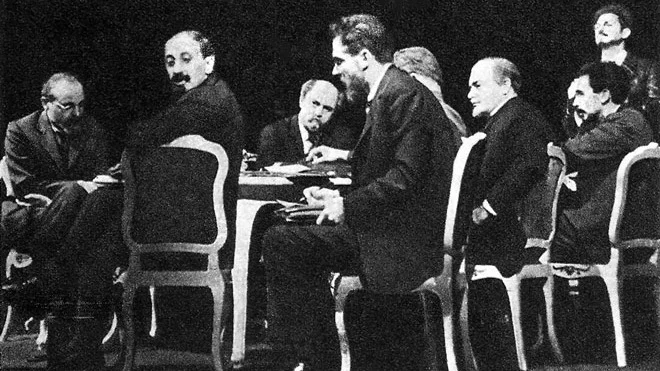
The scene from the play based on the play by Mikhail Shatrov “The Bolsheviks”. Photo: Maskball.ru
On the 50th anniversary of Soviet power, Oleg Efremov set the famous play by Mikhail Shatrov “Bolsheviks” in the Moscow “Contemporary”. All its action takes place in the apartment of Lenin, where a meeting of the Council of People's Commissars was held on August 30, 1918, which made a decision on the Red Terror. In the next room lies Vladimir Ilyich himself, wounded by a terrorist after a rally at the Mikhelson factory.
The then reviewer writes: “On the stage, not fictional heroes and, moreover, not our contemporaries, but historical persons, people who stood at the origins of the Soviet state, who gave the people the mind, will, talent, life. And here it is important not just the sincerity of the actors, through their living feeling of refracting the characters of the depicted people, but first of all - the ability of the theater to show the sincerity of the civilian and human feelings of each of the heroes of the performance ... The point of contact of the past and the present, state and personal, found in the restrained and excited tone of the narrative, gives rise to a tender sense of involvement of what is happening ... and the most important thing is revealed in the most important thing. These people: they voluntarily took on a huge burden of responsibility for the work of the revolution and retained the sincerity of living human feelings in a heavy and long struggle ... ”Already knowing where this would lead, the talents and Efremov talentedly supported the voters. The Moscow Contemporary Hall gets up and the International sings with the artists. We voted for the "red terror" unanimously.
When did it start?
In September 18? How is the reaction to the killing of small party functionaries Volodarsky and Uritsky in Petrograd? How is the response to the injury of Lenin?
And the execution by the Bolsheviks of the demonstration in defense of the Constituent Assembly on January 5 - what is this? And the brutal murder in the hospital of cadet ministers of the Provisional Government Kokoshkin and Shingarev? And the Bessed executions throughout the country?
In December 1917, 62 officers were executed in Sevastopol on the verdict of the military revolutionary tribunal on the Malakhov Kurgan (executions were carried out on the recommendations of ship teams). In the next few days, officers were killed without trial on the streets and in private apartments, using targeted books and telephone reference books for search. In December, 8 land and 120 naval officers were killed. The massacre was initiated by the Sevastopol Military Revolutionary Committee.
On January 14, 1918, a group of workers was shot at the Tula station, protesting against the murder of two railway workers by Bolshevik Kozharin.
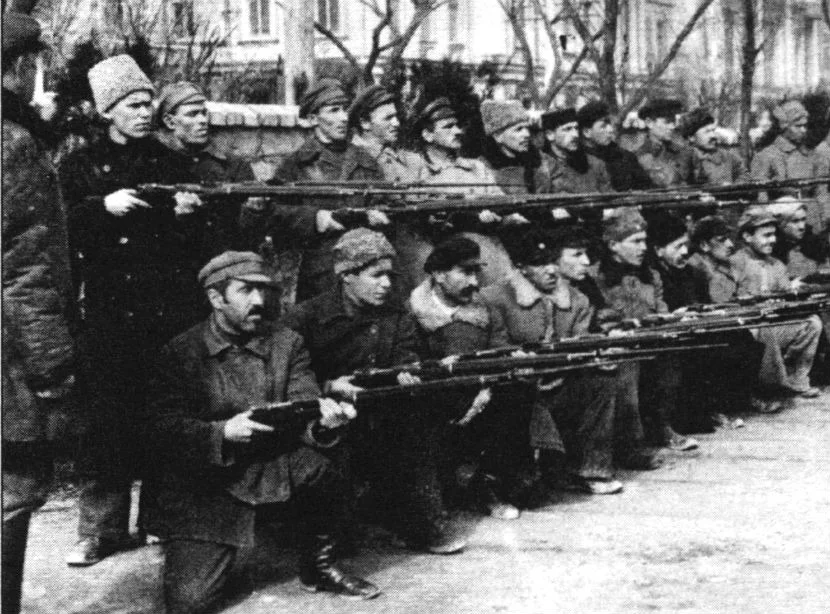
After the capture of Kyiv by the Bolshevik troops at the end of January 1918, the Bolsheviks killed in the city, according to various estimates, from two to five thousand officers, generals, civilians of Kyiv.
The largest punitive action was the execution in Petrograd 512 representatives of the elite (former dignitaries, ministers, professors). According to official data from the Cheka, in a total of 800 people in Petrograd during the “red terror” were shot.
Already in September of the 18th Central Committee of the RCP (b) and the Cheka, the following content is being developed: the following content:
“To shoot all counter -revolutionaries. Give the areas the right to shoot on their own ... take hostages ... to arrange small concentration camps in the areas ... Tonight at night, the Presidium of the VChK Consider the cases of counter -revolution and all obvious counter -revolutionaries to shoot. The same is the district Cheka. Take measures so that the corpses do not fall into unwanted hands. ”
In August 1919, in the materials of the Special Investigative Commission for the investigation of the villainous Bolsheviks organized by Denikin, the so -called "human Baen" of the provincial and district Cheka in Kyiv was reported. These facts are scattered in the memoirs of people who survived terror in Kyiv (spring-summer 1919):
“The entire floor of a large garage was flooded with a blood that had already stood on several inches, mixed in a terrifying mass with the brain, cranial bones, shreds of hair and other human residues. The walls were sprayed with blood, on them, next to thousands of holes from the bullets of the brain particles and pieces of head skin, a groove of a quarter meter of width and depth and about 10 meters of length was filled with blood throughout the entire length. Next to this place of horrors in the garden of the same house lay hastily the superficially buried 127 corpses of the last massacre ... All corpses were smeared with skulls, many have even completely flattened heads. Some were completely without a head, but their heads did not chop off, but ... fell off. We came across in the corner of the garden to another older grave, in which there were approximately 80 corpses ... There were corpses with broken bellies, others had no members, some were completely chopped off. Some had their eyes ... Heads, faces, necks and trunk were covered with stab wounds. Several did not have languages. There were old people, men, women and children. One woman was connected by a rope with her daughter, an eight girl. Both had gunshot wounds. "
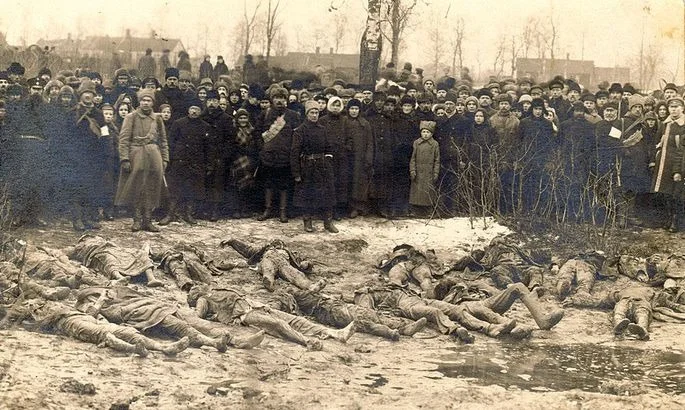
Information about the use of torture during interrogations penetrates the revolutionary press. In particular, the Izvestia newspaper dated January 26, 1919 No. 18 publishes the article “Is it really a medieval hinder?” With a letter of the random affected member of the RCP (b), which was tortured by the Investigative Commission of the Susvo-Mariinsky District in Moscow:
“I was arrested by accident, just in the place where fake cores were fabricated. Before the interrogation, I sat for 10 days and experienced something impossible. Here people were beaten until losing consciousness, and then they carried it without feelings right into the cellar or refrigerator, where they continued to beat with a break of 18 hours a day. It influenced me so much that I almost lost my mind. ”
Official Soviet print media in the fall of 1918 openly publish information about thousands of arrests produced, hundreds of executions and measures to reconcile and prevent counter -revolution.
"Izvestia of the Penza Gubchek":
“For the murder of Comrade Egorov, the Petrograd worker sent as part of a landfill, 152 White Guards were shot. Other, even more severe measures will be taken against those who dare to encroach on the iron hand of the proletariat in the future. ”
On October 6, 1918, the “Bulletin of the Cheka”, the article “Why are you almonds?”. The author is the chairman of the Nolinsky Cheka:
“Tell me - why didn’t you subject the Loccarta (diplomatic representative of Great Britain) the most sophisticated torture to get information, addresses that such a goose should have a lot? Tell me, why are you instead of subjecting it to such torture, from one description of which the cold of horror would cover counter -revolutionaries, tell me, why did he allow him to leave Ch.K.? Pretty almond! A dangerous scoundrel is caught. To extract from it everything that is possible and send to the next world. ”
All the most dark, dense, evil, which in any people try not to release white - all this spilled out, spread into the offices (from the Central Committee to the county "Extraordinary"), provided itself with mandates and with nothing comparable powers. They are not “historical faces”, who voluntarily took on the “huge burden of responsibility for the work of the revolution and retained the sincerity of living human feelings in a difficult and long struggle.” Their only task is to keep the power accidentally falling into their hands. Or, as Trotsky said, "leaving, we will slap the door so much that the whole world will shudder."
Today, it is extremely clear to anyone whom the past years managed to luggage with conversations about the “good of the people” and the “dictatorship of the proletariat”. It is enough to see who and how he lived - in the “Government’s houses” and the workers' barracks, who ate how he ate, who was treated and rested.
They seized power - for themselves and sharing it with anyone were not going to. The fundamental principle: ruthless disrespect, contempt for (everyone, any!) To a person. The absence of any moral brakes.
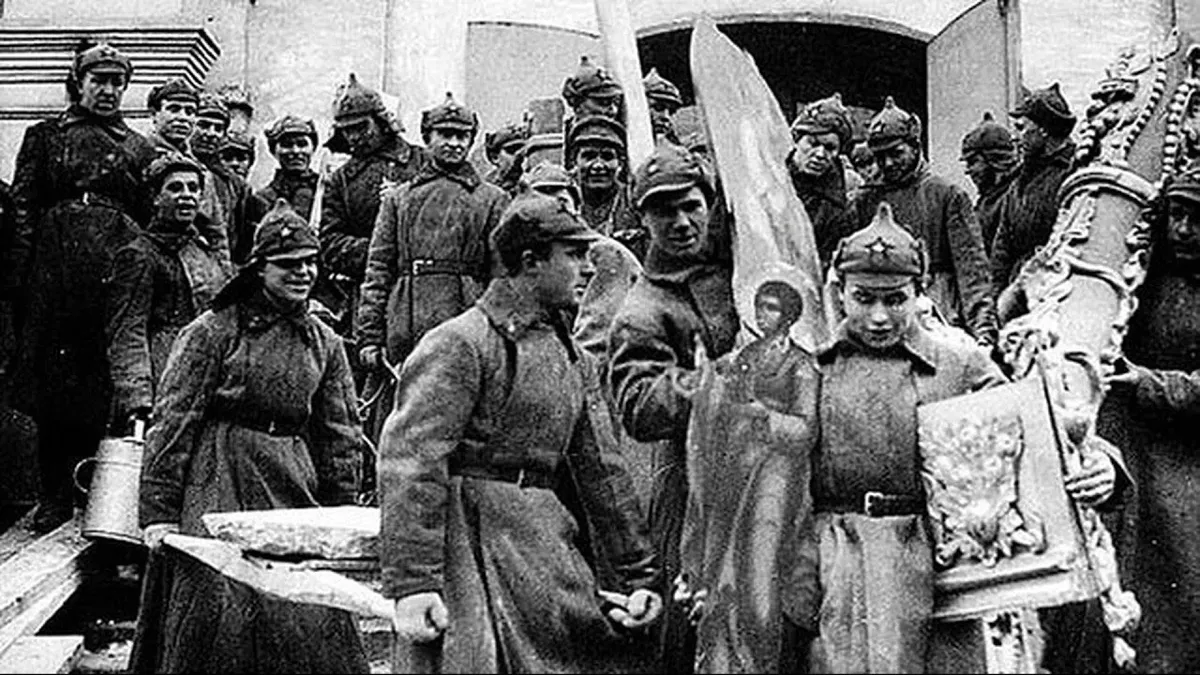
Shots in the leader
Closure on the morning of August 30, 1918, the Petrograd Viceroy Zinoviev, a sweaty palm grabs a telephone pipe to urgently connect with the Kremlin cabinet of Lenin: Killed Uritsky, chief of the Petrograd Cheka!
In the afternoon, Zinoviev gathers the asset of the Petrograd party committee and proposes to authorize, according to Leninist instructions, the reprisal of workers over the intelligentsia by improvised means and right on the street.
Zinoviev only give free rein ...
Later, the irritated Lenin will fall out with outsiders with a careless phrase: "That Grishka is a fool is known to many, moreover, he is a scoundrel and a coward." By the way, one of the most influential people of that time is a member of the Politburo, the omnipotent dictator of the Northern Commune.
On the same day, the younger sister of the leader of the world proletariat, Maria Ulyanova, excited by the Petrograd incident, invites Bukharin to dinner in order to jointly dissuade his brother from evening performances at rallies.
But the adamant leader, having completed a hasty meal, puts on a coat and retires for about 17 hours, forbidding a cold to his sister to follow him.
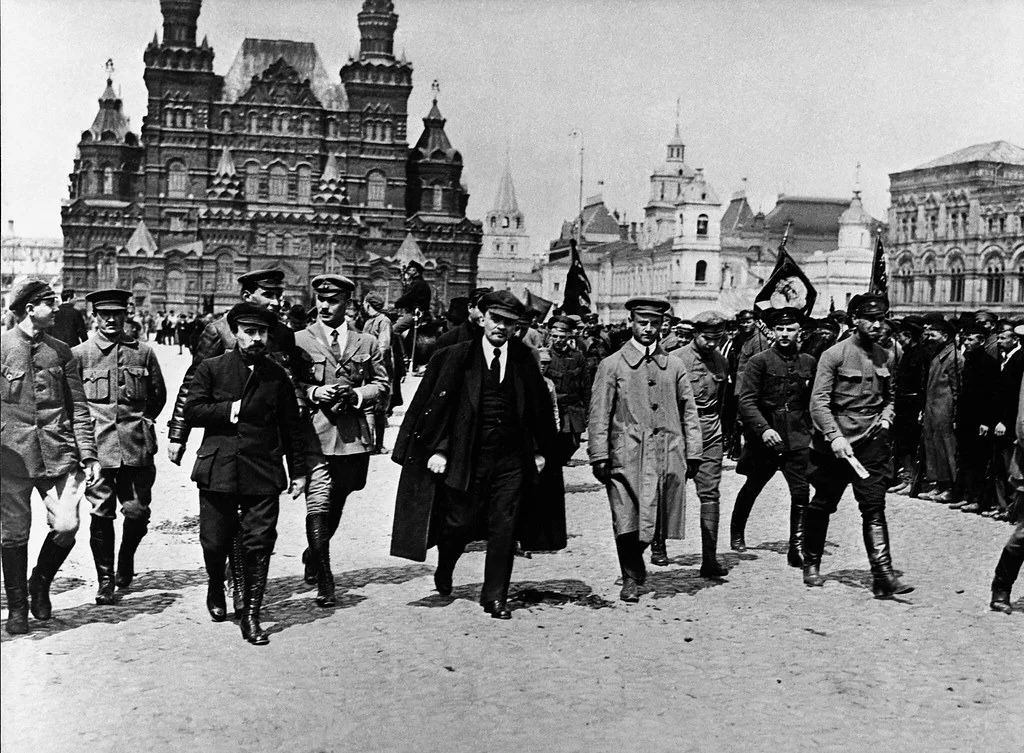
My senior comrade, doctor Viktor Topolyansky, wrote an amazing book filled with unknown archival documents and does not leave stone on a stone from the entire canonical version of the assassination attempt on Lenin, its participants and inspirers. The book is called the “Understall of the Entertainment”, it was published in 2021 with a circulation of as many as 600 copies. The questions that the author ask should have been posed 105 years ago.
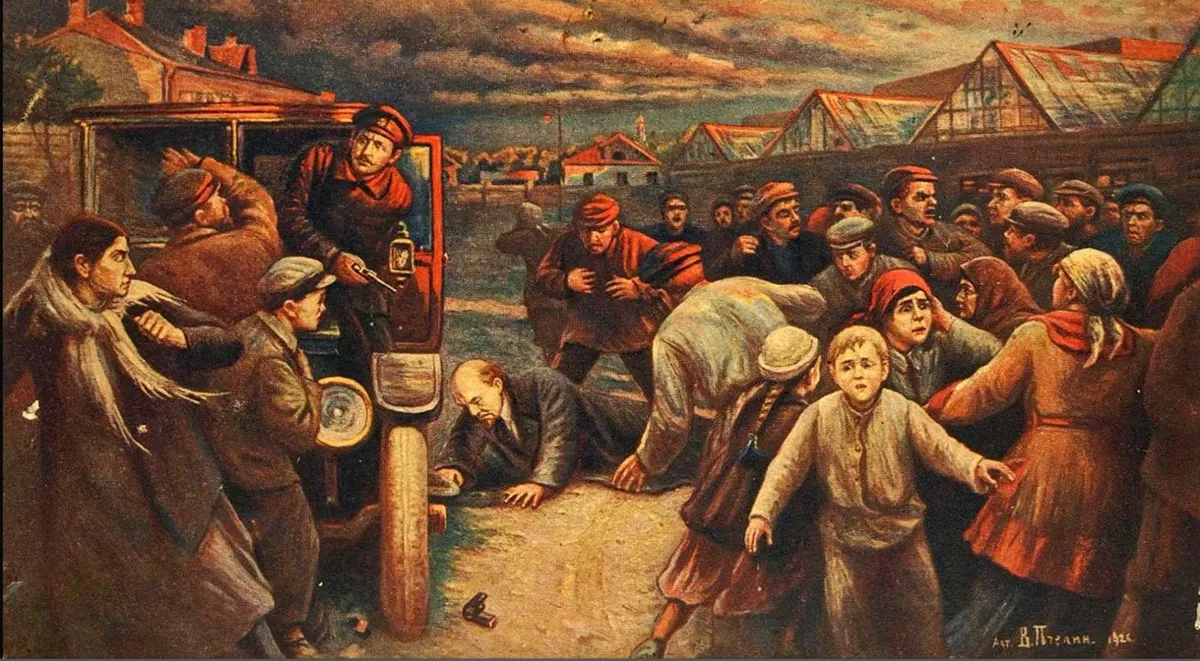
... It was already starting to get dark, the rally ends. Throwing a coat over his shoulders, the leader rushes to the bored limousine. A middle -aged blonde does not lag behind him. People hear how she complains to the leader: 20 pounds of flour were taken from her niece, despite the permission to transport. Seeing Lenin in the yard, the driver starts the motor. An incomprehensible blonde, having stubbornly, stubbornly holds around the leader. Suddenly a shot is heard from the crowd. The blonde shouts piercingly that her hand was taken away, and settles to the ground. Among the general confusion and bustle, there are still shots ...
A little recollected on the street, the proletarians grab a wounded and some other woman who is considered a terrorist. They spit in her face, not allowing her hands to close: "I knew how to shoot - know how to look people in the eyes."
Brought to the Kremlin, Lenin himself rises to the third floor ...
They call doctors: the People's Commissar of Social Universal Vinokurov, as well as a Weisboard, Mints, butt and Semashko. They state two blind gunshot wounds. Both wounds do not bleed. No one risks something to do primarily because of the lack of the necessary experience. “God forbid from the doctors of the comrades in general, the Bolshevik doctors in particular. It is necessary only for first-class celebrities to be treated (except for petty cases)-as Vladimir Ilyich once wrote in a letter to Gorky. “The Germans and only they will cure correctly, reliably and faster than all others.”
There were no Germans at hand.
Obukh, the head of Moscow medicine, who is better than others familiar with the medical world of the capital, invites the senior doctor of the soldier's hospital surgeon Rozanov and the hereditary nobleman, the senior doctor of the old -line hospital Mamonov.
Mamonov: “Everything here is extremely mysterious and incomprehensible. The wound is certainly fatal. Only the noted by fate can avoid death after such a injury. ” Rozanov agrees with him.
This is just a template reception that helps to increase the medical fee, Dr. Topolyansky believes, and I have to believe him ...
In the morning, the well -being of the leader improves so much that fresh newspapers are served for breakfast. In a fit of emotion, a raasted Bukharin is in a hurry to scrap a note on this subject, like a twice shot leader, neglecting a mortal danger, a healthy hand unfolds the Soviet press to find out whether the car was stalled in the locomotive, which carries us to the World Cups. "
On the second day (!) After the injury, September 1, the leader’s clinical state is evaluated as satisfactory, which in itself testifies to any significant blood loss.
On the same day, the full -time resident of the old -line hospital Budinov makes an X -ray and establishes the presence of one bullet (from the lower part of which two small fragments were separated) in the left of the left shoulder girdle, and the second in the soft tissues of the right half of the neck. The fragmented fracture of the left shoulder bone, a breakdown (crack) of the inner segment of the left scapular bone and “moderate hemotorax” are determined. The top of the left lung is not damaged.
Already on September 7, the press reports: "Comrade Lenin began to work again!"
The encrypram of Trotsky September 10: “It is surprised and alarmed by the slowdown in the operation against Kazan, especially if it is true that you have the full opportunity to destroy the enemy. In my opinion, you can’t regret the city and put off longer, because a merciless extermination is necessary. ”
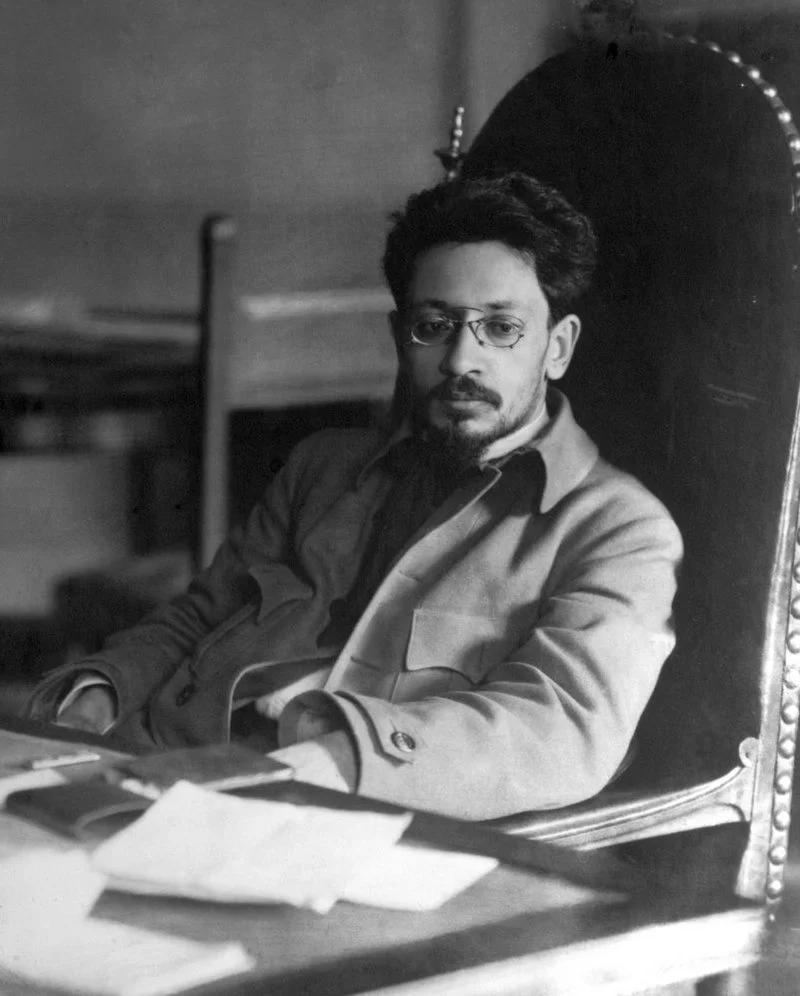
Provided by Sverdlov (even before the first examination by doctors!) The “mortal wound” of the leader of the revolution is not confirmed. The version that the bullets were poisoned by the "poison of Kurare" can be attributed to the expense of ignorance this version of the proclaimed.
"The authorities will figure it out!"
The investigation in the case of attempt on Lenin was entrusted with a graduated lawyer, a member of the All -Russian Central Executive Committee, Viktor Kingiseppu.
Several examples of the absurdities that he encountered during the investigation.
It is necessary to find the weapon itself from which they shot, and the weapon was gone. As a result, the Chekists are forced to send an announcement printed on September 1 to the press: “From the Cheka. An extraordinary commission did not find a revolver from which shots were fired in comrade Lenin. The commission asks persons who know anything about finding a revolver, immediately inform the commission. ”
The next day, September 2, one of the workers attended at the rally brings Browning to Lubyanka, selected, according to his assurances, at the scene. An unexpected souvenir was not sent to a fingerprint examination. From now on, it is simply believed that this browning, of course, belonged to an extremist.
Kingisepp states in the protocol: “Comrade. Kuznetsov provided Browning No. 150489 and a clip with four cartridges in it. ”
Now it is necessary to find out in whose name this browning is registered; And interrogate its owner. Methodical Kingiseppu only needs to send the corresponding request to each of the so -called law enforcement agencies endowed with the right to issue weapons, and carefully attach to the criminal case all the certificates received in response. But a copy of only one document floats out of the past:
“In response to your request by the telephone message of September 2, we bring the present to your attention that the certificate for No. 233 for wearing and storage of browning No. 150389 was issued by us on August 31 S.G. Comrade Tibor Samueli, according to the relationship of the Hungarian group of communists No. 370.
As for the permission to carry and storage of browning No. 150489, we do not have information about such.
Secretary of the All -Russian Central Executive Committee. "
By directing his (in all likelihood, the only) request to the superiors of the supreme closed weapon distributor for individuals, Kingisepp suggests that Browning could fall into the hands of a terrorist from the warehouses, one way or another, controlled by the All -Russian Central Executive Committee (!). The proximity of the numbers of registered and unaccounted brownings gives only additional grounds for such suspicion.
It can be assumed that due to some unknown circumstances, Samuel did not receive the aforementioned browning on August 31. But in this case, the Secretary of the All -Russian Central Executive Committee misleads the investigator for particularly important matters.
Meanwhile, the wounded random interlocutor of Lenin is first accompanied by a dressing in the Pavlovsk hospital, where she serves as castales, then to the Zamoskvoretsky military registration and enlistment office and from there to Lubyanka. In the morning they put her husband in prison, two daughters and a young nephew. However, the head of the counter -revolution and member of the collegium of the Cheka Skrypnik does not stand here: "Keep children for the fact that the mother was injured is a little sorry."
The newspapers of Retivo are preparing the population for the execution of the unreasonable casteleshi. She is called an accomplice or accomplice of a terrorist. But Kingisepp intervenes in her criminal case. At the end of the investigative experiment, he returns to the Lubyanka, interrogates the wounded and on the same day, September 2, draws up an official conclusion, in which he recognizes it only by the person who suffered during the attempt, and offers to place it in the hospital at the expense of the state. In the end (in the first decade of October!), The Zamoskvoretskaya bourgeois, wounded in the attempt on the leader, is released by the will, terminating the case “for lack of evidence”.
And finally, the arrest of Fanny Kaplan herself.
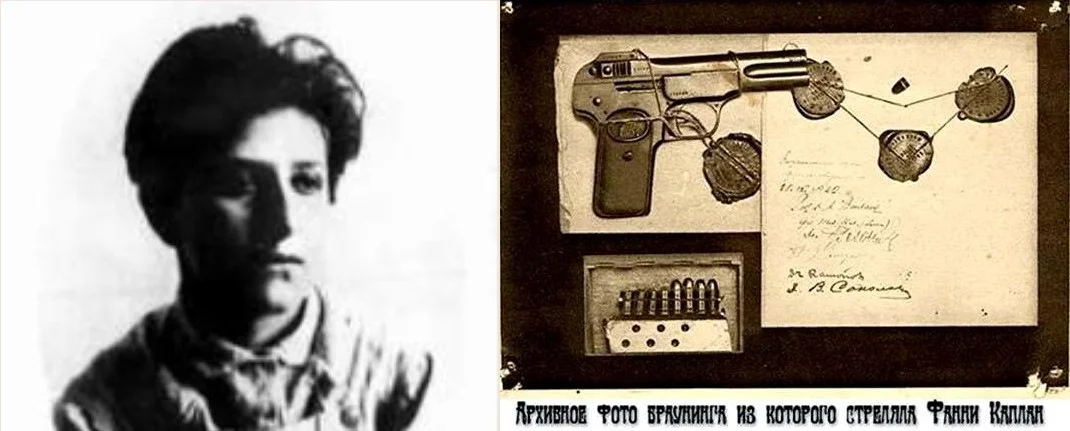
The investigation is forced to be content with the testimony of the assistant to the military commissar of the 5th Moscow Infantry Division of Batulin. Having shown miracles of determination and resourcefulness, he then leaves two versions of his testimony for the story. He voices the first on August 30 to the chairman of the Moscow revolutionary tribunal Dyakonov.
“At the time of the public release, I was 10 or 15 steps from Comrade. Lenin, ”Batulin reported. After the shots, he saw a leader in front of him, spread out on the ground, and turning around - a woman, "who behaved strangely." To his question why she is here and who she is, the woman impulsively blurted out: "It was not me who did it." Such a replica simply forced the brave assistant to the military commissar to detain her. Then the crowd surrounded them screamed that it was she who shot. Тогда загадочная незнакомка вдруг согласилась с разгневанной толпой, под конвоем красноармейцев была доставлена в Замоскворецкий военкомат и там призналась в злодеянии.
Вскоре Батулин предлагает чекистам исправленный и дополненный вариант. Отправленное 5 сентября с Ходынского поля, его послание блуждает в лабиринтах не то почтового ведомства, не то лубянской канцелярии почти три недели (!), вызывая ироническое удивление невозмутимого Кингисеппа: «Документ примечателен по своему 19-дневному странствию».
Неизвестно, попало бы вообще это свидетельство в руки следователя 24 сентября, если бы помощник военного комиссара не адресовал точно такую же эпистолу еще и прямо в Кремль. Желтоватый лист бумаги с напечатанным на нем текстом и отчетливой подписью Батулина зарегистрирован среди входящих документов в Управлении делами Совнаркома 20 сентября.
Человека, стрелявшего в Ленина, Батулин, оказывается, все-таки не видел, но общей панике не поддался и рванул на Большую Серпуховскую улицу, «по которой одиночным порядком и группами бежали в разном направлении перепуганные выстрелами и общей сумятицей люди». Домчался до так называемой стрелки, где остановился, огляделся и выследил позади себя стоящую под деревом женщину с портфелем и зонтиком в руках. Спросил для начала, «зачем она сюда попала?». Услышав в ответ, «а зачем вам это нужно?», Батулин окончательно удостоверился в правильности своего выбора.
Поскольку «она имела вид человека, спасающегося от преследования, запуганного и затравленного», он бесцеремонно обыскал ее карманы и в сопровождении вооруженных товарищей отвел в Замоскворецкий военкомат, где она во всем и созналась.
Трудно решить, какой рассказ Батулина ближе к действительности. Во всяком случае, стрелявшая не могла находиться за его спиной на заводском дворе — это не соответствует всей уже установленной картине покушения. Батулин исправляет этот свой промах, но тут же допускает еще один: мало того что она просто торчит под деревом, так еще держит в руках портфель и зонтик, неуместные при стрельбе.
Но следствие нисколько не сомневается ни в чистоте помыслов, ни в искренности помощника военного комиссара и даже не вызывает его на вторичный допрос для уточнения показаний.
В партийной анкете Батулина указано, однако, что с апреля 1918 года на протяжении пяти месяцев он посещает Социалистическую академию, числясь одновременно старшим инструктором Наркомата юстиции, и в августе (!) отбывает на Западный фронт. Пребывание в должности помощника военного комиссара 5-й Московской пехотной дивизии не отмечено в его послужном списке вовсе.
Четыре года Батулин на фронте, закончил Гражданскую войну членом Реввоенсовета отдельной группы войск, награжден…
Но человек, поймавший, можно сказать, феноменальную злодейку, как бы предает забвению этот эпизод и — вопреки, казалось бы, собственным интересам — напрочь выпадает из официальной ленинианы, не оставив ей ни своей армейской фотографии, ни хотя бы складной биографии.
Moreover. Советская пропаганда пытается заменить Батулина председателем заводского комитета Ивановым. Летом 1922 года, выступая во время показательного процесса по делу социалистов-революционеров, Иванов лжет с неподдельным воодушевлением: именно он схватил злоумышленницу, именно он оградил ее от гнева трудящихся, за что схлопотал «от этих же беспартийных товарищей две оплеухи», именно ему преступница заявила, что стреляла в Ленина «по предложению социалистов-революционеров» и теперь, «исполнив свой долг с доблестью», готова к смерти. Портрет колоритного рабочего с пышными усами и рельефными мышцами тиражирует центральная пресса: товарищ Иванов, который первым настиг злоумышленницу и уберег ее от самосуда толпы.
По показаниям, зафиксированным в протоколе допроса, секретной сотрудницы ВЧК Зинаиды Легонькой, проводившей первый обыск задержанной террористки, из ее портфеля были изъяты не только папиросы, записная книжка с вырванными страницами и всякая мелочь, но и… браунинг. Этот пистолет не посылают на дактилоскопическую экспертизу; его не предъявляют задержанной на допросах; он больше не упоминается в ходе следствия, а просто пропадает бесследно, как заяц под шляпой фокусника.
Чем объясняется исчезновение браунинга? Может быть, банальной халатностью?
Ведь еще в ноябре 1918 года Всероссийский съезд председателей революционных трибуналов вынужден констатировать: «Производство дел велось ЧК крайне небрежно, передаваемые в трибуналы дела приходили неподшитыми, без описи документов, с утерей их, без подписей на протоколах допрашиваемых и производящих допрос и прочее». Но может быть, кто-то умышленно изымает пистолет из следственных материалов? Почему показания Легонькой никак не комментируются чекистами? Сама же она рассматривает в дальнейшем тот исторический обыск как одну из главных своих заслуг перед партией, чуть ли не героическое деяние, дающее ей право претендовать на получение персональной пенсии республиканского значения.
Who benefits?
Сразу после ранения Ленина Свердлов возлагает на себя еще и функции председателя Совнаркома, становится фактически единоличным властителем в стране и даже сразу занимает ленинский кабинет, читает его почту — в том числе и личную (что крайне раздражало самого Ленина). В его действиях и распоряжениях нет растерянности; наоборот, он производит впечатление человека еще более твердого, решительного и собранного, чем прежде.
Через 10 минут после первого врачебного осмотра раненого вождя и почти за час до начала первого допроса арестованной Свердлов подписывает правительственное заявление, содержащее безоговорочные формулировки. Он возлагает ответственность за преступление на правых эсеров — «наймитов англичан и французов», а в качестве единственной программы действий выбирает беспощадный массовый террор.
Арестованная тем временем выдает Петерсу обрывки долгожданных сведений:
«В Акатуе я сидела вместе со Спиридоновой. В тюрьме мои взгляды оформились, я сделалась из анархистки социалисткой-революционеркой… Я стояла за Учредительное собрание и сейчас стою за это. По течению эсеровской партии я больше примыкала к Чернову».
И пусть Каплан ни в какую партию не входит, пусть Мария Спиридонова принадлежит левым эсерам, но раз Свердлов заказал правых, то и Петерс уведомляет прессу: злоумышленница, стрелявшая в Ленина, состоит членом партии правых социалистов-революционеров черновской группы.
Вслед за тем зампредседателя ВЧК Яков Петерс срочно переводит арестованную Каплан непосредственно в Кремль, где его комендант П. Мальков (по телефонному звонку — то ли самого Петерса, то ли секретаря ВЦИК Аванесова) уже 3 сентября ее расстреливает, тело (по распоряжению Свердлова) сжигает, а прах хоронит в Александровском саду. Так он напишет об этом в своих мемуарах.
Но закрывать уголовное дело упрямый Кингисепп не собирается. Усердный, рассудительный и неподкупный сыщик постепенно становится для кого-то опасным. 15 ноября Кингисеппа высылают в Петроград, навсегда разлучив с женой. По решению Президиума ВЦИК, его мобилизуют в эстонское коммунистическое подполье, ее — на фронт.
Три с половиной года, скрываясь от полиции, Кингисепп руководил Коммунистической партией Эстонии, но был в конце концов арестован. Обменять Кингисеппа на задержанных в России эстонцев ОГПУ отказалось. 3 мая 1922 года Кингисепп был расстрелян.
Через неделю Оргбюро ЦК ВКП(б) выносит постановление о переименовании Ямбурга в город Кингисепп.
***
What next?
Яков Свердлов через полгода умирает при достаточно загадочных обстоятельствах.
Яков Петерс, «человек Свердлова», зампредседателя ВЧК, расстрелян в 1938 году.
Авраам Аванесов, секретарь ВЦИК, умер в 1930-м.
В конце 1919 года созданная приказом генерала Деникина Особая следственная комиссия по расследованию злодеяний большевиков определила количество погибших от проводимой советской властью государственной политики террора в 1 766 188 человек только в период 1918‒1919 годов, включая 260 000 солдат и 54 650 офицеров, около полутора тысяч священников, 815 тысяч крестьян, 193 тысячи рабочих, 59 тысяч полицейских, 13 тысяч помещиков и более 370 тысяч представителей интеллигенции и буржуазии.
Через полтора десятка лет, 1 декабря 1934 года секретарь ЦК ВКП(б) Лазарь Каганович на собрании, посвященном десятилетию Института красной профессуры,сказал: «В особенности нужно по-большевистски, по-ленински подойти к истории вчерашнего дня и подойти так, чтобы историю этого вчерашнего дня увязать с генеральной линией партии, с теми грандиозными новыми задачами, которые стоят перед нами сегодня и которые будут еще стоять завтра».
С этим нас убеждают согласиться и сегодня.