
Translated material
Mobilization is not ready - Layout
Mobilization not ready
Russian authorities do not want to start a new wave of mobilization before the presidential elections
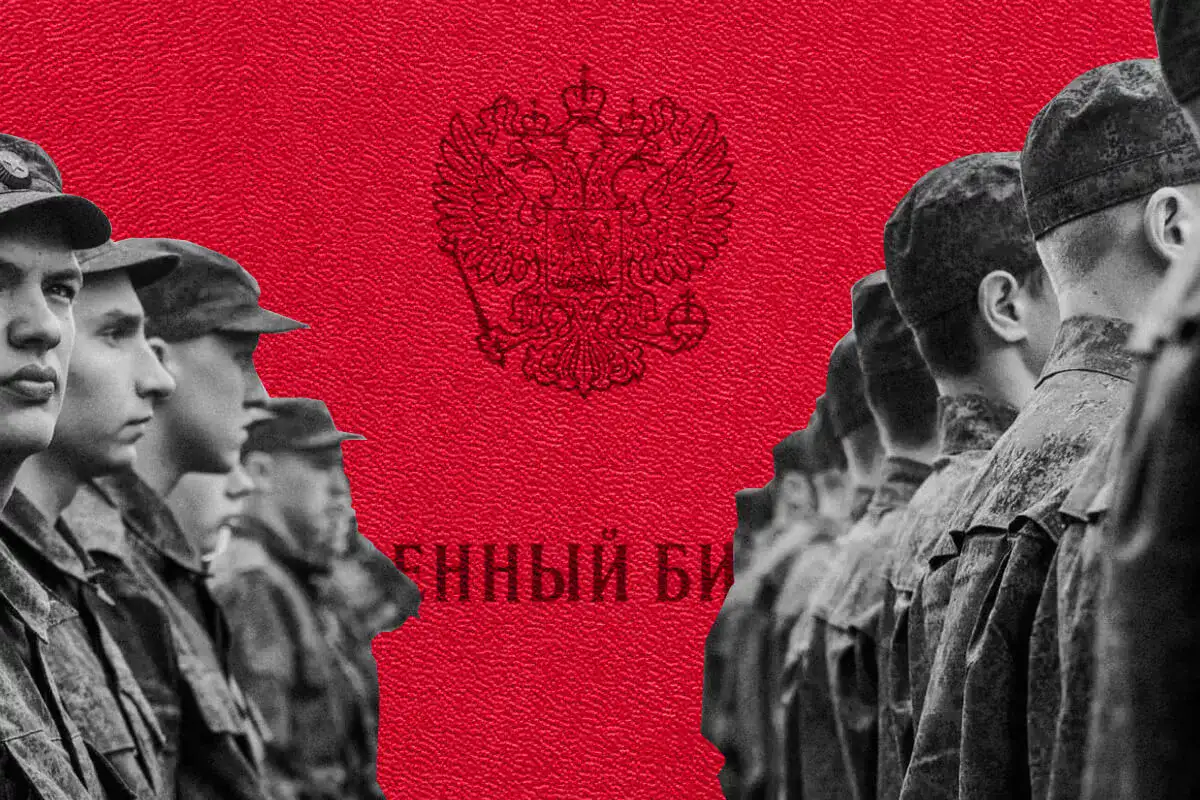
Vorstka’s sources in the military registration and enlistment offices, federal and regional authorities claim that preparations for a new wave of mobilization are not currently underway. The authorities will try to delay it until after the presidential elections, if it is needed at all. “Layout” has collected signs indicating that they are not preparing for mobilization. At the same time, it cannot be completely ruled out: everything will depend on the development of the situation at the front.
In order not to miss new texts from “Layout”, subscribe to our telegram channel
Shortly before the start of the autumn conscription, rumors about an imminent new wave of mobilization began to actively spread in Russia. A scan of Shoigu’s alleged order to recruit 200 thousand reservists appeared on social networks (Russian media called it a fake). In addition, in different regions there are more and more requests from relatives of those mobilized with the demand to rotate those called up last fall. In October, most of those who were mobilized and survived will have been at the front for a year.
The head of the State Duma Defense Committee, General Andrei Kartapolov, has already denied the possibility of such a rotation. According to him, those mobilized “will return home after the completion of a special military operation”; their rotation is not provided for. However, earlier Kartapolov repeatedly refuted his own statements (for example, before the announcement of partial mobilization, he excluded the possibility of its implementation).
Public calls from the families of those mobilized to “bring the boys home” worry the authorities, one of the parliamentarians, a former high-ranking military man, admitted in a conversation with Vestka. The question is whether there is a need for a new wave of mobilization and whether the authorities are ready to carry it out, he added.
Signs of unpreparedness
Right now, preparations for a new wave are not being carried out, Vorstka’s interlocutors in regional administrations and four military registration and enlistment offices said.
“Everything is as usual with us - we are preparing for the autumn conscription. Yes, people constantly come to us to clarify data, including to extend reservations, but this is all planned work,” said one of the interlocutors at the Moscow military registration and enlistment office. — We are extending reservations, gradually adding documents to the database. We haven’t heard about any preparations for mobilization.” At the same time, according to the source, if the order to start a new wave “is issued,” the process can begin within 24 hours .
However, not all military registration and enlistment offices are ready for such a drastic announcement of a new wave. Some commissariats still cannot cope with the transition to electronic document management, a representative of the Moscow City Hall, responsible for interaction between the authorities and military registration and enlistment offices, told Vorstka. “They need to stop shuffling pieces of paper around and enter these pieces of paper into the databases,” he explained. “Nobody understands when the level of this automation will come to be checked, so many military commissars are ‘sitting on the fence’: what if this happens during the draft, and this is already a busy time.” Because of this confusion, there is a fear that the commissariats may have problems with the autumn conscription : “They are not ready for it, because it is not clear how to work with documents - through computers or the old fashioned way.”
Previously, “Verstka” wrote about the problems of digitalization of military registration and enlistment offices and the creation of databases of summonses and persons liable for military service throughout Russia. By the beginning of the autumn conscription the situation had not changed. “We brought the computers to the regional military registration and enlistment office, we come back two weeks later, and they are in boxes where they were placed,” says an official in one of the Russian regions. “Are you crazy?” we ask. “We don’t know how to connect.” We send a system administrator, he returns the next day. He said they didn’t let me into the offices. They are supposedly secret. They let the system administrator in, but first it’s lunch, then the working day is over. In short, the computers were installed for two months.”
An employee of another military registration and enlistment office, when asked by Vorstka about the possibility of a new wave, replied: “There is nothing like that.” “Conscription work, that’s all. We are not planning a new mobilization,” he emphasized. His words were confirmed by a doctor working at the medical commission of the military registration and enlistment office in one of the regional centers.
A source for “Vestka” in the administration of one of the regions bordering Ukraine said that “nothing is moving except for the usual rumors” about the mobilization. “In the spring, an electronic system for distributing summons should be operational, and it is being done, first of all, for use in the spring draft. We are now mainly busy explaining to military registration and enlistment offices: computers are not the creation of the devil ,” he said. The information that there is “no emergency preparation” for imminent mobilization was confirmed by Vorstka’s sources in two more regional administrations.
“Mobilization can greatly frighten voters”
Recently, government officials have begun to actively deny the very possibility of a new wave. According to Meduza, the presidential administration recommended that propagandists and pro-government media not touch on this topic at all and not even quote refutations.
At the WEF plenary session, President Vladimir Putin answered the question about a new wave of mobilization. He explained that in Russia every day 1000–1500 people come to sign a contract, over the past six months the number of contract workers has reached 270 thousand people. However, he did not directly deny the possibility of a new mobilization.
Deputy Kartapolov said that there is no need for a new set of mobilized people. “Today we are actively recruiting for a contract. And all tasks are performed within the framework of this set,” he asserted. This time the general is telling the truth, several of Vorstka’s interlocutors believe.
Although the key opinion on this issue remains with the Ministry of Defense, in connection with the upcoming presidential elections, the opinion of civilians will also be taken into account. Elections are becoming a key task for the authorities, along with attempts to achieve success at the front , a source in one of the chambers of the Russian parliament told Vorstka. “The military is under a lot of pressure with this,” he is sure. “The people need good news, so now the news about the NWO must be either good or not at all.” Additional mobilization can greatly frighten voters; the system of power was having a hard time with the mass exodus of Russians and the fall in the government’s ratings a year ago, the source claims. “In March [after the elections] it’s a different matter, I wouldn’t vouch for anything there,” he added.
The situation at the front is now “stagnant”, “wear and tear” for both the Russian and Ukrainian military, says a source close to the presidential administration. At the same time, the Russian army has a greater “margin of safety”, so there is no urgent need for additional mobilization . “If they don’t give a fuck, they won’t recruit,” he is convinced. He describes the mood in the Kremlin and other government bodies as follows: “Please, let it be restored.” According to the official, a break - psychological and actual - is needed not only by the electorate, but also by the authorities themselves. “The [presidential] elections will now be under the spotlight - both from the West and from the president’s entourage,” the interlocutor of “Vestka” is convinced. “That’s why it’s important to carry them out without a hitch.” And nothing should interfere or spoil.”
The interlocutor refused to talk about the authorities’ plans after March 2024, saying that he could not give any guarantees of the absence of mobilization after the elections.
Outwardly, the situation at the front for the Russian army looks relatively stable, but this is a deceptive impression, military analyst Yan Matveev is convinced. “Judging by their own statements, there is a large shortage of various resources, including ammunition,” he explained to Vorstka. — Units are suffering serious losses. It may seem that there are enough personnel now, but they are already shuffling reserves from one side of the front to the other, and this is a sign of their shortage.”
In order not to miss new texts from “Layout”, subscribe to our telegram channel
“There is a big shortage of resources”
If a new wave is announced, its possible size remains unclear. One of the paragraphs of last year's decree - probably containing information about the number of reservists recruited - was classified. After the mobilization was announced, Defense Minister Sergei Shoigu said in an interview that it was planned to recruit 300 thousand people. 37 days after the announcement of the start of mobilization, he announced the recruitment of the required number of people and its completion. The decree, however, remains in force to this day. In fact , the document may indicate any number of reservists, including much more than is officially stated , a source in parliament told Vorstka. "Mediazona", having studied the data of registry offices, claimed that about 527 thousand people were mobilized.
Recently, Deputy Chairman of the Russian Security Council Dmitry Medvedev said that since January, about 280 thousand people have entered contract service in the armed forces. Earlier, deputy Yuri Shvytkin stated that Russian troops need up to 500 thousand contract soldiers to successfully carry out combat missions. For this statement, he received a “beating,” says Vorstka’s source in parliament, and subsequently began to say that mobilization was not needed and that rumors about it were being spread by the Ukrainian authorities.
“Mediazona” and the BBC Russian Service using open sources managed to verify the deaths of 3,534 mobilized at the front . This is 11% of all deaths verified by the media. The authorities have not officially disclosed the number of deaths mobilized since March last year .
Is mobilization necessary?
Political scientist Ilya Grashchenkov believes that mobilization will not be necessary. The authorities are already convinced that raids on draft evaders are not an effective method, he told Vorstka. “There are other sources for mobilization: people whose income in the “special operation” zone covers their debts, people who can be engaged through money, conscripts whose term is running out, and so on,” he emphasized. If it is not possible to cover the needs of the front with the help of these people, mobilization can still be announced, but hardly on the same scale as last year, Grashchenkov believes.
Another question is whether the authorities are ready to provide resources to the newly mobilized, he says. “As we remember, the last wave of mobilization led to the fact that people were simply thrown out somewhere in the fields, where they stood without tents, without food, and bought something with their own money ,” the expert noted. — Has the situation changed now? Not clear. It seems that there is still a shortage of weapons." But the main argument against the new wave is the vagueness of its goals, he concluded. Last year, people were recruited to quickly liberate the annexed territories, but now it is clear that this was not possible. “Should we try to do this again now? I doubt. And mobilizing for a defense project also doesn’t seem to make sense,” says Grashchenkov.
One-handed counteroffensive
In the spring, sources in a conversation with Vorstka named the Ukrainian counteroffensive as a possible reason for the new mobilization. However, as Western media note, Kyiv has not yet achieved significant success. The Financial Times, citing Ukrainian and Western sources, indicates that since the start of the counteroffensive, on June 4, Kiev's losses amounted to almost a fifth of the weapons provided by NATO. Because of this, the Ukrainian Armed Forces had to rethink its strategy.
American diplomat Kurt Volker said that Ukraine is conducting a counteroffensive “with one hand tied behind its back,” since it has no air advantage, no long-range ammunition, and insufficient ammunition reserves. He also attributed the lack of significant successes of the counteroffensive to the fact that Kyiv cares about its people. “They [the Ukrainian command] are not going to just throw people into a meat grinder, like the Russians do,” Volker emphasized.
Ukrainian President Vladimir Zelensky spoke in early September about the progress of the counteroffensive, albeit slowly. Previously, he admitted that it is going “very difficult” and the Ukrainian Armed Forces is encountering serious resistance, and in August he argued that the counteroffensive is seriously hampered by Russia’s air superiority. Then Zelensky again asked Western countries to provide Kyiv with American F-16 fighters. The Netherlands, Denmark and Sweden promised to supply them, but The Wall Street Journal, citing sources, indicated that the training of the first Ukrainian pilots would not be completed until next summer.
You can support “Layout” from any country in the world - it is still safe and very important. We really need your support now. How to help us →
Cover: Dmitry Osinnikov
Editorial "Layout"